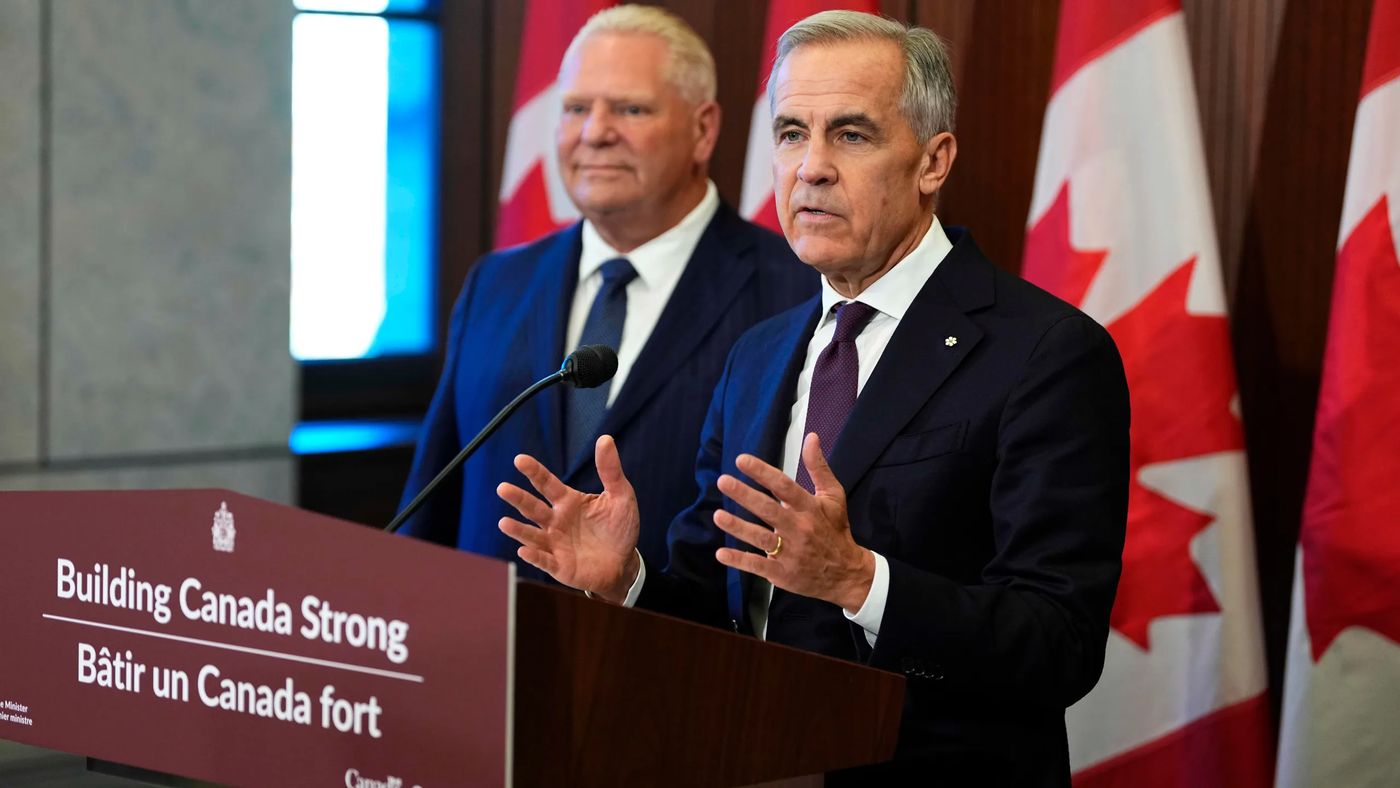
U.S. President Donald Trump's significant midterm election defeat has created a new political opening for Canada to push for an end to the trade war and a return to free trade, analysts say.
Voters handed Trump an enormous electoral reversal this month, with Democrats set to take large majorities in both houses of Congress in January.
"Tariffs, particularly those on Canada, were a big part of the reason for the drubbing," according to analysis from The Globe and Mail.
The Democrats' victory was driven by voter fury over affordability, with many Americans believing Trump's policies, including tariffs and the war with Iran, have made their lives less affordable.
Tariffs on Canada have far more public prominence than those on any other country, and U.S. industry is broadly opposed to them.
"We're America's biggest and best customer, particularly for manufactured goods," the analysis notes, arguing that tariffs on Canadian goods raise costs for U.S. manufacturers and consumers.
The new political reality means an end to the trade war is "no longer a pipe dream," though it is not imminent or inevitable.
Canada should be pitching Americans on a return to the status quo ante, meaning full respect for the United States-Canada-Mexico Agreement with zero-per-cent tariffs on almost all goods, the analysis suggests.
e2gold.ca reported in November that the trade war with Canada shaped key U.S. midterm races, helping Democrats flip the Senate.
The shifting balance of power in Washington is also prompting other nations to reassess their strategies.
In Indonesia, analysts say Trump's diminished political influence provides greater room for diplomatic maneuver.
"Trump has effectively become a lame-duck president, with his legislative agenda facing significant obstacles," said Didin Nasirudin, a doctoral candidate in diplomacy specializing in U.S. politics.
Didin said Jakarta should move away from being overly accommodating and focus on a more practical, transactional strategy.
Indonesia made substantial concessions to lower Trump's tariffs, agreeing to eliminate barriers on more than 99 percent of U.S. goods and committing to large purchases of U.S. energy and aircraft.
Iman Pambagyo, a former director general of international trade negotiations at Indonesia's Trade Ministry, said the country has made various commitments but has yet to receive comparable assurances from the U.S.
He cautioned that the Democrats' victory does not necessarily mean U.S. trade policy will become more favorable, as Trump remains president until January 2029.
For Sierra Leone, the election results raise questions about whether policies affecting travel, foreign aid and fuel prices could change.
Trump's administration introduced travel restrictions affecting Sierra Leonean nationals and restructured American foreign assistance, disrupting programs in healthcare, education and economic development.
The war involving Iran has also disrupted international energy markets, contributing to higher fuel prices in importing countries like Sierra Leone.
Democratic control of Congress will allow greater oversight of Trump's administration, but the president retains considerable authority over immigration and foreign policy.
"The travel restrictions remain in place, lost development funding has not automatically returned, and the cost of fuel still depends heavily on international markets," according to reporting from SwitSalone.
Trump has also shifted his tone on the war with Iran following the electoral defeat, speaking of the military end of the war and playing down the likelihood of a return to confrontation.
His remarks reflect a notable shift and raise questions over whether he has changed his calculations or is pursuing a new political maneuver to secure a deal with Tehran.
"Trump’s electoral defeat has shifted the balance of power in Washington, while the real test of his intentions lies in actions, not statements," according to MTV Lebanon.
For Canada, the path forward is to advocate for a simple return to the existing trade agreement.
"No new deal is needed. The U.S. simply has to return to honouring the one we have," the analysis concludes.
This story was written by the e2gold.ca newsroom from reporting by The Globe and Mail, Jakarta Globe, SwitSalone and MTV Lebanon. Quotes are checked word for word against that reporting.