The Canadian one-hundred-dollar note is the highest-value and one of the least-circulated banknotes currently issued by the Bank of Canada. It is a key component of the national currency, used for high-value transactions and as a store of value. The current version, made of durable polymer, features advanced security features designed to combat counterfeiting and honour Canadian contributions to medical science and governance. Understanding the $100 bill's evolution and features is important for recognizing its value and authenticity in everyday commerce.
Current Design and Security Features
The current $100 bill in circulation is part of the polymer Frontier series, first issued on 14 November 2011. It is printed on a synthetic polymer substrate, a material chosen for its durability and superior security characteristics compared to the older cotton-paper notes. The front of the note features a portrait of Sir Robert Borden, Canada's prime minister from 1911 to 1920, who led the country through the First World War. The source image for the engraving originated from the Montréal studio of Dupras & Colas and was engraved by Yves Baril of the Canadian Bank Note Company. The note's design incorporates Parliament Hill's East Block, highlighting its Gothic Revival architecture and its historical role as the nerve centre of government during Canada's first century. The East Block was designed by architects Thomas Stent and Augustus Laver and its construction was completed in the mid-1860s.
Security is a paramount feature of the modern $100 bill. A large, transparent window is a central element, framed by maple leaves and containing a smaller, holographic metallic portrait of Borden that changes colour when tilted. Adjacent to this is a translucent maple leaf that, when held up to a light source, reveals a detailed image of the denomination. These polymer-specific features are extremely difficult to replicate with standard printing technology. The note also includes raised tactile dots in the upper left corner to aid the visually impaired, a feature carried over from the previous Canadian Journey series. All text on the note appears in both of Canada's official languages, English and French.
The reverse side of the $100 bill is dedicated to celebrating Canadian innovations in medical research. The design includes a detailed vignette of a researcher at a microscope, based on a Carl Zeiss Axioplan 2 imaging microscope. Other elements include an illustration of a 1923 insulin bottle, honouring the discovery by Frederick Banting and Charles Best, and a stylized DNA strand representing genetic research. An electrocardiogram track symbolizes contributions to heart health, including the invention of the pacemaker by John Hopps in 1950. This thematic design marks a departure from earlier series that featured scenic landscapes or wildlife, and it underscores Canada's long-standing commitment to medical research and innovation.
Historical Evolution of the $100 Note
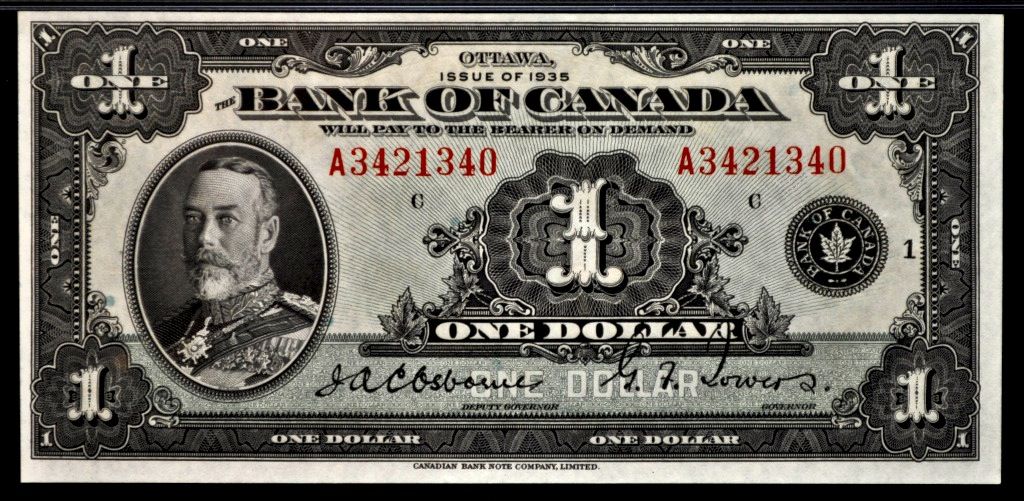
The history of the $100 denomination in Canada extends back well before the establishment of the Bank of Canada. In the 19th century, chartered banks and colonial governments issued notes in this denomination. Following Confederation, the Dominion of Canada began issuing its own $100 notes in 1872. These early notes were part of a diverse array of paper money issued by various authorities until the Bank of Canada was founded in 1934 and given the exclusive right to issue banknotes. The Bank's first series in 1935 included a $100 note, establishing it as a permanent fixture in the national currency. This series also included short-lived denominations like the $25 and $500 notes.
Over the decades, the $100 bill has appeared in every major series issued by the central bank, each reflecting the design and security priorities of its era. The 1954 Canadian Landscape series, for instance, featured a portrait of Queen Elizabeth II and a scene of Okanagan Lake in British Columbia on the reverse. This series became informally known as the Devil's Head series because highlights in the Queen's hair created an illusion of a demonic face, leading to a modified portrait in later printings. The 1969 Scenes of Canada series reintroduced portraits of prime ministers, with Sir John A. Macdonald appearing on the $100 note. The 1986 Birds of Canada series featured Sir Robert Borden on the front and a Canada goose on the back, incorporating a colour-shifting metallic patch for security. The Canada goose was chosen for its pan-Canadian habitat.
The $100 note underwent significant changes in the 21st century. The 2001 Canadian Journey series included literary excerpts and more advanced paper-based security features like watermarks and holographic stripes. This series was the last to be printed on cotton paper. A major shift occurred in 2011 with the launch of the polymer Frontier series, which dramatically improved durability and introduced the transparent window features seen today. This transition was part of a broader effort to stay ahead of counterfeiters, as polymer notes cost 19 cents to produce compared to 9 cents for the old cotton-paper notes. The polymer series did not continue the literary quotations from the previous series.
Counterfeiting and Security Measures
Combating counterfeiting has been a driving force behind the redesign of Canadian banknotes, particularly the high-value $100 bill. Counterfeiting rates are measured in parts per million (PPM), representing the number of fake notes found for every one million genuine notes in circulation. Canada's security was strong in the early 1990s with a rate of just 4 PPM, but the proliferation of advanced home computers, scanners, and colour printers led to a dramatic increase. This crisis made the need for a more secure currency urgent.
The introduction of the polymer Frontier series, starting with the $100 note in 2011, was a direct response to this threat. The polymer substrate itself, along with features like the large transparent window and holographic elements, are not reproducible with standard consumer equipment. This technological leap had a measurable impact. By 2012, the counterfeiting rate had fallen to 28 PPM, its lowest point. The Bank of Canada's medium-term planning target is to maintain a rate below 30 PPM, which is more stringent than the 50 PPM benchmark used by most G20 nations. The sustained reduction in counterfeiting has validated the investment in polymer technology, though the rate saw a modest rise to 36 PPM by 2014.
Older cotton-paper banknotes from before the 2013 polymer series are now considered unfit for circulation due to their lack of modern security features. Financial institutions are required to return these older notes to the Bank of Canada for destruction. However, individuals may keep them indefinitely, and they remain a collectible item. The most significant action against high-value counterfeiting was the withdrawal of the $1,000 note in 2000 at the request of law enforcement, as it was heavily used for money laundering and organized crime. This move left the $100 bill as the highest denomination in regular circulation, placing greater importance on its security.
Production and Issuance
The Bank of Canada has the sole authority to issue banknotes in Canada, a right it has held since 1935. However, the physical production of the notes is outsourced to a private firm. Since the first series, the Bank has contracted the Canadian Bank Note Company to produce notes according to its strict specifications and security requirements. This partnership has continued through the transition from paper to polymer. The production process for a polymer note is more complex, contributing to its higher unit cost of 19 cents compared to the 9 cents for a cotton-paper note. The actual production is done in accordance with the specifications and requirements set by the central bank.
The issuance of new note series follows a planned schedule, often starting with higher denominations. The Frontier polymer series was launched with the $100 note in November 2011, followed by the $50 in March 2012, the $20 in November 2012, and finally the $10 and $5 in November 2013. This staggered release allowed for public education on the new security features and logistical management of the currency supply. The subsequent series, known as the Vertical series, began in 2018 with a new $10 note featuring Viola Desmond, introducing a vertical orientation for the first time. Future plans announced in 2024 include featuring Terry Fox on the next $5 note and Wilfrid Laurier on the next $50 note, while a new vertical $20 note featuring King Charles III was revealed in September 2026.
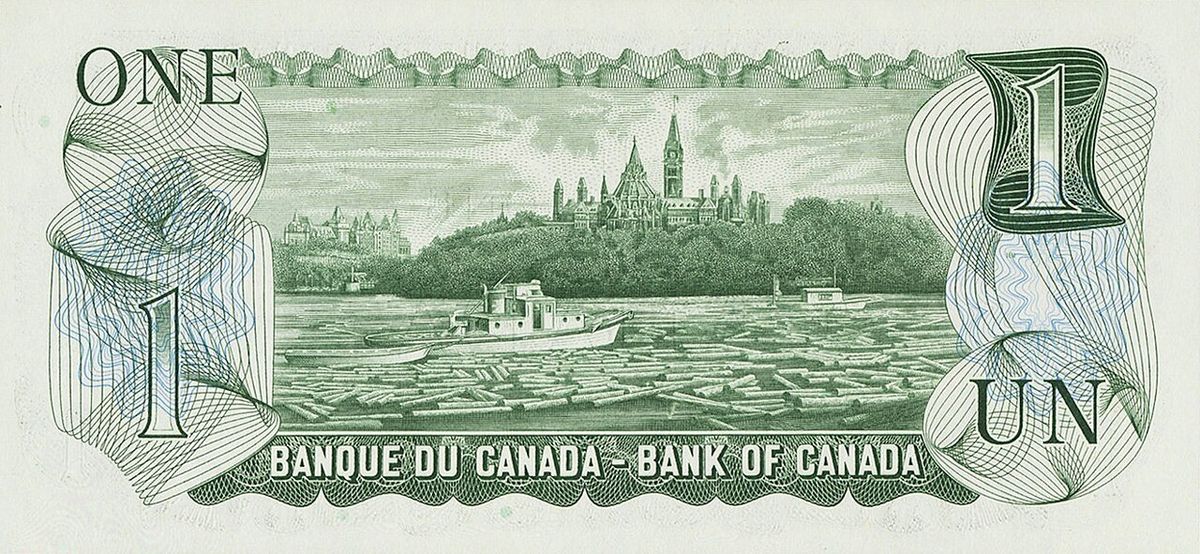
When a new series is introduced, older series are gradually withdrawn from circulation. For example, the 2004-style $100 note from the Canadian Journey series was withdrawn in November 2011 when the polymer note was released. Financial institutions remove these older notes from the cash they receive and send them back to the Bank of Canada. It is important to note that most withdrawn banknotes remain legal tender indefinitely, with the exception of specific denominations. As of 1 January 2021, the $1, $2, $25, $500, and $1,000 bills from every series are no longer legal tender and cannot be used for transactions.
Key Banknote Series Featuring the $100 Denomination
- 1935 Series: The inaugural Bank of Canada series. The $100 note was among the original denominations issued.
- 1954 Canadian Landscape Series: Featured Queen Elizabeth II and a view of Okanagan Lake, B.C. Known for the 'Devil's Face' portrait variant.
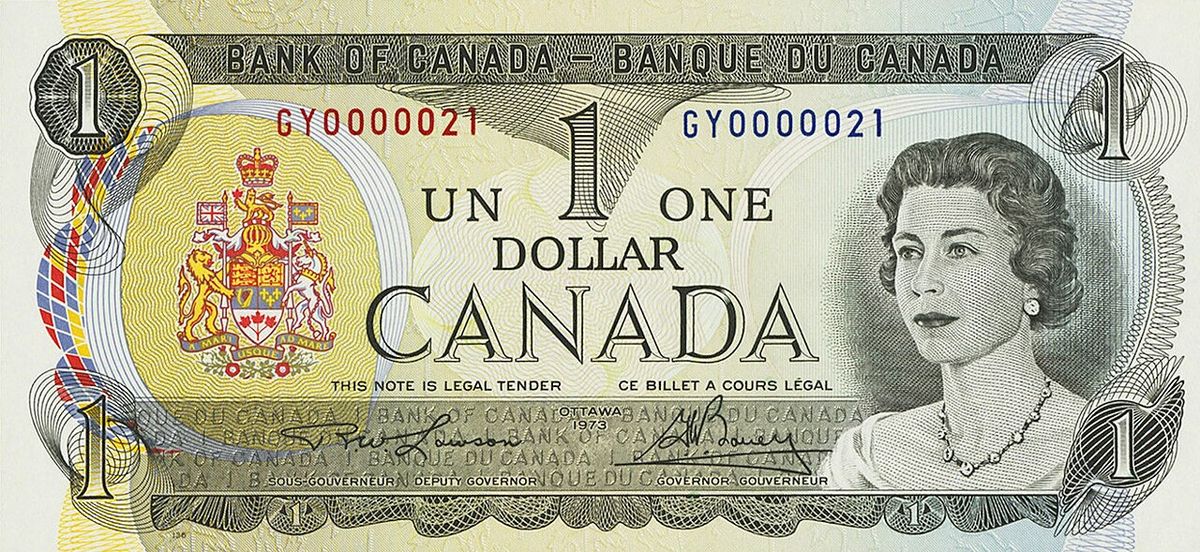
- 1969 Scenes of Canada Series: Featured a portrait of Sir John A. Macdonald and colourful, wavy patterns. The last series to include a $1 note.
- 1986 Birds of Canada Series: Featured Sir Robert Borden and a Canada goose. Included a colour-shifting metallic patch on the $100 note.
- 2001 Canadian Journey Series: The last paper series. Featured Borden and included a literary excerpt from Miriam Waddington. Added advanced paper security features.
- 2011 Frontier Series: The first polymer series. Features Borden, medical research themes, and transparent window security features. Currently in circulation.
- 2018 Vertical Series: Introduced a vertical format starting with the $10 note. The $100 note in this format has not yet been issued.
Transitions between banknote series have frequently been motivated by security needs. The move to polymer banknotes is a clear example of a change driven by security. Other changes have been made for commemorative goals, such as featuring new historical figures on the notes. The design of the one hundred dollar note has evolved from allegorical imagery and landscapes to portraits of prime ministers. More recent designs have featured themes of national innovation. The 2001 Canadian Journey series one hundred dollar note included a literary excerpt by Miriam Waddington. The excerpt asked if we remember that somewhere above the sky Jacques Cartier is still sailing to discover a new Canada.
Withdrawn Denominations and Legal Tender Status
Throughout Canada's monetary history, several high-value denominations have been issued and later withdrawn. The $100 bill has remained, but it was once part of a broader range that included notes for $500 and $1,000. The $500 note was part of the first 1935 series but had a very short life. Unissued stacks were destroyed in February 1938, and issued notes were recalled five months later. The $1,000 note had a much longer run but was withdrawn on 12 May 2000 at the request of the Royal Canadian Mounted Police and the Solicitor General, as it was extensively used for money laundering and organized crime. At the time of its withdrawal, 2,827,702 of these notes were in circulation, and by 2011 fewer than one million remained, most held by organized crime.
The legal tender status of older notes is a common point of confusion. A key rule is that most withdrawn banknotes remain legal tender indefinitely, meaning a business can choose to accept an old $100 bill from the 1950s. However, there are major exceptions. As of 1 January 2021, the $1, $2, $25, $500, and $1,000 bills from every Bank of Canada series are no longer legal tender. These cannot be used for transactions, but they can be exchanged at the Bank of Canada for their face value. For all other denominations, including the $100 bill from any series, the Bank of Canada will honour them at face value for all time, though older paper notes are removed from circulation by financial institutions due to their vulnerability to counterfeiting.
The withdrawal of the $1 and $2 notes in 1989 and 1996, respectively, and their replacement with coins, also changed the dynamics of cash use. This left the $5 note as the smallest bill, making the $100 note a more significant jump in value for everyday users. The continued circulation of the $100 bill, despite the removal of higher denominations, underscores its role as a practical high-value instrument for legitimate commerce and savings, balanced against the ongoing efforts to secure it from criminal use. The $100 bill's status is distinct from the withdrawn $1,000 note, which was removed specifically to disrupt illicit financial activities.
Comparative Counterfeiting Rates and Costs
The fight against counterfeit currency involves tracking performance metrics. One key metric is the counterfeit rate measured in parts per million. This fight also involves weighing the costs of implementing new security technologies. For example, a polymer banknote costs nineteen cents to produce. In comparison, a typical cotton paper note cost nine cents to produce.
| Year | Counterfeiting Rate (PPM) | Notable Event |
|---|---|---|
| 1990 | 4 | Among most secure currencies globally. |
| 1997 | 117 | Rise of home computer counterfeiting. |
| 2012 | 28 | Lowest rate after polymer introduction. |
| 2014 | 36 | Modest rise post-launch. |
| Target | <. 30 | Bank of Canada's medium-term goal. |
The 2010 figure is an absolute count of notes passed. The PPM equivalent is estimated based on the 2014 rate and historical trends. The data illustrates the severe counterfeiting crisis that prompted the development of the polymer series. The success of the new notes is clear from the drastic drop to 28 PPM in 2012. The associated cost of this security is also quantifiable. Producing a single polymer banknote costs 19 cents, more than double the 9-cent cost of a cotton-paper note. This investment is justified by the dramatic improvement in security and the longer lifespan of the durable polymer material, which reduces replacement frequency. The Bank of Canada's target of staying below 30 PPM is more ambitious than the international benchmark of 50 PPM used by most G20 nations, reflecting a proactive approach to maintaining confidence in Canadian currency. The ongoing management of counterfeiting risk involves not only technological features on the notes themselves but also public education campaigns to help individuals and businesses identify the security features on the $100 bill and other denominations.
Frequently asked questions
Who is on the Canadian $100 bill?
The current polymer $100 bill features Sir Robert Borden, who served as Canada's eighth Prime Minister from 1911 to 1920. He led the country through the First World War. The portrait is based on a photograph from the Montréal studio of Dupras & Colas. Previous series have featured other figures, including Queen Elizabeth II and Sir John A. Macdonald.
When did Canada switch to polymer $100 bills?
The polymer one hundred dollar bill was introduced as part of the Frontier series. This series began circulation in November 2011. The polymer fifty, twenty, ten, and five dollar notes followed over the next two years. The last of the older paper banknotes were made available in November 2013.
Are old Canadian $100 bills still valid?
All older Canadian one hundred dollar bills remain legal tender. Financial institutions must return the older cotton paper banknotes to the Bank of Canada. The Bank of Canada will then destroy these older notes. Individuals may keep the old banknotes indefinitely.
How can I tell if a $100 bill is counterfeit?
Check for the key polymer features. Look for the large, clear window with the small holographic portrait that changes colour when tilted. Feel the raised ink and the unique texture of the polymer. Hold the note to the light to see the detailed image in the translucent maple leaf. Genuine polymer notes are crisp and durable, while counterfeit paper versions will lack these complex features.
What are the security features on the new $100 bill?
The new Canadian one hundred dollar polymer bill features several advanced security elements. It uses a polymer substrate, a synthetic material that replaced cotton paper starting in 2011, which significantly improves security. The note includes a translucent maple leaf and a transparent window fringed by maple leaves. The window contains a smaller version of the portrait and a light-refracting metallic architectural feature from the parliament buildings. These polymer notes also continue the tactile feature of raised dots from the previous Canadian Journey series to aid the visually impaired. The shift to polymer was a key measure to reduce counterfeiting, as these notes incorporate modern security features lacking in older cotton-paper banknotes.
Why was the $1000 bill discontinued?
The one thousand dollar note was discontinued and withdrawn from circulation on 12 May 2000. This action was taken at the specific request of the Solicitor General of Canada and the Royal Canadian Mounted Police. The primary reason for its removal was that these high value notes were reported to be largely used for money laundering and organized crime. As part of the Birds of Canada series, it was the last series to include the $1000 denomination. Following its withdrawal, the number of these bills in circulation decreased sharply, from 2,827,702 at the time of withdrawal to fewer than one million by 2011, with most remaining notes held by organized crime.
Sources and further reading
- Canadian banknotes (Wikipedia) en.wikipedia.org
- $100 polymer note design elements bankofcanada.ca
- Birds of Canada Series $100 Note bankofcanadamuseum.ca
- Canadian One Hundred Dollar Bill Stock Photos istockphoto.com
- 1954 Bank of Canada $100 Dollar Coyne/Towers Bill Note ... coinsunlimited.ca
This article explains how things work and is not financial, tax or legal advice. Rules, limits and rates change, so check the current figures with the Canada Revenue Agency, your province or your financial institution before you act.