War bonds are debt securities issued by a government to finance military operations during wartime without resorting to unpopular tax increases. In Canada, these were famously known as Victory Bonds during both World Wars. They functioned as loans from citizens to the government, redeemable with interest after a set period, and were crucial for funding the enormous costs of conflict. The campaigns to sell them became massive national efforts combining financial appeal with patriotic propaganda. Understanding war bonds provides insight into how Canada financed its war efforts and engaged its civilian population.
What Are War Bonds and How Do They Work
War bonds are debt securities issued by a national government specifically to raise money for military expenditures during a war. The primary goal is to fund operations without immediately raising taxes to levels that could become politically unpopular or economically damaging. These bonds also serve a secondary purpose of controlling inflation in a stimulated wartime economy by taking money out of public circulation. Governments market these bonds directly to the public as retail investments, often in a wide range of denominations to make them affordable for most citizens. The bonds promise to pay back the principal amount plus interest after a predetermined maturity period, which could range from five to twenty years. Unlike standard market investments, war bonds often carry a yield below prevailing market rates, with the shortfall compensated by appeals to national patriotism and civic duty.
The History and Global Context of War Financing
The concept of governments borrowing to fund wars is ancient, but the modern war bond aimed at the general public is a more recent development. Before the 20th century, governments typically negotiated loans with a small consortium of wealthy financiers. The term war bond was used as early as 1812 in the United States, but that issue was not marketed to the public. The First World War marked a turning point, as the unprecedented scale of conflict forced nations to seek vast new sources of capital. Countries like Germany, Austria-Hungary, the United Kingdom, and the United States all launched extensive public bond drives. These campaigns were heavily propagandized, using posters, film stars, and patriotic appeals to encourage subscription. The British government, for instance, issued its first interest-bearing War Loan in November 1914 at a rate of 3.5%. The United States issued Liberty Bonds in 1917 and 1918, employing celebrities like Charlie Chaplin to promote them. This shift represented a fundamental change in war finance, moving from elite banking to mass public participation.
Canadian Victory Bonds in the First World War
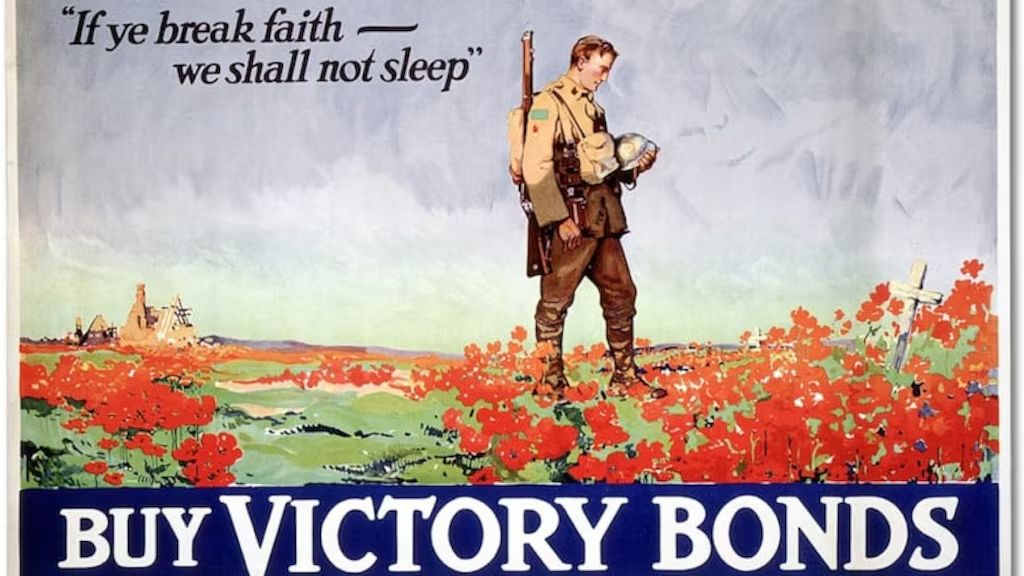
Canada entered the First World War in 1914, initially expecting a short and inexpensive conflict. Early war expenses were covered by borrowing from British and then American capital markets. As the war dragged on, costs soared, with the federal budget quadrupling to over $740 million and debt rising to $1.2 billion. The government turned to its own citizens to finance the shortfall. The first domestic war loan was raised in November 1915, but the term Victory Loan was first applied in the fourth campaign of November 1917. The First Victory Loan was a 5.5% issue of 5, 10, and 20 year gold bonds, available in denominations as small as $50. It was a phenomenal success, oversubscribed to collect $398 million, about $50 per capita, which was twice the initial estimate and far exceeded any previous Canadian bond issue. The Second and Third Victory Loans in 1918 and 1919 raised an additional $1.34 billion. In total, domestic bond purchases exceeded $2 billion, which was ten times the amount raised from foreign lenders.
The government awarded communities that bought large amounts of bonds with special honour flags, with the first such flag awarded for the fifth campaign in 1918. For those who could not afford bonds, the government also issued war savings certificates. The campaigns were supported by intense publicity linking bond purchases to the direct support and welfare of soldiers overseas, using tens of thousands of posters and emotional imagery. Long-term interest rates of up to 5.5 percent for terms of up to 20 years were also a powerful financial inducement for subscribers. Key elements of the First World War bond drives in Canada included:
- First domestic war loan: November 1915.
- First Victory Loan: November 1917, raising $398 million.
- Second Victory Loan: 1918.
- Third Victory Loan: 1919.
- Total domestic bond purchases: Over $2 billion.
- Smallest bond denomination: $50.
- Interest rate on first Victory Loan: 5.5%.
The success of the First World War victory bond campaigns demonstrated Canadians' willingness to support the war effort financially. The first victory loan in 1917 was quickly oversubscribed, collecting $398 million. This established a model for government borrowing from the public that would be used again in the future. Subsequent victory loans in 1918 and 1919 raised an additional $1.34 billion.
Mobilizing Finance in the Second World War
Canada declared war on Nazi Germany on September 10, 1939. Financing the war effort again relied heavily on public borrowing through War Savings Certificates and Victory Bonds. War Savings Certificates went on sale in May 1940, sold door-to-door by volunteers and through banks, post offices, and other authorised dealers. They matured after seven years, providing a return of $5 for every $4 invested, with an initial individual ownership limit of $500 per year in maturities, later raised to $600. While successful in involving millions of Canadians, the certificates raised $318 million, only a fraction of what was needed. The Victory Bond drives proved far more significant financially. There were ten wartime and one postwar Victory Bond drives. These bonds had no purchase limit and were issued with maturities from six to fourteen years, offering interest rates from 1.5% for short-term bonds to 3% for long-term bonds. Canadians bought $12.5 billion worth of Victory Bonds, approximately $550 per capita, with businesses accounting for half of all sales. The first Victory Bond issue in February 1940 met its $20 million goal in less than 48 hours, and the second issue in September 1940 reached its $30 million goal almost as quickly.
In December 1941, the programs were formally organized under the National War Finance Committee for more honed direction, initially led by the president of the Bank of Montreal and later by the Governor of the Bank of Canada. The committee orchestrated bond drives every six months, during which no other organization was permitted to solicit public funds. The government spent over $3 million on marketing, employing posters, direct mail, radio commercials, and movie trailers, including animations by Walt Disney in cooperation with the National Film Board of Canada. Some campaigns used shocking realism, such as the staged invasion scenario known as If Day in Winnipeg, to spur bond sales. The table below outlines key details of the WWII bond drives.
| Feature | Detail |
|---|---|
| Total Raised | $12.5 billion |
| Number of Wartime Drives | 10 |
| Per Capita Investment | ~$550 |
| Business Share of Sales | 50% |
| Interest Rate Range | 1.5% to 3% |
| Denomination Range | $50 to $100,000 |
| Governing Committee | National War Finance Committee |
The scale and sophistication of the Second World War Victory Bond campaigns far exceeded those of the First World War. The National War Finance Committee, established in 1941, developed organized strategies and extensive propaganda. The committee employed posters, movie trailers, radio commercials, and full-page advertisements. These efforts embedded the purchase of Victory Bonds deeply into Canadian home front culture during the war.
Rules, Features and Propaganda Techniques
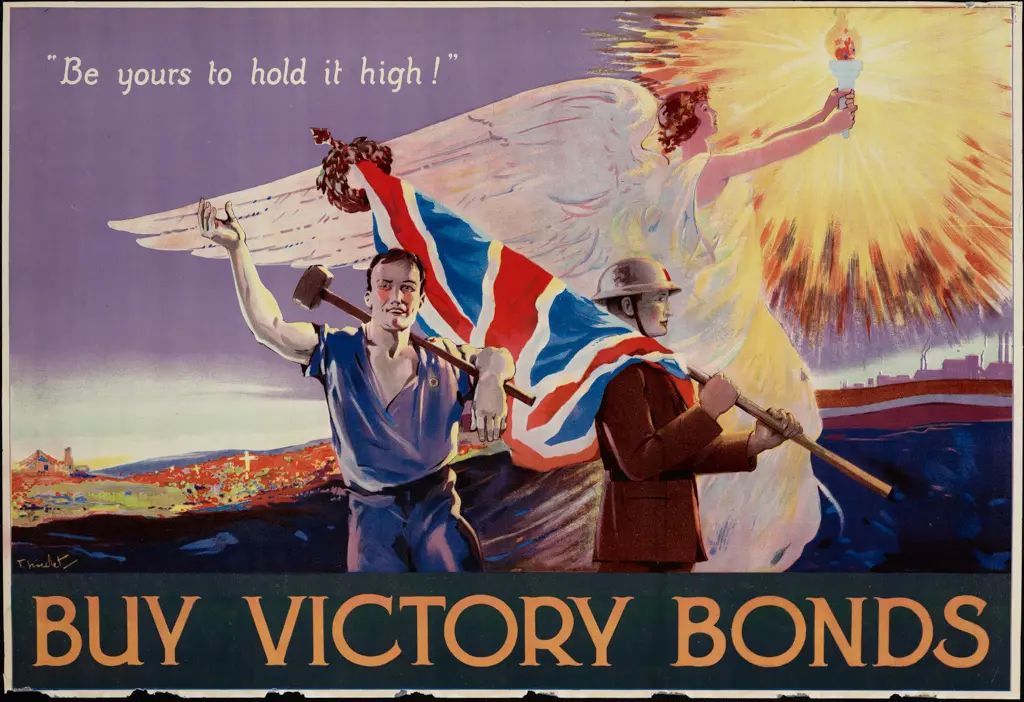
Canadian war bonds had specific financial features and were sold under a set of rules designed to maximize uptake and manage the process. The bonds were loans to the government that could be redeemed with interest after a set period, such as 5, 10, or 20 years. They were often advertised as being free from federal taxes, including income tax, imposed by the Parliament of Canada. Subscription could often be paid in installments, with failure to pay an installment risking forfeiture of previous payments and cancellation of the allotment. Bonds could be issued in bearer form with coupons or as fully registered bonds where interest was paid directly by government cheque, available in denominations from $50 up to $100,000. The campaigns were not merely financial instruments but were massive propaganda exercises. The government linked buying bonds directly to the welfare of soldiers and the survival of the nation, using messages that this was a war to the death where every spare dollar must be loaned to the country. Tens of thousands of posters were produced with slogans like Back Them Up and Lend to Defend the Right to Be Free. Communities competed for honour flags, and the government enlisted celebrities, used Walt Disney cartoons, and even staged fake enemy invasions to shock citizens into buying. Every medium was used, including newspapers, radio, and film trailers, to create a constant drumbeat of patriotic pressure to invest.
Economic Impact and Lasting Legacy
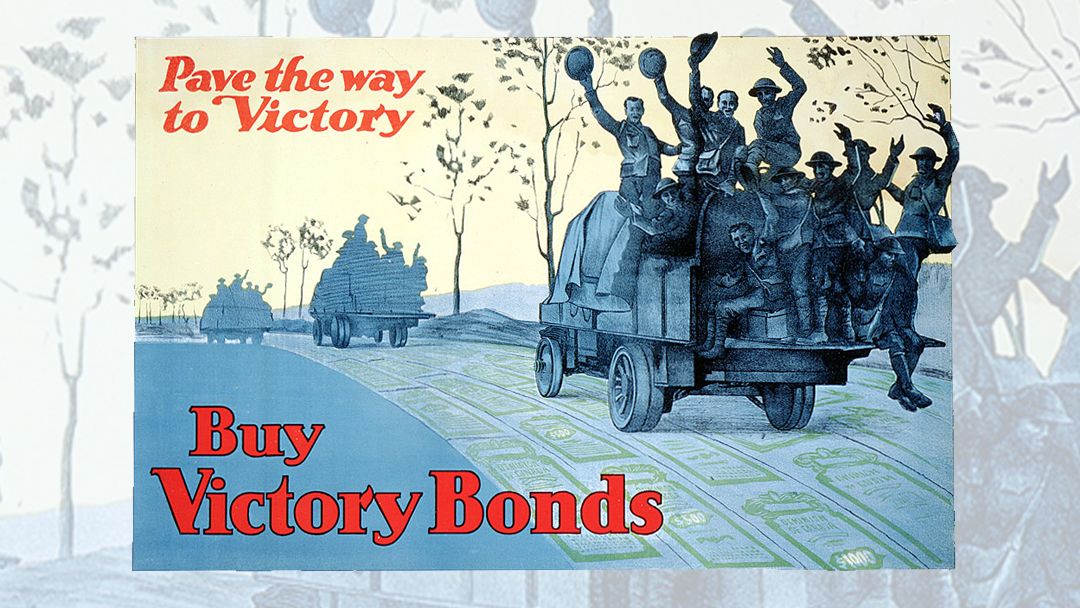
The war bond campaigns had a profound impact on Canada's economy and its public finance legacy. Initially, the outbreak of war in 1914 threatened economic crisis with layoffs and cancelled contracts in industries like railways. However, the massive demand for war materiel, especially artillery shells, soon provided stimulus, and unemployment had virtually ceased by 1916. Financing the war through domestic bonds allowed Canada to owe most of its war debt to its own citizens rather than foreign lenders, passing costs to future generations but keeping financial sovereignty. The success of the bond drives demonstrated the potential of mass public financing. This legacy directly led to the creation of Canada Savings Bonds in the postwar period, a peacetime instrument that continued the model of government borrowing directly from citizens. The campaigns also had political ramifications, as the immense cost of war spurred debates about the conscription of wealth and led to the introduction of new federal taxes on business profits in 1916 and personal incomes in 1917, setting important precedents for Canada's tax system, though these taxes initially accounted for a very small portion of revenue.
Modern Debates and Contemporary Examples
The concept of war bonds resurfaces in modern discussions about public finance during crises. Debates often focus on whether such instruments are still viable or necessary in an era of sophisticated capital markets and central banking. Proponents argue that bonds with patriotic appeals can foster national unity and direct public participation during a major conflict or national emergency. For example, some proposals for a modern Canadian version suggest features like tax-free returns, similar to the Victory Bonds in 1917 and 1918, and maturities set at 5 or 10 years. A recent real-world example is the Ukraine Sovereignty Bond issued by the Government of Canada in 2022. This was a five-year, $500 million bond, denominated in Canadian dollars and issued on November 29, 2022, with proceeds directed to support the government of Ukraine. While not a traditional war bond for Canada's own military, it shares the characteristic of a government debt instrument issued to support a wartime ally, demonstrating the enduring relevance of the model. The core debates centre on the balance between patriotic appeal and financial return, and whether such campaigns can raise meaningful sums compared to institutional borrowing in today's financial landscape.
Frequently asked questions
What were Victory Bonds in Canada?
Victory Bonds were the name for war bonds in Canada during both World Wars. They were debt securities sold to Canadian citizens as a loan to the government to finance military operations. The bonds paid interest and matured after a set period, such as 5, 10, or 20 years. The campaigns to sell them were massive national efforts that combined financial investment with patriotic appeals.
What were the interest rates on Canadian war bonds?
Interest rates varied by issue and term. In the First World War, the first Victory Loan in 1917 offered a 5.5% rate. During the Second World War, Victory Bonds had interest rates ranging from 1.5% for shorter-term bonds to 3% for longer-term bonds. These rates were often below market yields but were promoted with patriotic messaging.
How much money did Canada raise with Victory Bonds?
Canada raised over $2 billion through Victory Bonds during the First World War. The first Victory Loan in 1917 was quickly oversubscribed, collecting $398 million, or about $50 per capita. During the Second World War, Canadians bought a total of $12.5 billion worth of Victory Bonds, which was approximately $550 per capita. Businesses accounted for half of all Victory Bond sales in the WWII campaigns. The first WWII Victory Bond issue in February 1940 met its $20 million goal in less than 48 hours.
Could anyone buy Victory Bonds?
Yes, Victory Bonds were designed to be affordable for all citizens. They were issued in a wide range of denominations, from as low as $50 during the First World War to between $50 and $100,000 during the Second World War. There was no purchase limit for Victory Bonds, making them accessible to both individuals and large corporations. For those who could not afford bonds, the government also issued War Savings Certificates, which initially had an annual individual maturity limit of $500.
What was the National War Finance Committee?
The National War Finance Committee was established in December 1941 to centrally organize Canada's war bond and certificate programs during the Second World War. Directed initially by the Bank of Montreal president and later by the Bank of Canada Governor, it developed propaganda strategies and recruited volunteers. The committee coordinated bond drives every six months, during which no other organization could solicit public funds. It oversaw extensive marketing, including posters, movie trailers, and radio commercials.
Are there any modern equivalents to war bonds in Canada?
A modern equivalent is the Ukraine Sovereignty Bond issued by the Government of Canada in 2022. This was a five year, $500 million bond denominated in Canadian dollars to support Ukraine. Discussions about reviving war bonds for national emergencies sometimes propose features inspired by historical Victory Bonds, such as tax free returns and maturities set at 5 or 10 years. The Canada Savings Bond program also served as a peacetime instrument for government borrowing from citizens.
Sources and further reading
- War bond (Wikipedia) en.wikipedia.org
- The War Economy, Finance and War Production warmuseum.ca
- Victory Loans and War Savings wartimecanada.ca
- Victory Loans thecanadianencyclopedia.ca
- Victory Bonds www2.yrdsb.ca
This article explains how things work and is not financial, tax or legal advice. Rules, limits and rates change, so check the current figures with the Canada Revenue Agency, your province or your financial institution before you act.