The Canadian nickel, officially the five-cent piece, is a coin worth five cents or one-twentieth of a Canadian dollar. It became the smallest-valued coin in circulation after the penny was discontinued in 2013. The coin's history spans from early silver issues to its namesake nickel composition and modern multi-ply steel versions. Its design and metal content have evolved significantly, reflecting Canada's economic history and industrial identity, particularly its status as a major nickel producer.
Historical Origins and Early Silver Issues
The first five-cent coins for what would become Canada were minted in 1858 under legislation from the Province of Canada. These early coins were struck in sterling silver, an alloy of 92.5 percent silver and 7.5 percent copper. They had a tiny diameter of 15.5 millimetres and weighed 1.167 grams, a size necessary to contain five cents' worth of silver. Their small size led to the nickname fish scales. The obverse featured a young bust of Queen Victoria, while the reverse displayed two crossed maple boughs below a crown. This was a one-year issue, and silver coinage for Canada did not resume until 1870. The 1870 issue was prompted by the influx of depreciated United States silver coins after the American Civil War, which disrupted the Canadian banking system. The government expelled foreign silver and issued new domestic coins, with the five-cent pieces struck at the Royal Mint in London to the same specifications as the 1858 coins. From 1858 to 1921, the five-cent coin remained a silver piece, though its silver content was reduced to 80 percent in 1920 in response to rising metal costs. This reduction applied to the 5-, 10-, 25- and 50-cent pieces simultaneously as a cost-saving measure during a period of economic change.
Transition to Nickel and Wartime Changes
By 1920, proposals emerged to mint Canadian coins from nickel, a cheap and abundant metal given Canada's status as the world's largest nickel producer. The five-cent coin was the logical candidate for change due to its inconveniently small size. The Deputy Master of the Ottawa Royal Mint branch, Arthur H. W. Cleave, wrote to the Royal Mint in England on behalf of the Minister of Finance to request new designs for a larger coin to be made of nickel. From four proposals, Finance Minister Sir Henry Drayton selected a design most similar to the smaller one-cent coin that had recently been introduced. The chosen design featured the denomination stamped between two maple leaves with the date in the exergue below. The first pure nickel five-cent coins entered circulation on January 3, 1922. They were 99 percent nickel, weighed 4.54 grams, and had a diameter of 21.21 millimetres. This era was short-lived due to the Second World War, when nickel became a critical war material. From 1942 to 1945, the coin's composition changed to tombac, a brass alloy of 88 percent copper and 12 percent zinc. These wartime issues were also distinguished by a 12-sided shape to differentiate them from the cent. One notable 1943 variant, the V for Victory coin designed by Thomas Shingles, featured the Morse code message We Win When We Work Willingly on its rim. The shift to tombac required three V for Victory 5-cent coins that were not made of nickel, highlighting the metal's strategic importance.
Post-War Composition and Modern Specifications
After the Second World War, the five-cent coin returned to being made of pure nickel from 1946 to 1951. The composition and specifications of the coin have changed multiple times since then. These changes have often been driven by the cost of metals. For instance, since 1982, Canadian nickels have contained progressively less nickel. In the year 2000, the composition changed to nickel-plated steel.
| Years | Composition | Weight (g) | Diameter (mm) |
|---|---|---|---|
| 1946 to 1951 | 99.9% nickel | 4.54 | 21.21 |
| 2013–present | 94.5% steel, 3.5% copper, 2% nickel plating | 3.95 | 21.2 |
Since 1982, Canadian nickels have contained progressively less nickel, moving from a 25 percent nickel alloy to nickel-plated steel. The current multi-ply steel coin, introduced in 2013, has a lower weight of 3.95 grams but retains the familiar 21.2-millimetre diameter. This evolution reflects the ongoing balance between durability, cost, and the symbolic use of nickel in a coin that bears its name. The thickness of the modern coin is 1.76 millimetres, similar to its predecessors. The progressive reduction in nickel content demonstrates how the coin has adapted to commodity price fluctuations while maintaining its function in daily commerce.
Design Evolution and Commemorative Issues
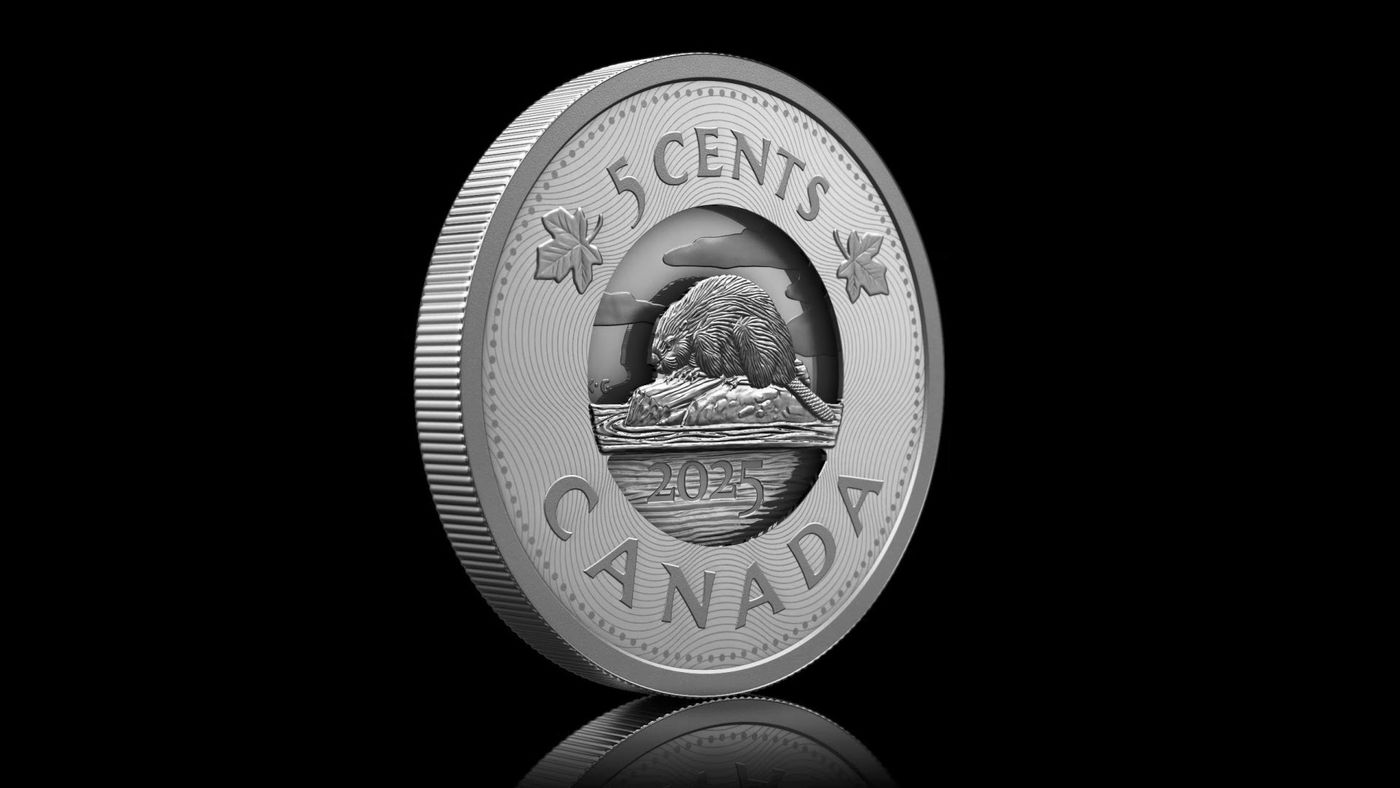
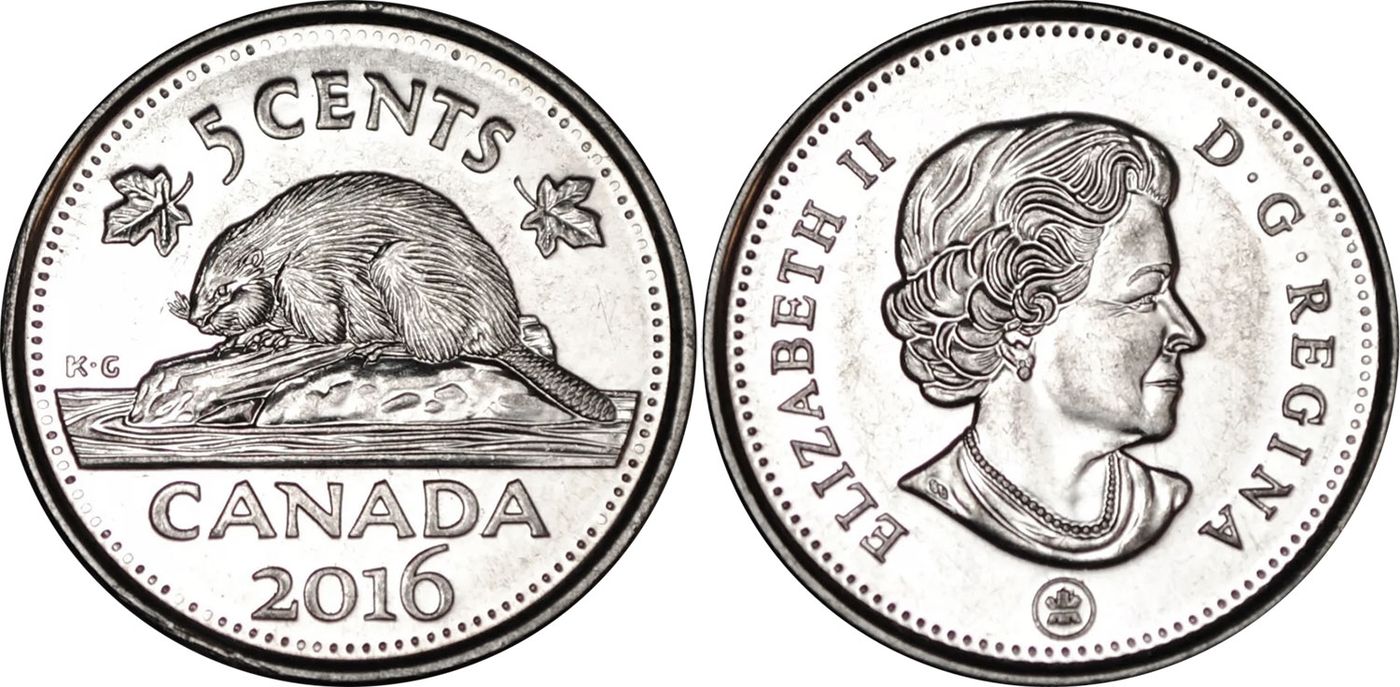
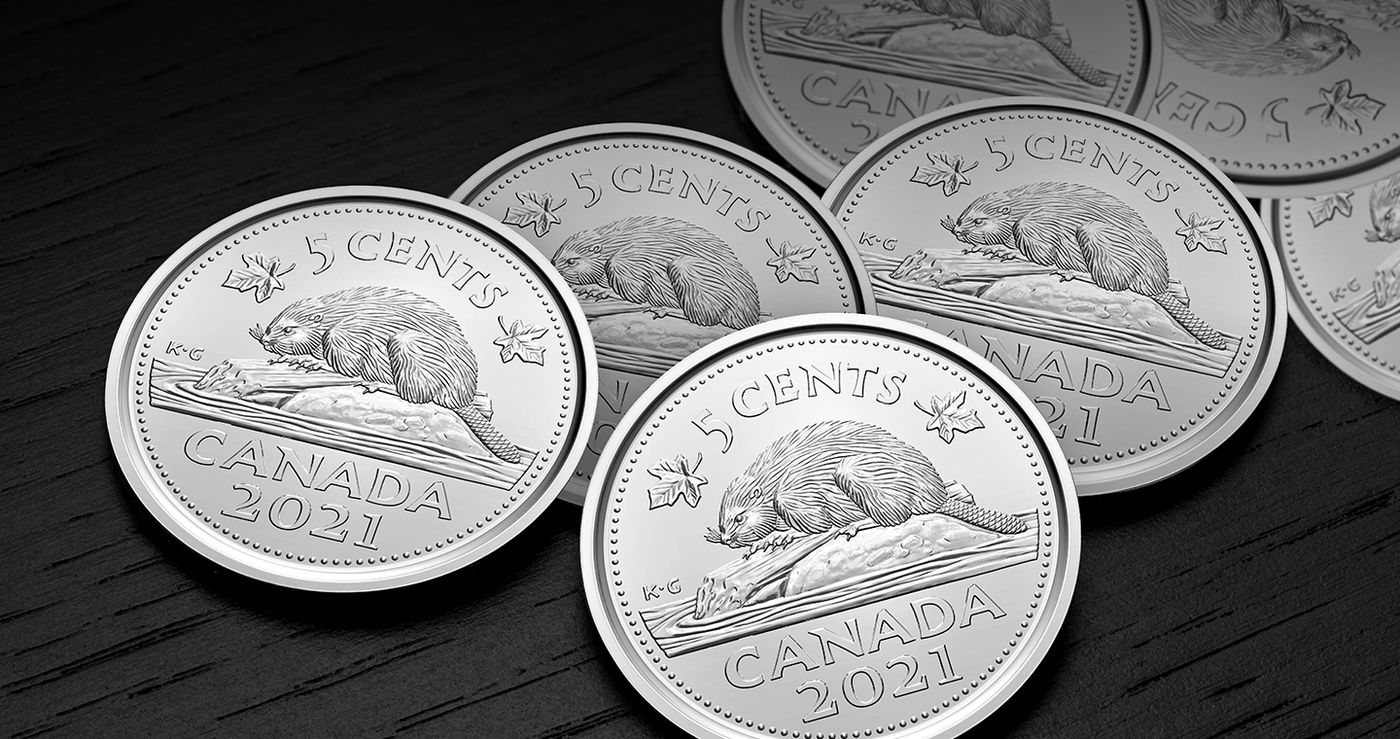
The most enduring design on the Canadian nickel is the beaver, created by artist G.E. Kruger-Gray and first introduced in 1937 as part of a coin modernization effort. The beaver was chosen for its long history as a Canadian commodity and cultural symbol, having appeared on the heraldic bearings of Québec City and Montréal and on Canada's first postage stamp. The Royal Canadian Mint has issued numerous commemorative five-cent coins to mark special events. Key commemorative designs include the 1951 coin celebrating the 200th anniversary of the discovery and naming of nickel by Swedish scientist A.F. Cronstedt, designed by Stephen Trenka and depicting a nickel refinery. In 2005, a Victory Anniversary nickel honoured the 60th anniversary of the end of the Second World War, reprising the 1943 wartime design. More recently, a 2017 issue marked the 150th anniversary of Confederation with a design titled Living Traditions by Gerald Gloade, one of five winners of the My Canada, My Inspiration contest. These special issues are part of a tradition that uses the coin to celebrate national milestones and achievements.
Collectibility, Key Dates and Valuation
Canadian nickels are popular among collectors, with certain dates and varieties being highly sought after. Coins struck in pure nickel are noted by author Allen G. Berman as being very difficult to grade due to the alloy's hardness. The rarest and most famous Canadian circulation nickel is the 1921 issue, often called the Prince of Canadian Coins. In May 1921, the government authorized the change to the larger nickel coin, and most of the 1921 mint run was melted down. Estimates suggest only 400 to 480 specimens survive. The finest-known example, graded PCGS MS-67, sold for US$115,000 at auction in January 2010 and was later resold for $160,000 in early 2012. Other notable collectibles include the wartime tombac issues and the elusive 1944 tombac variety, sometimes called The Holy Grail Nickel. The value of circulated coins from series like 1937 to 1952 can start from a base of $0.30 to $0.45 for common dates in lower grades, but values rise sharply for rare dates and high-grade specimens. For example, a 1922 Far Rim Canada 5-cent coin in Very Fine condition might have a retail price around $4.50. Collectors categorize coins as business strike coins showing circulation wear, or as proof-like, specimen and proof coins not intended for circulation, with the latter group commanding higher premiums.
Manufacturing and Industrial Context
The history of the Canadian nickel coin is deeply intertwined with the country's mining industry and manufacturing capabilities. Canada was the world's largest nickel producer at the time the nickel coin was introduced. The initial requirement for the 1922 coin blanks was that the nickel come from Canadian sources, a condition that was easily met. However, no Canadian firm at the time could refine the nickel and manufacture the blanks, so the contract was awarded to the UK-based Mond Nickel Company Limited after the Department of Finance relaxed its criteria. The initial run required 5 million blanks, amounting to about 50,000 pounds of nickel. Today, nickel remains a critical commodity, essential for electric vehicle batteries and stainless steel, with Canadian companies like Canada Nickel Company advancing new mining projects. The fluctuating cost of nickel and other metals has been the primary driver behind the coin's numerous compositional changes, from the wartime substitution to tombac to the modern use of steel plating. The coin's production has also been a point of national pride and industrial policy, reflecting Canada's ability to supply its own currency needs from domestic resources, even when initial manufacturing had to be sourced externally.
Cultural Significance and Physical Monuments
The five-cent coin holds a distinct place in Canadian culture, symbolized by the world's largest depiction of a coin, the Big Nickel. This 30-foot replica of a 1951 Canadian nickel is located in Sudbury, Ontario, a major global mining centre for nickel. The coin's beaver design reinforces national identity, as the beaver has appeared on city coats of arms and Canada's first postage stamp. The shift from silver to nickel in 1922 was directly tied to Canada's industrial might and natural resource wealth. Even as the coin's physical nickel content has diminished over recent decades, its name endures as a reminder of that heritage. The coin also played a role in wartime morale, with the 1943 V for Victory design carrying a hidden Morse code message to stimulate the war effort. The beaver design, in continuous use since 1937, is one of the most recognized symbols on Canadian currency. The Big Nickel monument serves as a tourist attraction and a demonstration of the importance of the nickel mining industry to the local and national economy, creating a direct physical link between the coin in one's pocket and the resource extraction that historically supported it.
Notable Varieties and Minting Details
Beyond key dates, several notable varieties and minting details define the Canadian nickel series. The 1922 issue itself has varieties such as the Near Rim and Far Rim based on the placement of the date relative to the rim, which affects collector value. The wartime tombac coins from 1942 to 1945 are unique for their 12-sided shape and yellow colour, a deliberate feature to prevent confusion with the cent. The 1943 V for Victory nickel exists in two primary types, one with a plain rim and one with the Morse code rim inscription. The 1951 issue commemorating the naming of nickel is a distinct one-year type with a refinery design. In the modern era, special finish coins not intended for circulation, such as proof-like and specimen strikes, are produced for collectors. The Royal Canadian Mint groups values and details of these proof-like, specimen and proof coins separately from business strike coins. Mint state grades define business strike coins that have barely or never been in circulation, and their values are determined by specific grading services. The ongoing production of commemorative issues ensures the series continues to grow, with new varieties added regularly to mark historical events and anniversaries like the 2005 Victory Anniversary and the 2017 Confederation 150th designs.
Frequently asked questions
What is a Canadian nickel made of?
The composition of the Canadian five-cent coin has changed many times. Currently, since 2013, it is made of multi-ply steel plated with nickel, specifically 94.5 percent steel, 3.5 percent copper, and 2 percent nickel plating. Historically, it has been made of silver (1858 to 1921), pure nickel (1922 to 1942, 1946 to 1951), tombac brass during WWII, and various copper-nickel alloys. The weight has also changed, from 1.167 grams for silver coins to the current 3.95 grams.
When did Canada stop making silver nickels?
Canada stopped making silver five-cent coins in 1921. The last silver issue was that year, after which the coin transitioned to a larger, pure nickel composition in 1922. The silver coins from 1858 to 1921 were very small, measuring 15.5 millimetres, and were nicknamed fish scales. Their silver content was reduced from 92.5 percent to 80 percent in 1920 just before the switch to nickel.
Why is the 1921 Canadian nickel so valuable?
The 1921 Canadian nickel is extremely valuable because it is one of the rarest circulation coins. After the government authorized a switch to a larger nickel coin in May 1921, the majority of the 1921 mint run was melted down. Only an estimated 400 to 480 specimens are known to exist, making it highly sought after by collectors. The finest-known specimen, graded PCGS MS-67, sold for US$115,000 in 2010 and $160,000 in 2012.
What was the Canadian nickel made of during World War Two?
During the Second World War, from 1942 to 1945, Canadian nickels were made of tombac, a brass alloy composed of 88 percent copper and 12 percent zinc. Nickel was needed for war materials, so it was removed from the coin. These wartime coins were also made with 12 sides to help distinguish them from the one-cent coin. The 1943 issue featured a V for Victory design with a Morse code message on the rim.
Are Canadian nickels magnetic?
Modern Canadian nickels, specifically those minted from 2000 onwards, are magnetic because their core is made of steel. The current composition is 94.5% steel with 3.5% copper and 2% nickel plating. However, the pure nickel coins minted from 1921 to 1942, which were 99% nickel, are not strongly magnetic as nickel itself is only weakly magnetic. The tombac alloy coins used from 1942 to 1946, made of 88% copper and 12% zinc, are also not magnetic. The magnetic property is a key identifier for the modern steel-based coins.
Sources and further reading
- Nickel (Canadian coin) (Wikipedia) en.wikipedia.org
- Canada Nickel: Home canadanickel.com
- 5 cents mint.ca
- 5 cents 1937 to 1952 - Price guide and values coinsandcanada.com
- The first Canadian nickel bankofcanadamuseum.ca
- Canadian Nickel Stock Photos istockphoto.com
This article explains how things work and is not financial, tax or legal advice. Rules, limits and rates change, so check the current figures with the Canada Revenue Agency, your province or your financial institution before you act.