The Canadian five-dollar bill is the lowest denomination and one of the most common banknotes of the Canadian dollar. All modern Canadian banknotes feature text in both English and French. The note has undergone several design series, with the most recent Frontier series introduced in 2013 featuring former Prime Minister Wilfrid Laurier. In December 2024, the Government of Canada announced that famed athlete Terry Fox will be the new face of the next $5 bill.
The Current Frontier Series Five-Dollar Note
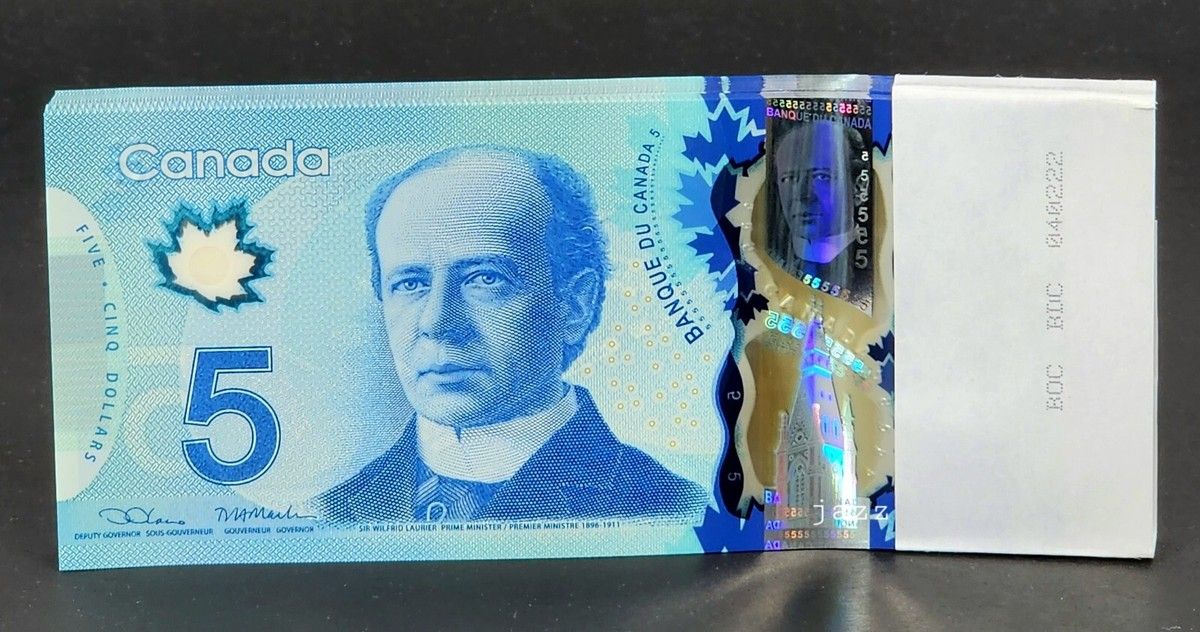
The most recent Canadian five-dollar note, part of the Frontier series, was introduced on 7 November 2013. It is predominantly blue in colour and uses advanced polymer technology. The front of the bill features a portrait of Canada's seventh prime minister, Sir Wilfrid Laurier, alongside a hologram of the Mackenzie Tower from the West Block on Parliament Hill. The reverse side depicts an astronaut working with Dextre attached to the Canadarm2, symbolizing Canada's contribution to space exploration. This note is made from a single piece of biaxially oriented polypropylene (BOPP) polymer, which makes the bills more durable and harder to counterfeit.
The Frontier series note incorporates several security and accessibility features. It features raised, textured printing as well as a special tactile feature similar to Braille dots to assist the blind in identifying the denomination. Key security features include the words "Bank of Canada" and "Banque du Canada" visible only under ultraviolet light, and yellow dots representing the EURion constellation on the reverse side. The public is encouraged to check notes by feeling the raised ink, looking at the frosted maple leaf window and transparent areas, and tilting the note to see colour-shifting elements.
Previous Designs and the Canadian Journey Series
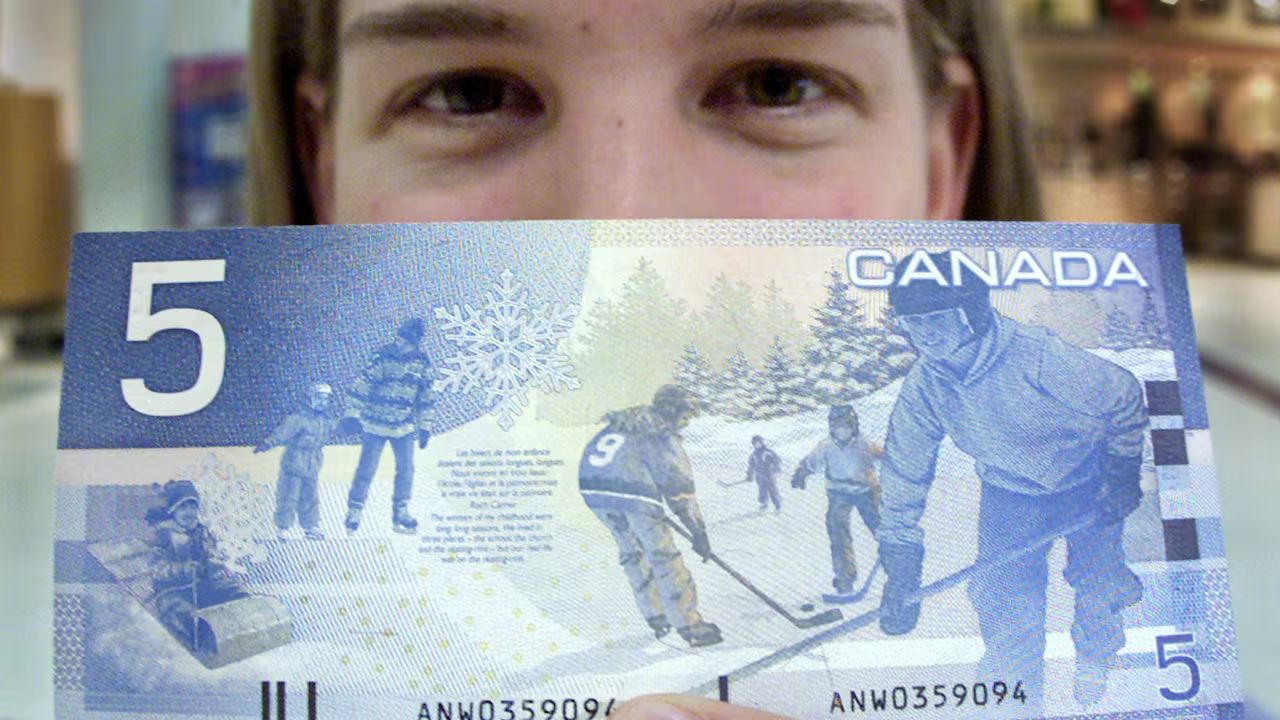
The immediate predecessor to the Frontier series was the Canadian Journey series five-dollar note. Its front also featured a portrait of Sir Wilfrid Laurier, the coat of arms, and a picture of the West Block of the Parliament buildings, but in a different layout. The reverse side of this note had a winter theme titled "Children at Play," depicting children engaged in sledding, ice skating, and hockey. This imagery was accompanied by a quotation from Roch Carrier's 1979 short story, "The Hockey Sweater," which appears in both French and English.
The story tells of a young boy in a hockey-mad Quebec village who receives a Toronto Maple Leafs jersey by mistake. In the banknote image, one of the hockey players, notably a girl, wears a hockey sweater number 9 to honour Canadian hockey legend Maurice Richard, who is idolized in Carrier's story. The engraved portrait of Laurier on this note was created by world-renowned engraver Czeslaw Slania. Due to increased counterfeiting concerns, this note was reissued in 2006 with enhanced security features like holographic stripes, ghost images, and see-through numbers, which replaced the iridescent maple leaves from the 2002 issue.
Historical Series and Design Evolution
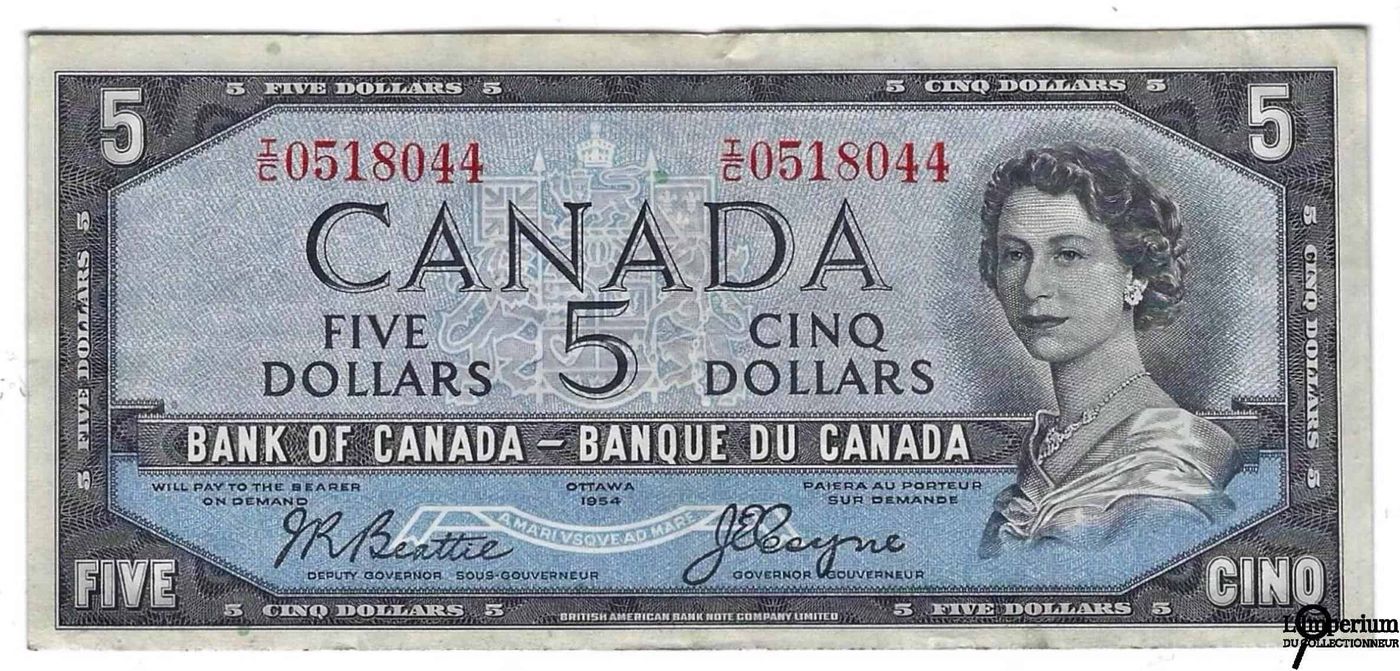
The design of the five-dollar bill has evolved significantly over the decades. Prior to the Canadian Journey series, other designs were in circulation. For example, a design from 1986 featured Laurier with the Centre Block of the Parliament Buildings as it appeared in his day, complete with the Red Ensign flag flying on the tower. This flag choice later caused a minor controversy known as the "flag flap," as some Canadians unfamiliar with the pre-1965 flag mistook it for an American flag. The back of that 1986 note featured a belted kingfisher bird against a typical landscape.
Key design years for the Canadian five-dollar bill include 1979, 1986, 2006, and 2013, marking significant updates in aesthetics and security. The shift from paper to polymer substrate with the Frontier series in 2013 represented a major technological leap. Polymer notes are more resistant to wear and tear and incorporate more sophisticated anti-counterfeiting measures. The Bank of Canada's research and development efforts have consistently focused on creating notes that are durable and difficult to forge.
Security Features and Public Verification
Modern Canadian five-dollar bills are equipped with a multi-layered suite of security features designed to deter counterfeiting and allow for easy public verification. The Bank of Canada promotes a four-step check process: Feel, Look, Tilt, and Flip. The polymer substrate itself, a smooth, unique texture made from a single piece of polymer with transparent areas, is the first line of defence. Specific features to check include the raised ink on the large number, the shoulders of the portrait, and the words "Bank of Canada" and "Banque du Canada."
The large transparent window contains a detailed metallic portrait and building that should match the main portrait when looked through. The transparent numbers matching the note's value and the word "Canada" are slightly raised. When the note is tilted, elements within the large window and holographic stripe change colour. Flipping the note reveals that key images are repeated in the same colours and detail on the back. Maple leaves border and cross into the large transparent window.
The Transition to a New Portrait Featuring Terry Fox
In December 2024, the Bank of Canada announced a significant change for the future of the five-dollar bill. Famed Canadian athlete and cancer research advocate Terry Fox will replace Sir Wilfrid Laurier on the next edition of the note. This decision followed a public consultation process that began in 2020, where a shortlist of eight notable Canadians was selected from 600 nominees. The final selection was made by the Minister of Finance, and it was reported in 2023 that Laurier would remain on the bill for some time before the change.
- The 2020 shortlist included: Terry Fox, Crowfoot, Pitseolak Ashoona, Robertine Barry, Binaaswi, Won Alexander Cumyow, Lotta Hitschmanova, and Fred Loft.
- The official announcement of Terry Fox as the new portrait subject was made on 16 December 2024.
- An image of Laurier is planned to be used for the fifty-dollar note when a new design for that denomination is implemented.
This change marks the first time in decades that the portrait on the commonly used five-dollar note will feature someone other than a prime minister. The selection of Terry Fox honours his national symbol status as a figure known for his cross-Canada Marathon of Hope. The new bill will be a vertical polymer note, continuing the use of advanced substrate technology. The Government of Canada announced on December 16, 2024, that Terry Fox will be featured on the new five-dollar note. Polymer notes are made from a single piece of polymer with transparent areas, making them durable and harder to counterfeit. The decision to feature Terry Fox came from a shortlist of notable Canadians considered to replace Sir Wilfrid Laurier.
Notable Public Discussions and the Five-Dollar Coin
The five-dollar bill has been at the centre of several public debates and phenomena. In 2005, the Canadian government polled citizens on the idea of retiring the five-dollar note and replacing it with a five-dollar coin, with savings intended to fund the Canadian Olympic team. The proposal was resoundingly rejected and ridiculed by the public. Many pointed out the note had been recently redesigned in 2002, and there was widespread aversion to carrying another heavy coin. Due to the overwhelmingly negative response, plans for the coin were discarded, and the Bank of Canada instead released an updated version of the five-dollar note in November 2006 with enhanced security features.
Another well-known phenomenon is the practice of "Spocking Fives," where Canadians used ink pens to alter the features of Sir Wilfrid Laurier on certain note editions to resemble Spock, the Star Trek character portrayed by Leonard Nimoy. The Bank of Canada officially objected to the mutilation of banknotes in 2002, noting it could shorten their lifespan. When the practice surged in 2015 following Nimoy's death, the Bank clarified that while defacing notes is not illegal and the notes remain legal tender, it can damage security features and lead retailers to refuse them. The 2013 Frontier series note features an image of Laurier with less resemblance to Spock, partly in response to this trend.
Collectibility and Market Value
Canadian five-dollar bills, especially older series and those with unique attributes, are collectible items. The value of a banknote depends on its condition, rarity, series year, and any special serial numbers or printing errors. Standard grading scales such as Good (G), Very Good (VG), Fine (F), Very Fine (VF), Extremely Fine (EF), About Uncirculated (AU), and Uncirculated (UNC) are used to assess condition. While most modern circulating notes are worth only their face value, there is an extremely rare chance that a note with a unique serial number or manufacturing error could be worth several thousand dollars to collectors.
| Series Period | Key Characteristics |
|---|---|
| 1986 to 1991 | Features Laurier with Parliament's Centre Block. Back has belted kingfisher. |
| Canadian Journey (pre-2006) | "Children at Play" reverse with Roch Carrier quotation. |
| Canadian Journey (2006 issue) | Added holographic stripe, watermark, see-through numbers. |
| Frontier Series (2013 onward) | Polymer note with space theme (Canadarm2, Dextre). |
Specialized dealers and auction houses provide price guides and sales data for historical notes, such as those from 1986 to 1991. It is important for collectors to verify the authenticity and grade of any note considered for purchase. The design and production of a bank note is a formidable challenge, and notes that survive in high grades from older series become increasingly valuable over time. Bank notes from older series, like the Canadian Journey series or earlier, are collected and traded. Collectors can view average prices of certified notes sold at auctions to determine value. Authenticity checks are crucial due to the security features and research focused on foiling counterfeiters.
Frequently asked questions
When will Terry Fox be on the $5 bill?
The announcement that Terry Fox will be featured on the new $5 note was made on 16 December 2024. The exact date when the new note will enter circulation has not yet been specified. The process involves finalizing the design and printing the new polymer notes. The portrait of Sir Wilfrid Laurier is expected to be moved to the fifty-dollar note when it is next redesigned.
What are the security features of the polymer $5 bill?
The polymer five-dollar bill has multiple security features. These include a large transparent window with a metallic portrait, raised ink on the large number and portrait shoulders, transparent numbers that match the note's value, and colour-shifting elements when the note is tilted. The note is made from a single piece of durable polymer. The Bank of Canada advises the public to check notes by feeling the texture, looking at the transparent areas, tilting to see colour changes, and flipping to compare front and back images.
Was there ever a plan for a Canadian five-dollar coin?
Yes, in 2005 the Canadian government proposed retiring the five-dollar note and replacing it with a five-dollar coin. The idea was that the cost savings from producing longer-lasting coins would fund the Canadian Olympic team. The proposal was put to a public poll and was overwhelmingly rejected and ridiculed by Canadians. As a result, the plan was abandoned, and the Bank of Canada instead issued an updated five-dollar paper note with improved security features in November 2006.
What was the 'Spocking Fives' trend?
"Spocking Fives" was a trend where people used pens to alter the portrait of Sir Wilfrid Laurier on certain five-dollar bills to resemble Mr. Spock from Star Trek. The practice became particularly popular after the death of actor Leonard Nimoy in 2015. The Bank of Canada stated that while defacing banknotes is not illegal and the notes remain legal tender, it can damage the security features and cause retailers to refuse them. The design of Laurier on the 2013 Frontier series note was altered to bear less resemblance to Spock.
Who is currently on the Canadian five-dollar bill?
The current Canadian five-dollar bill features a portrait of Sir Wilfrid Laurier, Canada's seventh prime minister. This note is part of the Frontier series, which was introduced on 7 November 2013. On 16 December 2024, the Bank of Canada announced that famed athlete and cancer research advocate Terry Fox will replace Laurier on the next edition of the bill. Laurier's image will then be moved to the fifty-dollar note when it is next redesigned.
What is on the back of the current $5 bill?
The reverse side of the current Frontier series five-dollar bill depicts an astronaut working with Dextre, a robotic hand, attached to the Canadarm2. This imagery represents Canada's role in space exploration and research. The front of the same bill also includes a hologram of the Mackenzie Tower from the West Block on Parliament Hill. This modern theme contrasts with the back of the previous Canadian Journey series note, which showed children engaged in winter sports like hockey and skating alongside a quotation from Roch Carrier's story The Hockey Sweater.
Sources and further reading
- Canadian five-dollar bill (Wikipedia) en.wikipedia.org
- Canadian Journey Series $5 Note bankofcanadamuseum.ca
- Canada 5 Dollar Bill Stock Photos istockphoto.com
- $5 polymer note security features bankofcanada.ca
- 5 dollars 1986 to 1991 values and prices coinsandcanada.com
This article explains how things work and is not financial, tax or legal advice. Rules, limits and rates change, so check the current figures with the Canada Revenue Agency, your province or your financial institution before you act.