Converting Danish kroner (DKK) to US dollars (USD) is a common financial transaction for Canadians involved in international trade, travel, or remittances. The exchange rate between these two currencies is determined by global foreign exchange markets and is influenced by factors such as interest rates, economic data, and geopolitical events. Canadians have several options for converting money, including banks, online transfer services, and currency exchange kiosks, each with different fee structures and exchange rate margins. Understanding how the rate is set and the costs involved can help manage cross-border finances more effectively.
The Danish Krone and US Dollar
The Danish krone is the official currency of Denmark, Greenland, and the Faroe Islands, with the currency code DKK and the symbol kr. It is a stable European currency pegged to the euro through the European Exchange Rate Mechanism II. The United States dollar, coded USD and symbolized by $, is the world's primary reserve currency and the most traded currency globally. For Canadians, transactions involving DKK and USD often occur in the context of international business, investment, or personal travel between North America and Europe. The most popular Danish krone exchange rate globally is the DKK to USD pair, while the most popular Canadian dollar rate is CAD to USD. This highlights the central role the US dollar plays in global finance, acting as a common intermediary in many currency conversions, including those originating from Canada. The Canadian dollar itself has a direct relationship with the US dollar, which is a primary focus for many domestic currency converters.
How the DKK to USD Exchange Rate is Determined
The exchange rate between the Danish krone and the US dollar is set by the global foreign exchange market, where currencies are traded 24 hours a day. The rate constantly fluctuates based on the forces of supply and demand. The price quoted in financial media is typically the interbank rate, which is the wholesale rate used for large transactions, often with a minimum of 5 million US dollars. This interbank rate forms the basis for all retail exchange rates. When individuals or businesses convert smaller amounts, they receive a retail rate. This retail rate includes a spread or margin added to the interbank rate by banks or currency services. The spread compensates the provider for market risk and operational costs associated with handling smaller transactions that cannot be immediately hedged on the interbank market. The rate a Canadian customer sees online or in a bank is this retail rate, not the pure interbank rate. Providers accumulate smaller client amounts before trading them on the larger interbank market, and the margin accounts for potential market movement during this accumulation period.
Factors Influencing the DKK/USD Exchange Rate
Several economic and geopolitical factors cause the DKK to USD rate to move. Interest rate differentials between the US Federal Reserve and Denmark's central bank are a primary driver, as higher rates in one country can attract foreign capital, increasing demand for that currency. Relative economic performance, measured by indicators like GDP growth, employment data, and inflation, also impacts currency strength. Political stability and geopolitical events can cause investors to seek safe-haven currencies like the US dollar, affecting its value against the krone. Since the Danish krone is pegged to the euro, monetary policy decisions from the European Central Bank indirectly influence the krone's value against the dollar. Trade flows and investment patterns between the United States, the Eurozone, and Denmark further contribute to daily exchange rate volatility. Market sentiment and speculative trading can amplify these movements in the short term. The performance of the pair over specific periods, such as 30 or 90 days, shows measurable volatility and average rates that reflect these underlying economic pressures.
Historical Context and Notable Rate Movements
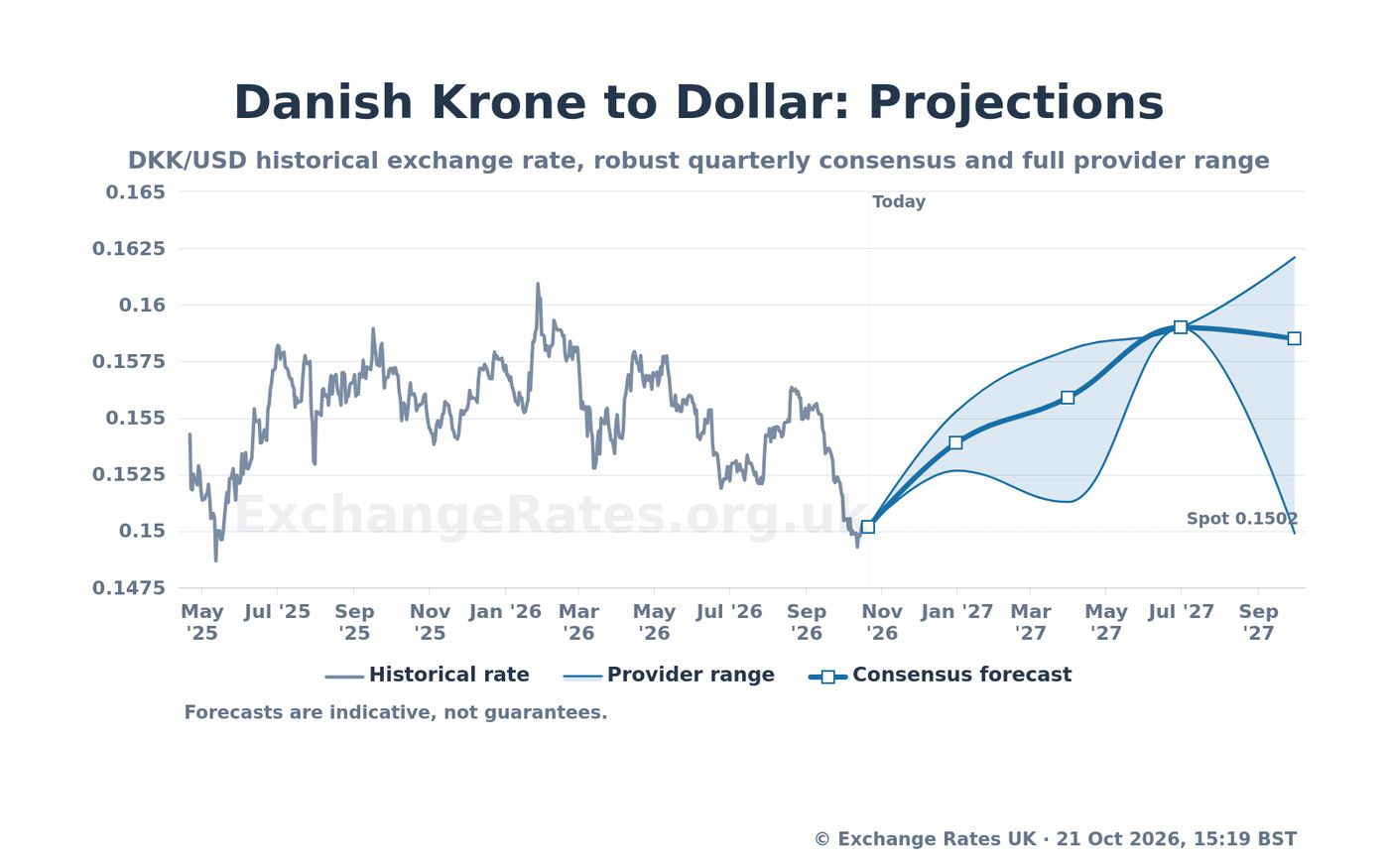
The historical relationship between the Danish krone and the US dollar has evolved with global economic shifts. During times of global uncertainty, the US dollar often strengthens as a safe-haven asset, which can lead to a lower DKK/USD rate, meaning it takes more kroner to buy one US dollar. Conversely, when the US economy faces challenges or the Federal Reserve adopts a dovish monetary policy, the krone may strengthen relative to the dollar. For example, over a 90-day period, the rate can have a high and a low point with a calculable average and percentage change, demonstrating the dynamic nature of the currency market.
Methods for Canadians to Convert Currency
Canadians have multiple avenues to convert Danish kroner to US dollars, each with distinct processes and ideal use cases. Traditional banks offer currency exchange services both at branches and through online banking platforms, particularly for clients with cross-border accounts. Online money transfer specialists and fintech companies provide digital platforms for currency conversion and international transfers, often advertising competitive rates. Currency exchange kiosks at airports or in city centres offer immediate cash conversion but usually at less favourable rates. Some financial institutions facilitate conversions through linked cross-border accounts, allowing instant transfers between currencies held in Canadian and US accounts. The choice of method often depends on the amount being converted, the need for speed, the importance of cost, and whether the funds are needed in cash or can be received electronically. Services like Western Union allow sending money online, through an app, or in person at an agent location for cash pickup by the receiver.
- Banks: Convert via branch, online banking, or linked cross-border accounts.
- Online Transfer Services: Digital platforms for sending money internationally to over 190 countries.
- Currency Exchange Kiosks: For immediate physical cash conversion.
- Multi-Currency Accounts: Hold and convert currencies within a single account.
- Debit Card Cash Access: Use a Visa Debit card at ATMs or for cash back at retail merchants in the US.
- Credit Card Cash Advance: Obtain a cash advance at a US financial institution with a US Visa Debit card, with limits up to $5,000.
For larger amounts or regular transactions, setting up specialized accounts or using services designed for frequent transfers can provide efficiency and potential cost savings over time. Some banks offer premium accounts that provide a preferred exchange rate as a benefit to clients. For example, a Premium Checking account may offer a preferred exchange rate every time you convert currency. With a linked Canadian and U.S. account, you can transfer money cross-border when conversion rates are favorable. You can transfer CAD to USD and back as many times as you want for free with certain accounts.
Fees, Rates, and Limits by Provider Type
The total cost of converting DKK to USD includes both the exchange rate margin and any explicit transaction fees. Providers apply a margin to the mid-market rate, which is the difference between the buy and sell prices in the global market. This margin is how many services make their profit, and it can vary significantly. Banks typically add a spread of 2-4% to the interbank rate for retail clients. Online money transfer services often promote narrower margins, sometimes close to 1%, but may charge a separate transfer fee. Credit and debit card networks use their own dynamic currency conversion rates, which usually include a margin plus a potential foreign transaction fee from the card issuer. Explicit fees can include flat wire transfer fees, percentage-based charges, or fees for expedited service. It is crucial for consumers to review the total cost, which is the combination of the offered exchange rate and all applicable fees, before confirming any transaction. Western Union notes that fees vary by amount sent, payment method, destination country, and payout option.
| Provider Type | Typical Cost Components | Notes on Limits |
|---|---|---|
| Major Canadian Banks | Exchange rate margin (spread), possible wire transfer fee. | Cross-border transfers between linked accounts may have per-transaction limits (e.g., $25,000). Phone service can raise limit to $100,000. |
| Online Transfer Specialists | Exchange rate margin, sometimes a separate transfer fee. | Limits may be based on account verification level and regulatory requirements. Some offer transfers in 130+ currencies. |
| Currency Exchange Kiosks | Wider exchange rate margin, often no separate fee. | Cash transaction limits may apply for large amounts without prior notice. |
| Cross-Bank Transfers (e.g., RBC) | Bank's retail exchange rate. Transfers between own accounts are often free. | Instant transfers, limit of $25,000 online, $100,000 by phone. No limit on number of transfers for checking/savings. |
Providers like Western Union and others clearly state that the rates and fees shown are estimates and vary based on payment method, payout method, amount, and destination. They recommend checking the real-time estimate with all costs included before sending money. The comparison savings advertised by some providers are based on specific examples and may not be indicative of actual savings for all transactions. Different currency exchange amounts, currency types, dates, times, and other individual factors will result in different comparison savings. These results therefore may not be indicative of actual savings and should be used only as a guide.
Cross-Border Banking with Canadian Institutions
Some Canadian banks offer integrated cross-border banking services that simplify converting and holding US dollars. For example, RBC allows clients to link their Canadian RBC Royal Bank accounts with US-based RBC Bank accounts. Through online banking or a mobile app, clients can instantly and freely transfer funds between these linked accounts while converting currency. The exchange rate applied is the bank's retail rate for such transactions. There are limits to these transfers, such as a cap of $25,000 Canadian or US dollars per transaction when initiated online. For larger amounts, clients can call the bank to arrange a single transfer of up to $100,000. These cross-border accounts enable Canadians to hold US dollars and convert them when rates are favourable, providing a tool for currency risk management. Clients with certain premium checking accounts may also qualify for preferred exchange rates, offering a slight improvement over the standard retail rate. To open a US account with RBC Bank, a Canadian resident must be 18 or older and provide standard Canadian identification. A US address or Social Security Number is not required. This system allows for holding US currency until exchange rates are more favourable before converting back to Canadian dollars.
Practical Steps and Transaction Details
Initiating a currency conversion typically involves several clear steps, whether online or in person. First, you select the currencies you are converting from and to, such as DKK to USD. Next, you enter the amount you wish to convert. The provider will then display an exchange rate quote and outline any applicable fees, showing the total amount the recipient will receive in US dollars. Before confirming, it is essential to review this total cost, including the rate and fees. For online transfers, you will need to provide recipient details and choose a delivery method, such as bank deposit or cash pickup. If using a linked cross-border account, the process is often integrated into online banking, where you select the accounts and amount to transfer. For cash conversions at a kiosk, you present the physical kroner and receive US dollars on the spot, minus the applied exchange rate margin. Many services offer tracking, such as a Money Transfer Control Number (MTCN), which allows you to monitor the transfer's progress online or via a mobile app. Setting up rate alerts within apps or on websites can notify you when the DKK to USD rate reaches a desired level, helping you time your conversion. Some providers allow you to save favourite currency pairs to check how the exchange rate changes over time.
Security and Best Practices for Currency Conversion
When converting currency or sending money internationally, security and informed decision-making are paramount. Reputable providers use encryption and fraud prevention systems to protect transactions. Customers should always verify the recipient's details thoroughly and only send money to people they know and trust. Using tracking features, such as a Money Transfer Control Number (MTCN), allows senders and receivers to monitor the transfer's progress. To understand the full cost, consumers must look beyond the advertised exchange rate and examine the total landed amount, which accounts for both the rate margin and any fees. For card-based transactions, it is important to know that using a credit card for a money transfer may be treated as a cash advance, incurring additional fees and immediate interest charges from the card issuer. A debit card or direct bank transfer may avoid these costs. Staying informed about current market conditions and setting rate alerts can help individuals time their conversions to achieve a more desirable rate. Providers encourage customers to be fraud-smart by keeping the MTCN private and being alert to scam warning signs. Western Union and similar services move money to over 200 countries and territories, and their security measures are designed for both online and in-person transactions. They advise sending money only to people you know and checking receiver details carefully.
Frequently asked questions
What is the difference between the mid-market rate and the rate I get?
The mid-market rate is the real-time midpoint between the global buy and sell prices for a currency pair, used as a benchmark. The rate you receive from a bank or transfer service is the retail rate, which includes a margin or spread added to the mid-market rate. This margin covers the provider's costs, risk, and profit. For personal transactions, you will not receive the pure mid-market rate, as smaller client amounts are accumulated and traded later on the interbank market.
Are there limits on how much Danish kroner I can convert to US dollars?
Yes, providers impose limits. For instance, with RBC's online cross-border transfers between linked Canadian and US accounts, the limit is $25,000 Canadian or US dollars per transaction. To transfer more than that in one go, you must contact the bank by phone, where advisors can accommodate single transfers up to $100,000. Other services have their own limits based on account type and regulations, and cash advances with a debit card may be limited to $5,000 per institution.
How can I avoid high fees when converting DKK to USD?
To minimize costs, compare the total exchange rate and fees across different providers like banks, online transfer services, and currency exchanges. Some online specialists advertise low margins and no hidden fees, using the mid-market rate. Using a linked cross-border bank account can offer free transfers between your own accounts, though a rate margin still applies. Avoid using credit cards for transfers if they trigger cash advance fees, and always review the full cost breakdown before confirming. Holding US dollars in an account until rates are favourable is another strategy some banks promote.
Can I open a US bank account from Canada to hold US dollars?
Yes, some US banking subsidiaries of Canadian banks allow Canadian residents to open accounts. For example, to open an RBC Bank US account, you need to be 18 or older and live in Canada or the US. You do not need a US address, US residency, or a Social Security Number. The process is done online and requires standard Canadian identification documents. This allows you to hold and manage US dollars directly.
How quickly does a currency conversion and transfer happen?
Speed varies by method. Transfers between linked cross-border accounts at some banks are instant, with funds appearing immediately after confirmation. Online money transfer services can range from same-day to several business days, depending on the destination, payment, and payout methods. Conversions for physical cash at a kiosk are naturally immediate. Money sent for cash pickup at an agent location can often be available within minutes. Always check the estimated delivery time provided by the service before you send.
Is the exchange rate I see on Google the rate I will get?
No, the rate displayed on Google or other financial websites is typically the mid-market reference rate. The actual rate you are offered by a bank or money transfer service will be different, as it includes a margin. The final rate you receive depends on the provider, the transfer amount, the payment method, and the time of the transaction. Western Union explicitly states their rate may differ from the Google rate due to an exchange rate margin and other variables. Always check the provider's own quote for the accurate, applicable rate.
Sources and further reading
- Danish kroner to Canadian dollars Exchange Rate. ... wise.com
- 1 DKK to CAD, Danish Kroner to Canadian Dollars ... xe.com
- USD ⇔ CAD Currency Converter, RBC Bank rbcbank.com
- Convert Danish Krone to Canadian Dollars | DKK to CAD currency.me.uk
- CAD to DKK | Convert Canadian Dollar to Danish Krone westernunion.com
This article explains how things work and is not financial, tax or legal advice. Rules, limits and rates change, so check the current figures with the Canada Revenue Agency, your province or your financial institution before you act.