The price of copper is a critical economic indicator, closely watched by investors, industries and scrap metal dealers across Canada. Its value is determined by global supply and demand dynamics, traded on major exchanges like the COMEX in New York and the London Metal Exchange. For Canadians, understanding copper pricing is essential for making informed decisions in construction, manufacturing, recycling and commodity investing. The metal's role in electrification and green technology also makes its price a barometer for the energy transition.
How the Copper Price is Determined
The global price for copper is established through trading on major commodity exchanges, primarily the COMEX, part of the CME Group in New York, and the London Metal Exchange. These markets facilitate the trading of copper futures contracts, where buyers and sellers agree on a price for delivery at a future date, which in turn sets the benchmark spot price for immediate delivery. The price is quoted in U.S. dollars per pound, the standard unit for copper trading, though Canadian dealers often convert it to Canadian dollars for local transactions. Trading hours for COMEX copper futures are extensive, allowing for nearly continuous price discovery as global markets react to news and economic data. The live spot price that investors see on financial portals is derived from the most active futures contracts and reflects the current market value for physical copper.
In Canada, local prices for physical copper products like bullion, rounds and scrap metal are based on the international spot price, adjusted for currency exchange, fabrication costs, dealer premiums and local supply and demand. For example, a Mississauga scrap metal yard listed prices for clean Copper #1 at $7.75 per pound and Copper #2 at $7.40 per pound in Canadian dollars, illustrating how the international benchmark filters down to local recycling markets. These prices are subject to constant fluctuation based on material quality, daily market movements and currency exchange rates. Investors and industrial buyers monitor the live charts and futures prices from these major exchanges to gauge the metal's direction and timing for their purchases or sales.
Key Factors Influencing Copper's Value
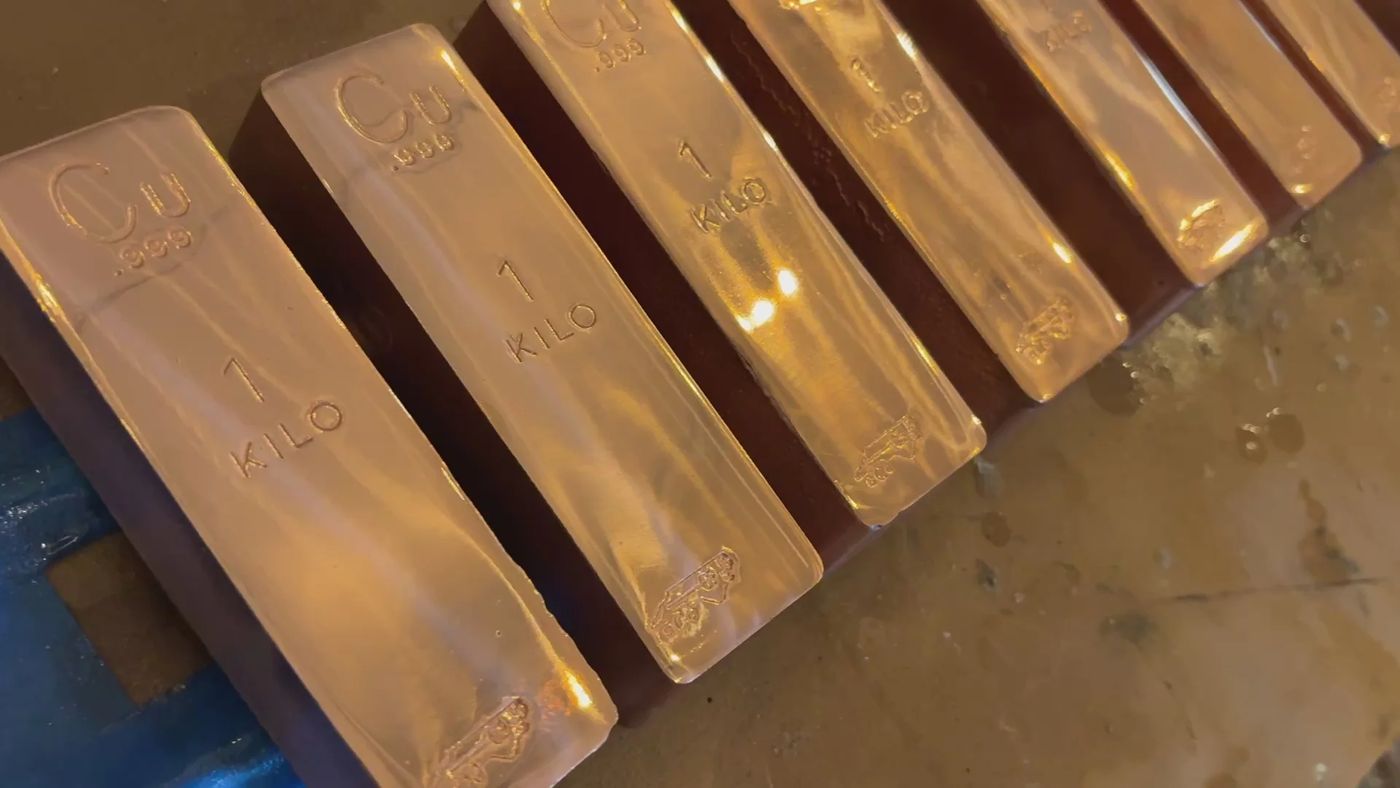
Copper is a cyclical commodity whose price is driven by a complex interplay of global macroeconomic and industry-specific factors. Its widespread use in construction, electronics and power infrastructure means its demand is closely tied to global economic health, rising during periods of industrial growth and falling during slowdowns. A primary demand driver in recent years is the global transition to renewable energy and electric vehicles, which require significantly more copper wiring and components than traditional systems. Technological advances, particularly in electric vehicles and green energy infrastructure, are raising demand for copper to new levels, creating long-term bullish pressure on its price.
On the supply side, copper production depends on mining output, which can be affected by geopolitical stability in producing countries, labour disputes and the technical challenges of extracting ore from declining grades. Chile is the world's leading producer, contributing 23 percent of global mined output in 2024, followed by other major producers like Peru and Australia. Canada itself produced 514,582 tonnes of copper in concentrate in 2024, ranking 12th globally. The availability of recycled copper, which accounted for 4.7 million tonnes of global refined production in 2024, also contributes to supply dynamics. Furthermore, because copper is traded globally in U.S. dollars, fluctuations in the value of the dollar directly impact its price for buyers using other currencies, including the Canadian dollar.
Historical Price Trends and Records
Copper prices have experienced significant volatility over the decades, reflecting its sensitivity to economic cycles, supply disruptions and technological shifts. Prices rebounded to $6,530 per tonne in 2018, dropped to $6,010 in 2019 and then increased to $6,174 in 2020. A rapid surge followed, reaching $10,162 by a subsequent year, demonstrating the metal's potential for sharp price movements. More recently, as of October 20, 2026, copper was $6.60 per pound, representing a 31.8 percent increase from $5.01 a year earlier. The price had grown 15.9 percent so far in 2026 and had averaged an annual growth rate of 6.9 percent over a longer period.
The market has witnessed several notable record-breaking moves and periods of intense speculation. Copper futures in the United States have hit record highs, with instances of jumping more than 10 percent in a single day, marking the biggest one-day gain in recent history. Conversely, prices have also experienced some of the sharpest weekly declines in recent years during periods of economic uncertainty or when speculative fervour recedes. These historical swings underscore the commodity's reputation for both offering substantial return potential and carrying significant price risk for investors and industries that rely on it.
How Canadians Buy, Hold and Sell Copper
Canadian investors and institutions have several avenues to gain exposure to copper, each with distinct characteristics regarding ownership, liquidity and complexity. The most direct method is purchasing physical copper in the form of bullion bars, rounds or coins from specialized dealers. For instance, as of September 2026, a 12-inch piece of C110 copper round cost $12.47 CAD at a quarter-inch thickness, $34.23 at half an inch and $126.37 at one inch. These products carry a premium over the spot price to cover fabrication, distribution and dealer margins. Purchasing physical copper requires consideration of storage, insurance and authentication, and when sold, may be subject to sales tax depending on the province and the form of the product.
Many Canadians prefer financial instruments that track copper prices without the hassles of physical storage. Exchange-traded funds that hold copper futures contracts or physical metal allow investment through a standard brokerage account. Another popular indirect method is investing in stocks of copper mining companies, which can offer leveraged exposure to copper prices but also carry company-specific operational and financial risks. For sophisticated investors, trading copper futures contracts on the COMEX allows for speculation on future price directions, though this involves significant leverage and risk. Finally, participation in the copper market can also occur through the recycling sector, either by selling scrap metal or by investing in companies that process recycled copper, aligning with sustainable investment trends.
- Physical Copper: Bullion bars, rounds and coins purchased from dealers.
- Copper ETFs: Exchange-traded funds that track copper prices.
- Mining Stocks: Shares in companies that mine or refine copper.
- Copper Futures: Derivative contracts for speculating on future prices.
- Recycled Copper: Selling scrap metal or investing in recycling firms.
When transacting, especially for larger physical purchases, dealers typically require government-issued identification and may require address verification, particularly for credit card payments. Major credit cards like Visa, MasterCard and American Express are commonly accepted, though prepaid cards or gift cards are often not supported. Payments must often be authenticated through security protocols like Verified by Visa, and the shipping address must match the card's confirmed address. These measures are standard for high-value commodity transactions to prevent fraud and ensure regulatory compliance.
Copper's Role in the Canadian Economy
Copper is a significant contributor to the Canadian economy, particularly in mining and export sectors. In 2024, Canadian mines produced 514,582 tonnes of copper in concentrate, an increase of 6.2 percent from the previous year. However, production has declined 26.2 percent over the decade from 2015 to 2024. British Columbia is the nation's leading copper producer, accounting for about 48 percent of total output and hosting the largest copper mine, Highland Valley, near Logan Lake. Canada also has one primary copper smelter and refinery in Quebec, along with two other sites in Ontario and Newfoundland and Labrador that produce limited refined copper as a by-product of processing other metals.
The country's trade in copper and copper-based products was valued at $17.3 billion in 2024. Exports alone were worth $10.7 billion, a 15 percent increase from the previous year, with 348,211 tonnes of copper ores and concentrates exported. The United States was the main destination, accounting for 56 percent of the total export value, followed by China at 19 percent, Japan at 9 percent and South Korea at 7 percent. While Canada is a meaningful producer, its share of global reserves is about 1 percent, or 8.3 million tonnes, within a worldwide total estimated at 1 billion tonnes. This production and trade activity underscores copper's importance as a natural resource that generates jobs, government revenue and export earnings for the nation.
Global Supply, Demand and the Future Outlook
The global copper market is characterized by growing demand, particularly from the electrification of transportation and energy systems, and a supply side that faces long-term challenges. In 2024, global mined copper production reached approximately 23 million tonnes, with Chile producing 5.3 million tonnes, or 23 percent of the total. Global refined copper production increased 3.8 percent to 27.5 million tonnes, comprising 22.8 million tonnes from primary sources and 4.7 million tonnes from recycled secondary sources. The increasing incorporation of recycled copper, which can be reused indefinitely without quality loss, is a critical component for a sustainable supply chain and a lower-carbon economy.
Demand projections remain robust, driven by copper's irreplaceable role in electrical conductivity. Its largest global use in 2024 was for building construction at 26 percent, followed by consumer and general products at 23 percent, infrastructure at 17 percent, transportation at 13 percent and industrial equipment at 12 percent. The green energy transition is anticipated to significantly increase copper demand due to its critical applications in expanding electricity grids and in clean energy technologies like electric vehicles and solar power. This fundamental demand shift, coupled with potential supply constraints from declining ore grades and long mine development timelines, suggests copper will remain a strategically important and closely watched commodity for years to come.
Frequently asked questions
What is the price of copper per pound?
The price of copper per pound is the standard trading unit quoted on international commodity exchanges like the COMEX in New York. It is set by the trading of futures contracts and determines the spot price for immediate delivery. This price is in U.S. dollars and fluctuates continuously based on global supply and demand. Canadian dealers and recyclers convert this to Canadian dollars, leading to local prices such as $7.75 per pound for Copper #1 scrap metal in Mississauga.
What moves the price of copper?
Copper prices are moved by global economic conditions, as industrial and construction activity drives demand. Specific demand surges come from technological advances like electric vehicles and renewable energy infrastructure. On the supply side, mining production levels, geopolitical events in producing countries and the availability of recycled copper are key factors. Currency exchange rates, particularly the strength of the U.S. dollar, also have a direct effect because copper is traded globally in dollars.
Where can I see a live copper price chart?
Live copper price charts are provided by major financial data portals and precious metals dealers, often sourcing data from the COMEX and London Metal Exchange. These charts display the current spot price and allow viewers to analyze price movements across different time frames, from minutes to years. Many Canadian bullion dealer websites integrate these live charts alongside their product listings. The charts are essential tools for investors and industry participants to track real-time market fluctuations and historical trends.
How do copper futures work?
Copper futures are standardized contracts traded on exchanges like the COMEX, where buyers and sellers agree on a price for the delivery of a specific quantity of copper at a future date. These contracts are used by commercial entities to hedge against price risk and by investors to speculate on price direction. The trading of these futures contracts establishes the benchmark price for copper globally. Futures trading involves leverage and significant risk and is generally suited for experienced investors or industrial hedgers.
How can I invest in copper in Canada?
Canadians can invest in copper by purchasing physical bullion bars or rounds from specialized dealers. Another common method is through exchange-traded funds that track the price of copper, traded on the stock market. Investing in shares of copper mining companies provides indirect exposure. More advanced investors may trade copper futures contracts. Additionally, individuals can sell scrap copper to recycling yards, participating in the secondary market for the metal.
Is copper a good investment?
Copper is a cyclical commodity whose price can offer significant returns during periods of economic expansion and high demand from sectors like construction and green technology. However, its price is also volatile and can decline sharply during global economic slowdowns. As an investment, it can provide diversification and a hedge against inflation, but it carries risks related to supply, demand and currency fluctuations. Investors should carefully consider their risk tolerance and investment goals, and often seek professional advice, before committing capital to copper or any commodity.
Sources and further reading
- Mississauga Scrap Metal Pricing premierrecycling.ca
- Copper Spot Price & Charts aubullion.ca
- Copper facts, Natural Resources Canada natural-resources.canada.ca
- Today's Copper Price | Copper Price Chart | IFCM Canada ifcmarkets.com
This article explains how things work and is not financial, tax or legal advice. Rules, limits and rates change, so check the current figures with the Canada Revenue Agency, your province or your financial institution before you act.