The Canadian penny, officially the one-cent coin, was a coin worth one cent, or 1/100 of a Canadian dollar. Production ceased due to inflation eroding its value and the coin costing more to make than it was worth. Since February 2013, cash transactions have been rounded to the nearest five cents, though the penny remains legal tender indefinitely.
Origins and Early History
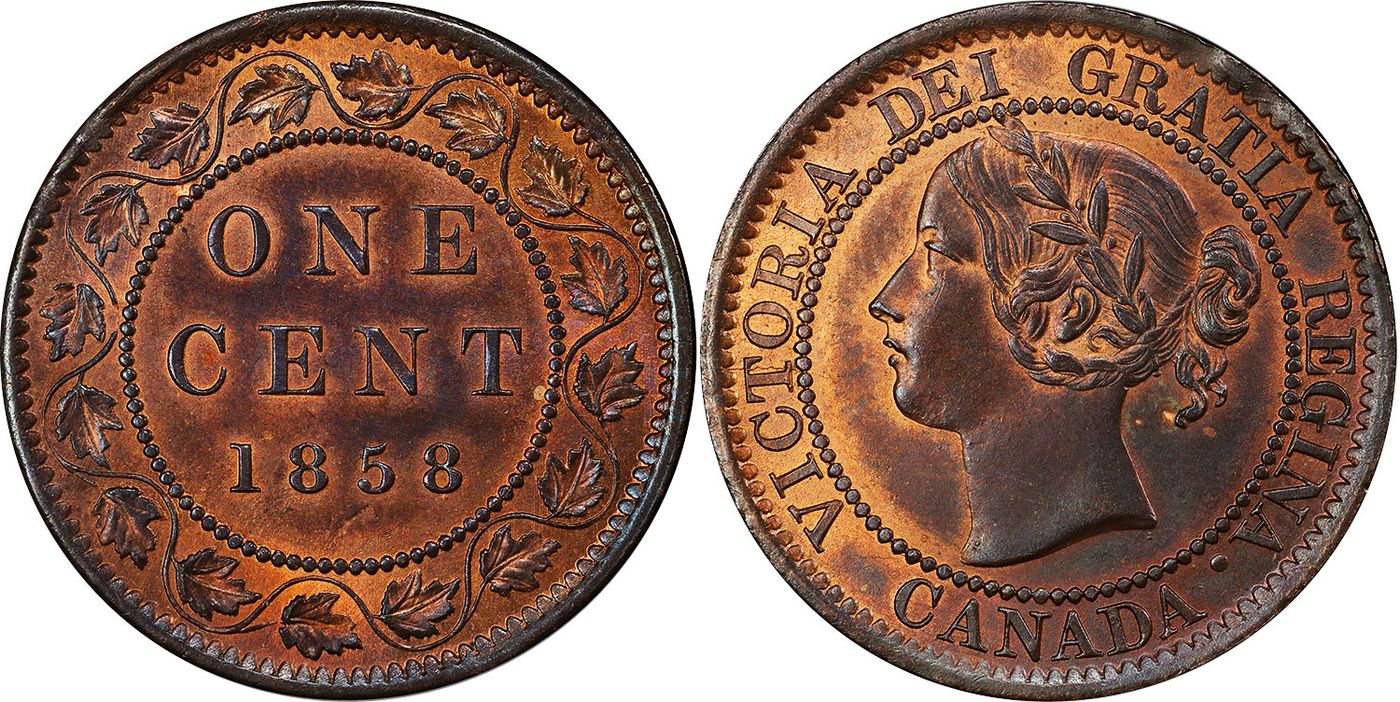
The penny's story begins before Confederation with the decimalization of Canadian currency. In 1858, the Province of Canada issued its first one-cent coins to replace the antiquated pounds, shillings, and pence system. These first pennies, known as large cents, were struck in bronze in England. They had a substantial diameter of 25.4 millimetres and weighed 5.67 grams. The initial order was for 10 million coins, a number that vastly exceeded the needs of a population under 2 million. This oversupply forced the government to release the coins into circulation at a 20 percent discount over the following decade. Production of these large cents, often marked with an 'H' for the Heaton Mint in Birmingham, continued intermittently until 1920. The coin's obverse featured the reigning British monarch, beginning with Queen Victoria.
The transition to a smaller cent occurred in 1920. A proclamation issued that year introduced a new bronze cent measuring 19.1 mm and weighing 3.24 grams. This size brought it closer to the American penny and established the modern dimensions. The reverse design featured the words 'one cent' supported by a maple leaf on either side. The old large cents were not immediately withdrawn but were allowed to wear out of circulation naturally. The small cent's design saw its first major update in 1937 with a new maple twig reverse by artist G.E. Kruger-Gray, a design that would become widely recognized. A rare variety from this era is the 1936 'dot' cent, minted in 1937 while awaiting new dies for King George VI. Only three specimens are known to exist.
The words were added back into the design the following year. The Ottawa Mint, a branch of Britain's Royal Mint, opened in 1908 and began producing Canada's coinage domestically, including the cent. Countess Grey struck the first one-cent coin at its official opening on January 2, 1908. The large cent was reduced to its modern size in 1920, ending an era of coinage that had begun over six decades prior.
Evolution of Design and Composition
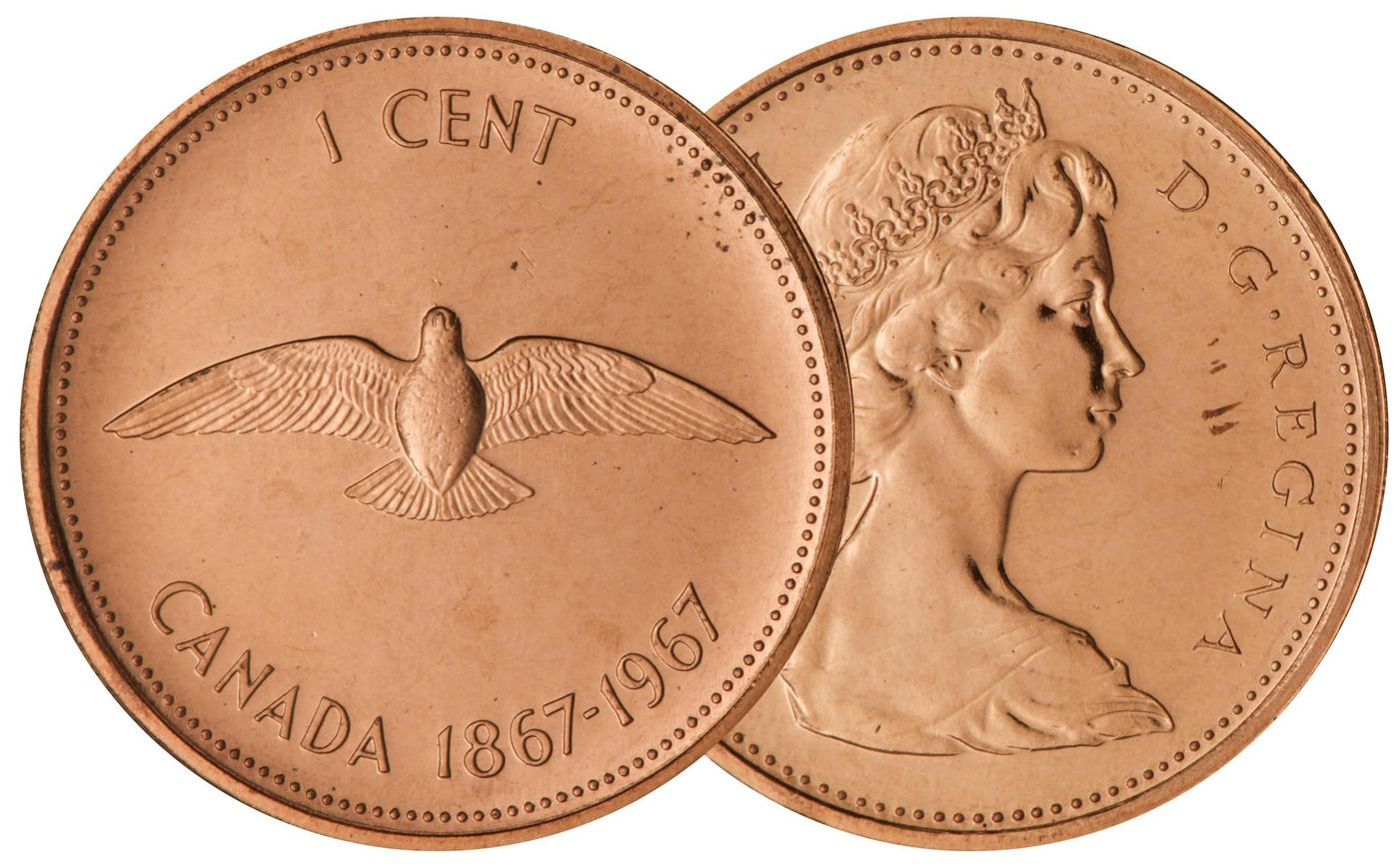
The penny's specifications changed numerous times throughout the 20th century, driven by economic factors and technological advancements. The composition was first altered during World War II, with the copper content increased to 98 percent and tin reduced to 0.5 percent in 1942. When Queen Elizabeth II ascended the throne in 1952, her effigy by Mary Gillick appeared on the obverse in 1953. A notable variety from this period is the 1955 penny, which comes with and without a fold of fabric on the queen's shoulder, with the reason for the difference remaining unclear. The 1960s saw the introduction of high-speed presses, dramatically increasing production rates by over 70 percent compared to prior years. Canada's centennial in 1967 was marked by a special reverse design by Alex Colville featuring a rock dove and the dual date 1867 to 1967.
To reduce costs and aid the visually impaired, the penny underwent significant physical changes starting in the late 1970s. From 1982 to 1996, pennies featured a distinctive twelve-sided shape. Their weight was also reduced, first to 2.8 grams in 1980, then to 2.5 grams in 1982. Despite these measures, the Royal Canadian Mint noted as early as 1984 that it cost more than one cent to produce each penny. The most drastic material change came in 1997, when the coin switched from bronze to copper-plated zinc, reverting to a round shape as the new metal proved difficult to plate on a dodecagonal planchet. In the final years, from 2000 onward, pennies were minted in two compositions: copper-plated zinc and copper-plated steel, the latter being magnetic and sometimes marked with a 'P' below the queen's bust in 2002.
Four different official effigies of Queen Elizabeth II were used on the penny. The first was by Mary Gillick from 1953, followed by Arnold Machin's design introduced in 1965. The third effigy, by Dora de Pedery-Hunt, debuted in 1990 and depicted the queen at age 64. The reverse design, aside from commemorative years, remained the maple twig by G.E. Kruger-Gray from 1937 until the coin's end. The Indian Independence Act of 1947 required the removal of 'Ind:Imp:' (Emperor of India) from the obverse, leading to the creation of the 1947 maple leaf variety for coins struck into 1948.
The Road to Abolition
The debate over the penny's usefulness gained momentum in the late 2000s. A 2007 survey by the Desjardins Group indicated that only 37 percent of Canadians regularly used pennies, with the average person hoarding about 600 of them. The survey also noted the government produced about 825 million pennies per year from 2001 to 2005. Inflation had eroded the coin's purchasing power to the point where it was often considered a nuisance. The government was also producing vast quantities to replace coins that disappeared from circulation due to hoarding. A study by the Standing Senate Committee on National Finance in 2010 concluded the penny had outlived its usefulness and recommended its removal, arguing that a century of inflation had eroded its value.
The federal government announced the penny's demise in its March 29, 2012 budget, citing a production cost of 1.6 cents per coin. The final penny for circulation was struck at the Royal Canadian Mint's Winnipeg plant on May 4, 2012, in a ceremonial event involving former finance minister Jim Flaherty, who pushed buttons on the machine that pressed the final coin. The mint ceased distribution of pennies on February 4, 2013, and began the process of melting down the estimated 35 billion pennies in circulation. This date was also marked by a Google Doodle commemorating the coin's phase-out. The final coin was entrusted to the Bank of Canada Museum in Ottawa for display.
Attempts to abolish the penny had been made earlier but were met with resistance because the coin was considered necessary to pay provincial sales taxes. The issue of the coin being a money-losing venture had been noted since at least 1984. The 2007 centennial of the Ottawa Mint brought the coin's future into greater public discussion, setting the stage for the parliamentary studies that ultimately led to its withdrawal. The Royal Canadian Mint was forced to produce large amounts of pennies as they disappeared from circulation due to hoarding or avoidance by the public, creating a costly cycle.
How Cash Transactions Work Without the Penny
With the penny withdrawn from circulation, a rounding system was implemented for cash transactions. The rule applies to the final total of a purchase, not to individual items. Totals are rounded to the nearest five-cent increment. Specifically, amounts ending in 1 or 2 cents round down to 0. Amounts ending in 3, 4, 6, or 7 cents round to the nearest 5. Amounts ending in 8 or 9 cents round up to 10. This method is standard for cash rounding and applies only to cash payments. Electronic transactions, such as those made by credit or debit card, continue to be settled to the exact cent. The penny itself retains its status as legal tender indefinitely, but the Currency Act limits its use for payment to a maximum of 25 cents. Vendors are no longer expected to give pennies as change, and consumers are not obliged to use them for payment, though they may if both parties agree.
Goods and services can still be priced in one-cent increments, which only affects the final calculation for cash payments. The rounding system is designed to be revenue-neutral over time, as rounding both up and down is equally likely. According to the Mint Act, only pennies produced from 1982 to their discontinuation in 2013 are still legally defined as circulation coins, though all earlier pennies also retain their legal tender status. This rounding protocol is typical of cash rounding methods used in other jurisdictions and is not specific to Canada.
Collectibility and Valuable Varieties
Most Canadian pennies are common and worth little more than face value in worn condition. Their value to collectors is determined by factors like mintage, condition, and the presence of errors or varieties. The most sought-after dates are generally from the 1920s, a period of low mintage described as a period of economic malaise. Pennies from 1922 to 1926 are particularly scarce, with the 1923 date being especially rare in collectable condition. According to the Canadian Coin Digest, mintages are not always a reliable indicator of rarity. Beyond regular issues, certain error coins and varieties command high prices at auction.
- 1936 Dot Cent: Only three known specimens exist from a mintage of 678,823. One sold for US$402,500 in 2010.
- 1955 No Shoulder Fold: A variety missing the fold of fabric on Queen Elizabeth's gown, also known as the 'no strap' variety.
- 2006 Steel Error: A magnetic steel penny mistakenly struck for that year.
- 1859 Brass/Narrow 9: A pattern coin sometimes considered a business strike by collectors. One sold for US$9,000 in 2019.
- 1937 Paris Mint Patterns: Experimental brass pieces struck at the Paris Mint. One sold for US$4,230 in 2017.
- 1922 to 1926 Low Mintage Cents: Coins from these years have markedly lower production figures, making them key dates.
- 1966 Nickel Penny: An intriguing rarity reportedly struck in nickel, referred to as the Holy Grail penny.
The Royal Canadian Mint also produced collectable versions of the penny in proof, proof-like, and specimen finishes, with specimen sets dating back to 1858. In 2012, the mint issued special farewell editions in silver and gold to commemorate the end of the penny's long history. Commemorative designs for the penny, such as the 1967 dove and the 1992 dual date for Canada's 125th anniversary, continue to be featured on non-circulating coins for collectors. The mid-20th century brought a series of varieties to Canadian coins, adding to the collectible landscape.
Historical Specifications by Era
The composition and size of the Canadian penny evolved considerably from its introduction to its discontinuation. The first large cents, minted from 1858, were made of bronze and measured 25.4 millimetres in diameter. In 1920, the penny was reduced to a smaller size of 19.1 millimetres, though it remained bronze. A temporary change during World War II increased the copper content to 98 percent. The coin's weight and shape were altered several times, including a shift to a twelve-sided shape from 1982 to 1996 to aid the visually impaired. The final major change came in 1997 when the penny's composition was changed from bronze to copper-plated zinc, and its shape was returned to round.
| Years | Composition | Weight (grams) | Diameter (mm) | Notable Features |
|---|---|---|---|---|
| 1858 to 1920 | 95.5% copper, 3% tin, 1.5% zinc | 5.67 | 25.4 | Large cent, 'H' mintmark for Heaton |
| 1982 to 1996 | 98% copper, 1.75% tin, 0.25% zinc | 2.5 | 19.1 | Twelve-sided shape, thickness 1.45mm |
| 2000 to 2012 | 94% steel, 1.5% nickel, 4.5% copper plating OR Copper-plated zinc | 2.35 (steel) 2.25 (zinc) | 19.05 | Dual composition, magnetic steel option |
The shift from a bronze alloy to copper-plated zinc in 1997 was a major cost-saving measure. The final dual-composition period from 2000 allowed the mint to use either zinc or steel cores, identifiable by the magnetic property of the steel version. The thickness remained relatively constant at 1.45 mm from 1982 onward. The 1947 penny featured a small maple leaf next to the date on the reverse to denote coins minted in 1948, a change made necessary by the Indian Independence Act which required the removal of 'Ind:Imp:' from the obverse. Master dies for Canadian coinage were first made at the Royal Canadian Mint in 1953 for the new Queen Elizabeth II effigy.
Cultural Significance and Etymology
Despite its official name being the one-cent coin, the term 'penny' is deeply ingrained in Canadian language and culture, much like 'loonie' for the dollar coin. This is a colloquial holdover from the British monetary system, where the penny was a fundamental unit. The true British penny was originally an 8th-century silver coin, and later a large copper coin, valued at 1/240th of a pound. In Canadian French, the coin is often called a 'cent', pronounced with the English 's' sound to distinguish it from the word for hundred. Other Quebec French slang terms include 'cenne', 'cenne noire', or 'sou noir'. The coin's imagery, particularly the maple leaf twig design introduced in 1937, became a familiar national symbol appearing on all Canadian coins minted between Confederation and 1935.
Commemorative designs, like the 1967 rock dove for Canada's centennial and the 2002 dual date for Queen Elizabeth II's Golden Jubilee, marked important national milestones. The penny also carried a dual-dated '1867 to 1992' design for Canada's 125th anniversary. Even after its demise, the penny's legacy continues through collector coins and its place in the historical narrative of Canadian commerce. The coin's history reflects the broader economic story of Canada, from the decimalization of currency and the shift from British to domestic production, to the modern realities of inflation and changing payment habits.
The coin filled a practical need in the decimal system established before Confederation, with 100 cents to the dollar. Prior to 1858, the Canadian economy used a mix of British coinage and merchant tokens, such as the Wellington copper tokens brought by soldiers during the War of 1812. The first Canadian cents were a shade bigger than a modern quarter and were intended to replace these older coppers. The legacy of the British penny system is why Canadians never officially had a 'penny' but always used the name for their cent. The maple leaf is a proud and distinctive Canadian symbol that appeared on the penny's reverse for most of its circulating life.
Frequently asked questions
Are Canadian pennies still legal tender?
Yes, Canadian pennies retain their legal tender status indefinitely. However, the Currency Act limits payments made with pennies to a maximum of 25 cents. Since February 4, 2013, businesses are not required to give or accept pennies as change, and cash transactions are rounded to the nearest five cents. Pennies produced from 1982 to 2013 are specifically defined as circulation coins under the Mint Act.
How does rounding work without the penny?
For cash payments, the final total is rounded to the nearest five cents. Totals ending in 1 or 2 cents round down to 0. Totals ending in 3, 4, 6, or 7 cents round to 5. Totals ending in 8 or 9 cents round up to 10. This rounding only applies to the total bill, not individual items, and does not apply to electronic payments like credit or debit cards, which are settled to the exact cent.
When did Canada stop making pennies?
Canada stopped making pennies for circulation in May 2012. The final penny was minted at the Royal Canadian Mint's Winnipeg plant on May 4, 2012, in a widely publicized ceremony. The mint officially ceased distribution of the coin on February 4, 2013, which also marked the beginning of the process to melt down the estimated 35 billion pennies in circulation. From that date forward, cash transactions were rounded to the nearest five cents. While the penny retains its legal tender status indefinitely, it is no longer produced or distributed.
Why did Canada get rid of the penny?
Canada eliminated the penny because inflation had eroded its value and usefulness over a century, making it a nuisance coin. Production had been a financial loss since at least the mid 1980s, costing 1.6 cents to make a one cent coin by 2012. Parliamentary studies and surveys concluded the penny was falling out of use, with many Canadians hoarding them instead of spending them. Furthermore, the coin was no longer deemed necessary for paying provincial sales taxes due to the implementation of rounding rules for cash transactions.
What is the most valuable Canadian penny?
The most valuable Canadian penny is the extremely rare 1936 'dot' cent, with only three known specimens in existence. One of these coins sold at auction for US$402,500 in January 2010. Other highly valuable pennies include low mintage coins from 1922 to 1926, particularly the 1923 penny, and notable varieties like the 1955 'no shoulder fold' coin and the 2006 steel error penny. Valuable pattern coins include the 1859 'Brass/Narrow 9' variety and 1937 pennies struck at the Paris Mint.
What were Canadian pennies made of?
Canadian pennies were made from various materials throughout their history. Their composition was adjusted in 1942, increasing the copper content to 98 percent. In 1997, the material changed to copper plated zinc, and the coin's shape reverted from twelve sided to round. In their final years, from 2000 to 2012, pennies were made from either copper plated zinc or copper plated steel, with the magnetic steel versions sometimes marked with a 'P' in 2002.
Sources and further reading
- Penny (Canadian coin) (Wikipedia) en.wikipedia.org
- Canadian coins price guide, value, errors and varieties coinsandcanada.com
- 1 cent | The Royal Canadian Mint mint.ca
- Whatever happened to the penny? A history of our one- ... bankofcanadamuseum.ca
This article explains how things work and is not financial, tax or legal advice. Rules, limits and rates change, so check the current figures with the Canada Revenue Agency, your province or your financial institution before you act.