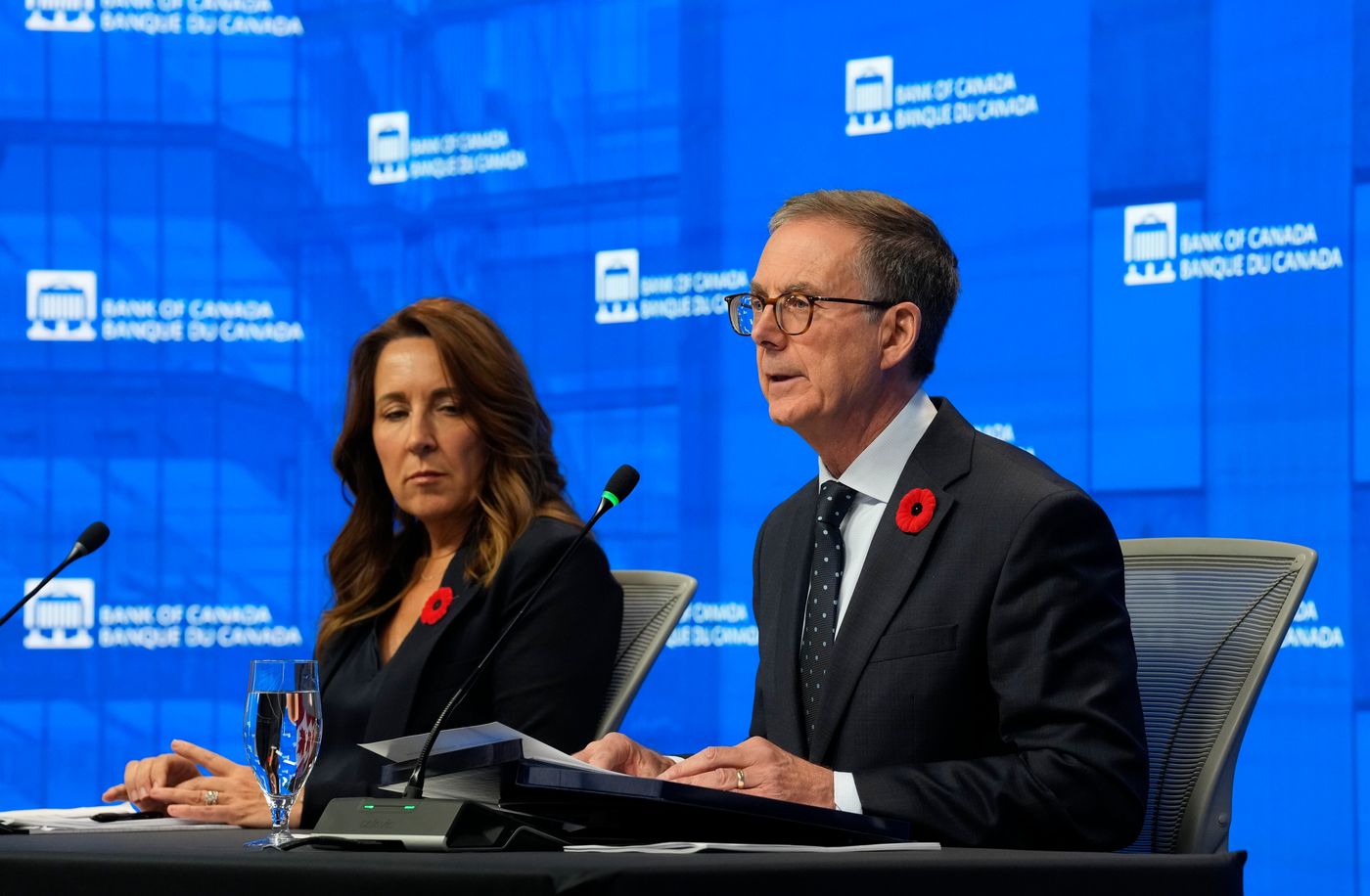
The Bank of Canada raised its benchmark interest rate for the first time in more than three years on Wednesday, warning of a subdued outlook for the housing market as higher borrowing costs add to existing pressures.
The central bank increased its policy rate by a quarter-point to 2.5 per cent, citing concerns that persistently high energy prices could fuel broader inflation.
"There’s a number of things weighing on housing right now," senior deputy governor Carolyn Rogers told reporters, describing a "subdued" outlook for the sector.
"Certainly, borrowing rates are currently weighing a bit on the housing market. An increase will add to that a bit on the margin, so I think the outlook we’ve got for housing in the forecast here takes all of that into account."
The bank also warned that higher energy and import costs are expected to raise the costs of housing construction and maintenance through higher prices for materials and equipment.
"A home isn’t a home without the roads, sewers and watermains that support it, and higher borrowing costs put pressure on the margins of the contractors building them, which are already stretched by global supply chain disruptions and material costs," said Nicole Emmett, vice-president of the Canadian Construction Association.
In September, national home sales were down 7.7 per cent from the same month last year, according to the Canadian Real Estate Association.
The national average sale price fell 1.6 per cent year-over-year to $666,538.
In Toronto, sales declined nine per cent year over year, while the composite benchmark home price fell 4.7 per cent, according to the Toronto Regional Real Estate Board.
"Canada's housing sector is a powerful engine of economic activity, supporting employment and consumer spending across the economy," said Phil Soper, president and CEO of Royal LePage.
"Its prolonged weakness is already weighing on economic growth, and higher borrowing costs will only deepen that challenge."
Marco Pedri, a broker with Toronto-based Shoreline Realty Corp., said many prospective buyers had anticipated the increase, making an immediate shift in demand unlikely.
"For sellers whose properties are still sitting on the market, that could translate into a long, slow winter, with fewer buyers willing to make compromises or stretch their budgets," he said.
Some realtors do not expect the quarter-point increase to significantly change market conditions.
"A 0.25 per cent increase alone is unlikely to cause a broad price decline. Local supply, employment and buyer demand will matter more," said Sammy Kohn, a Toronto-area realtor with HouseSigma.
Davelle Morrison, an agent with Bosley Real Estate in Toronto, suggested the increase could encourage some buyers to act before borrowing costs climb further.
"I think it will make some buyers feel that their procrastination has caused them to miss the boat," she said.
Mortgage broker Phil Edwards said higher borrowing costs could force prospecting purchasers to reduce their budgets or delay buying.
Shawn Zigelstein, a broker for Royal LePage Signature Realty, said clients are more concerned about other day-to-day costs and whether the overall inflation environment makes it the right time to buy a home.
"They have been worried about other factors, including tariffs and such. Are they going to have the jobs that they had? Are their investments going to do what they’ve been doing? So they’ve got bigger concerns than worrying about interest rates," he said.
While Canada "is not facing a broad mortgage crisis," there are signs of financial pressure concentrated in specific regions such as the Greater Toronto and Hamilton Area and southwestern Ontario, said Aled ab Iorwerth, deputy chief economist for Canada Mortgage and Housing Corp.
He said trade tensions are weighing on key manufacturing sectors such as the automotive industry in those areas, leading to labour-market uncertainty and softer housing market conditions.
CMHC said Ontario’s mortgage arrears rate reached 0.32 per cent in the second quarter, which is still below historical peaks but expected to continue rising through mid-2027.
British Columbia and Atlantic Canada are expected to see a more moderate rise in mortgage arrears over the same period.
"The mortgage system is adjusting, but these early warning signs, particularly in parts of Ontario, need to be monitored closely," ab Iorwerth said.
The central bank left the door open to more rate increases but said it would proceed cautiously amid uncertainty around trade and energy prices.
e2gold.ca reported last week that a new report predicts a nearly five per cent rise in existing home sales in Ontario next year, though activity remains below long-term norms.
This story was written by the e2gold.ca newsroom from reporting by BNN Bloomberg and Yahoo News. Quotes are checked word for word against that reporting.