SHENZHEN
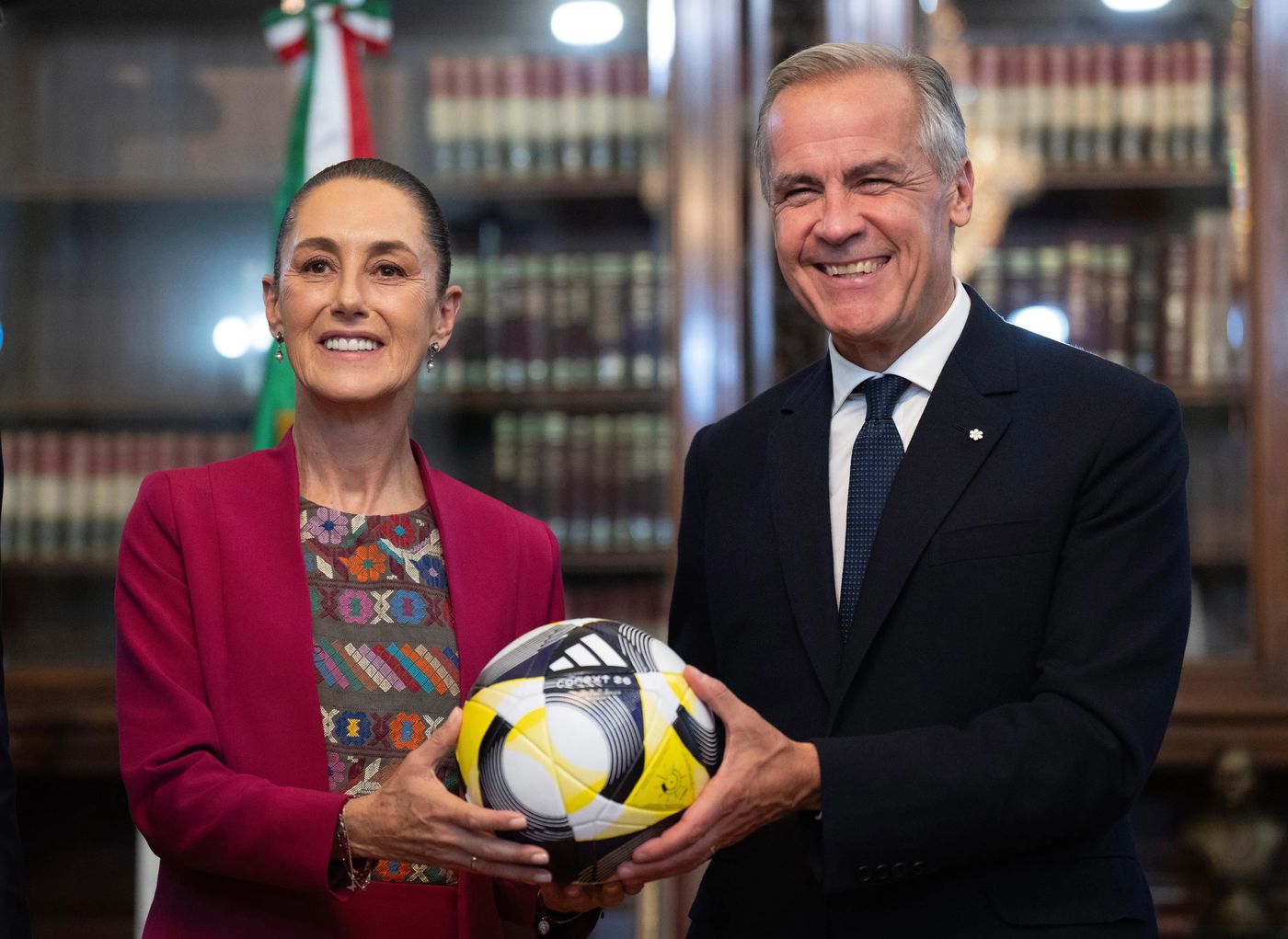
Prime Minister Mark Carney met Tuesday with Mexican President Claudia Sheinbaum on the sidelines of an economic summit in China, as both leaders handle tumultuous and unpredictable trade talks with the United States.
The meeting was an opportunity for the two leaders to commiserate over stalled negotiations and the future of the Canada-U.S.-Mexico Agreement (CUSMA).
“We see many opportunities for further co-operation with each other and working together with partners around the world, including the United States,” Carney said.
Sheinbaum said in Spanish that the meeting was a chance to discuss continental trade and a possible agreement between the three countries, but the important thing for her was the “extraordinary relationship” between Canada and Mexico.
Carney visited Mexico in September 2025 where both governments agreed to an action plan for deeper ties.
He said Tuesday that 120 initiatives from that plan have been accomplished, with trade up 18 per cent compared with a year prior.
The prime minister called that “an indication both of the strength of the relationship and the scale of the opportunity between Mexico and Canada.”
Mexico and Canada continue to be slammed by U.S. President Donald Trump’s tariffs, with threats of new duties looming, and both countries had trade talks sidelined by the interference of a close Trump ally and administration official.
Reports said U.S. Commerce Secretary Howard Lutnick created an impasse in Mexican trade talks last month while he was also blamed for the eleventh-hour breakdown in negotiations with Canada in August.
Ottawa and Mexico City had been negotiating with U.S. Trade Representative Jamieson Greer, who stated that his goal is to have interim limited agreements by the end of the year. But reports said Lutnick intervened in both sets of trade talks and was unwilling to budge over Trump’s sector-specific tariffs on things like automobiles.
Canada and Mexico are also looking to find a pathway to renew the trilateral trade pact, known as CUSMA, bringing predictability and tariff relief back to their economies.
The Trump administration in July chose not to renew CUSMA. The decision triggered a rolling annual review for up to a decade, at which point the agreement will expire if the three countries cannot agree on an extension.
‘A really hard dynamic to negotiate in’
Typically, it would be clear which American officials that Canada and Mexico are negotiating with, said Andrea Van Vugt, who was a foreign-policy adviser to former prime minister Stephen Harper.
“It’s become clear in the last six months it’s not just Ambassador Greer. It’s also Secretary Lutnick and then it is the president’s office and then it is the president,” the chief operating officer of Wellington Advocacy told a panel discussion for the Washington International Trade Association on Monday.
“That is a really hard dynamic to negotiate in and it makes it very hard to understand how to bring a negotiation to conclusion.”
She said the goal of Canadian negotiators will be to preserve as much of the trilateral trade pact as possible while also lifting tariffs, adding it’s not clear how much of that is possible.
Trump escalated the trade war, hitting an array of Canadian goods with 50 per cent tariffs and banning the import of others after talks broke down this summer. Ottawa responded with retaliatory tariffs.
Mexico has not retaliated to Trump’s tariffs with its own round of levies. Kenneth Smith Ramos, the former Mexican chief negotiator during the first Trump administration, told a panel discussion that Sheinbaum’s initial goal was to find a way to get tariffs dropped before CUSMA negotiations started.
Mexico worked with Trump administration on human and drug trafficking, as well as to resolve other bilateral issues. No matter what was offered, Mexico did not see duties decrease nor was it given an indication that it would get preferential tariff treatment through the continental trade agreement, Ramos said.
“We are sort of spinning our wheels in the U.S.-Mexico discussion because it’s a little bit of a game of chicken,” said Ramos, a partner at Mexico City-based Agon.
Antonio Ortiz-Mena, the former minister for economic affairs at Mexico’s embassy in the United States, said it is positive that many goods compliant with CUSMA are not being hit with levies but added that tariff threats are always changing.
Ortiz-Mena noted how Mexico is under investigation for new duties related to overcapacity.
“There’s a question, I think a legitimate question, on the Mexican side of what else do we need to do?” Ortiz-Mena said at the panel. “Is this a moving goal post? What else does the U.S. want?”
The meeting came during Carney’s trip to summits in four countries to advance trade and security ties, as e2gold.ca reported last week.
This story was written by the e2gold.ca newsroom from reporting by The Globe and Mail and CityNews. Quotes are checked word for word against that reporting.