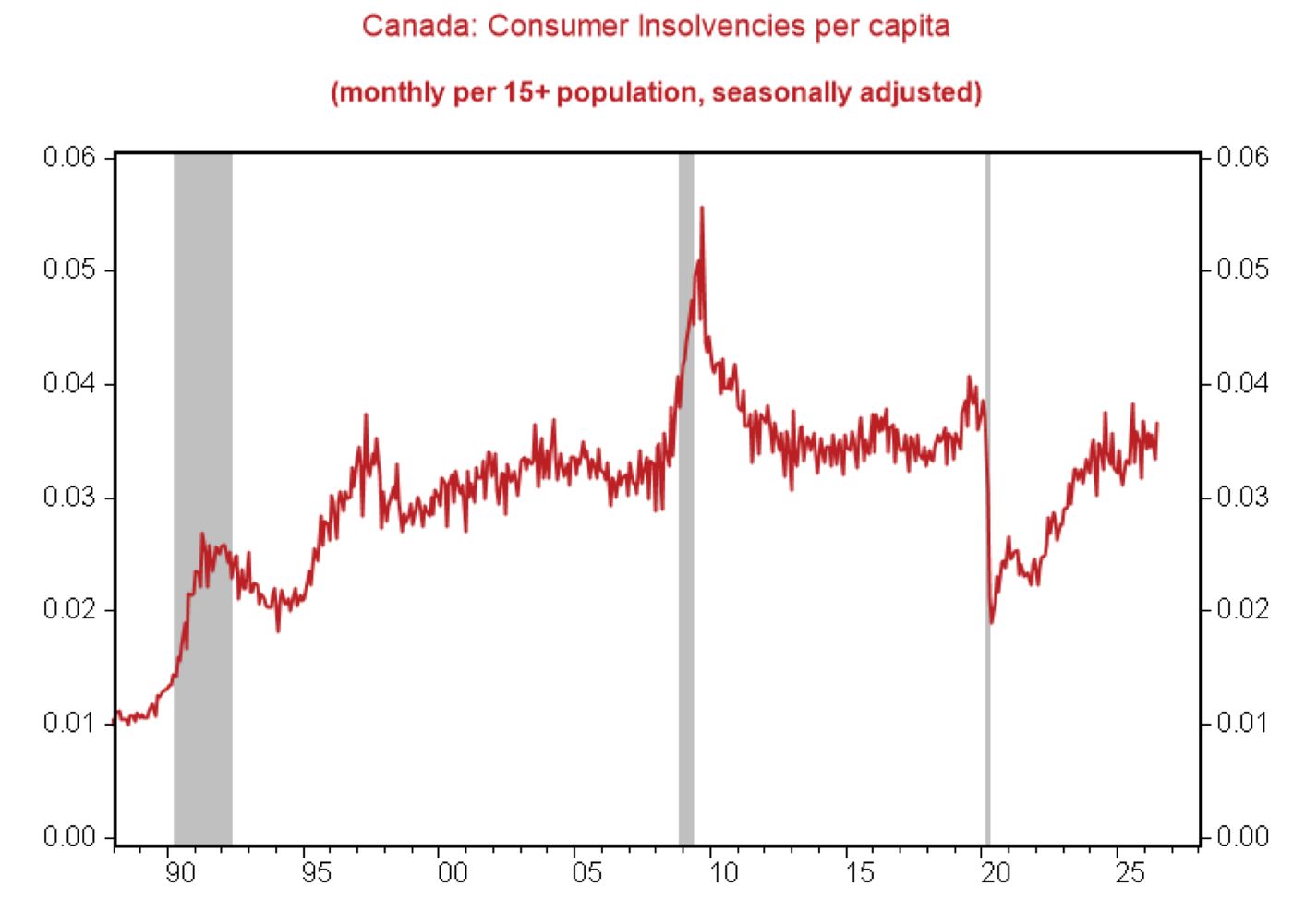
Consumer insolvencies in Canada reached their highest quarterly volume since 2009 in the third quarter of 2026, new data shows.
In July, August and September, 36,797 Canadians filed for insolvencies, according to the Canadian Association of Insolvency and Restructuring Professionals (CAIRP).
This is the highest volume of Canadians filing for insolvencies since the first three quarters of 2009, CAIRP said, when the Canadian economy was reeling from the aftershocks of the Great Recession of 2008.
"A 'persistently high' volume of fillings show that Canadians are struggling to keep up with debt," said Wesley Cowan, licensed insolvency trustee and CAIRP vice chair.
However, the rate of insolvencies was at 1.1 per 1,000 Canadian adults in the third quarter, still lower than the 1.5 per 1,000 in the third quarter of 2009.
Cowan said the lower rate is because of high population growth.
Between September 2025 and September 2026, consumer insolvencies increased by five per cent compared to the 12-month period between September 2024 and September 2025.
In September alone, 12,836 Canadians filed for insolvency, up 9.2 per cent from August and 1.3 per cent compared to September 2025.
Atlantic Canada accounted for the largest increases in annual insolvency filings compared to September 2025.
Filings rose 15.9 per cent to 175 filings in Prince Edward Island, 5.4 per cent to 649 in Newfoundland and Labrador, and five per cent to 1,125 in Nova Scotia.
New Brunswick saw 1,006 filings, a 4.1 per cent increase.
In Ontario, filings rose 5.3 per cent to 15,920. In Quebec, they increased 4.7 per cent to 11,129.
Manitoba saw a 3.8 per cent increase to 1,639 filings, while Saskatchewan had a 3.5 per cent increase to 1,272.
Alberta filings rose 4.2 per cent to 5,671, and British Columbia saw a 4.9 per cent increase to 5,449.
Business insolvencies
In the third quarter, 1,133 Canadian businesses filed for insolvencies.
While this was a drop of 11.6 per cent compared to the second quarter, it was up 2.3 per cent compared to the third quarter of 2025.
The accommodation and food services sector saw the largest increase in insolvency fillings, up 35 per cent to 182 fillings, followed by transportation and warehousing with a 15 per cent increase to 96 filings.
Accommodation and food services accounted for the largest share of business insolvencies in Canada at 16.4 per cent, followed by the construction sector at 14.9 per cent.
The data comes from the Office of the Superintendent of Bankruptcy.
Consumer insolvencies are a measure that indicates how many Canadians filed for relief under the Bankruptcy and Insolvency Act.
This story was written by the e2gold.ca newsroom from reporting by Global News, https://unpublished.ca/ and cedarnews.net. Quotes are checked word for word against that reporting.