SHENZHEN
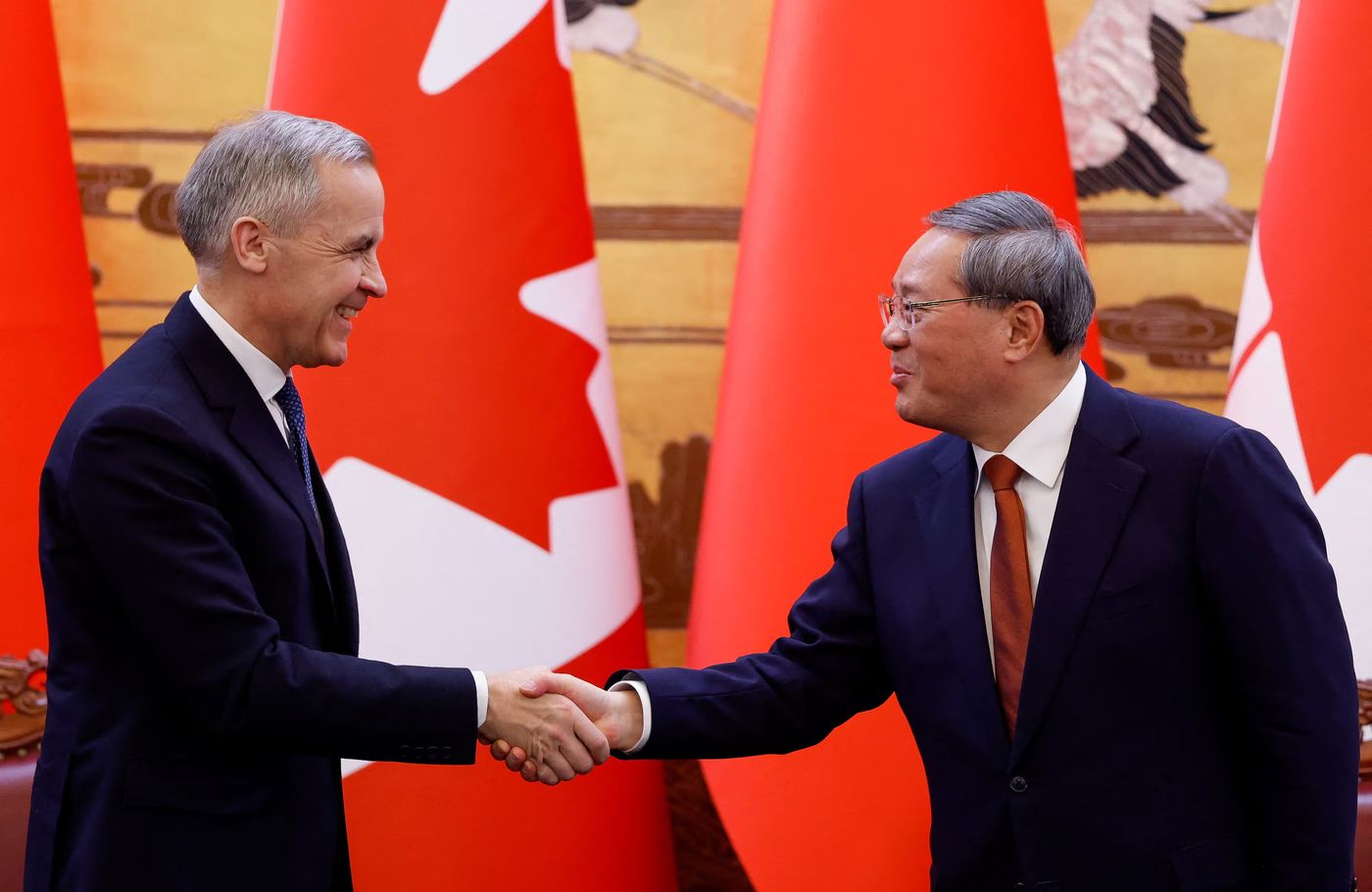
China will cut tariffs on Canadian pork and seafood exports as Prime Minister Mark Carney met with Chinese President Xi Jinping on Tuesday ahead of the Asia-Pacific Economic Cooperation summit.
Carney’s office said China will provide additional tariff relief for about $400 million in Canadian exports, including frozen pork cuts and fish and seafood.
Carney said Canada was well ahead of schedule in its goal of boosting exports to China by 50 per cent by the end of this decade.
The two leaders also agreed to extend and expand a preliminary arrangement to improve access to the Chinese market for Canadian farmers and seafood harvesters.
In exchange, Canada has agreed to extend by two years existing remission measures for certain Chinese steel and aluminum products that are set to expire at the end of 2026.
"Stronger communication and cooperation between China and Canada will benefit not only our two countries but also Asia-Pacific and the world," Xi told Carney during their meeting.
Tuesday's talks marked the third meeting between Carney and Xi since Carney became prime minister.
Driving much of Carney’s international trip is a strategy to diversify Canada’s economy and reduce its reliance on the United States, which has imposed hefty tariffs on many Canadian products.
Canadian merchandise exports to China increased 31.4 per cent in the first half of 2026, reaching $21.5 billion, according to Global Affairs Canada.
Shipments of Canadian crude oil to China have risen about 37 per cent this year.
Carney has also signalled he wants Chinese automakers to consider investing in Canadian manufacturing, potentially creating opportunities for Canadian autoworkers affected by U.S. tariffs.
"We have the best auto workers in the world, and we want them fully deployed, full opportunity, in an integrated North American market," Carney told reporters in Phnom Penh, Cambodia last week.
"If they are not fully utilized in a North American context, that provides other opportunities."
He said any Chinese automotive investment in Canada must involve genuine domestic manufacturing, rather than simply assembling vehicles from imported Chinese parts.
"It’s not just about kit cars. There has to be a manufacturing aspect involved," Carney said.
The federal government wants Chinese manufacturers to create Canadian jobs and develop domestic supply chains.
Chinese automakers BYD, Geely and Chery have taken steps to enter the Canadian market since Ottawa approved annual imports of 49,000 cars at a tariff rate of 6.1 per cent.
The quota is set to rise to 70,000 cars over five years.
White House trade adviser Peter Navarro responded to Carney’s earlier comments on social media.
"Are u really threatening to play China off the U.S.? This is offensive in the extreme. You should be far more worried China is going to eat Canada alive," Navarro wrote.
The relationship remains complicated by disagreements over foreign interference, cybersecurity, human rights and national security.
Critics have pointed to the imprisonment of Hong Kong pro-democracy media mogul Jimmy Lai, China's secret execution of four Canadians last year and Canadian intelligence findings that Beijing interfered in at least two federal elections.
China has said it has no interest in interfering in Canada's internal affairs.
Carney has said closer economic engagement with China does not mean Canada is setting aside those concerns.
The two countries established a broader strategic partnership during Carney’s January visit, covering trade, energy, financial services, public safety and other areas of co-operation.
That visit also saw China reduce tariffs on Canadian canola seed from almost 85 per cent to 14.9 per cent, and suspend additional tariffs on Canadian canola meal, peas, lobster and crab.
On Nov. 4, the two countries agreed to extend those market-access concessions through the end of 2028.
China has also restored market access for Canadian beef from 20 registered meat establishments.
Several important trade irritants remain, particularly Chinese tariffs on Canadian agricultural products.
China continues to impose an additional 100 per cent tariff on Canadian canola oil and a 25 per cent tariff on Canadian pork and related products.
Former prime minister Stephen Harper, who appointed Carney as a central bank governor, warns in a new memoir that while pragmatic engagement with China is worth pursuing, a fully bilateral free trade deal may never be possible.
"I am a China skeptic," Harper writes. "And my views have become considerably more pessimistic in recent years because of the governance of Xi Jinping."
Carney has also ruled out a comprehensive free trade deal with China.
e2gold.ca reported last week that Democrats' control of the U.S. Congress creates a new opening for Canada to push for an end to the trade war.
For Carney, the challenge is to expand Canada’s access to the Chinese market while protecting domestic industries and managing an increasingly complicated relationship with the United States.
This story was written by the e2gold.ca newsroom from reporting by BNN Bloomberg, Yahoo News and Toronto Star. Quotes are checked word for word against that reporting.