The Federal Reserve System, commonly called the Fed, is the central banking system of the United States. Established in 1913, its core mandates are to promote maximum employment, stabilize prices, and moderate long-term interest rates. While independent of direct government control, the Fed's monetary policy decisions have profound effects on global financial markets and economic conditions. For Canadians, changes in U.S. interest rates set by the Fed can influence cross-border investment flows, the value of the Canadian dollar, and the policy decisions of the Bank of Canada. Understanding the Fed's structure and functions is crucial for anyone following North American economics.
Origins and Core Purposes
The Federal Reserve System was created by the Federal Reserve Act of 1913, largely in response to a series of severe banking panics, most notably the crisis of 1907. The primary declared motivation was to address these banking panics and establish a more stable monetary system. Other original purposes included furnishing an elastic currency, providing a means for rediscounting commercial paper, and establishing more effective supervision of banking. Over its history, events like the Great Depression and the Great Recession led to a significant expansion of the Fed's roles and responsibilities. Today, its duties extend far beyond its original design to include broader financial stability and consumer protection.
The modern purposes of the Federal Reserve are extensive and enshrined in law. They include addressing banking panics and serving as the central bank for the United States. The Fed must balance the private interests of banks with the centralized responsibility of government, which involves supervising and regulating banking institutions. It also protects the credit rights of consumers through various regulations. A core function is conducting monetary policy by influencing market interest rates to achieve the goals of maximum employment and stable prices, the latter interpreted as an average inflation rate of 2 percent per year.
Additional critical responsibilities are maintaining the stability of the overall financial system and containing systemic risk in financial markets. The Fed provides essential financial services to depository institutions, the U.S. government, and foreign official institutions. It facilitates the exchange of payments among regions and operates the nation's payments system to ensure efficiency. The system is also designed to respond to local liquidity needs through its network of regional banks. Finally, the Federal Reserve plays a part in strengthening the United States' standing in the world economy through its policies and international engagements.
Structure and Governance
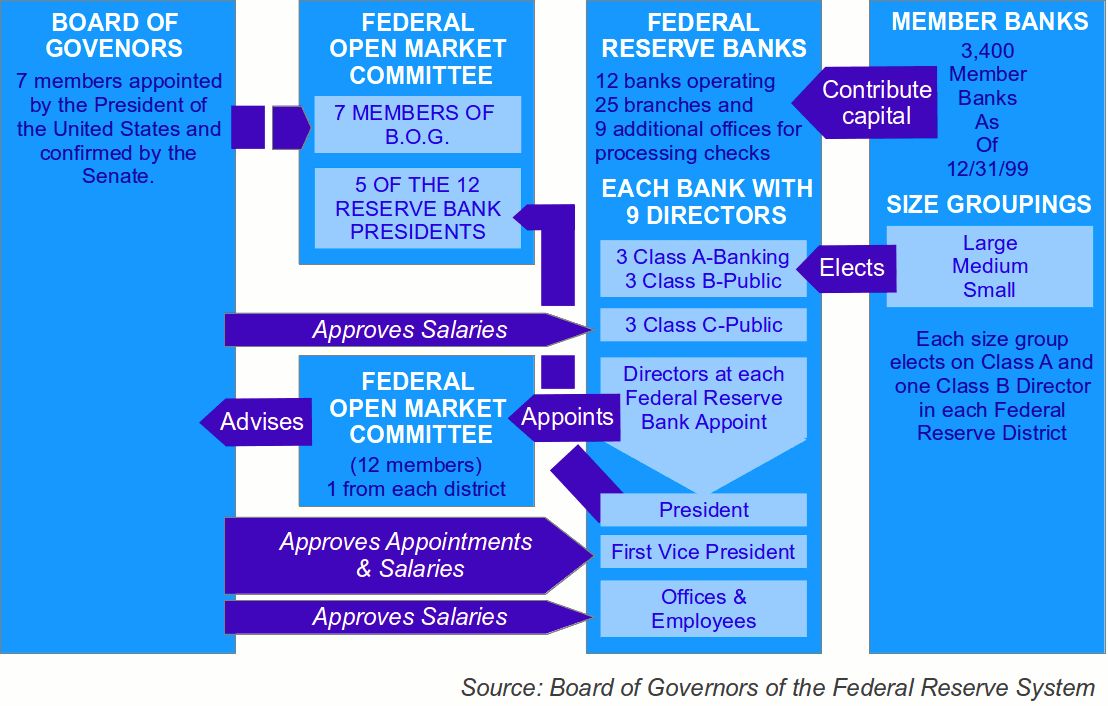
The Federal Reserve System has a unique hybrid structure that is both public and private, described as independent within the government. Its authority derives from the Federal Reserve Act passed by Congress, which can modify or repeal it. The system does not rely on public funding for its operations. The four main components are the Board of Governors, the Federal Open Market Committee, the twelve regional Federal Reserve Banks, and member banks throughout the country. This structure was designed as a compromise between those favoring public control and those advocating for banker control, resulting in a decentralized yet coordinated national system.
The seven-member Board of Governors is a federal agency headquartered in Washington, D.C. It oversees the 12 District Reserve Banks and sets national monetary policy. The board also has broad supervisory and regulatory responsibilities for the U.S. banking system. Governors are appointed by the President of the United States and confirmed by the Senate for staggered 14-year terms, with one term beginning every two years. Members serving a full term cannot be renominated for a second term. The chair and vice chair of the board are appointed by the president from among the sitting governors for four-year terms and can be renominated multiple times.
The Federal Open Market Committee is the body responsible for setting national monetary policy, primarily through open market operations. The FOMC consists of 12 members, which includes all seven members of the Board of Governors and five of the twelve regional Federal Reserve Bank presidents. The Committee must obtain consensus on all its decisions. Its most important tool is adjusting the target for the federal funds rate, which is the interest rate at which depository institutions lend reserve balances to each other overnight. This rate forms the basis for influencing broader market interest rates and economic activity.
The twelve regional Federal Reserve Banks are located in major cities throughout the United States. These banks regulate and oversee privately owned commercial banks within their districts. They also provide critical banking services to depository institutions and the federal government. Each regional bank has its own board of directors, which includes representatives from the private banking sector. This regional structure is intended to ensure that the diverse economic conditions across the country are considered in the central bank's decision-making process.
Key Functions and Operations
The Federal Reserve executes its mandate through several key functions, including monetary policy, banking regulation, and operating the national payments system. As a fractional-reserve banking system, U.S. banks are required to hold reserves equal to a fraction of their deposit liabilities. The Fed was designed to prevent bank runs and act as a lender of last resort to institutions whose collapse would have serious implications for the economy. It provides liquidity to banks to meet short-term needs from seasonal deposit fluctuations or unexpected withdrawals through its discount window, charging the discount rate for these loans.
As the central bank, the Fed serves as a banker's bank and the government's bank. For the government, it processes a variety of financial transactions involving trillions of dollars, handles incoming federal tax deposits and outgoing payments, and sells and redeems U.S. government securities. The U.S. Treasury produces the nation's cash, which it sells to the Federal Reserve Banks at cost for paper currency and at face value for coins. The Federal Reserve Banks then distribute currency and coin to other financial institutions. In the 2020 fiscal year, the Bureau of Engraving and Printing delivered 57.95 billion notes at an average cost of 7.4 cents per note.
The Fed plays a central role in the nation's retail and wholesale payments systems. Retail services include distributing currency and coin, collecting checks, electronically transferring funds through the FedACH system, and, beginning in 2023, facilitating instant payments using the FedNow service. Wholesale services involve electronically transferring large-dollar funds through the Fedwire Funds Service and transferring government securities through the Fedwire Securities Service. The Depository Institutions Deregulation and Monetary Control Act of 1980 reaffirmed the Fed's role in promoting an efficient nationwide payments system and subjected all depository institutions to reserve requirements.
The Federal Reserve regulates private banks, but it does not have complete responsibility for the U.S. banking system. The Board of Governors has supervisory responsibilities for state-chartered banks that are members of the Federal Reserve System, bank holding companies, the foreign activities of member banks, and the U.S. activities of foreign banks. The Board and the Federal Reserve Banks supervise approximately 900 state member banks and 5,000 bank holding companies. Other agencies, like the Office of the Comptroller of the Currency and the Federal Deposit Insurance Corporation, also supervise commercial banks. The Board issues regulations governing consumer credit protection laws that apply to both banks and other lenders.
Monetary Policy and the Federal Funds Rate
The Federal Reserve's primary tool for implementing monetary policy is the federal funds rate. This is the interest rate at which depository institutions lend reserve balances to other depository institutions overnight. The Federal Open Market Committee sets a target range for this rate. Adjustments to this target are intended to influence broader market interest rates, credit conditions, and ultimately economic activity to achieve the Fed's dual mandate of maximum employment and price stability. The process by which changes in the federal funds rate affect the economy is known as the monetary transmission mechanism.
Federal funds are the reserve balances that private banks keep at their local Federal Reserve Bank. These balances are the namesake reserves of the Federal Reserve System. The market where banks lend these funds to one another is fundamental for monetary policy work. By influencing the cost of these interbank loans, the Fed affects the rates banks charge for consumer and business loans. The FOMC adjusts the target rate based on its assessments of economic conditions, including employment data, inflation trends, and global financial developments.
When the FOMC changes the federal funds rate target, it signals a shift in monetary policy stance. A cut in the target rate is typically used to stimulate economic activity by making borrowing cheaper, while a hike is used to cool an overheating economy and curb inflation. For example, in a recent policy move, the Fed cut its target rate by 25 basis points, bringing it down to the range of 4.00 to 4.25 percent. This decision was made in light of a softening labour market and a shift in the balance of risks, despite inflation tracking higher than preferred. Such decisions are communicated through official statements following FOMC meetings.
Impact on the Canadian Economy and Financial System
The monetary policy decisions of the U.S. Federal Reserve have significant direct and indirect effects on Canada. Financial conditions in the United States quickly transmit to Canada through integrated capital markets, trade links, and exchange rate movements. When the Fed changes its policy rate, it influences global interest rate benchmarks, which affects borrowing costs worldwide. Canadian financial institutions rely on U.S.-owned financial infrastructure to conduct transactions supporting their market-making activities in Canada. Consequently, U.S. monetary policy is a critical external factor for Canadian economic policymakers.
The Bank of Canada, while an independent institution, often faces parallel economic conditions and may make coordinated or similar policy moves. For instance, both the Fed and the Bank of Canada recently cut their respective policy rates by 25 basis points on the same day. The Bank of Canada's rate was brought down to 2.50 percent. These simultaneous cuts occurred amid weakening labour markets in both countries, though each central bank's decision was based on its domestic economic assessment. The Bank of Canada cited a weaker economy and less upside risk to inflation as reasons for its cut.
Changes in U.S. interest rates directly affect the Canadian dollar's exchange rate against the U.S. dollar. A higher Fed rate, all else being equal, can lead to capital flows into U.S. dollar assets, putting downward pressure on the Canadian dollar. This can make imports from the U.S. more expensive for Canadians, potentially affecting inflation. Furthermore, many Canadian businesses have operations or sales in the United States, so U.S. economic conditions influenced by Fed policy directly impact their revenues and profitability. Canadian exports to the U.S. are also sensitive to changes in American demand driven by monetary policy.
For Canadian consumers and homeowners, Fed policy actions can have indirect consequences. While the Bank of Canada sets domestic policy rates, its decisions are made within a global context shaped by the Fed. When the Bank of Canada cuts its policy rate, it generally leads to lower interest rates on products like variable-rate mortgages and personal loans. Canadians with variable-rate mortgages may see their payments shrink or a larger portion go toward principal. However, fixed-rate mortgages in Canada are commonly based on five-year bond yields, which are influenced by both domestic and U.S. interest rate expectations.
Criticisms and Evolution of the Fed's Role
The Federal Reserve has faced various criticisms throughout its history regarding its policy decisions and its structure. It has been criticized for its approach to managing inflation and for a perceived lack of transparency in its operations. Its role in economic downturns, particularly the Great Depression, has been a subject of historical debate. Some economists, following Milton Friedman, argued that the Fed inappropriately refused to lend money to small banks during the bank runs of 1929, which contributed to the severity of the Depression. These critiques have shaped subsequent reforms and the expansion of the Fed's lender-of-last-resort functions.
The Fed's regulatory role has also evolved. The board of directors of each Federal Reserve Bank district has regulatory and supervisory responsibilities, including monitoring member banks for the undue use of bank credit for speculative purposes. If a district bank judges that a member bank is performing poorly, it reports this to the Board of Governors. The Board has the authority, after notice and a hearing, to suspend a bank from using the Federal Reserve's credit facilities. This oversight is intended to maintain sound credit conditions throughout the banking system.
In recent decades, the Fed's responsibilities have expanded significantly beyond its original focus on banking panics. It now plays a central role in monitoring systemic risk, implementing consumer protection regulations, and ensuring the stability of the entire financial system. The Fed's independence is designed to insulate it from short-term political pressures, allowing it to focus on long-term economic goals. However, this independence is periodically scrutinized by Congress, and the Fed is subject to audits by the Government Accountability Office, though with certain restrictions on what can be audited.
Recent Policy Coordination and Future Outlook
The recent coordinated rate cuts by the Federal Reserve and the Bank of Canada highlight the interconnected nature of the North American economy. In the U.S., the cut followed a weak jobs report and data showing a recent uptick in inflation, despite it being hotter than preferred. The Fed stated that in considering additional adjustments, it would carefully assess incoming data, the evolving outlook, and the balance of risks. TD Economics predicted that the Fed would likely cut its rate two more times in that year. The balance of risks for the Fed was tilted toward reducing the policy rate enough to support the softening labour market, though a flare-up in inflation could encourage it to keep rates higher for longer.
In Canada, the Bank of Canada's cut followed back-to-back job reports showing job losses, with the unemployment rate rising to 7.1 percent in August. While inflation had come down from its peak, the annual rate rose to 1.9 percent in August, up from 1.7 percent in July. Core inflation remained near 3 percent, above the Bank's 2 percent target. The Bank cited a weaker economy and less upside risk to inflation as reasons for the cut. TD Economics expected the Bank of Canada to deliver one more 25-basis-point cut before the end of 2025, which would bring its policy rate down to 2.25 percent.
This projected level would bring the Canadian policy rate closer to the lower end of the estimated neutral rate range, a level that neither restrains growth nor fuels inflation. The economic outlook for both countries involves balancing inflation risks against signs of economic weakness. In Canada, the impact of trade disruptions and tariffs was noted as weighing on trade and business investment and creating slack in the labour market, warranting additional policy support. For U.S. consumers, higher tariffs were expected to increasingly show up at the consumer level, potentially putting upward pressure on inflation in the future.
Frequently asked questions
How does the Federal Reserve affect interest rates in Canada?
The Federal Reserve does not set interest rates in Canada, but its policy decisions have a major impact. Changes in U.S. rates influence global capital flows and bond yields, which affect the interest rate environment in Canada. The Bank of Canada makes independent decisions but operates in a global context heavily influenced by U.S. monetary policy. Often, economic conditions lead both central banks to move in similar directions, as seen in recent coordinated rate cuts.
What is the federal funds rate?
The federal funds rate is the interest rate at which depository institutions lend reserve balances to other depository institutions overnight. The Federal Open Market Committee sets a target range for this rate. It is the Federal Reserve's primary tool for implementing monetary policy. Adjustments to this target influence the cost of borrowing throughout the economy, affecting everything from business loans to mortgage rates.
How does a Federal Reserve rate cut affect Canadian mortgages?
A Fed rate cut does not directly change Canadian mortgage rates, as those are set by the Bank of Canada and market forces. However, if the Bank of Canada also cuts its policy rate in response to similar economic conditions, it can lead to lower interest rates on variable-rate mortgages. For Canadians with variable-rate mortgages, a cut could mean lower payments or more of their payment going toward principal. Fixed-rate mortgages are based on longer-term bond yields, which are influenced by expectations for both U.S. and Canadian rates.
Who owns the Federal Reserve?
The Federal Reserve System is not owned by any individual or entity. It is an independent entity within the U.S. government. The twelve regional Federal Reserve Banks are organized like private corporations, with member banks holding stock in them, but this does not confer ownership in the conventional sense. The system's overall governance involves public oversight through the presidentially appointed Board of Governors and Congressional authority over its mandate.
What is the difference between the Federal Reserve and the Bank of Canada?
Both are independent central banks, but the Federal Reserve serves the United States while the Bank of Canada serves Canada. Their mandates are similar, focusing on price stability and full employment, but their structures differ. The Fed has a decentralized system with 12 regional banks and a hybrid public-private governance model. The Bank of Canada is a single, wholly public institution. Their policy decisions are independent but often correlated due to closely linked economies.
What is the Federal Reserve and what does it do?
The Federal Reserve is the central banking system of the United States. It was created on December 23, 1913 with the enactment of the Federal Reserve Act following a series of financial panics. Its core duties are to conduct monetary policy to achieve the goals of maximum employment and stable prices, which is its dual mandate, and to moderate long term interest rates. The Fed also supervises and regulates banks, maintains the stability of the financial system, and provides financial services to depository institutions, the US government, and foreign official institutions. It influences the economy primarily through the Federal Open Market Committee, which sets the target for the federal funds rate to affect market interest rates.
Sources and further reading
- Federal Reserve (Wikipedia) en.wikipedia.org
- Bank of Canada bankofcanada.ca
- The U.S. Federal Reserve and the Bank of Canada cut rates stories.td.com
This article explains how things work and is not financial, tax or legal advice. Rules, limits and rates change, so check the current figures with the Canada Revenue Agency, your province or your financial institution before you act.