The Federal Open Market Committee (FOMC) is the principal monetary policy-making body of the United States Federal Reserve System. It makes key decisions on interest rates and the growth of the US money supply, primarily by setting a target for the federal funds rate. These decisions have profound effects on global financial markets, exchange rates, and capital flows. For Canadians, the FOMC's actions directly influence cross-border borrowing costs, the value of the Canadian dollar relative to the US dollar, and the investment climate, making its meetings a critical event for businesses, investors, and policymakers.
What the FOMC Is and How It Works
The Federal Open Market Committee is charged under US law with overseeing the nation's open market operations, which involve the buying and selling of United States Treasury securities and other instruments. Its primary function is to set monetary policy by specifying a short-term objective for these operations, which is almost always a target level for the federal funds rate. The federal funds rate is the interest rate commercial banks charge each other for overnight loans, and it serves as a benchmark for many other interest rates globally. The committee also directs operations undertaken by the Federal Reserve System in foreign exchange markets, although any intervention is coordinated with the US Treasury. By influencing the cost and availability of money and credit, the FOMC aims to promote maximum employment, stable prices, and moderate long-term interest rates, which are its congressionally mandated goals.
Membership and Voting Structure
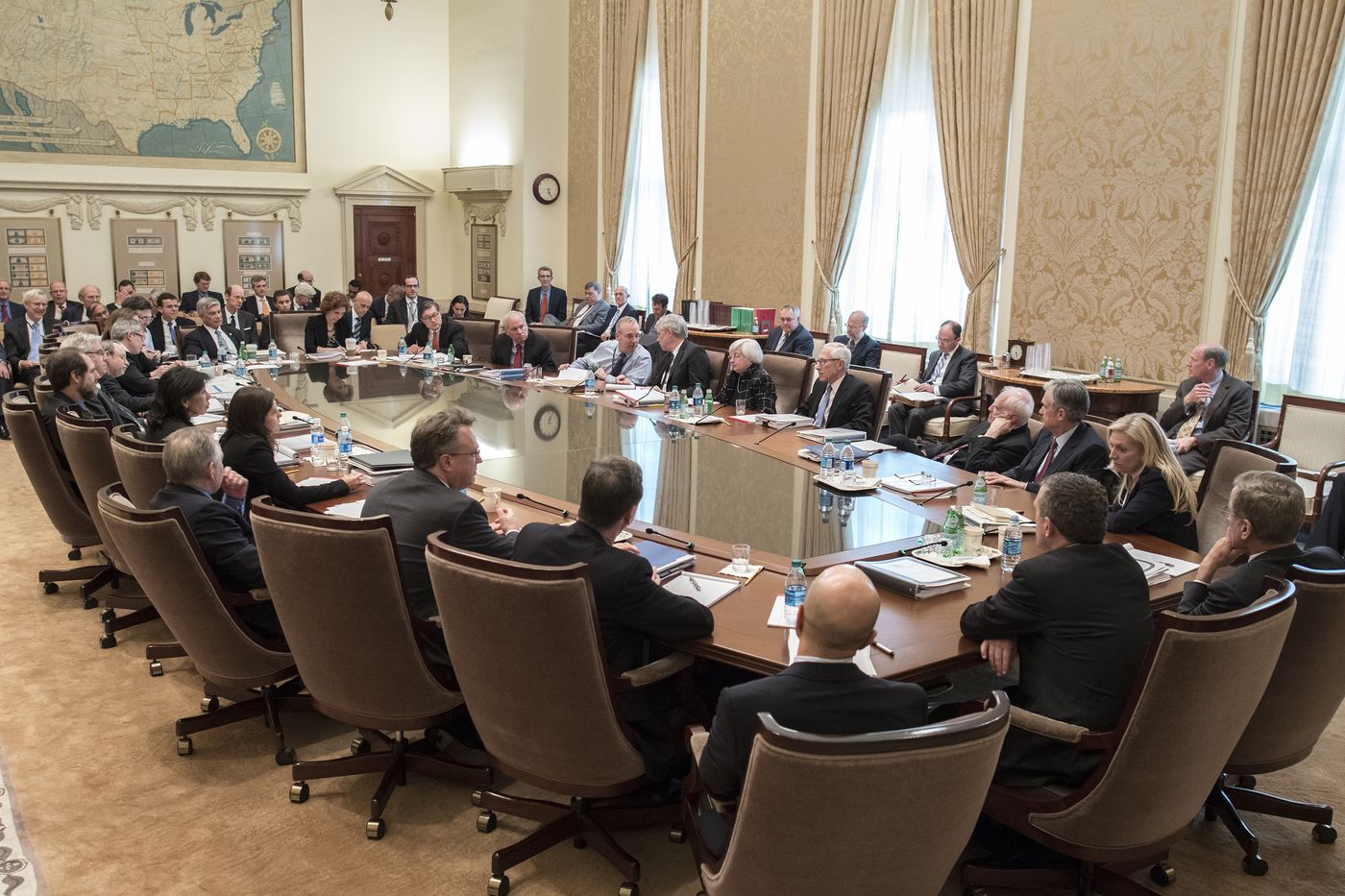
The FOMC has twelve voting members. This group consists of the seven members of the Federal Reserve Board of Governors, the president of the Federal Reserve Bank of New York, and four of the other eleven regional Federal Reserve Bank presidents who serve one-year terms on a rotating basis. The chair of the Federal Reserve Board has been appointed as the chair of the FOMC since 1935. The president of the New York Fed always holds a voting seat and serves as the committee's vice chairman. The four rotating seats are filled from four predetermined groups of regional banks. All Reserve Bank presidents, including those who are not currently voting members, attend the meetings, participate in discussions, and contribute to the committee's economic assessment. The committee's membership changes at the first regularly scheduled meeting of each year.
The Federal Open Market Committee includes four regional Federal Reserve Bank presidents who serve one-year voting terms on a rotating basis. The rotating seats are filled from four specific groups of banks. One bank president serves from each of the following groups: Boston, Philadelphia, and Richmond. Cleveland and Chicago. Atlanta, St. Louis, and Dallas. And Minneapolis, Kansas City, and San Francisco. This rotation ensures that different regions of the United States are represented in the committee's monetary policy decisions. The president of the Federal Reserve Bank of New York always holds a voting membership and is not part of this rotation.
- Group One: Boston, Philadelphia, and Richmond.
- Group Two: Cleveland and Chicago.
- Group Three: Atlanta, St. Louis, and Dallas.
- Group Four: Minneapolis, Kansas City, and San Francisco.
The committee's membership consists of the seven members of the Federal Reserve Board of Governors, the president of the Federal Reserve Bank of New York, and four of the other eleven regional Federal Reserve Bank presidents. As of May 22, 2026, the voting members are Chairman Kevin Warsh, Vice Chairman John C. Williams of New York, and Governors Michael S. Barr, Michelle Bowman, Lisa D. Cook, Philip N. Jefferson, Jerome Powell, and Christopher Waller. The four rotating regional bank presidents with voting rights for 2026 are Beth M. Hammack from Cleveland, Neel Kashkari from Minneapolis, Lorie K. Logan from Dallas, and Anna Paulson from Philadelphia. Committee membership changes at the first regularly scheduled meeting of the year.
Meeting Schedule and Decision-Making Process
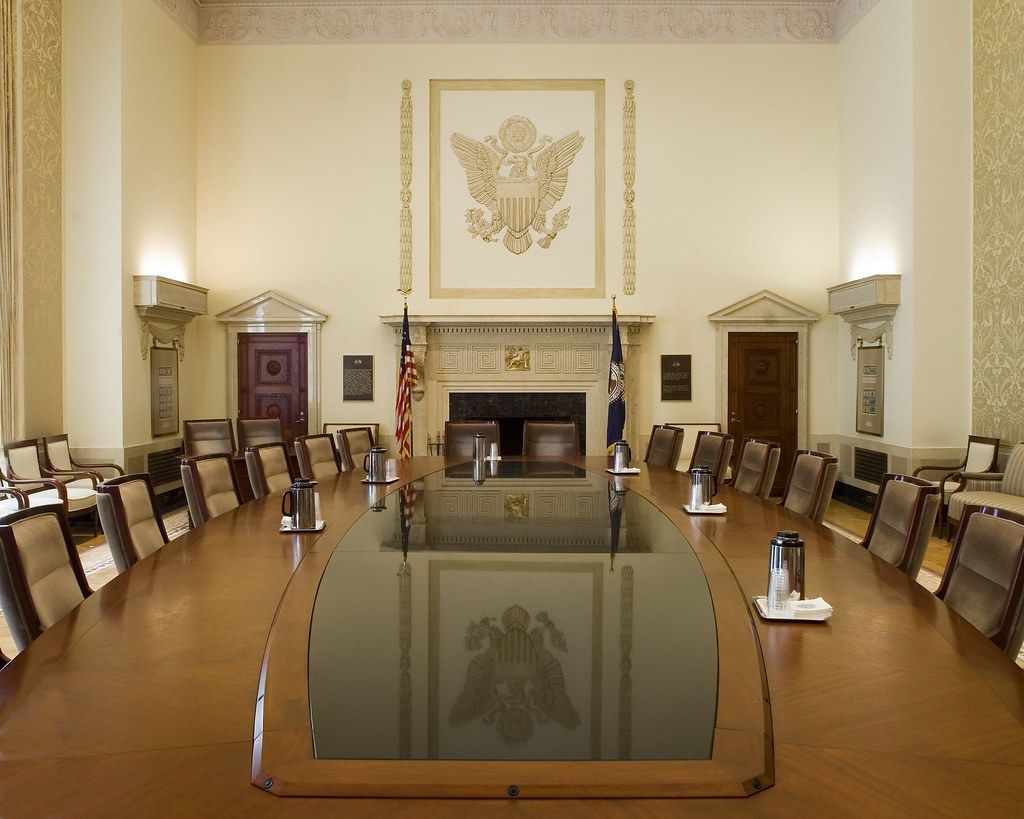
By law, the FOMC must meet at least four times each year in Washington, D.C. Since 1981, it has held eight regularly scheduled meetings annually at intervals of five to eight weeks. If circumstances require urgent consultation between these regular meetings, members may participate in a special meeting, a telephone conference, or vote by proxy. Attendance at the regular meetings is restricted due to the confidential nature of the information discussed. Before each meeting, Federal Reserve System staff prepare detailed written reports on past and prospective economic and financial developments for the committee members and nonmember Reserve Bank presidents.
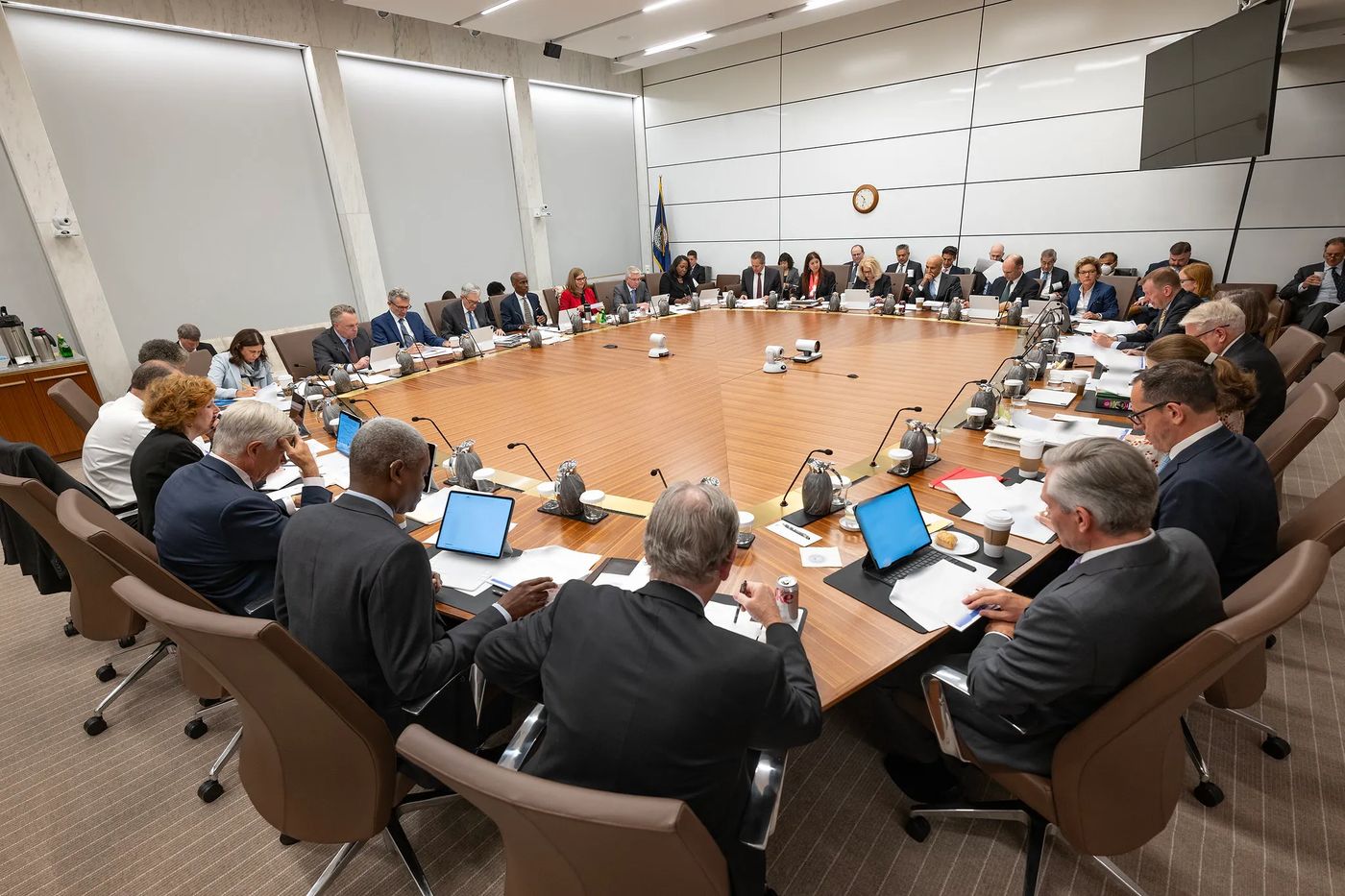
The decision-making process during a meeting follows several key steps. Staff officers first present oral reports on the current and prospective business situation, conditions in financial markets, and international financial developments. The committee then engages in discussions, considering a wide range of factors. These factors include trends in prices and wages, employment and production, consumer income and spending, business investment, foreign exchange markets, interest rates, and fiscal policy. Typically, each participant expresses their views on the state of the economy and the appropriate direction for monetary policy, followed by a more explicit policy recommendation. The committee must ultimately reach a consensus, which is incorporated into a directive to the Federal Reserve Bank of New York, the bank that executes the open market transactions. The directive sets forth the committee's objectives for long-run growth of key monetary aggregates and operating guidelines for reserve conditions.
Market Expectations and Policy Communication
Before each FOMC meeting, financial market participants attempt to predict the committee's decisions based on economic data and market signals. When the actual decision diverges from these expectations, it creates a 'monetary policy surprise,' often measured by movements in federal funds futures contracts around the announcement. Research indicates these surprises are partly predictable from information available before meetings. Economists offer several explanations for this predictability. First, the Federal Reserve may possess private information about the economy that markets learn only through its policy actions, a dynamic suggested by stock prices sometimes rising after surprise rate hikes as investors interpret the Fed's stance as a positive economic signal.
A second explanation is that markets may underestimate how strongly the Fed reacts to certain economic news, especially during economic downturns. Variables like the slope of the yield curve, stock returns, and commodity prices can help predict policy surprises because they capture information the Fed responds to more aggressively than markets expect. A third view is that the Fed does not react mechanically to individual data releases but instead observes how that news influences broader financial market conditions before deciding on policy. This view is supported by findings that financial stress indices help forecast FOMC decisions. In a May 2023 press conference, Chair Jerome Powell noted that the Fed looks at financial conditions very broadly as an important piece of information for assessing the likely path of the economy, but does not target them directly. This approach to communication and transparency has evolved, with former Chairman Ben Bernanke advocating for a strategy that focuses and anchors public inflation expectations, a practice the Fed now employs by publicly indicating its desired range for future inflation.
Historical Development and Congressional Oversight
The Banking Act of 1933 formally created the FOMC, though it did not initially include voting rights for the Federal Reserve Board of Governors. The Banking Act of 1935 revised the committee's structure to include the Board of Governors, and it was amended in 1942 to establish the current structure of twelve voting members. This legislative history codified the central role of the Board of Governors in national monetary policy. Under the Federal Reserve Act, the chairman of the Board of Governors must appear before congressional hearings at least twice per year to report on the efforts, activities, objectives, and plans of the Board and the FOMC regarding monetary policy.
The congressional oversight schedule is specified by statute. The chairman appears before the House Committee on Financial Services in February and July of odd-numbered years, and before the Senate Committee on Banking, Housing, and Urban Affairs in February and July of even-numbered years. This requirement ensures a regular line of accountability from the independent central bank to elected officials. There is a very strong consensus against selecting committee members primarily based on their political views, emphasizing the technocratic nature of the appointments. The committee's practice of interest rate targeting has been criticized by some commentators who argue that it may risk an inflationary bias, a debate that continues within economic circles.
Policy Debates and Alternative Approaches
The FOMC's practice of interest rate targeting has been subject to criticism and debate. Some commentators argue it may carry an inflationary bias. Throughout its history, the committee has evaluated alternative monetary policy frameworks. In 1979, under inflationary pressure, the Fed temporarily abandoned interest rate targeting in favor of targeting non-borrowed reserves. It concluded this approach led to increased volatility in interest rates and monetary growth and reversed the change in 1982. Other alternative rules that enjoy support among economists include traditional monetarism, which targets stable growth in a chosen monetary aggregate, and inflation targeting, practiced by many other central banks.
Former Fed Chairman Ben Bernanke, while a governor in 2003, spoke sympathetically about inflation targeting as a framework of 'constrained discretion' paired with a communication strategy to focus public expectations. He explained that a well-conceived strategy of inflation targeting can deliver good results for output and employment as well as inflation. A related criticism is that the Fed's statements do not fully explain how it weighs incoming information, particularly the role of financial market conditions alongside its formal mandates of employment and price stability. When markets expect a more direct reaction to specific data like jobs reports, predictable forecast errors can arise, manifesting as the policy surprises observed by economists.
Impact on Canada and Comparative Context
The decisions of the FOMC have immediate and significant repercussions for the Canadian economy. Changes in the US federal funds rate influence global interest rates, affecting the cost of borrowing for Canadian governments, businesses, and households with exposure to US dollar debt or variable-rate loans. Furthermore, shifts in US monetary policy are a major driver of the USD/CAD exchange rate, impacting Canadian exporters, importers, and cross-border investment flows. Canadian policymakers, including the Bank of Canada, closely monitor FOMC announcements and must often consider the Fed's actions when setting domestic monetary policy to maintain economic stability and manage inflationary pressures.
While Canada does not have an exact equivalent to the FOMC, its monetary policy is set by the Governing Council of the Bank of Canada. The broader context of financial regulation and market openness in Canada involves ongoing domestic policy initiatives. For instance, the Canadian government has been working to implement a consumer-driven banking, or open banking, framework. Initial legislation was passed in the 2024 federal budget implementation bill, giving the Financial Consumer Agency of Canada a mandate to lead the framework. The government indicated in its 2024 fall economic statement it was targeting early 2026 for implementation, though subsequent political events have introduced uncertainty. This initiative aims to allow secure data sharing between financial institutions and third-party fintechs, moving away from less secure 'screen scraping' practices where users share full banking credentials.
Key Facts and Data
The FOMC's structure and operations are defined by specific legal and procedural details. The committee meets eight times a year, and its policy directives guide the daily open market operations conducted by the Federal Reserve Bank of New York. The table below outlines the composition of the FOMC's voting membership as established by law and rotation. This structure ensures a mix of national and regional perspectives in monetary policy deliberations. The committee's focus on a broad set of economic indicators, from employment and inflation to financial market conditions, underscores the complexity of its mandate.
| Member Type | Number | Selection Method |
|---|---|---|
| Federal Reserve Board Governors | 7 | Appointed by the US President and confirmed by the Senate |
| President, Federal Reserve Bank of New York | 1 | Permanent voting member |
| Other Regional Federal Reserve Bank Presidents | 4 | Rotate annually from four designated groups |
The FOMC is the principal organ of United States national monetary policy and its decisions are closely watched by global financial markets. The committee also directs operations undertaken by the Federal Reserve System in foreign exchange markets, although any intervention is coordinated with the U.S. Treasury. Under the Federal Reserve Act, the chairman of the Board of Governors must appear before congressional hearings at least twice per year regarding the efforts and plans of the Board and the FOMC regarding monetary policy. These hearings are held before the House Committee on Financial Services and the Senate Committee on Banking, Housing, and Urban Affairs on a scheduled basis.
Frequently asked questions
What is the FOMC?
The Federal Open Market Committee is the committee within the US Federal Reserve System responsible for setting national monetary policy. It does this primarily by establishing a target for the federal funds rate and overseeing open market operations, which are the Fed's purchases and sales of US Treasury securities. The committee consists of twelve voting members and meets eight times per year. Its decisions are critical for US economic conditions and have major international spillover effects.
When is the next Fed meeting?
The FOMC holds eight regularly scheduled meetings each year at intervals of five to eight weeks. While the exact dates are published in advance, they are not fixed to a specific monthly schedule. For the most current meeting schedule, one should consult the official Federal Reserve website. The committee can also call special meetings if economic circumstances require consultation between the regular sessions.
How does the FOMC affect Canada?
FOMC decisions directly impact Canada through several channels. Changes in US interest rates affect global capital flows and borrowing costs, influencing rates offered by Canadian lenders. They are a primary driver of the value of the Canadian dollar relative to the US dollar, affecting trade competitiveness and import prices. The Bank of Canada often considers Fed actions when making its own policy decisions to maintain economic stability and manage inflationary pressures within the Canadian context.
What is the federal funds rate?
The federal funds rate is the rate that commercial banks charge between themselves for overnight loans. The Federal Open Market Committee sets monetary policy by specifying a target level for this rate as the short term objective for its open market operations. This committee is the principal organ of United States national monetary policy. Its decisions on this rate are a key tool for influencing the growth of the United States money supply and broader economic conditions. The target is set during FOMC meetings and implemented through directives to the Federal Reserve Bank of New York.
What is a monetary policy surprise?
A monetary policy surprise is an event where the Federal Open Market Committee's decision catches financial markets off guard. Economists define this gap by how much federal funds futures contracts move in the minutes around an FOMC announcement. Interestingly, these surprises are partly predictable from pre meeting information. Explanations include that the Fed may possess private economic data, or that markets underestimate the Fed's reaction to news. The Fed also watches how data ripples through financial markets, using indicators like financial stress indices, which can make its subsequent actions predictable to analysts.
Sources and further reading
- Federal Open Market Committee (Wikipedia) en.wikipedia.org
- Federal government says it will move open banking ... ipolitics.ca
- https://open.canada.ca/data/dataset/?sort=&jurisdi... open.canada.ca
- A National Conference on the Future of Free Trade Within ... iedm.org
This article explains how things work and is not financial, tax or legal advice. Rules, limits and rates change, so check the current figures with the Canada Revenue Agency, your province or your financial institution before you act.