The federal funds rate is the overnight interest rate at which U.S. depository institutions lend reserve balances to each other. Set by the Federal Reserve's Federal Open Market Committee, it is a primary tool for conducting U.S. monetary policy. This rate influences a wide range of market interest rates and has significant international effects, including on the Canadian economy and the value of the Canadian dollar. Understanding the federal funds rate is crucial for Canadians as it affects global investment flows, currency exchange rates, and the monetary policy decisions of the Bank of Canada.
Definition and Mechanism
The federal funds rate is the interest rate at which depository institutions such as banks and credit unions lend reserve balances to other depository institutions overnight on an uncollateralized basis. Reserve balances are amounts held at the Federal Reserve, the central bank of the United States. Institutions with surplus balances in their accounts lend those balances to institutions in need of larger balances to meet regulatory liquidity requirements. The interest rate for each transaction is negotiated between the two banks, and the weighted average of all such transactions across a day forms the effective federal funds rate, which is published daily by the Federal Reserve Bank of New York.
The Federal Open Market Committee sets a target range for the federal funds rate, typically at eight scheduled meetings per year, based on its assessment of U.S. economic conditions and policy goals. The FOMC does not directly set the rate but uses administrative tools to guide the effective rate into its desired range. The primary tool for this is the interest rate paid on reserve balances held at Federal Reserve Banks, which provides a floor for overnight lending rates. Additional tools include the overnight reverse repurchase agreement facility and the discount rate, which is the rate at which the Fed lends directly to institutions.
How the Federal Reserve Implements Its Target
The Federal Reserve uses several key mechanisms to steer the effective federal funds rate into the FOMC's target range. The interest on reserve balances gives banks little incentive to lend reserves to private counterparties at a rate lower than what the Fed pays. The overnight reverse repurchase agreement facility supplements this floor by offering an alternative overnight investment to money market funds and government-sponsored enterprises that cannot earn interest on reserves. The discount rate, at which the Fed lends via its discount window, acts as a ceiling for the federal funds rate since institutions are unlikely to borrow at a higher rate from other banks. Open market operations, where the Fed buys or sells government securities, are used to add or remove liquidity from the banking system.
Adjusting the supply of reserves is fundamental to making the other tools effective. When the FOMC wishes to lower the federal funds rate, it instructs the trading desk at the Federal Reserve Bank of New York to buy securities, injecting money into the system. Conversely, to raise the rate, it sells securities, withdrawing money from circulation. This process influences the cost of borrowing funds across the economy. Without sufficient liquidity in the banking system, the other tools the Fed uses become ineffective in guiding the rate.
Historical Rate Cycles and Recent Trends
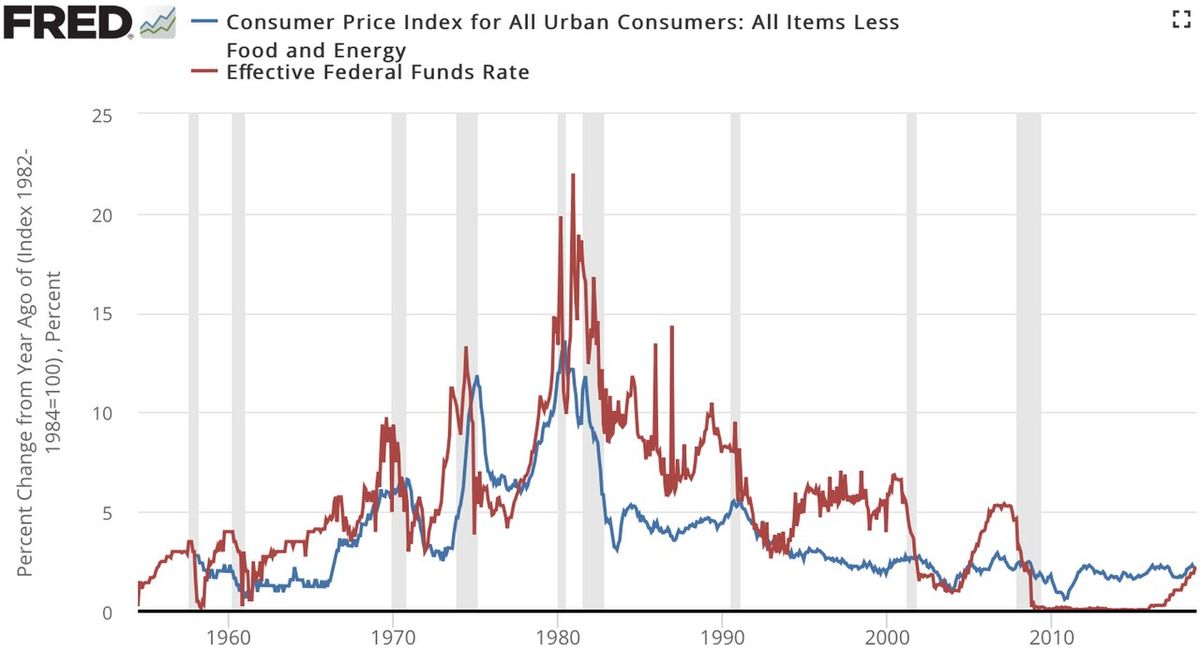
The federal funds rate has undergone significant cycles throughout its history, often in response to economic recessions or periods of high inflation. A notable cycle of rate increases occurred between January 2022 and July 2023, when the target range rose steadily from 0-0.25% to 5.25-5.50%. This was followed by over a year of stability at that peak. The Federal Reserve then began a cycle of easing monetary policy from September 2024 to December 2025, lowering the target range from 5.25-5.50% to 3.50–3.75%.
Market participants closely watch for signals of future FOMC actions. Prices of federal funds futures contracts traded on the Chicago Board of Trade are used to infer market expectations. Tools like the CME Group FedWatch tool calculate probabilities of upcoming rate changes based on these futures prices. Historical data shows the Fed often lowers the target rate ahead of or during recessions to stimulate economic activity, as seen before the 1990 to 1991, 2001, and 2008 downturns.
The last cycle of easing monetary policy through the federal funds rate was conducted from September 2024 to December 2025. During that period, the target rate fell from 5.25-5.50% to a range of 3.50–3.75%. The target rate remained at 5.25-5.50% for over a year prior to the easing cycle beginning in September 2024. Following the easing cycle, the rate was increased to 3.75–4.00% by September 2026. The Federal Open Market Committee sets the target range for the federal funds rate approximately eight times a year.
| Date | Target Range |
|---|---|
| Jul 26, 2023 | 5.25–5.50% |
| Sep 18, 2024 | 4.75–5.00% |
| Dec 18, 2024 | 4.25–4.50% |
| Sep 17, 2025 | 4.00–4.25% |
| Dec 10, 2025 | 3.50–3.75% |
| Sep 16, 2026 | 3.75–4.00% |
Comparison with Other Benchmark Rates
While the federal funds rate deals with interbank lending, it is distinct from other major benchmarks like LIBOR and SOFR. The target federal funds rate is set by the FOMC as a tool for U.S. monetary policy. The effective federal funds rate is the actual outcome of overnight transactions between banks. In contrast, the London Interbank Offered Rate was based on bank estimates of borrowing rates and was not set by a central bank for policy purposes. The Secured Overnight Financing Rate has emerged as a new benchmark based on transactions in the Treasury repurchase market. The federal funds rate is also different from the Bank of Canada's policy interest rate, though both are central bank tools.
The Canadian overnight rate is the interest rate at which major financial institutions borrow and lend one-day funds among themselves. The Bank of Canada sets a target for this rate to achieve its monetary policy goals, primarily to keep inflation within a target range of 1% to 3%. Both rates serve as the foundation for their respective countries' short-term interest rate structures. The federal funds rate influences a wide range of market interest rates in the U.S., while the Bank of Canada's policy rate influences rates on products like mortgages, business loans, and car loans in Canada.
Impact on the Canadian Economy and Monetary Policy
The federal funds rate exerts a powerful influence on the Canadian economy through international capital flows and currency markets. A high federal funds rate makes investments in the United States more attractive relative to those in other countries, potentially drawing capital away from markets like Canada. This can slow investment in Canadian businesses and assets. Conversely, a low federal funds rate can encourage investment in developing economies and higher-yielding markets, which can include Canada. The rate also affects the value of the Canadian dollar, as a higher U.S. rate can strengthen the U.S. dollar relative to the loonie.
The Bank of Canada operates its monetary policy independently but is keenly aware of the Federal Reserve's actions. Significant divergence between the two central banks' policy rates can lead to substantial currency movements and economic imbalances. As of September 2026, the Bank of Canada's policy rate was 2.25%, having been held steady for several announcements. This compares to a federal funds target range of 3.75-4.00% as of September 2026. The Bank of Canada adjusts its policy rate based on domestic conditions, with a focus on achieving its 2% inflation target, but it must weigh the impacts of cross-border monetary policy differences.
The Bank of Canada uses its own tools to steer the overnight rate to its target. It provides a standing facility where banks can deposit funds at the bank rate, setting a floor. It also acts as a lender of last resort. The Canadian overnight market functions similarly to the U.S. federal funds market, with banks lending surplus balances to each other to manage daily liquidity needs. The Bank of Canada's governing council, led by the Governor, assesses the policy rate eight times per year.

Effects on Canadian Consumers and Borrowers
Changes in the federal funds rate indirectly affect Canadian consumers through their impact on global financial conditions and the Bank of Canada's subsequent decisions. When the Bank of Canada changes its policy rate, it directly influences the prime rates set by Canadian lenders. This affects borrowing costs for products like variable-rate mortgages, home equity lines of credit, and some personal loans. For Canadians with a variable-rate mortgage, a decrease in the Bank of Canada's rate typically leads to a decrease in the lender's prime rate.
With many variable-rate mortgages featuring fixed payments, a rate cut means more of each payment goes toward the principal rather than interest, which can shorten the amortization period. For those with variable payments, the total monthly payment amount may shrink. Fixed-rate mortgages in Canada are primarily influenced by five-year Government of Canada bond yields, which are affected by longer-term expectations for monetary policy and inflation, not directly by a single policy rate change. However, a sustained shift in the Bank of Canada's rate path can influence these bond yields over time.
The Bank of Canada's rate decisions also influence housing affordability and the broader real estate market. Higher interest rates can cool housing demand by making mortgages more expensive, potentially slowing price growth. Lower rates can stimulate demand and support higher price levels. Consumers are advised to stress-test their finances against potential rate increases and stay informed about economic indicators and central bank announcements.
Key Risks and Current Debates
Central banks, including the Federal Reserve and the Bank of Canada, face several persistent risks and debates in setting interest rates. A primary challenge is balancing the fight against inflation with the need to support economic growth and employment. For example, in 2024 and 2025, the Fed and Bank of Canada cut rates in response to softening labour markets, even as some inflation metrics remained above target. The risk of cutting rates too quickly is that it could re-ignite inflationary pressures, while moving too slowly could unnecessarily weaken the economy.
External shocks present significant risks to the policy path. For Canada, a major risk is the ongoing trade war with the United States, which has weighed on exports, business investment, and the labour market. For the U.S., the implementation of tariffs has created uncertainty about future consumer price inflation. Geopolitical events, such as conflicts affecting global oil supplies, can cause sharp increases in energy prices, complicating inflation control. The Bank of Canada has noted that persistently high oil prices could necessitate consecutive rate increases.
Another debate centres on the neutral rate of interest, the level that neither stimulates nor restrains the economy. Estimates of this rate have shifted over time. As of late 2025, the Bank of Canada viewed its policy rate of 2.25% as being at the lower end of the neutral range. There is also ongoing discussion about the effectiveness of monetary policy tools at the effective lower bound, with some global central banks having experimented with negative interest rates in the past.
The Federal Reserve uses several tools to keep the effective federal funds rate within the FOMC's target range. Its primary tools are the interest rate paid on reserve balances and the overnight reverse repurchase agreement facility. The discount rate and open market operations are also key tools at the Fed's disposal. Market participants use prices from federal funds futures contracts traded on the Chicago Board of Trade to infer expectations of future Fed policy changes. The CME Group FedWatch tool uses these futures prices to show the probability of an upcoming Fed rate change.
- The Federal Reserve uses Interest on Reserve Balances as its primary tool for guiding the federal funds rate.
- The Bank of Canada has eight scheduled interest rate announcement dates per year.
- As of September 2026, the Bank of Canada's policy rate was 2.25%, with expectations for it to remain stable through 2026.
- Market expectations, as seen in interest rate swap markets, can price in future rate moves based on economic data.
- The inflation-control target for Canada is reviewed every five years, with the next review scheduled for 2026.
- The zero lower bound is no longer a strict limit, as evidenced by past negative rate policies in Europe and Japan.
Frequently asked questions
What is the federal funds rate?
The federal funds rate is the interest rate at which depository institutions lend reserve balances to other depository institutions overnight. These reserve balances are amounts held at the Federal Reserve. The rate is a key benchmark in financial markets and central to the conduct of monetary policy in the United States. The effective federal funds rate is the median interest rate of these overnight transactions from the previous business day.
How does the federal funds rate affect Canada?
The federal funds rate affects Canada through international investment flows and currency values. A higher U.S. rate can attract capital away from Canada, potentially slowing investment. It can also strengthen the U.S. dollar relative to the Canadian dollar. These cross-border effects are factors the Bank of Canada considers when setting its own policy interest rate.
What is the Bank of Canada's equivalent to the federal funds rate?
The Bank of Canada's equivalent policy instrument is its target for the overnight rate. This is the interest rate at which major financial institutions borrow and lend one-day funds among themselves. The Bank of Canada's policy interest rate was 2.25 percent as of September 2026. This rate is used by the central bank to keep inflation within its target range.
How often does the Federal Reserve change the federal funds rate?
The Federal Open Market Committee normally meets eight times a year to determine the federal funds target range. These meetings are typically about seven weeks apart. The committee can also hold additional meetings and implement target rate changes outside of its normal schedule. The target range is chosen to influence market interest rates and, ultimately, economic activity, employment, and inflation.
What happens when the Federal Reserve cuts rates?
When the Federal Reserve cuts the federal funds rate, it generally makes borrowing cheaper in the United States. This can lead to an influx of credit into the economy through various types of loans. A lower federal funds rate can also make investments in developing countries more attractive relative to U.S. investments. Furthermore, a lower rate can affect currency values, such as slowing the decrease of the U.S. dollar.
Does a Fed rate cut lower Canadian mortgage rates?
A Fed rate cut does not directly lower Canadian mortgage rates. Canadian mortgage rates are primarily influenced by the Bank of Canada's policy decisions and domestic bond yields. However, a significant Fed action can influence global financial conditions and expectations, which may indirectly affect the environment in which the Bank of Canada operates. Variable-rate mortgages in Canada are tied to lenders' prime rates, which move with the Bank of Canada's policy rate.
Sources and further reading
- Federal funds rate (Wikipedia) en.wikipedia.org
- The U.S. Federal Reserve and the Bank of Canada cut rates stories.td.com
- Interest rates bankofcanada.ca
- Bank of Canada interest rate update (September 2, 2026) rbcroyalbank.com
- Bank of Canada interest rate decisions theglobeandmail.com
- Current Bank of Canada Policy Interest Rate: 2.25% wowa.ca
This article explains how things work and is not financial, tax or legal advice. Rules, limits and rates change, so check the current figures with the Canada Revenue Agency, your province or your financial institution before you act.