The Bank of Canada's policy interest rate is currently 2.25% as of late 2026, holding steady after a period of higher rates. Most major Canadian bank economists forecast this rate to remain at 2.25% through the end of 2026, though financial markets are pricing in potential increases over the next year. The outlook for 2027 and beyond remains uncertain, heavily influenced by inflation trends, global energy prices, and economic growth. Understanding these forecasts is crucial for Canadians managing mortgages, renewals, and other debt as borrowing costs directly impact household budgets.
Current Interest Rate Environment and Key Benchmarks
Canada's interest rate environment is defined by two primary benchmarks that affect consumer borrowing costs. The Bank of Canada's policy interest rate, also known as the overnight rate, is the central tool of monetary policy and was set at 2.25% as of September 2, 2026, marking the seventh consecutive decision to hold. This rate influences the cost at which financial institutions lend to one another overnight and sets the tone for broader credit conditions. Lenders' prime rates, which are directly influenced by the Bank of Canada's policy rate, are currently 4.45% at most major Canadian banks, excluding any discounts offered on variable mortgage products. Variable-rate mortgages, home equity lines of credit (HELOCs), and other floating-rate loans are directly tied to changes in these prime rates, meaning any future Bank of Canada move would quickly affect these borrowing costs.
Fixed mortgage rates operate on a different mechanism, primarily influenced by the Government of Canada bond market rather than the central bank's policy decisions. The five-year Government of Canada bond yield is the key benchmark for pricing five-year fixed mortgages. As of late September 2026, this yield hit a 52-week high near 3.73%, prompting major banks to raise select fixed mortgage rates. This decoupling explains why fixed mortgage rates can rise even when the Bank of Canada holds its policy rate steady. The current spread between the policy rate and the five-year bond yield reflects market expectations for future inflation and economic growth, which are currently putting upward pressure on longer-term borrowing costs. The bond market is reacting to global inflationary pressures, including sustained energy prices and concerns over government debt levels.
Bank of Canada and Economist Forecasts for 2026
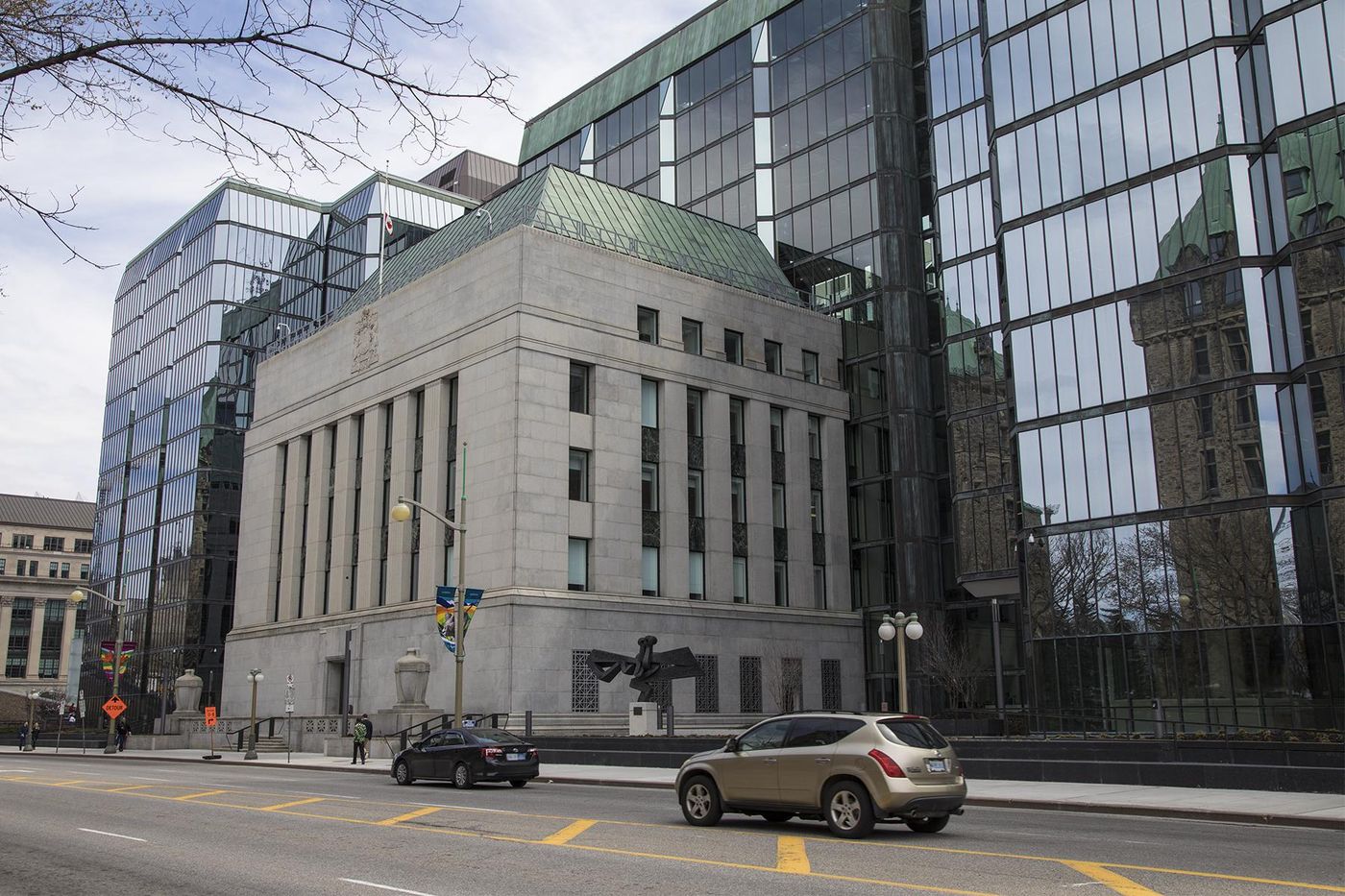
The consensus among economists at Canada's largest banks is for the Bank of Canada to maintain its current policy rate of 2.25% through the remainder of 2026. This forecast is based on an assessment of easing inflation pressures, a softening but resilient labour market, and moderate economic growth. Banks including BMO, CIBC, National Bank, RBC, and TD all project the policy rate to stay at 2.25% through year-end. Scotiabank presents a more hawkish view, expecting gradual rate increases to begin as early as July 2026 if inflation proves more persistent than anticipated. The Bank of Canada itself estimates the neutral rate range, where policy neither stimulates nor slows the economy, to be between 2.25% and 3.25%, placing the current rate at the lower end of that band.
Financial markets, however, are often a leading indicator and currently signal a different outlook. As of early October 2026, money markets were pricing in roughly 100 basis points of Bank of Canada rate increases over the following twelve months. Following a strong September jobs report released on October 9, 2026, markets assigned about a one-in-four probability of a quarter-point hike at the October 28, 2026 announcement. This divergence between economist forecasts and market pricing highlights the uncertainty in the outlook, driven by risks such as sustained energy price inflation and global trade disruptions. Governor Tiff Macklem has emphasized that future decisions remain data-dependent, leaving both rate cuts and hikes on the table depending on economic developments. The market-implied path from CORRA futures suggests rates will gradually move higher over the next few years.
Market-Based Forecasts Using CORRA Futures
Beyond economist surveys, financial markets provide a real-time, probabilistic forecast of future interest rates using derivative instruments. The Canadian Overnight Repo Rate Average (CORRA) is the benchmark for the overnight funding rate and closely tracks the Bank of Canada's target rate. Traded on the Montréal Exchange, CORRA Futures contracts allow market participants to hedge or speculate on the future path of interest rates. The prices of these contracts, specifically the Three-Month CORRA Futures (CRA), are used to derive market-implied forecasts for the Bank of Canada's policy rate. These forward curves are dynamic and change constantly as new economic data is released, providing a snapshot of collective market expectations.
The implied forecasts from these markets suggest the overnight rate is expected to remain near current levels through 2026 before gradually moving higher in the subsequent years. For example, the final settlement price for the September 2028 CORRA Futures contract (CRAU28) implies a rate of 3.695%, while the December 2028 contract (CRAZ28) implies 3.69%. These figures are significantly higher than the current 2.25% rate, indicating that markets anticipate a sustained period of higher borrowing costs in the medium to long term. This tool is comparable to the WIRP function on Bloomberg terminals which uses the Canadian Overnight Index Swap (OIS) curve. The methodology involves dividing each futures contract into periods between Bank of Canada announcement dates to isolate the impact of each potential decision, and the expected final settlement price is calculated based on the user-inputted Bank of Canada decision path.
Impact on Variable and Fixed Mortgage Rates
The forecast for variable mortgage rates is directly tied to the path of the Bank of Canada's policy rate. Since most major banks expect the overnight rate to hold at 2.25% through 2026, variable mortgage rates are also expected to remain relatively stable in the near term. As of June 2026, the lowest available five-year variable mortgage rate was 3.45%, which represents a discount of 100 basis points below the typical prime rate of 4.45%. Variable rates will only fall significantly if the Bank of Canada cuts its policy rate, an action not currently forecast by any major bank for 2026. Conversely, if inflation risks materialize and prompt the Bank to hike, variable mortgage costs would increase commensurately with the rise in lenders' prime rates, affecting monthly payments for holders of these loans.
Fixed mortgage rates follow a separate path dictated by the bond market. The five-year Government of Canada bond yield, which hit a 52-week high near 3.73% in late September 2026, is the primary driver. This yield has risen due to global inflationary pressures, including sustained energy prices and concerns over government debt levels. All Big Six banks have raised select fixed mortgage rates in response. The table below shows key interest rate benchmarks as of mid-2026 and their influence on mortgage products, based on data from TD Economics and other sources.
| Rate Benchmark | Approximate Value (Mid-2026) | Primary Influence |
|---|---|---|
| Bank of Canada Overnight Rate | 2.25% | Variable mortgage rates, HELOCs |
| Major Bank Prime Rate | 4.45% | Variable mortgage rates (benchmark) |
| 5-Year GoC Bond Yield | ~3.09% (TD Economics forecast) | 5-year fixed mortgage rates |
| 3-Month T-Bill Rate | ~2.31% (TD Economics forecast) | Short-term borrowing |
The Bank of Canada held its policy rate at 2.25 percent as of September 2, 2026, and variable mortgage rates are expected to stay where they are for the near term. Fixed mortgage rates, however, have already climbed as the five-year Government of Canada bond yield reached a 52-week high near 3.73 percent in late September 2026. This divergence means borrowers face a choice between a stable variable rate or a higher fixed rate. The decision hinges on a borrower's risk tolerance and view on the direction of the economy.
Economic Data Influencing the Rate Outlook
The Bank of Canada's decisions are data-dependent, focusing on key indicators of inflation, growth, and the labour market. Headline inflation in September 2026 was reported at 3.1%, driven primarily by higher oil and fuel prices, placing it above the Bank's preferred target range of 1% to 3%. While some core measures showed a year-over-year dip, the Bank's preferred three-month annualized core rate rose from 2.3% in August to 2.6% in September. Furthermore, surveys indicate that business and consumer inflation expectations are rising, suggesting a perception that higher prices may persist. These factors are inflationary and increase the likelihood of future rate hikes to anchor expectations and nudge inflation back toward target, as Governor Macklem has indicated the Bank will act if inflation does not look likely to come down on its own.
On the growth front, the Canadian economy showed surprising strength in the second quarter of 2026, with real GDP growing at an annualized rate of 3.3%, the fastest pace in over three years. This was driven by a rebound in auto exports, a rise in business investment, and increased residential investment. However, momentum appeared to fade by late summer, with preliminary estimates suggesting modest growth in August 2026. The external position also strengthened, with the current account swinging to an $8.8 billion surplus in Q2 2026, supported by record energy and auto exports. A strong economy can absorb higher interest rates, but if growth slows significantly while inflation remains high, it could create a challenging stagflationary scenario for policymakers where they feel compelled to raise rates even as the economy weakens.
Renewal Impact and Mortgage Holder Stress
A significant number of Canadian mortgage holders are facing renewal in a much higher interest rate environment than when they originally secured their loans. By the end of 2026, approximately 33% of mortgage holders are expected to face higher monthly payments. For those renewing a five-year fixed-rate mortgage, which constitutes about 75% of borrowers facing an increase, payment hikes are expected to average around 20%. This reflects the stark transition from the ultra-low pandemic-era rates to today's higher borrowing costs. The stress from these renewals is beginning to manifest in financial data, with implications for household budgets and the broader economy, as the total dollar value of mortgage interest paid by households rises.
Data from Equifax Canada for the second quarter of 2026 shows severe mortgage delinquency rates (90 or more days past due) rising significantly. Delinquencies reached 0.30% of mortgage balances, up 33.8% from a year earlier, and 0.23% of accounts, up 17.5%. Ontario and British Columbia were noted as outliers, with missed payments on non-mortgage debt among Ontario mortgage holders rising 27% by balance. Equifax also reported that insolvencies had reached their highest rate since 2009, with a sharp increase among homeowners. The outcomes for variable-rate mortgage holders at renewal vary widely. Roughly 10% are projected to see payments rise by more than 40%, while about 25% could see payments fall by at least 7%, largely depending on whether they experienced negative amortization during the rate-hike cycle or kept their payments level to cover principal and interest.
Key Factors That Could Alter the Forecast
The interest rate forecast is subject to change based on several volatile domestic and global factors. The Bank of Canada has outlined specific conditions that could prompt a shift in policy. The central bank may consider raising interest rates if inflation remains persistently above the 1-3% target band, if inflation expectations become unanchored and rise significantly, or if demand in the economy continues to exceed supply, creating sustained inflationary pressure. Global events, particularly those affecting energy markets, pose a major risk. The ongoing Middle East conflict and its effect on oil supplies could keep energy prices high for an extended period, feeding into broader inflation and forcing the Bank's hand.
Conversely, the Bank of Canada may consider cutting interest rates under different circumstances. A significant weakening in the Canadian economy, leading to a substantial rise in the unemployment rate, would be a primary trigger. A faster-than-expected decline in inflation back toward the 2% target midpoint could also open the door for rate cuts. Additionally, a major escalation in the U.S.-Canada trade war that severely damages economic growth could force the Bank's hand, even if inflation remains somewhat high. The following list details specific data points and events that analysts monitor closely for signs of a shift in the interest rate trajectory, as these are the variables that drive the Bank of Canada's data-dependent approach.
- Monthly Consumer Price Index (CPI) reports, especially core inflation measures.
- Employment data, including the unemployment rate and wage growth.
- Gross Domestic Product (GDP) growth figures and business investment indicators.
- Global oil prices and geopolitical developments affecting energy supply.
- U.S. Federal Reserve policy decisions and U.S. economic data.
- U.S.-Canada trade relations and tariff announcements.
- Government of Canada bond yield movements, particularly the 5-year yield.
- Consumer and business sentiment surveys regarding inflation expectations.
The mortgage rate outlook for the rest of 2026 depends on whether energy-driven inflation spreads into everyday prices. It also depends on how the Bank of Canada weighs that inflation against slower economic growth. Most economists at Canada's largest banks expect the policy rate to hold through the end of 2026. The forecast remains inherently uncertain, and borrowers are advised to prepare for potential volatility in borrowing costs.
Frequently asked questions
What is the Bank of Canada interest rate forecast for 2026?
Most major Canadian bank economists forecast the Bank of Canada's policy rate to remain at 2.25% through the end of 2026. Banks including RBC, TD, BMO, CIBC, and National Bank share this view. Scotiabank expects a slightly higher path, with gradual increases potentially starting in the latter half of the year if inflation persists. Financial markets, however, are more aggressive, pricing in about 100 basis points of hikes over the next twelve months as of early October 2026.
When is the next Bank of Canada interest rate announcement?
The next scheduled Bank of Canada interest rate announcement is on October 28, 2026. The central bank typically makes eight scheduled announcements per year, and this upcoming decision is critical for borrowers. As of early October 2026, money markets were pricing in about a one in four chance of a quarter point hike at this meeting. Most bank economists, however, still expect the first increase to occur in 2027. The Bank's decision will directly affect lenders' prime rates, which in turn influence variable mortgage rates, lines of credit, and other floating rate products.
What is the neutral interest rate in Canada?
The Bank of Canada currently estimates Canada's neutral interest rate range to be between 2.25 percent and 3.25 percent. The neutral rate is the theoretical level that neither stimulates nor slows down the economy. With the overnight rate at 2.25 percent as of September 2026, the Bank is at the lower end of this estimated neutral range. This positioning means the central bank has limited room to cut rates further unless the economy weakens more than expected. Consequently, borrowing costs are unlikely to return to the ultra low levels seen during the pandemic era.
Will fixed or variable mortgage rates go down in 2026?
Variable mortgage rates are not expected to fall significantly in 2026 unless the Bank of Canada cuts its overnight rate. Most major banks forecast the policy rate to hold at 2.25 percent through year end, suggesting variable rates will remain stable. Conversely, fixed mortgage rates have already risen because they follow bond yields, not the policy rate. The five year Government of Canada bond yield, which sets fixed mortgage pricing, hit a 52 week high near 3.73 percent in late September 2026. This increase has prompted all Big Six banks to raise select fixed rates, meaning fixed mortgage costs are under upward pressure.
How many Canadians will see higher mortgage payments at renewal?
By the end of 2026, approximately 33 percent of Canadian mortgage holders are expected to face higher monthly mortgage payments. About 75 percent of those facing an increase have five year fixed rate mortgages. For these borrowers, payment increases at renewal are expected to average around 20 percent, reflecting the shift from pandemic era lows to current higher rates. The experience varies for variable rate borrowers. About 10 percent could see payments rise by over 40 percent, while roughly 25 percent might see payments fall by at least 7 percent, depending on how they managed payments during the prior tightening cycle.
What economic data does the Bank of Canada watch most closely?
The Bank of Canada closely monitors inflation data, aiming to keep it within a 1 to 3 percent target range. In September 2026, headline inflation was 3.1 percent, driven by higher oil prices and officially above target. The Bank also watches core inflation measures, employment figures, and GDP growth. For instance, real GDP grew at an annualized 3.3 percent in the second quarter of 2026 before momentum faded. Internationally, global energy prices and geopolitical events that affect inflation are critical, as sustained energy prices pose a risk of inflation spreading into everyday prices.
Sources and further reading
- Mortgage Rate Forecast (2026 to 2030) truenorthmortgage.ca
- Latest Forecast Tables, TD Economics economics.td.com
- Mortgage Rates Forecast Canada 2026 to 2030 nesto.ca
- Canada Interest Rate Forecast (2026 to 2030) ratehub.ca
- Canadian Interest Rate Expectations Tool m-x.ca
This article explains how things work and is not financial, tax or legal advice. Rules, limits and rates change, so check the current figures with the Canada Revenue Agency, your province or your financial institution before you act.