The Lightning Network is a second-layer payment protocol built on top of the Bitcoin blockchain. It is designed to enable fast, low-cost, and private transactions by moving them off the main blockchain. For Canadian users, this addresses Bitcoin's scalability limitations, making micropayments like buying coffee practical by reducing fees and confirmation times. The network operates through a decentralized system of bidirectional payment channels and nodes.
What is the Lightning Network?
The Lightning Network is a second-layer payment protocol built on the Bitcoin blockchain, intended to solve the bitcoin scalability problem. It operates as an overlay network, conducting transactions off-chain while using the Bitcoin blockchain as a final settlement layer. This design allows for a significant increase in transaction throughput compared to the base layer, which is limited to around 7 transactions per second. The network's core purpose is to enable fast, cheap, and private peer-to-peer Bitcoin payments, reviving Bitcoin's original vision as an electronic cash system for everyday use. By moving the majority of transactions off the main chain, it aims to reduce congestion and high fees, particularly for small, frequent payments. The network is a decentralized system using the smart contract functionality inherent in Bitcoin's blockchain to enable instant payments across a network of participants without requiring trust in third-party custodians.
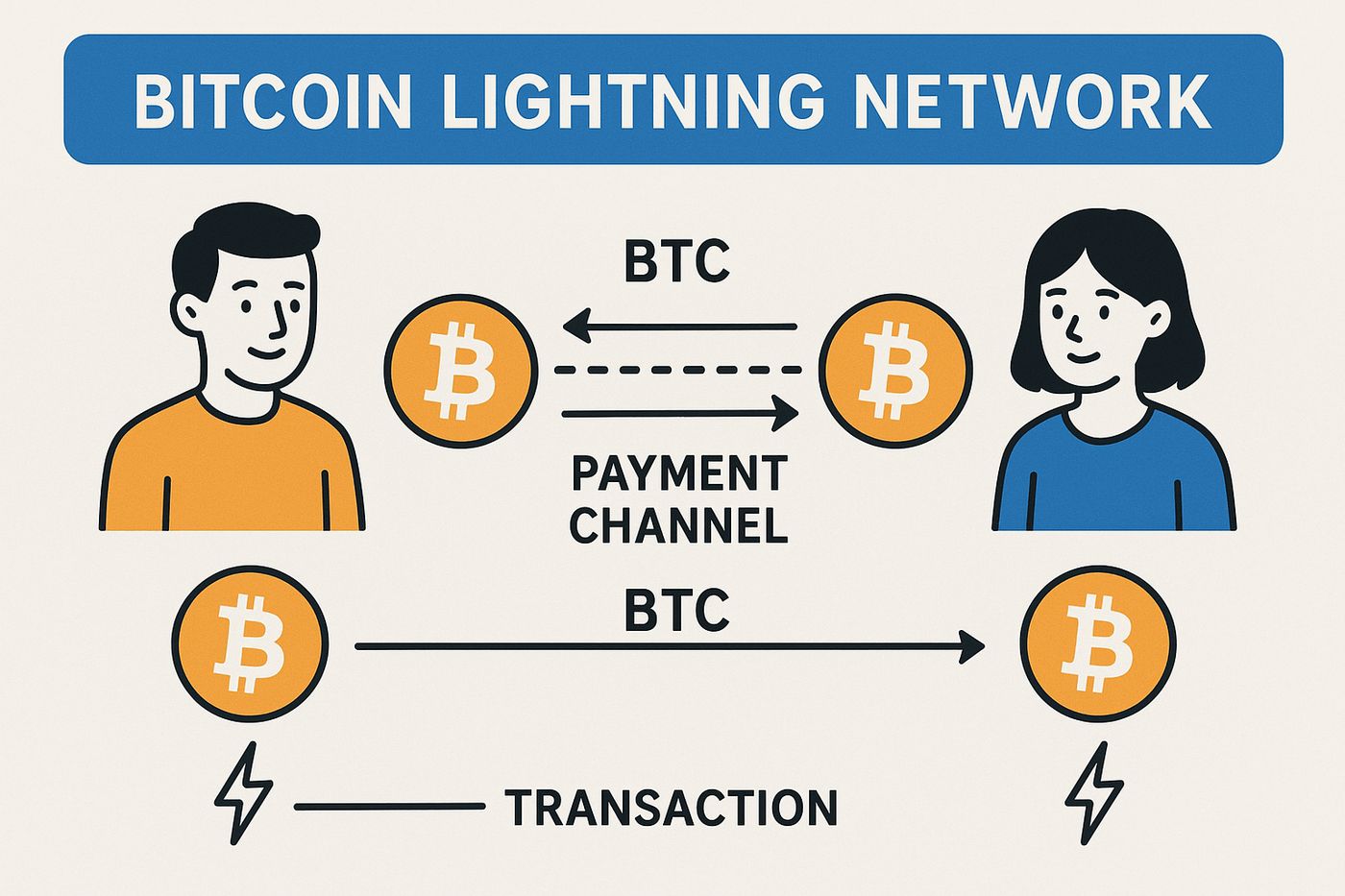
How the Lightning Network Works
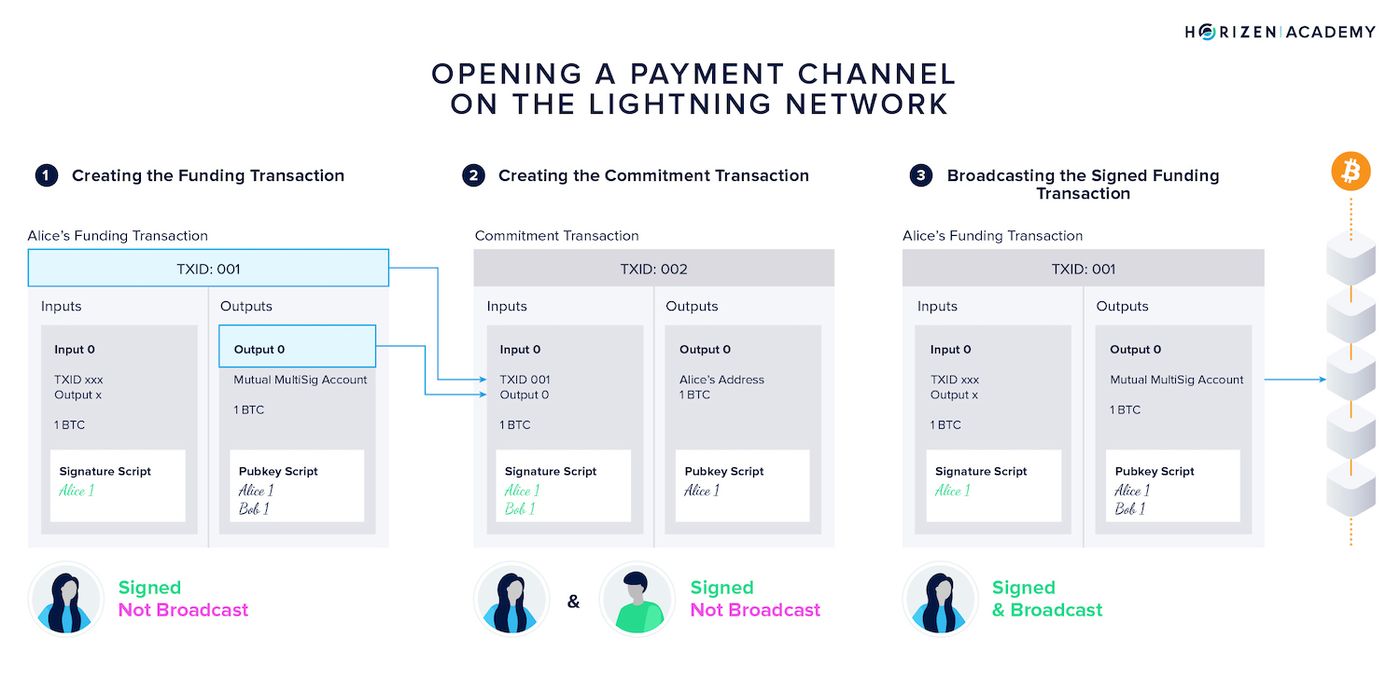
The network is built around the concept of bidirectional payment channels between two participants, often called Lightning nodes. To open a channel, the participants create and broadcast a funding transaction on the Bitcoin blockchain, locking an amount of bitcoin into a 2-of-2 multi-signature address. This transaction requires both parties' signatures to spend the funds and is secured by penalizing uncooperative participants using time-based script extensions like CheckSequenceVerify and CheckLockTimeVerify. Once this channel is open and confirmed on-chain, the two parties can conduct an unlimited number of off-chain transactions between themselves. These transactions are not broadcast to the Bitcoin network but are instead private updates to the balance held within the shared channel, similar to updating a contract where the total locked amount remains constant but the internal allocation changes.
Each off-chain payment involves the participants creating and signing new commitment transactions. These transactions represent the latest agreed-upon balance within the channel and can be broadcast to the Bitcoin blockchain to close the channel if necessary. The process is similar to updating a contract. The total amount locked in the channel remains the same, but the internal allocation between the two parties changes with each payment. When the participants are finished transacting, they cooperatively close the channel by broadcasting a final settlement transaction to the Bitcoin blockchain, which distributes the final balances to their individual wallets. This design means only two on-chain transactions are required to open and close a channel, regardless of how many payments were made in between, which is the fundamental mechanism for scaling transaction throughput.
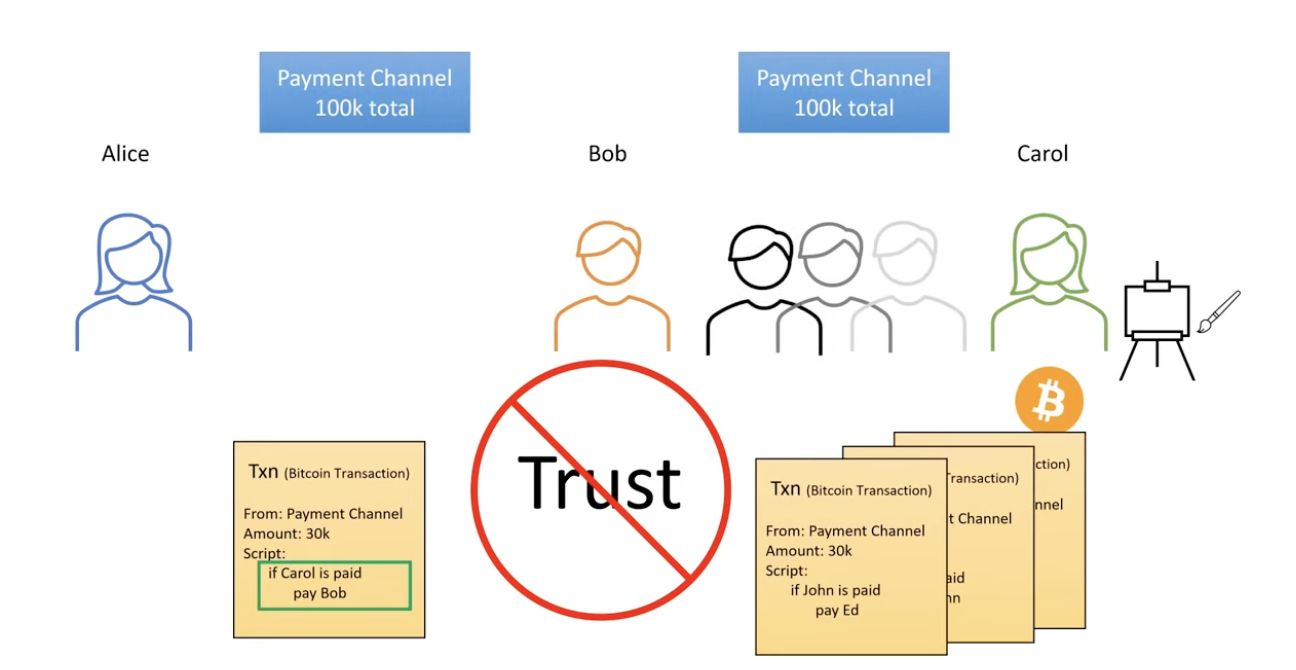
The network scales through routing. If Alice wants to pay Carol but does not have a direct payment channel with her, the payment can be routed through intermediary nodes, such as Bob, who has channels open with both parties. The network uses an onion routing protocol to preserve privacy, where each node in the path only knows the immediate previous and next hop, not the full origin or destination of the payment. The payment's success is enforced by smart contract scripts that ensure atomicity, meaning the entire payment either succeeds completely or fails across all hops, preventing loss of funds. This routing capability allows the network to function like a large interconnected hive, enabling payments between any connected parties without requiring a direct channel between every single user.
History and Development
The concept for the Lightning Network was first detailed in a white paper published by Joseph Poon and Thaddeus Dryja in February 2015. The protocol was launched in 2018 by Lightning Labs with the goal of reducing the cost and time required for cryptocurrency transactions, specifically addressing Bitcoin's limit of around 7 transactions per second compared to traditional systems like Visa. Development is driven by several independent teams, resulting in multiple software implementations. The three major implementations are Lightning Network Daemon (LND) by Lightning Labs, Core Lightning (CLN) by Blockstream, and Eclair by ACINQ. A fourth implementation library, the Lightning Development Kit (LDK), is maintained by Spiral, a subsidiary of Block, Inc.
A notable early promotional event for the network began on January 19, 2019, when a pseudonymous Twitter user named hodlonaut started the 'lightning torch.' This was a game-like test where a payment of 100,000 satoshis was passed from one trusted recipient to another, with each adding 10,000 satoshis before sending it on. The torch payment passed through the wallets of notable figures in the cryptocurrency space, including former Twitter CEO Jack Dorsey, Litecoin creator Charlie Lee, Lightning Labs CEO Elizabeth Stark, and Binance CEO Changpeng Zhao. Despite initial enthusiasm, reports on social media of failed transactions, security vulnerabilities, and over-complication led to some decline in interest after the launch period. The development of the network represents the outcome of the 2017 'Block Size War,' where part of the Bitcoin community advocated for this off-chain scaling solution instead of increasing the block size limit on the main chain.
Benefits and Advantages
The Lightning Network offers several key advantages over standard on-chain Bitcoin transactions. The primary benefit is transaction speed, with settlements occurring in milliseconds to seconds, compared to the average ten-minute block confirmation time on the base Bitcoin layer. This enables true instant payments without waiting for blockchain confirmations, which is optimal for retail scenarios like buying coffee. Another major advantage is low cost, as conducting transactions off-chain allows for exceptionally low fees, making micropayments economically viable and enabling new use cases such as pay-per-click or pay-per-action models. The network also provides enhanced privacy for payments. While individual node operators can see transactions passing through their direct channels, the onion routing protocol obscures the full payment path, so non-adjacent nodes cannot identify the source or final destination.
Scalability is a fundamental design goal. The protocol has no inherent limit on transactions per second, as capacity is only constrained by the speed and capacity of individual nodes, theoretically allowing for millions to billions of transactions per second across the entire network, which blows away legacy payment rails by many orders of magnitude. Some implementations allow for payments denominated in amounts smaller than a single satoshi, the smallest unit of bitcoin, enabling extreme granularity. The network also enables cross-blockchain atomic swaps, allowing for trustless trades between different cryptocurrencies that support the same cryptographic hash functions, all conducted off-chain instantly. This system allows users to maintain full control and self-custody of their funds, adhering to Bitcoin's original principles while solving its scalability challenges.
Limitations, Risks, and Debates
While powerful, the Lightning Network has limitations and associated risks. Its operation is dependent on on-chain transactions to open and close payment channels, which introduces a scalability constraint tied to Bitcoin's base layer capacity and fees. This necessity means the network cannot completely decouple from the underlying blockchain's limitations. Users must have bitcoin on-chain before they can fund a Lightning channel, and the opening transaction competes for block space during periods of high congestion. A significant operational complexity is the need for nodes to manage channel liquidity. To receive funds, a node must have inbound capacity, which requires other participants to lock funds on their side of the channel. This can complicate the user experience and requires active network participation or the use of liquidity services.
Security models differ from on-chain Bitcoin. While the underlying smart contracts are designed to penalize uncooperative behaviour using time-locks and penalty transactions, there are risks if a node goes offline or acts maliciously. If a channel counterparty disappears or attempts to broadcast an outdated channel state, the other party must be vigilant to claim their funds using a penalty transaction within a specific time window. This introduces a requirement for constant monitoring or the use of a watchtower service to watch the blockchain for fraudulent closure attempts. The network also faces routing challenges. A payment may fail if there is no path with sufficient liquidity between sender and receiver, though this improves as the network grows and more channels are established. Debates within the community have historically centred on whether scaling solutions should focus on layer-two protocols like Lightning or on increasing the base layer block size, a conflict known as the Block Size War in 2017 which caused a major split among Bitcoin users.
Using the Lightning Network in Canada
For Canadian users, accessing the Lightning Network starts with choosing a compatible wallet. Several non-custodial and custodial wallets offer support, including Phoenix, Muun, Zeus, Breez, Strike, and Cash App. These wallets are typically available for download on mobile app stores like the App Store or Google Play Store. To begin transacting, users must first move bitcoin from the base blockchain (layer 1) onto the Lightning Network (layer 2). This process, often called creating inbound liquidity, usually involves opening a channel, which can be done directly through some wallets or via exchanges like Bitfinex, ZigZag, or Boltz that offer Lightning services. Some wallets like Muun simplify this by allowing users to send on-chain BTC to their wallet and use it directly for Lightning payments, handling the channel management automatically in the background.
Making a payment requires the recipient to generate a payment request, typically in the form of a QR code or a Lightning invoice, which is a long string of characters similar to a Bitcoin address. The sender scans the QR code or copies the invoice into their wallet to authorize the payment. The transaction is then routed and settled nearly instantly. Canadians can use the network for both peer-to-peer transfers and to pay merchants. While adoption in Canadian brick-and-mortar businesses is still emerging, it is being used by some businesses in the United States like Steak N Shake and on some Square terminals, indicating a path for future Canadian merchant adoption. Online services like Bitrefill allow users to test payments by purchasing gift cards. The first step for any Canadian is to download a Lightning wallet, acquire some bitcoin, and follow the simple steps to begin transacting on this globally established network.
Network Statistics and Growth
The Lightning Network has shown consistent growth in key metrics since its launch. These metrics provide a snapshot of the network's health, capacity, and decentralization. The total amount of bitcoin locked in public payment channels represents the network's liquidity available for routing payments. The number of public nodes indicates the level of decentralization and the potential routing paths available. It is important to note that these figures only represent the public network. Many private channels and nodes exist but are not included in these statistics, meaning the actual usage and capacity are likely higher.
| Metric | Figure (as of March 2026) |
|---|---|
| Total Network Capacity | Approximately 4,900 BTC |
| Number of Public Nodes | Over 17,000 |
| Number of Public Channels | Approximately 40,000 |
The growth in these figures demonstrates increasing adoption and capital commitment to the network. The capacity of nearly 4,900 BTC represents a significant sum of value available for instant transfer. The over 17,000 public nodes contribute to the network's resilience and decentralized routing capabilities, forming the backbone of the peer-to-peer payment system. As the network continues to develop, these metrics are closely watched by users and developers as indicators of its utility and stability for handling payments ranging from micropayments to larger transactions.
Key Technical Components and Concepts
The Lightning Network relies on several core Bitcoin technologies and novel concepts to function. The foundational element is the bidirectional payment channel, which is a ledger entry on the blockchain requiring both participants to sign any spending. The smart contract scripting language of Bitcoin is used to create scripts that enforce the rules of the channel, such as time-locks and penalty conditions. Time-based script extensions like CheckSequenceVerify (CSV) and CheckLockTimeVerify (CLTV) are crucial as they make the penalty mechanisms possible, allowing a cheated party time to claim funds if their counterparty broadcasts an old state.
The network employs an onion routing protocol for privacy and security during payment routing. In this system, the payment is wrapped in layers of encryption, and each node in the path decrypts only enough information to determine the next hop, without knowledge of the full path, source, or final destination. The atomicity of multi-hop payments is enforced by Hashed Timelock Contracts (HTLCs), which ensure that either all steps of a payment succeed or the entire payment fails, preventing loss of funds mid-route. The blockchain acts as a final arbiter and court system, only needed in cases of dispute or channel closure, similar to how legal contracts are only brought to court in the event of non-cooperation.
Frequently asked questions
What is the Bitcoin Lightning Network?
The Bitcoin Lightning Network is a second-layer payment protocol built on top of the Bitcoin blockchain. It is designed to enable fast, cheap, and secure off-chain transactions by creating a network of bidirectional payment channels. This addresses Bitcoin's scalability problem by moving numerous small transactions off the main chain, settling only the final results on-chain. It is intended to make peer-to-peer electronic cash payments practical again for everyday use.
How does the Lightning Network work?
Two parties open a payment channel by locking bitcoin into a shared, multi-signature address on the Bitcoin blockchain. They can then make unlimited instant payments between themselves by privately updating the balance within that channel using signed commitment transactions. For payments between parties without a direct channel, the network routes payments through interconnected nodes using an onion routing protocol for privacy. Only the opening and closing transactions are recorded on the main Bitcoin blockchain, with all intermediate payments occurring off-chain.
Is the Lightning Network safe to use?
The Lightning Network uses Bitcoin's smart contract functionality to enforce security, with mechanisms to penalize participants who try to cheat. It introduces different risks than on chain Bitcoin, such as the need for nodes to stay online to monitor for fraud. Using well audited wallet software is crucial for safety. Users should also understand the concept of watchtowers for monitoring channels when offline.
What are the main benefits of the Lightning Network?
The key benefits are speed, with payments settling in milliseconds, and very low fees, enabling micropayments. It offers improved privacy through onion routing and high scalability with no fundamental limit on transactions per second. The network allows for granular payments smaller than a satoshi. It also enables cross chain atomic swaps for trading different cryptocurrencies without a custodian.
How do I start using the Lightning Network in Canada?
To start using the Lightning Network in Canada, download a compatible wallet such as Phoenix, Muun, or Breez. You will need to fund the wallet with bitcoin, which may involve moving bitcoin from an exchange onto the Lightning Network. Some wallets automate the channel opening process. Once funded, you can pay by scanning a recipient's Lightning invoice QR code or pasting an invoice string into your wallet.
What are the downsides or risks of the Lightning Network?
Limitations include dependency on on-chain transactions to open and close channels, which can be slow and expensive during Bitcoin network congestion. Users must manage channel liquidity, ensuring they have both inbound and outbound capacity, which adds complexity. There is also complexity in running a node securely, requiring vigilance against fraudulent channel closures, though watchtower services can help mitigate this. Routing failures can occur if a path with sufficient liquidity cannot be found between sender and receiver.
Sources and further reading
- Lightning Network (Wikipedia) en.wikipedia.org
- Understand how the Lightning Network works bitstack-app.com
- Lightning Network lightning.network
- How does the Bitcoin Lightning network actually work? blog.bitbox.swiss
- How to Make Bitcoin Lightning Network Payments? ulam.io
- Bitcoin Lightning Network Explained calebandbrown.com
This article explains how things work and is not financial, tax or legal advice. Rules, limits and rates change, so check the current figures with the Canada Revenue Agency, your province or your financial institution before you act.