James Harris Simons was an American hedge fund manager, investor, mathematician, and philanthropist. He was the founder of Renaissance Technologies, a quantitative hedge fund based in East Setauket, New York. He and his fund are known as quantitative investors who use mathematical models and algorithms to make investment gains. Due to the long-term returns of Renaissance and its Medallion Fund, Simons was called the greatest investor on Wall Street and the most successful hedge fund manager of all time.
From Mathematician to Codebreaker
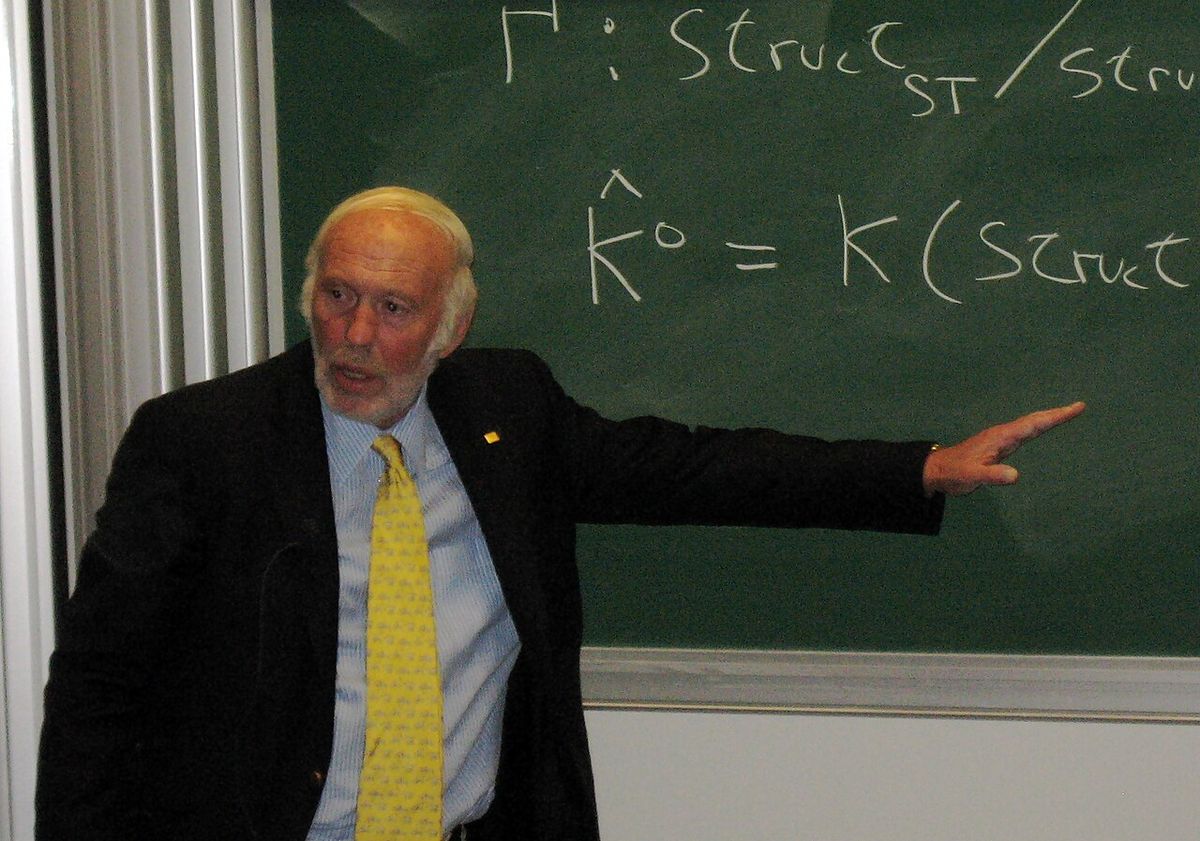
James Simons displayed prodigious talent in mathematics from a young age, completing his bachelor's degree at MIT in three years and earning his PhD from UC Berkeley at the age of 23. His doctoral thesis provided a new proof related to the classification of holonomy groups in Riemannian geometry. Following his graduation, Simons began a career that blended academia, government work, and early entrepreneurial ventures. From 1964 to 1968, he worked as a codebreaker for the National Security Agency and the Institute for Defense Analysis's Communications Research Division. During this period, he also taught mathematics at both MIT and Harvard University. His public opposition to the Vietnam War led to his departure from the IDA, after which he joined the faculty at Stony Brook University, chairing its mathematics department from 1968 to 1978. In 1973, IBM asked Simons to attack the block cipher Lucifer, an early precursor to the Data Encryption Standard. Simons's early attempt at a trading venture, a company named iStar started with colleagues including Richard Leibler, was discovered by management and failed.
Founding Renaissance Technologies
He gradually developed the conviction that mathematical models could be constructed from collected financial data to predict market movements. To execute this vision, Simons hired fellow mathematicians and scientists, including Leonard E. Baum and James Ax, who had no traditional finance backgrounds. The firm's unique approach was fully realized with the establishment of the Medallion Fund in 1988. Renaissance Technologies operates as a quantitative hedge fund, meaning it uses mathematical and statistical models, rather than fundamental analysis or human intuition, to make investment decisions. The firm's headquarters in East Setauket, New York, became a hub for PhD-level researchers in fields like physics, astronomy, and speech recognition, all applying their skills to find patterns and inefficiencies in market data. Simons officially retired as CEO on January 1, 2010, but remained as the firm's nonexecutive chairman.
The Medallion Fund and Its Historic Performance
The Medallion Fund is the most successful product of Renaissance Technologies and the source of its renown. The fund has been closed to outside investors for many years, available exclusively to current and past employees of the firm and their families. Since its inception in 1988, the Medallion Fund has earned over $100 billion in trading profits. Its performance metrics are the highest documented in modern finance, with an average gross annual return of 66.1% and an average net annual return of 39.1% for the thirty-year period between 1988 and 2018. This performance dramatically outpaced the returns of other legendary investors and firms during the same period. The fund's success was notably resilient even during market downturns, such as in 2008 when it surged approximately 80% while many other funds suffered heavy losses. Renaissance Technologies also manages other funds open to institutional and outside investors, which have performed well but not at the same extraordinary level as Medallion. As of April 2019, these funds included the Renaissance Institutional Equities Fund (RIEF), Renaissance Institutional Diversified Alpha (RIDA), and Renaissance Institutional Diversified Global Equity Fund, which together managed approximately $55 billion in assets. The performance gap between the employee-only Medallion Fund and the externally-focused funds like RIEF, which declined 16% in 2008 and also lost money in 2009, became a point of discussion and scrutiny among investors.

Scientific Contributions and Academic Legacy
Beyond finance, James Simons made lasting contributions to mathematics and theoretical physics. His most famous scientific work was conducted with mathematician Shiing-Shen Chern, resulting in the discovery of the Chern, Simons form, a topological invariant of 3-manifolds. This work later found crucial applications in theoretical physics, particularly in the development of topological quantum field theory and its connections to string theory. For these contributions to geometry and topology, Simons received the American Mathematical Society's prestigious Oswald Veblen Prize in Geometry in 1976. He was elected to the U.S. National Academy of Sciences in 2014. His academic legacy is also cemented through his philanthropic foundation's massive support for research institutes. The International Astronomical Union named asteroid 6618 Jimsimons in his honour in 2016. Simons was awarded honorary doctorates by York University in 2016 and Trinity College Dublin in 2018, indicating the international recognition of his scientific and philanthropic work.
Philanthropy Through the Simons Foundation
In 1994, James Simons and his wife, Marilyn Hawrys Simons, founded the Simons Foundation, a charitable organization that became their primary vehicle for philanthropic giving. Simons gave over $4 billion to philanthropic causes during his lifetime. The foundation's mission is to advance research in mathematics and the basic sciences. It established several major initiatives, including the Simons Foundation Autism Research Initiative (SFARI) in 2003, dedicated to understanding autism spectrum disorders. A significant portion of the foundation's giving was directed toward education, exemplified by Simons founding Math for America in 2004 with an initial $25 million pledge to improve mathematics education in U.S. public schools, a pledge he doubled to $50 million in 2006. The Simons Foundation became the top benefactor of Stony Brook University, Marilyn Simons's alma mater, and a major contributor to Simons's own alma maters, MIT and UC Berkeley. The foundation funded the renovation of the building housing the MIT mathematics department, which was named in their honour in 2016, and endowed the Simons Center for the Social Brain. In memory of his son Paul, Simons established the 130-acre Avalon Nature Preserve in Stony Brook, which was extended to 216 acres in 2024. Following the death of his son Nicholas in Nepal, the Simonses became large donors to Nepalese healthcare through the Nick Simons Institute.
- 2006: Donated $25 million to Stony Brook University, then the largest gift to a State University of New York school.
- 2008: The foundation gave $60 million to found the Simons Center for Geometry and Physics at Stony Brook, the largest gift to a public university in New York state history at the time.
- 2011: The couple donated $150 million to Stony Brook for medical sciences, a new life sciences building, and endowed professorships.
- 2012: Pledged $60 million to UC Berkeley to establish the Simons Institute for the Theory of Computing.
- 2016: Established the Flatiron Institute, a computational science research center with five core departments.
- 2020: The foundation made separate grants totaling over $46 million to UC Berkeley to support the Simons Institute.
- 2023: Gave a $500 million endowment gift to Stony Brook University, the second-largest donation to a public university in U.S. history.

Controversies and Tax Disputes
Despite its success, Renaissance Technologies and Jim Simons faced significant controversies, primarily related to taxation. In July 2014, Simons was the subject of a bipartisan condemnation by the U.S. Senate Permanent Subcommittee on Investigations. The committee alleged that Renaissance used complex financial instruments known as basket options to disguise its frequent, short-term stock trading as long-term investments, which are taxed at a lower rate. Senator John McCain stated the practice allowed Renaissance to avoid paying more than $6 billion in taxes. The New York Times reported in 2015 that the Internal Revenue Service was reviewing the loophole, which was estimated to have saved the fund approximately $6.8 billion in taxes over a decade. In September 2021, it was announced that Simons and his colleagues would pay billions of dollars in back taxes, interest, and penalties to resolve the dispute, marking one of the largest settlements in IRS history. This tax strategy was a focal point for critics who questioned the fairness of the fund's operations despite its market success.
Personal Life, Wealth, and Death
James Simons was known for his private nature, famously shunning publicity and rarely giving interviews. He once cited Benjamin the Donkey from Animal Farm, saying he would rather have no tail and no flies, to describe his feelings about publicity. He was married twice and had five children. His family endured profound tragedy with the deaths of two sons: Paul Simons died in a car accident in 1996 at age 34, and Nicholas Simons drowned in Bali in 2003 at age 24. His three surviving children, Liz, Nathaniel, and Audrey Simons, each run their own charitable foundations: the Heising-Simons Foundation, the Sea Change Foundation, and the Foundation For A Just Society. Simons's personal wealth grew enormously through his firm's success. He was consistently ranked among the world's richest people, with a net worth estimated at $31.4 billion at the time of his death in May 2024, placing him 55th on Forbes's list of the world's billionaires. In previous years, his net worth was $30 billion in 2023, $21.6 billion in 2019, and he personally earned $2.6 billion in 2020. Politically, Simons was a major donor to Democratic Party causes and candidates, contributing millions to federal campaigns over the years. He donated $7 million to Hillary Clinton's Priorities USA Action in 2016 and $1.5 million to the Senate Majority PAC in 2020. James Simons died peacefully in New York City on May 10, 2024, at the age of 86. He was active in the work of his foundation until the end of his life.
Renaissance Technologies' Strategy and Canadian Context
Renaissance Technologies manages a multi-billion dollar public equity portfolio, filed quarterly with the U.S. Securities and Exchange Commission as a 13F report. The firm's investment strategy is fundamentally quantitative, determining investments based on mathematical models that identify market inefficiencies. Its approach does not involve analyzing company fundamentals like revenues or profits, and its traders likely cannot list the specific stocks they own at any given moment due to the automated, model-driven nature of the trading. For Canadian investors and finance professionals, the story of Renaissance Technologies is a powerful case study in quantitative finance, algorithmic trading, and the application of advanced mathematical and scientific research to capital markets. The firm's success challenges traditional notions of active management and highlights the potential of systematic, model-based investing. Furthermore, Simons's philanthropic legacy, particularly in funding basic scientific research and institutions like the Flatiron Institute, aligns with similar academic and research priorities within Canada's scientific community. His honorary doctorate from York University in 2016 further indicates a connection to Canadian academia.
Legacy and Recognition
James Simons left a profound legacy in both finance and science. He was inducted into Institutional Investor Alpha's Hedge Fund Manager Hall of Fame in 2008. The Financial Times named him the world's smartest billionaire in 2006, and Bloomberg Markets Magazine included him in its 50 Most Influential ranking in 2011. He was elected to the American Philosophical Society in 2007. A book about Simons and his investing methods, The Man Who Solved the Market: How Jim Simons Launched the Quant Revolution by Gregory Zuckerman, was released in 2019. Edward Witten, a preeminent theoretical physicist, noted it was startling to see such a highly successful mathematician achieve success in another field. Simons's unique personal habits, such as not wearing socks and smoking up to two packs of Merit cigarettes a day, were noted aspects of his character. He owned a motor yacht named Archimedes, built in 2008. The extreme secrecy of Renaissance Technologies, enforced by lifetime non-disclosure agreements for employees, along with the closed nature of the Medallion Fund, has maintained an aura of mystery around the firm's most precise methods, even as its overall approach to quantitative investing has influenced the entire finance industry.
Frequently asked questions
What was Jim Simons's net worth when he died?
At the time of his death in May 2024, James Simons's net worth was estimated to be $31.4 billion, according to Forbes. This placed him as the 55th-richest person in the world on the Forbes 2024 billionaires list. His wealth was primarily derived from his ownership and the extraordinary performance of Renaissance Technologies, particularly the Medallion Fund. In 2023, his net worth was estimated at $30 billion, ranking him 25th on the Forbes 400 list.
Can I invest in the Medallion Fund?
No, the Medallion Fund has been closed to outside investors for many years. It is available exclusively to current and past employees of Renaissance Technologies and their families. The firm's partners became so wealthy from the fund's profits that they chose to limit participation. Renaissance does manage other funds open to outside investors, such as the Renaissance Institutional Equities Fund, but these have not matched Medallion's historic performance and experienced losses in 2008 and 2009.
What is Renaissance Technologies?
Renaissance Technologies is a quantitative hedge fund management firm founded by James Simons. Based in East Setauket, New York, it uses complex mathematical and statistical models, developed by teams of scientists and mathematicians, to execute its investment strategies. It is famous for its Medallion Fund, which has generated over $100 billion in trading profits since 1988 with average annual returns of 66.1% before fees. The firm also manages other funds with approximately $55 billion in combined assets for outside investors as of 2019.
What was the Chern, Simons form?
The Chern, Simons form is a mathematical construct in differential geometry discovered by James Simons and Shiing-Shen Chern. It is a type of characteristic class for 3-dimensional manifolds. This theoretical work later found profound applications in physics, particularly in topological quantum field theory and string theory, providing a framework to combine geometry and topology with quantum field theory. This contribution was a key reason Simons received the Oswald Veblen Prize in Geometry in 1976.
What did the Simons Foundation do?
Founded by Jim and Marilyn Simons in 1994, the Simons Foundation is a philanthropic organization that supports projects related to scientific research, education, and health. It is a major funder of basic science research, autism research through SFARI, and mathematics education via Math for America. The foundation has donated billions, including a $500 million gift to Stony Brook University in 2023, and it established the Flatiron Institute for computational science. The foundation contributed nearly $22 million to Math for America in 2018 alone.
What was the tax controversy involving Renaissance?
Renaissance Technologies was investigated by the U.S. Senate and the IRS for using complex basket options to characterize its frequent trading as long-term capital gains, which are taxed at a lower rate than ordinary income. Authorities alleged this strategy saved the fund an estimated $6.8 billion in taxes over roughly a decade. In 2021, Simons and his colleagues agreed to pay billions in back taxes, interest, and penalties to settle one of the biggest tax disputes in IRS history. The Senate committee had accused the firm of avoiding more than $6 billion in taxes.
Sources and further reading
- Jim Simons (mathematician) (Wikipedia) en.wikipedia.org
- Renaissance Technologies acquired.fm
This article explains how things work and is not financial, tax or legal advice. Rules, limits and rates change, so check the current figures with the Canada Revenue Agency, your province or your financial institution before you act.