The economy of Canada is an advanced, diversified mixed economy and the eleventh-largest in the world in nominal terms. It is characterized by abundant natural resources, a highly developed service sector, and extensive international trade networks, particularly with the United States. The economy features a strong social security system, a stable and efficient banking sector, and ranks highly on measures of economic freedom and low corruption. Understanding Canada's economic structure, key industries, and policy frameworks is essential for grasping the nation's standard of living and its position in the global marketplace.
Economic Structure and Key Sectors
The Canadian economy is dominated by the service sector, which employs about three-quarters of the workforce and accounts for 70% of GDP. The retail sector is the largest employer within services, followed by business services encompassing finance, real estate, and communications. Other major service industries include education, healthcare, and tourism, which supported nearly 1.8 million jobs and contributed over $100 billion to the economy in 2024. Despite this service-oriented structure, Canada retains an unusually important primary sector among developed nations, with forestry, petroleum, and mining being prominent components. The real estate, rental, and leasing sector alone constituted over 13% of GDP in 2024, with housing investment accounting for 25% of national wealth. Manufacturing, while having declined from its peak during World War II, still represents a significant part of the economy, particularly in central Canada where automotive and aeronautics industries are concentrated.
Canada's economy is also defined by its role as a major global supplier of raw materials and energy. The country is one of the few developed nations that is a net exporter of energy, with Alberta hosting the world's fourth-largest oil reserves, largely from the Athabasca oil sands. Canada is also a leading global producer and exporter of numerous metals, including zinc, uranium, gold, nickel, and aluminum. The agricultural sector, centred on the Canadian Prairies, is a vital global producer of wheat, canola, and other grains. This combination of a robust service economy and a powerful resource base creates a diversified economic profile that provides stability against sector-specific shocks.
Monetary and Fiscal Policy Framework
The Bank of Canada functions as the nation's central bank, with a mandate to conduct monetary policy that preserves the long-term purchasing power of the Canadian dollar. Since the early 1990s, the foundation of this policy has been inflation targeting, with a goal set at 2%, which is the midpoint of an inflation control range of 1 to 3%. This framework is designed to keep inflation low, stable, and predictable to foster sustained economic growth, employment gains, and an improved standard of living. Following the Great Recession, the Bank of Canada adopted a more flexible approach to inflation targeting, allowing for considerations that favor employment or broader economic gains under specific conditions. In response to the economic challenges of the COVID-19 pandemic and ongoing trade tensions, the Bank of Canada reassessed its mandate in 2026.
Its policy framework was adjusted to prioritize reducing inflation, addressing rising housing costs, and building protection against supply shocks. On the fiscal side, the Government of Canada formulates economic policy, and the nation maintains the lowest net debt-to-GDP ratio among G7 countries. Recent fiscal policy has focused on responding to global economic ruptures and trade tensions with temporary supports, which contributed to an $11.5 billion improvement in the projected budgetary balance for 2025-26. This fiscal strength has allowed the government to deploy resources toward improving affordability in areas like fuel, food, and housing for Canadians.
International Trade and Economic Integration
Canada's economy is deeply integrated into global trade networks, with commerce being a fundamental engine of economic growth. Economic integration with the United States has been particularly significant since World War II, evolving through agreements like the Automotive Products Trade Agreement of 1965, the Canada, United States Free Trade Agreement of 1988, and the North American Free Trade Agreement (NAFTA) of 1994. This framework was replaced by the Canada, United States, Mexico Agreement (CUSMA), which as of 2025 protected approximately 85% of Canadian goods exports from recent U.S. trade measures. Canada is a signatory to 15 free trade agreements with 51 countries, facilitating broad market access.
Despite this deep integration, the global economic environment has become more fragmented, with economic security and geopolitical competition increasingly shaping trade. Recent conflicts, such as those in the Middle East which disrupted key shipping routes, have underscored the fragility of global supply chains and pushed energy prices higher. U.S. trade actions have imposed economic costs and are reshaping parts of the Canadian economy, though goods exports have begun to recover. Canada leads the G7 in per capita direct investment inflows, and among G20 members, it has the second-largest foreign direct investment to GDP ratio, reflecting continued global confidence in the Canadian market.
- Canada, Israel Free Trade Agreement (1997)
- Canada, Chile Free Trade Agreement (1997)
- Canada, Costa Rica Free Trade Agreement (2002)
- Canada, European Free Trade Association FTA (2009)
- Canada, Peru Free Trade Agreement (2009)
- Canada, Colombia Free Trade Agreement (2011)
- Canada, Jordan Free Trade Agreement (2012)
- Canada, Panama Free Trade Agreement (2013)
- Canada, South Korea Free Trade Agreement (2015)
Recent Economic Performance and Labour Market
Canada's economy demonstrated resilience in a challenging global context, expanding by 1.7% in 2025 and avoiding a recession despite significant uncertainty and trade tensions. Domestic activity remained solid, supported by the adaptability of businesses and workers. Private sector forecasters expect real GDP growth of 1.1% in 2026 and 1.9% in 2027, with the International Monetary Fund projecting Canada to post the second-fastest growth in the G7 over that period. The labour market has shown notable strength, with Canada adding nearly three times as many jobs per capita as the United States since the start of 2025, the majority in the private sector. The unemployment rate peaked at 7.1% in September 2025 before falling to 6.7% by March 2026, which was below private sector expectations.
Wage growth has outpaced inflation for more than three consecutive years, supporting continued gains in real incomes for Canadians. Business sentiment recovered as firms diversified suppliers and markets, and a Statistics Canada survey indicated businesses planned to step up capital spending in 2026. However, overall net employment growth for Canada has been limited since January 2025, and activity in sectors highly dependent on U.S. demand has declined more than in less trade-exposed sectors. This reflects the ongoing impact of sustained U.S. trade measures on specific parts of the Canadian economy.
Major Industry Contributions and Data
The relative weighting of industries within the Canadian economy provides insight into its diversified structure. The service sector is the largest contributor, employing about three quarters of Canadians and accounting for 70 percent of GDP. Other industries such as real estate, manufacturing, and the primary sector also play critical roles in output, employment, and exports. For instance, the real estate, rental, and leasing sector comprised over 13 percent of GDP by sector in 2024. The following table illustrates the contribution of selected key industries to the economy, based on recent data.
| Industry | Key Contribution or Metric |
|---|---|
| Real Estate, Rental & Leasing | Over 13% of GDP (2024) |
| Defence | Over $9.6 billion in GDP, $8 billion in annual exports |
| Tourism | Contributed over $100 billion (2024), supports 10% of labour force |
| Manufacturing | 10% of GDP (2017), down from 29% in 1944 |
| Steel Production | World's 19th-largest exporter (2018), 83% of exports to U.S. (2019) |
| Oil & Gas | 27% of Canada's total greenhouse gas emissions |
| Agriculture & Agri-Food | $49.0 billion to GDP (2015), 2.6% of total GDP |
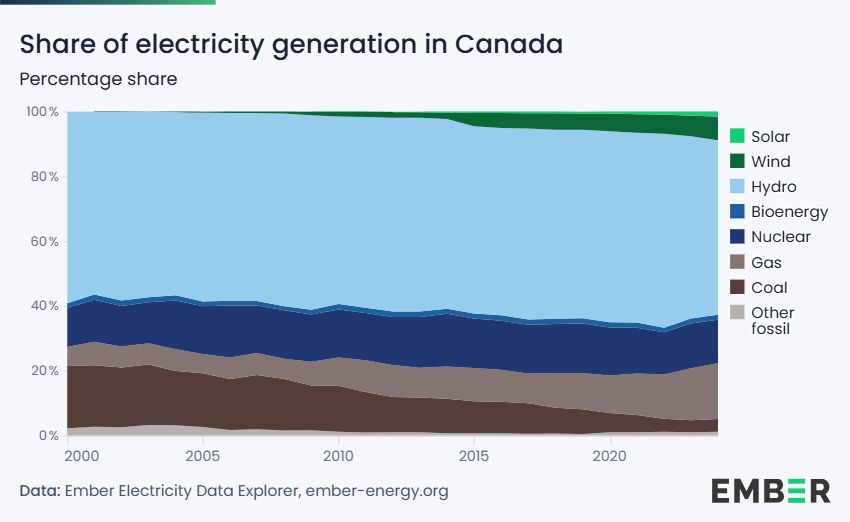
| Electricity Generation | Hydroelectricity: 59% (2016). Nuclear: 15%. Fossil Fuels: 19% |
Beyond these sectors, Canada's high technology industry and burgeoning film, television, and entertainment sector are significant creators of content for both domestic and international consumption. The cooperative banking sector is pronounced, with Canada having the world's highest per-capita membership in credit unions. The Toronto Stock Exchange ranks as the tenth-largest stock exchange in the world by market capitalization, underscoring the sophistication of the country's financial markets. The defence sector is a high-tech, export-driven industry centred on aerospace, simulation, and cyber technology.

Economic Challenges and Risks
The Canadian economy faces several structural challenges and external risks. Housing affordability ranks among the lowest of the most developed countries, presenting a significant social and economic issue. The Bank of Canada has identified rising housing costs as a priority in its revised mandate. Environmental considerations are also paramount, as certain industries contribute substantially to greenhouse gas emissions. The oil and gas sector accounts for 27% of Canada's total emissions, while heavy industry and electricity generation account for 10.2% and 10% respectively. The agriculture sector is responsible for 8.4% of emissions.
External risks are dominated by geopolitical tensions and trade policy shifts. The global economy is in a period of profound rupture where economic security and industrial policy are reshaping investment and trade. Conflicts disrupting key shipping routes have pushed energy prices higher and highlighted supply chain fragility. Sustained U.S. trade measures, while partially mitigated by CUSMA, continue to impose economic costs and have a long-lasting reshaping effect on trade-dependent sectors of the Canadian economy. An adverse oil supply shock has mixed effects, supporting energy incomes and government revenues while raising costs for households and businesses and adding to near-term uncertainty. The conflict in the Middle East, for instance, has disrupted the Strait of Hormuz, a route for about 20% of global oil and liquefied natural gas shipments.
Historical Development and Policy Evolution
Canada's economic history is marked by a transformation from a largely rural economy to an urbanized, industrial one, driven by the growth of manufacturing, mining, and services in the 20th century. Post-World War II policy was heavily influenced by the goal of economic integration with the United States, leading to important trade agreements. The 1970s saw a shift towards economic nationalism with policies like the National Energy Program (NEP) and the Foreign Investment Review Agency (FIRA), aimed at ensuring energy self-sufficiency and reviewing foreign ownership. These were largely reversed in the 1980s under a new government that renamed FIRA to Invest in Canada to encourage foreign investment and abolished the NEP.
The late 20th century cemented Canada's open trade stance with the landmark free trade agreements with the United States and later Mexico. This era also established the modern framework for monetary policy with the adoption of inflation targeting in the early 1990s. The 21st century has seen Canada continue to expand its free trade network globally while grappling with the economic impacts of the 2008-09 Great Recession, the COVID-19 pandemic, and evolving trade relations. Throughout these changes, the economy has maintained its dual character as a resource powerhouse and an advanced service economy, adapting to new global realities while confronting domestic challenges like productivity and affordability.
Frequently asked questions
How does Canada's economy compare to other G7 countries?
Canada's GDP per capita in purchasing power parity terms ranks third among G7 countries. It has the lowest net debt-to-GDP ratio in the G7 and leads the G7 in per capita direct investment inflows. The International Monetary Fund expects Canada to post the second-fastest growth in the G7 over 2026 and 2027. However, Canada ranks among the lowest developed countries for housing affordability.
What is Canada's inflation rate and target?
The Bank of Canada, the nation's central bank, has an inflation target of 2%, which is the midpoint of a control range of 1 to 3%. This policy aims to keep inflation low, stable, and predictable. In October 2025, headline consumer inflation was reported at 2.2%. The Bank's mandate was reassessed in 2026 to place a higher priority on reducing inflation and housing costs.
What is the current state of Canada's labour market?
The labour market has remained resilient. Since early 2025, Canada has added nearly three times as many jobs per capita as the United States, mostly in the private sector. The unemployment rate peaked at 7.1% in September 2025 and fell to 6.7% by March 2026. Wage growth has outpaced inflation for more than three consecutive years, supporting gains in real incomes for workers.
What type of economy does Canada have?
Canada has an advanced and diversified mixed economy. It relies upon its abundant natural resources and well developed international trade networks. As of 2026, it is the world's eleventh largest economy in nominal terms and ranks highly on economic freedom and stability. The country has a highly efficient and strong social security system with social expenditure at roughly 23.1 percent of GDP. The economy also features low corruption and a highly developed banking sector, including the world's highest per capita membership in credit unions.
What are the main industries in Canada?
The main industry in Canada is the service sector, which employs about three quarters of the workforce and accounts for 70 percent of GDP. Canada also has an unusually important primary sector, with forestry and petroleum as its most prominent components. The real estate, rental, and leasing sector comprises over 13 percent of GDP. Other key industries include a sizeable heavy manufacturing sector centred in southern Ontario and Quebec, a high tech defence sector, and a leading agricultural sector that makes Canada one of the world's largest suppliers of wheat and other grains.
Who is Canada's largest trading partner?
The United States is Canada's largest trading partner, a relationship deepened by significant economic integration since World War II. This was formalized by the Canada United States Free Trade Agreement of 1988 and the North American Free Trade Agreement in 1994. Trade data illustrates this close link for example, Canada sent 83 percent of its steel exports to the United States in the year to date 2019. The two countries are also primary partners within the broader network of 15 free trade agreements Canada maintains with 51 countries as of 2023.
Sources and further reading
- Economy of Canada (Wikipedia) en.wikipedia.org
- Economic and fiscal overview | Spring Economic Update 2026 budget.canada.ca
- Canada: Introduction >> globalEDGE globaledge.msu.edu
- Canadian Economic Tracker www150.statcan.gc.ca
This article explains how things work and is not financial, tax or legal advice. Rules, limits and rates change, so check the current figures with the Canada Revenue Agency, your province or your financial institution before you act.