MANILA
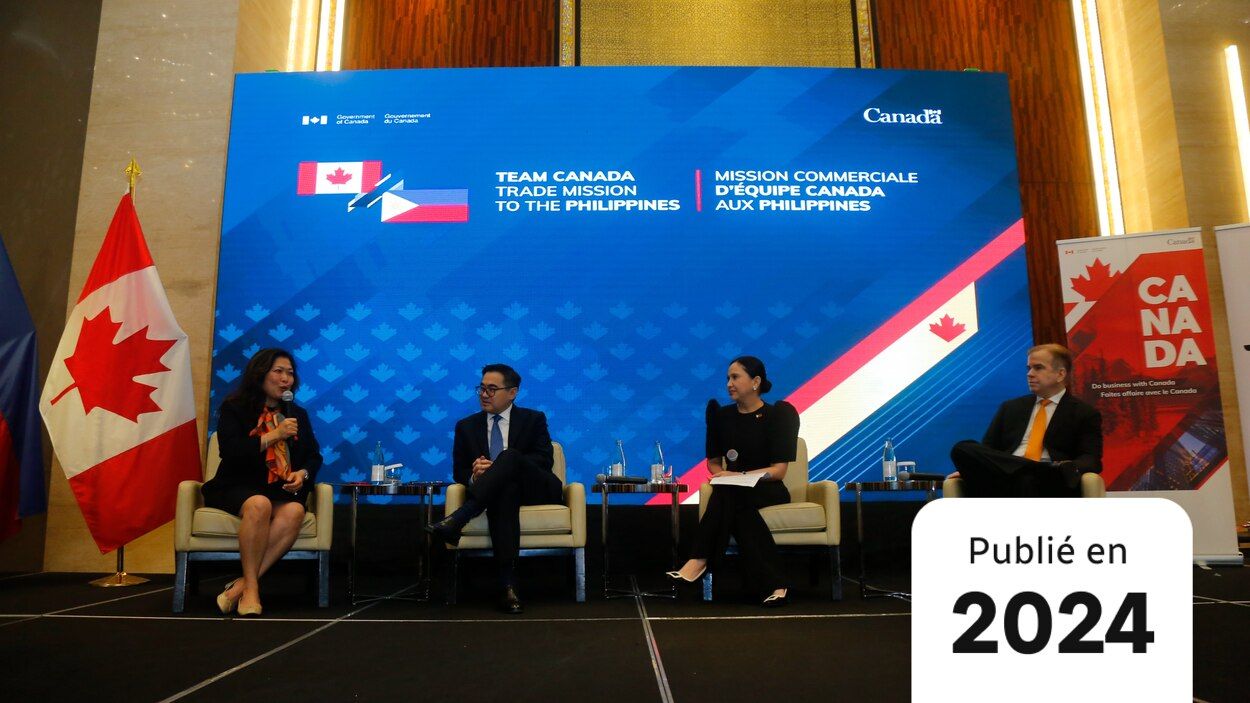
Prime Minister Mark Carney announced Canada and the Philippines have concluded negotiations on a free-trade agreement, with the goal of finalizing the deal by 2027.
"Today, we have successfully concluded negotiations on a Canada-Philippines Free Trade Agreement. We will move just as fast to finalize the deal and bring it into force next year," Carney said in prepared remarks released ahead of a media availability in Manila.
He said the agreement could help triple trade between the two countries to more than $10 billion annually by 2035.
Carney arrived in Manila on Friday for the Association of Southeast Asian Nations summit, where he is also seeking a broader trade pact with the 11-country ASEAN bloc.
He was set to meet with Philippine President Ferdinand Marcos Jr. later in the day.
Carney said the agreement is another step in Canada’s strategy to diversify trade away from the United States.
"We are developing a dense web of reliable partners to create more opportunities for our business and more choice for Canadians, while reducing our reliance on the United States," he said.
"Whether you’re a Canadian tech start-up, canola farmer, pork producer, or small business owner, looking for an expanding middle-class market, this agreement will make it easier, cheaper and faster to sell your goods to this region as a whole."
Kyle Larkin, president and CEO of the Canadian Meat Council, said "the conclusion of negotiations toward a Canada-Philippines free trade agreement is an encouraging development for Canada’s pork industry and the longstanding relationship between our two countries."
Canadian pork producers will be watching closely to see whether the agreement helps resolve long-standing restrictions on pork exports to the Philippines, though details of the deal have not yet been released.
Canada exported about $279 million in pork products to the Philippines in 2024.
Carney said Thursday in French that he was "fighting for this industry."
The ASEAN summit involves 20 heads of government, including guests from outside the region such as U.S. President Donald Trump and Brazilian President Luiz Inacio Lula da Silva.
Ottawa says trade between Canada and ASEAN countries amounted to $52.3 billion last year, a fifth larger than the previous year.
The group is key to Carney’s goal of doubling exports to countries other than the U.S. by 2035.
Vina Nadjibulla, co-founder of the Centre for Strategic Statecraft, said the ASEAN summit is a chance for Carney to reinforce the importance of Asia to Canadians.
"So much of his diplomacy over the last few months has been focused on Europe, understandably so. But we also need to remind everyone that Canada is a Pacific nation, we have an Indo-Pacific strategy, and the region is really critical to Canada’s prosperity," she said.
Canada and the Philippines have been in talks on a bilateral trade deal since 2015, with Carney and Marcos restarting those efforts a year ago.
In 2025, bilateral merchandise trade between the two countries totalled $3.4 billion, with Canada exporting mineral ores, meat, cereals, fertilizers and aircraft, while importing cooking oils, leather and rubber products from the Philippines.
Queen’s University professor Stéphanie Martel, who studies ASEAN and international diplomacy, said Carney has a narrower policy approach to the region than his predecessor Justin Trudeau, who she said tended to offer "lofty, general commitments."
Carney has focused on strategic sectors, she said, particularly trade and military collaboration.
Martel said the trade and navy ships are welcome but they miss a key point.
"That’s not the way that ASEAN countries approach security," she said. "These countries all have a very strong tradition, in government and in their military, to look at security in what they call a comprehensive way."
Southeast Asian leaders see security as linked to climate change, regime stability through economic growth, and the involvement of women in military and security issues, she said.
"I worry that this is getting sidelined to refocus on the most immediate, strategic sectors like AI and food and energy, and supply chains," Martel said.
Nadjibulla said Canada’s challenge is to ensure it has enough partnerships in Asia that touch on defence-industry co-operation, digital trade, mobility and education.
"We need to do a lot more in not just exporting more to the region or doing trade with the region, but also becoming part of the production and supply chains in the region," she said.
The summit comes at a time of rising geopolitical and economic competition between the United States and China.
Nadjibulla said that competition has been a factor in most ASEAN summits in recent years, particularly as it affects semiconductors, critical minerals and tariffs.
"Canada wants to be there as an alternative, as a partner that is similar to Japan, Australia, and others who give more options to ASEAN, so that they’re not stuck between these two superpowers," she said.
e2gold.ca reported earlier this week that Carney departed for summits in four countries to advance trade and security ties.
This story was written by the e2gold.ca newsroom from reporting by BNN Bloomberg, CTV News, National Newswatch and CP24. Quotes are checked word for word against that reporting.