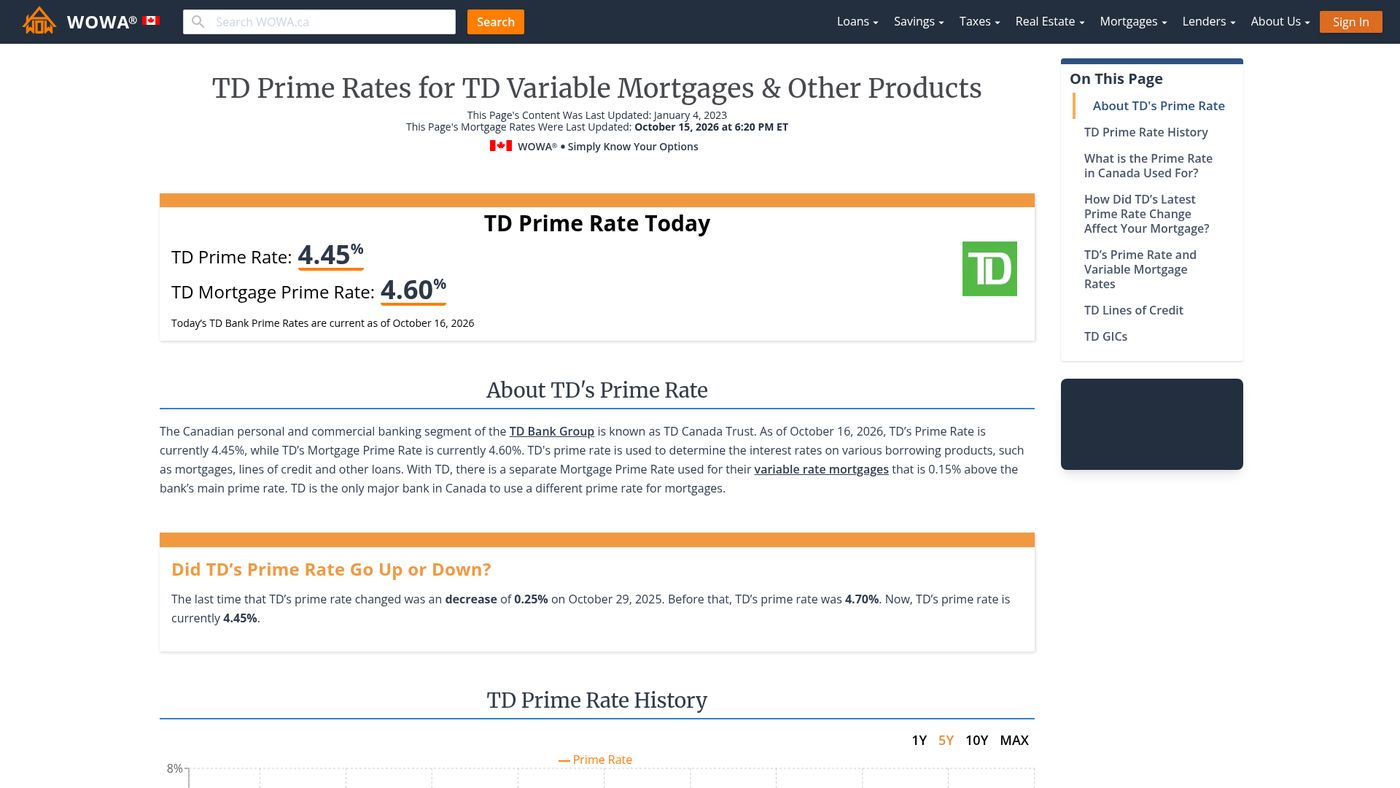
The TD Prime Rate is the benchmark interest rate set by TD Bank Group for pricing variable-rate loans in Canada. It serves as the foundation for interest rates on products like variable-rate mortgages, personal lines of credit, and some credit cards. Changes to the TD Prime Rate directly affect the borrowing costs for millions of Canadian consumers and businesses. Understanding this rate is crucial for anyone with or considering a variable-rate loan from TD Canada Trust or other lenders that follow similar benchmarks.
Definition and Function of the Prime Rate
The prime rate is a fundamental interest rate used by banks to set the cost of borrowing for their most creditworthy customers. In Canada, each major financial institution, including TD Bank Group, publishes its own prime rate, though these rates typically move in close alignment. The TD Prime Rate specifically acts as an index or benchmark for pricing a wide array of variable-interest financial products. When a customer obtains a variable-rate loan, such as a mortgage or line of credit, the interest rate is commonly expressed as the TD Prime Rate plus or minus a fixed percentage known as the spread or margin. This structure means that when TD changes its prime rate, the interest costs on these variable-rate products adjust automatically by the same amount. The prime rate is therefore not a uniform rate across all borrowers but a reference point that determines individual loan pricing based on the agreed-upon spread.
How the TD Prime Rate Works for Borrowers
For Canadian borrowers, the TD Prime Rate is directly embedded in the terms of their variable-rate loans. A common example is a variable-rate mortgage where the contract states an interest rate of TD Prime minus 0.50 percent. Should TD Bank announce a change to its prime rate, the borrower's mortgage rate would change by the identical number of basis points. This mechanism creates a direct link between the bank's benchmark rate and the customer's monthly payments. Conversely, fixed-rate mortgages and loans are not tied to the prime rate for the duration of their term, insulating borrowers from rate fluctuations but also preventing them from benefiting from potential decreases. The prime rate also forms the basis for pricing for home equity lines of credit, certain student loans, and variable-rate credit cards, making it a pervasive factor in personal finance.
TD Bank maintains a unique practice of publishing a separate prime rate specifically for mortgages, known as the TD Mortgage Prime Rate. As of June 15, 2023, this rate was listed at 7.10 percent, which was distinct from the general TD Prime Rate at that time. This indicates that the spread applied to mortgages may be calculated from a different baseline than other consumer loans. The existence of a mortgage-specific prime highlights how the bank tailors its benchmark rates for different product categories. Borrowers must carefully review their loan agreements to confirm which specific prime rate index their interest is tied to, as it directly impacts their final borrowing cost.
Historical Changes and Recent Trends
The TD Prime Rate is not static and undergoes periodic adjustments primarily in response to changes in the Bank of Canada's key policy rate, the target for the overnight rate. Historical announcements show that adjustments can be increases or decreases, typically in increments of 25 or 50 basis points. For instance, on June 2, 2022, TD increased its prime rate by 50 basis points to 3.70 percent. More recently, the rate was decreased by 25 basis points to 4.70 percent effective September 18, 2025, and then again to 4.45 percent effective October 30, 2025. These changes are publicly announced by TD Canada Trust and take effect on a specified future date, giving borrowers notice of impending payment adjustments.
There have been instances where TD's adjustment did not fully mirror the change by the central bank. In July 2015, when the Bank of Canada lowered its overnight rate by 25 basis points, TD initially reduced its prime rate by only 10 basis points. Following moves by other major banks to lower their prime rates by 15 basis points, TD eventually matched that level. This historical episode illustrates that while the prime rate is closely linked to central bank policy, the transmission is not always one-to-one and can be subject to competitive dynamics among financial institutions. The timing and magnitude of changes can vary slightly between banks, though they generally move in the same direction.
- October 30, 2025: Decreased to 4.45%
- September 18, 2025: Decreased to 4.70%
- March 13, 2025: 4.95%
- January 30, 2025: 5.20%
- December 12, 2024: Rate listed in history
- June 2, 2022: Increased by 50 bps to 3.70%
The Prime Rate in the Canadian Banking System
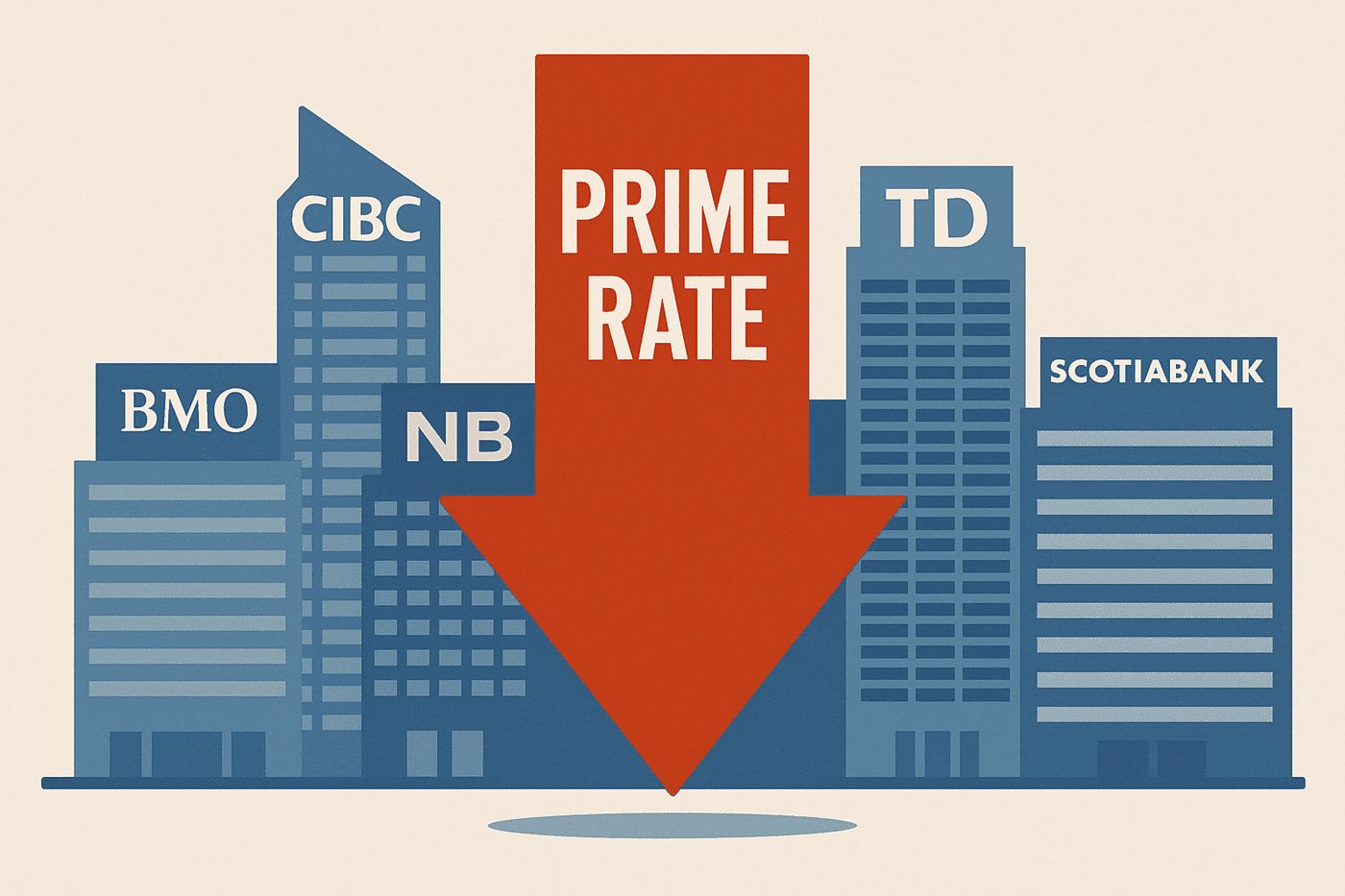
In the Canadian banking system, the prime rate serves as a critical benchmark for variable-interest lending. While each major bank sets its own prime rate, these rates are highly correlated and often change in unison following Bank of Canada announcements. As of a recent historical point, the general Canadian prime rate was listed at 4.95 percent. The prime rate in Canada functions similarly to its counterpart in the United States, where it traditionally runs approximately 300 basis points above the federal funds rate. In Canada, the prime rate is closely tied to the Bank of Canada's target for the overnight rate, which is the rate at which major financial institutions borrow and lend one-day funds among themselves.
The setting of the prime rate is a commercial decision by each bank, but it is heavily influenced by monetary policy. The Bank of Canada's Governing Council meets eight times a year to set the target for the overnight rate, which directly influences the cost of funds for banks. This cost is then reflected in the prime rates offered to consumers and businesses. The widespread use of the prime rate as an index means that changes in monetary policy quickly filter through to a broad swath of loans and credit products, affecting economic activity, consumer spending, and housing market dynamics across the country.
Comparison with Other Lending Benchmarks
The TD Prime Rate is one of several key interest rate benchmarks used in Canadian finance, each serving distinct purposes. The most direct influence on the prime rate is the Bank of Canada's target for the overnight rate, which is the primary tool of Canadian monetary policy. While the prime rate is a commercial lending rate for creditworthy customers, the overnight rate is an interbank lending rate. Another important historical benchmark is LIBOR, the London Interbank Offered Rate, which has been used in some financial contracts but is being phased out globally. In contrast to these, the prime rate is specifically designed as a reference point for retail banking products.
Internationally, different countries employ their own systems. For example, in Malaysia, the Base Lending Rate structure was replaced with a new Base Rate system effective January 2, 2015, where banks determine their interest rate based on a formula set by the central bank. In the United States, the prime rate is published by The Wall Street Journal based on the base rate posted by at least 70 percent of the top ten banks by assets, reflecting the concentrated nature of the banking industry. These international comparisons highlight that while the function of a prime rate as a benchmark is common, the specific methodology for its determination and application can vary significantly by jurisdiction.
Risks and Considerations for Consumers
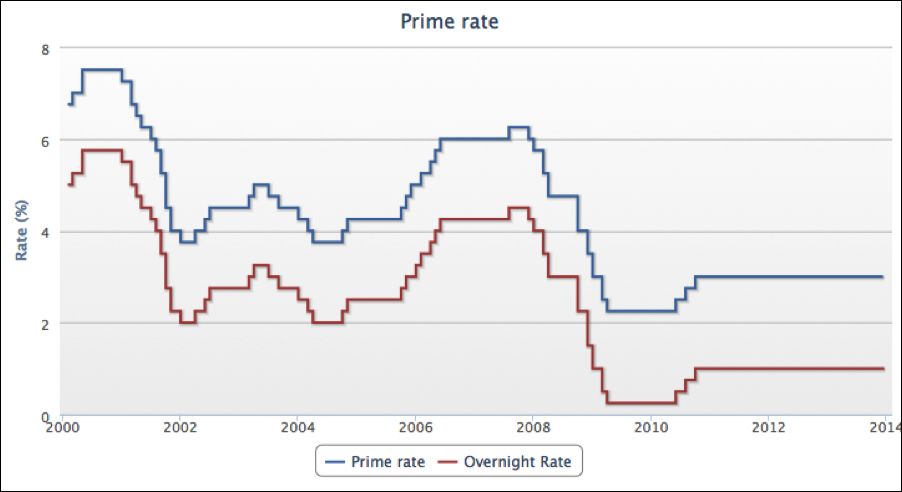
For consumers, the primary risk associated with the TD Prime Rate is interest rate volatility on variable-rate debt. When the prime rate rises, monthly payments on products like variable-rate mortgages and lines of credit increase correspondingly, which can strain household budgets. This risk is inherent to the structure of variable-rate loans, where the interest rate is not fixed for the term. Borrowers must assess their ability to absorb potential payment increases over the life of the loan. Historical data shows that the prime rate can change multiple times within a year, either up or down, based on economic conditions and central bank policy.
Another consideration is the distinction between the general TD Prime Rate and the TD Mortgage Prime Rate. Borrowers with mortgages may find their rate tied to the mortgage-specific prime, which can differ from the published general prime rate. This adds a layer of complexity when comparing loan offers or tracking rate changes. Furthermore, while banks often move their prime rates in tandem, the timing and occasional differences in the magnitude of changes, as seen in 2015, mean that borrowers cannot always assume a perfectly uniform response across all lenders. Consumers are advised to monitor official announcements from their financial institution for precise changes to the applicable prime rate index stated in their loan agreements.
Frequently asked questions
What is the TD Prime Rate today?
As of October 2026, the TD Prime Rate is currently 6.95 percent. It is important to note that this rate is subject to change based on economic conditions and Bank of Canada policy. TD Bank publishes updates to its prime rate through official announcements, and the effective date of any change is always specified. Consumers should check TD's official resources or their loan documents for the most current rate applicable to their products.
Why does TD have a separate mortgage prime rate?
TD Bank publishes a distinct TD Mortgage Prime Rate, which was 7.10 percent as of June 2023. This separate rate indicates that the benchmark for pricing variable-rate mortgages may differ from the benchmark used for other consumer loans like lines of credit. The existence of a mortgage-specific prime allows TD to tailor its pricing and risk assessment for the mortgage portfolio separately from other lending products. Borrowers must verify which prime rate their specific mortgage contract references.
How often does the TD Prime Rate change?
The TD Prime Rate does not change on a fixed schedule but adjusts in response to changes in the Bank of Canada's overnight rate target and broader market conditions. The Bank of Canada's policy announcements occur eight times a year, which often triggers prime rate reviews by TD and other major banks. Changes can happen multiple times a year or less frequently, depending on the economic cycle. Recent history shows changes occurring several times within a single year.
What is the difference between prime rate and the Bank of Canada rate?
The Bank of Canada sets the target for the overnight rate, which is the interest rate at which banks lend to each other overnight. The TD Prime Rate is a commercial lending rate set by TD Bank for its best customers and is heavily influenced by, but not mechanically identical to, the overnight rate. The prime rate is typically higher than the overnight rate, as it incorporates bank funding costs, overhead, and profit margin. Changes in the overnight rate are the primary driver for changes in the prime rate.
How does the TD Prime Rate affect my mortgage?
The TD Prime Rate directly affects variable rate mortgages but not fixed rate mortgages. For a variable rate mortgage from TD, your interest rate is set as the TD Prime Rate, or a specific TD Mortgage Prime Rate, plus or minus a fixed percentage spread. Any change TD makes to its prime rate will cause your mortgage interest rate to change by the same amount immediately. In contrast, a fixed rate mortgage has an interest rate guaranteed for the entire term, so it is not affected by prime rate changes during that period, providing payment stability regardless of market fluctuations.
Is TD's prime rate the same as other banks' prime rates?
TD's prime rate is very similar to other major Canadian banks' prime rates, but they are set independently. Historically in North America, prime rates vary little among banks and adjustments are generally made at the same time. However, there can be slight differences in timing or amount. For example, in July 2015 when the Bank of Canada changed its rate, TD initially lowered its prime rate by only 10 basis points while other banks settled on a 15 basis point drop, before TD eventually matched them. Generally, the prime rates across major banks move in a highly correlated manner, making the TD Prime Rate representative of the broader Canadian prime lending benchmark used for variable loans.
Sources and further reading
- Prime rate (Wikipedia) en.wikipedia.org
- TD Prime Rate and Today's Rates | TD Canada Trust td.com
- TD Canada Trust announces change to TD Prime Rate stories.td.com
- TD Bank Prime Rate ratehub.ca
- TD Canada Trust announces change to TD Prime Rate ca.finance.yahoo.com
- TD Canada Trust announces change to TD Prime Rate newswire.ca
This article explains how things work and is not financial, tax or legal advice. Rules, limits and rates change, so check the current figures with the Canada Revenue Agency, your province or your financial institution before you act.