Canada's banking system comprises a diverse range of financial institutions, from large domestic banks to foreign bank subsidiaries and government-owned entities. The sector is regulated by the Office of the Superintendent of Financial Institutions (OSFI), which oversees all banks operating in the country, including six designated as systemically important. Understanding the types of banks, their historical evolution, and the regulatory framework is important for Canadians managing their finances, accessing credit, and using payment systems. This guide provides a factual overview of the banks in Canada, including their classifications, key identifiers, and the rules that govern them.
The Structure and Regulation of Canada's Banking System
The Canadian banking system is structured into distinct categories based on size, ownership, and function, all under the supervision of the Office of the Superintendent of Financial Institutions. There are six systemically important banks, designated as domestic systemically important banks (D-SIBs), which are subject to additional regulatory measures like the domestic stability buffer. This buffer is a capital reserve these banks must set aside to cover losses during financial uncertainties. Beyond these major banks, the system includes many small and medium-sized banks, foreign bank subsidiaries, and government-owned financial institutions, creating a landscape with around 86 banks in total. The regulatory framework also includes consumer protection measures such as the minimum qualifying rate on uninsured mortgages, which tests a borrower's ability to repay during financial hardship, and loan-to-income limits to reduce highly leveraged residential property loans. These rules apply uniformly to all regulated banks operating within Canada, contributing to a consistent national standard for financial stability and consumer protection.
Domestic Systemically Important Banks (The Big Six)
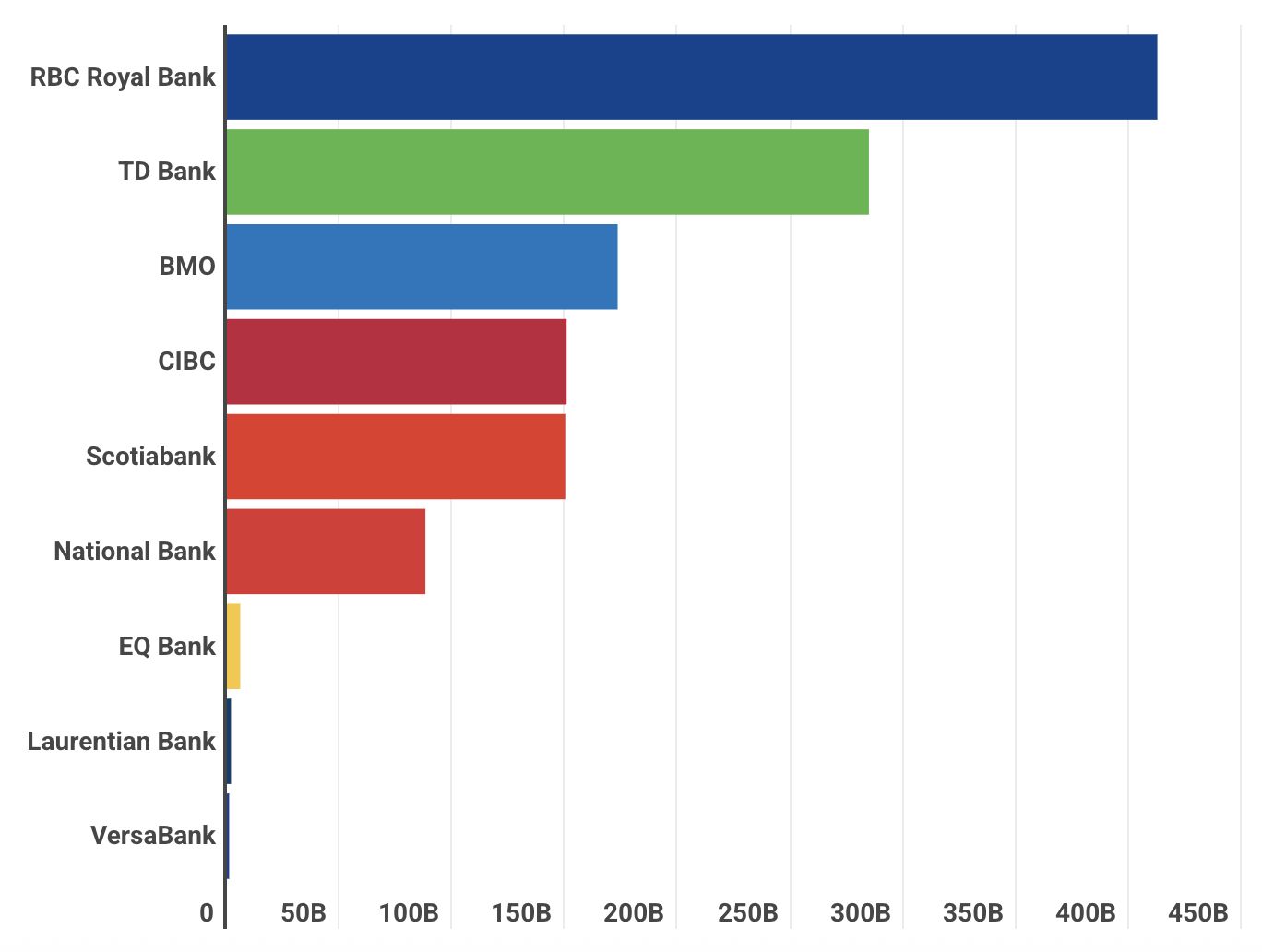
The six domestic systemically important banks form the core of Canada's financial system and are among the largest financial institutions in the country. These banks are the Royal Bank of Canada (institution 003), Toronto-Dominion Bank or TD Bank Group (004), Bank of Montreal or BMO (001), Scotiabank (002), Canadian Imperial Bank of Commerce or CIBC (010), and National Bank of Canada (006). Their designation as D-SIBs means their stability is critical to the overall financial system, requiring them to maintain higher capital buffers. These institutions manage vast sums, with examples like BMO Financial Group and Scotiabank each commanding balance sheets of approximately $1.5 trillion. Their operations span extensive retail networks, commercial lending, wealth management, and international banking, supported by significant investments in digital infrastructure and technology. The Canadian Imperial Bank of Commerce handles more than $1.1 trillion in total assets and employs about 48,000 people, focusing on backend AI and cloud infrastructure. Scotiabank employs 89,000 people globally and operates international Digital Factories that develop proprietary machine learning algorithms and payment APIs.
Other Domestic Banks and Digital Challengers
Beyond the Big Six, Canada's domestic banking sector includes several other Schedule I banks that are widely held and often publicly traded. Laurentian Bank of Canada is a mid-tier institution with a strong retail presence in Quebec and assets of roughly $49 billion, pursuing a tech strategy that integrates with third-party fintech providers. Canadian Western Bank is another domestic bank that provides personal and commercial services, particularly in Western Canada, and was the subject of a technical acquisition by National Bank. Bridgewater Bank and Cidel Bank Canada are also examples of domestic banking institutions operating within the market. The sector also features digital-born challenger banks like EQ Bank, a subsidiary of Equitable Bank that operates without physical branches and manages over $100 billion in assets by using a completely cloud-based model. Tangerine Bank, a wholly owned subsidiary of Scotiabank originally launched as ING Direct, manages more than $40 billion in assets without a traditional branch network, focusing on UI/UX simplicity and mobile features. These challengers contribute to increased competition and innovation in personal finance, offering products like high-interest digital accounts and fee-free international money transfers.
Foreign Banks and Government-Owned Financial Institutions
Foreign banks operate in Canada through subsidiaries or branches, offering additional options for consumers and businesses under full OSFI regulation. Examples include HSBC Bank Canada, which holds institution number 016, and Citibank Canada. Citi Private Bank and Citi Wealth also operate under the Citibank Canada umbrella. These institutions provide global banking services and, in some cases, specialized programs for newcomers to Canada. Alongside private banks, Canada has several government-owned financial institutions that serve specific national economic purposes. The Bank of Canada, located at 234 Wellington Street in Ottawa, acts as the central bank responsible for monetary policy. The Business Development Bank of Canada provides financing and advisory services specifically to Canadian businesses. Farm Credit Canada offers specialized financial services to the agricultural sector, supporting a key industry within the national economy. These crown corporations operate under distinct mandates to fill gaps in the market or support strategic economic sectors, complementing the services of private commercial banks.
Credit Unions, Trust Companies, and Cooperative Institutions
Credit unions are member-owned financial cooperatives that operate alongside banks, offering similar retail banking services like savings accounts, loans, and mortgages. Some, like Coast Capital Savings Federal Credit Union, are federal credit unions. Desjardins Group is North America's largest cooperative financial institution, managing over $524 billion in assets and operating as a significant force in Quebec and beyond, with investments in digital ID architecture and automated lending platforms. Trust companies also form part of the broader financial services landscape, providing services like estate and trust administration. CIBC Trust is an example listed as a member institution. These cooperative and trust institutions provide competitive alternatives to traditional bank accounts and lending products, often with a strong regional or community focus, thereby increasing the diversity of financial services available to Canadians. They are regulated at both the provincial and federal levels, depending on their charter.
Historical Evolution Through Mergers and Name Changes
The list of banks in Canada has evolved dramatically over the past century and a half through a consistent process of mergers, acquisitions, and name changes documented in private acts of Parliament. Many institutions that were members of the Canadian Bankers' Association upon its formation in 1900 have since consolidated into the larger banks of today. Historical records show the Anglo-Canadian and Continental Bank changed its name to the Anglo-Canadian Bank in 1909. The Bank of New Brunswick changed its name from The President, Directors and Company of the Bank of New Brunswick in 1880, and later amalgamated with the Union Bank of Prince Edward Island in 1883. The Merchants' Bank of Canada was formed from an amalgamation of the Commercial Bank of Canada and the Merchants' Bank, an act confirmed in 1868. The Royal Bank of Canada obtained its current name in 1900, changing from the Merchants' Bank of Halifax. Other notable changes include La Banque d'Hochelaga changing its name to the Bank of Montreal in 1924, and the Consolidated Bank of Canada being formed from the amalgamation of the City Bank and the Royal Canadian Bank in 1876. The Imperial Bank of Canada changed its name from the Imperial Bank in 1874 and later amalgamated with the Niagara District Bank in 1875. These consolidations have significantly reduced the total number of banking charters over time, leading to the more concentrated market structure seen today.
Key Regulatory Tools for Financial Stability
The regulatory framework governing banks in Canada employs specific tools designed to ensure systemic stability and protect consumers from excessive risk. The domestic stability buffer is a capital buffer that domestic systemically important banks need to set aside to cover losses during financial uncertainties, and its level is adjusted periodically by OSFI based on economic conditions. The minimum qualifying rate for uninsured mortgages requires borrowers to prove they can afford payments at a higher interest rate than their actual contract, testing resilience to financial hardship such as rising interest rates. Loan-to-income limits help reduce the proportion of highly leveraged loans secured against a residential property by capping the size of a mortgage relative to the borrower's income. These measures aim to prevent excessive household debt accumulation and mitigate risks to the broader financial system, contributing to Canada's reputation for conservative and stable banking practices. The framework applies uniformly to all banks operating in the country, regardless of their size or ownership structure, and is a key reason international observers often cite the strength of the Canadian banking system.
Identifying Financial Institutions: Numbers and Types
Every financial institution in Canada is identified by a unique institution number used for routing transactions such as direct deposits, pre-authorized payments, and wire transfers. This number is part of the standard routing information that also includes a branch transit number and an account number. These identifiers are used by government payment programs like the Quebec Parental Insurance Plan (QPIP) for direct deposit. The institution number provides a clear way to identify the specific bank or credit union holding an account, which is essential for setting up automated transactions and verifying banking details.
| Institution Number | Financial Institution Name | Type |
|---|---|---|
| 001 | Bank of Montreal (BMO) | Domestic D-SIB |
| 002 | The Bank of Nova Scotia (Scotiabank) | Domestic D-SIB |
| 003 | Royal Bank of Canada | Domestic D-SIB |
| 004 | TD Canada Trust | Domestic D-SIB |
| 006 | National Bank of Canada | Domestic D-SIB |
| 010 | Canadian Imperial Bank of Commerce (CIBC) | Domestic D-SIB |
| 016 | HSBC Bank Canada | Foreign Bank Subsidiary |
| 030 | Canadian Western Bank | Domestic Bank |
Other banks and all credit unions have their own distinct institution numbers assigned within this national system. For example, the Bank of Montreal uses institution number 001, Scotiabank uses 002, and the Royal Bank of Canada uses 003. Understanding these codes helps Canadians correctly set up financial transactions and identify their service provider on official documents and statements. The directory maintained by the Bank of Canada includes these numbers for all regulated deposit-taking institutions, ensuring a standardized payment infrastructure across the country. These institutions are regulated and supervised by the Office of the Superintendent of Financial Institutions.
Pension Funds and Historical Bank Societies
The history of Canadian banking includes the early formation of pension and guarantee societies for bank employees, often established through private acts. The Bank of Hamilton Pension Fund was incorporated in 1908. The winding-up of the Annuity and Guarantee Funds Society of the Bank of Montreal was authorized in 1885, the same year the Pension Fund Society of the Bank of Montreal was incorporated. The Guarantee and Pension Fund Society of the Dominion Bank was incorporated in 1887, with its name changed to The Pension Fund Society of the Dominion Bank in 1899 and later to The Pension Fund Society of the Toronto-Dominion Bank in 1956 following a merger. In 1929, an act vested the pension funds of Molsons Bank and the Merchants' Bank of Canada into the Pension Fund Society of the Bank of Montreal. These early structures highlight the long-standing focus on employee security within the sector and the complex legal history behind modern banking entities. The investment rules for these pension funds were sometimes amended by subsequent acts, such as in 1949 when an amendment was made to a 1936 act governing the Pension Fund Society of the Bank of Montreal.
The Role of the Canadian Bankers' Association and Member Institutions
The Canadian Bankers' Association (CBA) has been a longstanding industry group, with membership dating back to its foundational year of 1900. Many historical and contemporary banks have been members of this association. The original member list from 1900 included institutions like the Bank of Montreal, the Bank of New Brunswick, the Canadian Bank of Commerce, the Dominion Bank, the Imperial Bank of Canada, the Merchants Bank of Canada, and the Royal Bank of Canada. Membership was often confirmed or noted in private acts, such as the act for the Bank of British North America in 1900. The association's founding act in 1900, chapter 93, has been amended several times, including significant amendments and repeals of sections in the period 1980-81-82-83 under chapter 40. While the CBA serves as an advocacy and policy group, the actual regulation of banks remains the sole responsibility of the federal government through OSFI and the Bank of Canada. The list of member institutions today includes a wide range of banks, from the largest D-SIBs to smaller domestic and foreign banks, as well as associated trust companies like CIBC Trust.
Frequently asked questions
How many banks are there in Canada?
The Office of the Superintendent of Financial Institutions regulates all banks operating in Canada. The system includes six domestic systemically important banks and many other small and medium-sized banks. As of recent information, the total number of banks operating in the country is around 86. This figure includes domestic Schedule I and II banks, foreign bank subsidiaries, and other regulated deposit-taking institutions, all of which are subject to federal oversight and the same core stability regulations.
What are the Big Six banks in Canada?
The six systemically important domestic banks, often called the Big Six, are the Royal Bank of Canada (RBC, institution 003), Toronto-Dominion Bank (TD, 004), Bank of Montreal (BMO, 001), Scotiabank (002), Canadian Imperial Bank of Commerce (CIBC, 010), and National Bank of Canada (006). These are the largest banks in the country and are designated as domestic systemically important banks (D-SIBs). The Office of the Superintendent of Financial Institutions regulates and supervises all banks operating in Canada, including these six systemically important banks. These banks are subject to additional regulatory requirements like the domestic stability buffer and specific mortgage stress tests, including the minimum qualifying rate on uninsured mortgages and loan-to-income limits.
Are credit unions considered banks in Canada?
Credit unions are not technically classified as banks under the federal Bank Act, but they offer similar retail financial services like savings accounts, loans, and mortgages. They are member-owned financial cooperatives. Some, like Coast Capital Savings Federal Credit Union, operate under a federal charter. Major cooperatives like Desjardins Group manage hundreds of billions in assets and are awarded recognitions like The Banker's Canadian Bank of the Year. While they are regulated under different legislation than banks, often provincially, they form a significant and competitive part of the financial services landscape available to Canadians, particularly in certain regions.
What is a systemically important bank?
A systemically important bank is one whose failure could pose a significant risk to the overall financial system due to its size, interconnectedness, and complexity. In Canada, there are six domestic systemically important banks (D-SIBs). These banks are required to hold additional capital reserves, known as the domestic stability buffer, to absorb losses during periods of financial stress. This buffer is a key regulatory tool used by the Office of the Superintendent of Financial Institutions to maintain the stability and resilience of the Canadian financial system. The designation leads to more stringent oversight and higher capital requirements.
What government-owned banks operate in Canada?
Several government-owned financial institutions operate in Canada, though they are not all traditional retail banks. The Bank of Canada is the central bank, responsible for monetary policy and located in Ottawa. The Business Development Bank of Canada provides financing and advisory services to Canadian businesses. Farm Credit Canada offers financial services specifically to the agricultural sector. These crown corporations fulfill specific policy and economic development roles, complementing the services provided by the private banking sector without competing directly for general retail deposits. They are established by separate acts of Parliament and have distinct mandates.
How can I find my bank's institution number?
Every Canadian bank and many credit unions have a unique institution number. Common examples include 001 for Bank of Montreal, 002 for Scotiabank, and 003 for Royal Bank of Canada. This number is part of your bank's routing information, almost always printed on a personal cheque alongside the transit number and account number. It is used for setting up direct deposits, pre-authorized payments, and other electronic fund transfers. A list of institution numbers is often published by government payment programs like QPIP and can be found on your financial institution's website or documentation. The number is essential for ensuring electronic payments are correctly routed to your account.
Sources and further reading
- Banks, Office of the Superintendent of Financial ... osfi-bsif.gc.ca
- Alphabetical list of Private Acts, Banks, Justice Laws Website laws-lois.justice.gc.ca
- Top 10: Banks in Canada fintechmagazine.com
- A list of the top banks in Canada wise.com
This article explains how things work and is not financial, tax or legal advice. Rules, limits and rates change, so check the current figures with the Canada Revenue Agency, your province or your financial institution before you act.