Yearly Renewable Term (YRT), also known as Annual Renewable Term (ART), is a type of term life insurance policy that provides coverage for one year at a time with the option to renew annually. This structure offers a low initial premium that increases each year as the policyholder ages. In Canada, YRT is commonly used as the cost of insurance component within Universal Life insurance policies. Understanding how premiums escalate over time is crucial, as the long-term affordability of YRT can become a significant concern after 15 to 20 years.
How Yearly Renewable Term Insurance Works
Yearly Renewable Term insurance functions as a series of one-year term life insurance contracts. The policyholder pays a premium for a guaranteed death benefit that lasts for one year. At the end of that year, the policyholder has the option to renew the coverage for another year. The renewal is typically guaranteed, meaning the insurance company cannot refuse to renew the policy based on changes in the insured's health. However, the cost of insurance is recalculated annually based on the policyholder's attained age. This annual recalculation means the premium increases each year, reflecting the higher mortality risk associated with aging. The initial premium for a YRT policy is often lower than the starting premium for a level term policy of the same face amount, making it appear attractive for new buyers. This structure provides maximum flexibility for short-term needs but introduces uncertainty regarding future costs.

YRT Versus Level Term Insurance
The fundamental difference between Yearly Renewable Term and level term insurance lies in the stability of the premium. A level term policy, such as Term 10, Term 20, or Term 30, locks in both the death benefit and the premium for the entire duration of the chosen term. For example, a Term 20 policy guarantees the same premium payment for 20 years. In contrast, a YRT policy only guarantees the premium for a single year before it increases. While YRT premiums start lower, they will inevitably surpass the cost of a level term policy over a longer period. Industry analysis suggests that YRT becomes a significantly more expensive affair within about 15 to 20 years as the annually increasing premiums accumulate. This makes level term insurance generally more cost-effective and predictable for covering long-term financial obligations like a mortgage or income replacement.
The choice between the two often hinges on the duration of the needed coverage. YRT can be suitable for very short-term, temporary needs where the policyholder is certain the coverage will not be required beyond a few years. For any need expected to last a decade or more, a level term policy provides greater financial certainty. The predictability of a level premium allows for easier long-term budgeting and ensures the coverage remains affordable throughout the critical period it is meant to protect. A 35-year-old purchasing $500,000 of Term 20 life insurance for $50 per month would normally see that $50 premium remain the same for the full 20-year term, whereas an annually renewable policy for the same person would start lower but increase every year.
Common Policy Terms and Structures in Canada
The Canadian life insurance market offers a range of term structures, with YRT representing one end of the spectrum. Understanding the available options helps contextualize where YRT fits. Level term policies are the most common, offering fixed premiums for set periods. These policies are designed to align with specific financial planning timelines, such as the length of a mortgage or the years until retirement. The availability of different term lengths allows consumers to match their coverage period to their specific liability period. Some insurance providers also let you pick your own term between 5 and 40 years that best suits your needs, which are all examples of level term policies where the death benefit and monthly premium remain the same through your chosen term.
- Term 10: Provides level premiums for a 10-year period.
- Term 20: Provides level premiums for a 20-year period.
- Term 30: Provides level premiums for a 30-year period.
- Term to Age 65: Provides level premiums until the policyholder reaches age 65.
- Term 100: A form of permanent insurance where premiums are level until age 100.
- Annual Renewable Term (YRT): Premiums are level for only one year at a time.
- Decreasing Term: A policy where the death benefit decreases over later years of the term.
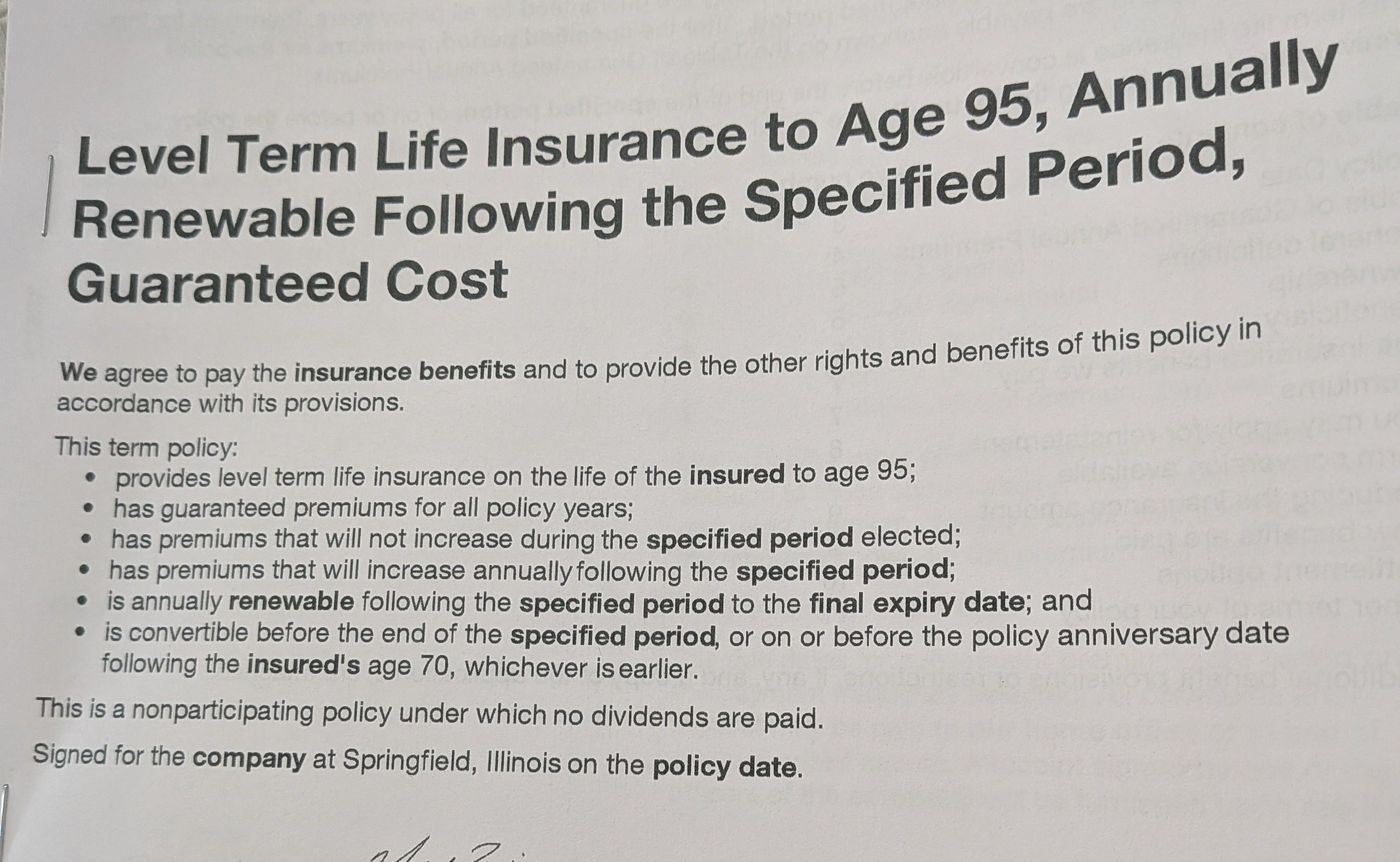
After a level term period ends, many policies include a renewal feature. For example, the Canada Life My Term product will renew yearly at the end of its initial term period. This renewal allows the policy to continue without requiring new medical evidence. However, the policy converts to a Yearly Renewable Term structure. Under this structure, the premium increases significantly each year according to an annually increasing schedule.

YRT as a Component of Universal Life Insurance
A primary application of Yearly Renewable Term in Canada is as the cost of insurance (COI) mechanism inside a Universal Life (UL) insurance policy. Universal Life is a form of permanent insurance that combines a death benefit with a tax-advantaged investment account. The policyholder pays premiums, from which the insurance company deducts the YRT cost of insurance and policy fees, depositing the remainder into the investment component. The use of YRT COI is intended to keep the insurance cost low in the policy's early years, allowing more money to be directed toward the investment fund with the goal of growth. This strategy is sometimes marketed as an investment insurance or tax-free growth plan, and it can sound exciting because it shows potential growth and flexibility.
This strategy carries significant risks that policyholders must understand. The YRT cost increases every year with age. The investment returns are not guaranteed and depend on market performance. If the investment portion underperforms or the escalating YRT charges drain the cash value, the policy can lapse unless the policyholder injects more money. A policy may be designed to last a lifetime, but if the required premiums become unaffordable in later years, often when the YRT costs are at their peak, the coverage can end. This underscores the distinction between a policy that is contractually capable of remaining in force for life and one that is financially realistic to maintain for life. The long-term affordability and sustainability of such a plan must always be reviewed carefully, as many people do not fully understand how YRT premiums work and that is where problems start.
Cost Progression and Long-Term Affordability Risks
The central challenge with a standalone YRT policy or a UL policy using YRT is the long-term affordability of the escalating premiums. The premium increases are not linear. They accelerate as the insured enters higher age brackets where mortality risk rises more sharply. A policy that seems inexpensive for a 35-year-old can become a substantial financial burden by the time that individual reaches their 50s, 60s, or 70s. This creates a potential coverage gap: if the policy becomes too expensive and lapses, the individual may find it difficult or prohibitively expensive to obtain new coverage at an older age, especially if their health has declined. Future affordability is especially important because replacing life insurance can become more difficult as you age, and at 35 someone may have access to many options that may not be available twenty or thirty years later.
This risk necessitates careful financial planning. Prospective buyers should model the projected YRT premiums over a 20 to 30-year horizon, not just consider the first-year cost. The future affordability is especially critical for permanent coverage needs. If a policy is intended to provide a lifelong death benefit, the structure must ensure the owner can sustain the payments throughout retirement when income may be fixed. Failing to account for the steep rise in YRT costs is a common pitfall that can undermine the very purpose of purchasing life insurance. The issue becomes more important as the policyholder gets older, and small annual increases in youth can compound into unmanageable costs later, which is why future affordability should be considered while someone still has options.
Key Considerations Before Choosing a YRT Structure
Choosing any life insurance product requires a clear understanding of its mechanics and long-term implications. For Yearly Renewable Term, either as a standalone policy or within a Universal Life contract, several specific factors demand scrutiny. Buyers must move beyond comparing only the initial monthly premium and evaluate the policy's behaviour over decades. Informed decision-making involves reviewing contractual details and projecting outcomes under various scenarios. This process helps ensure the insurance gives you peace of mind, not pressure, and is based on your goals, comfort level, and budget.
- Premium Escalation: Understand how the cost of insurance changes every year and obtain illustrations showing premiums at ages 55, 65, and 75.
- Investment Performance Risk: For UL with YRT, scrutinize what happens under different investment returns, as returns are not guaranteed and depend on market performance.
- Policy Sustainability: Determine how long your policy will last if you stop adding deposits or if investment growth is lower than projected.
- Guaranteed vs. Non-Guaranteed Values: Differentiate between the guaranteed cost of insurance rates and the illustrated non-guaranteed investment returns.
- Comparison to Level Cost Options: Directly compare the YRT structure with a level cost of insurance option within a UL policy.
- Renewal Conversion: For level term policies, understand the guaranteed renewal rates that will apply when the policy converts to YRT.
- Exit Strategy: If using YRT in UL for its low initial cost, have a defined plan, such as cashing out within 15-20 years before costs jump, depending on your interest and what returns you expect from your investment.
These considerations help ensure life insurance provides peace of mind instead of financial pressure. The goal is to secure coverage that aligns with your financial goals and budget for the entire period you need it. Understanding the details of how premiums work helps you make a confident and informed choice. This prevents you from purchasing a large and complex plan without a proper review or full understanding of its long-term costs.
Suitability and Common Debates
The suitability of Yearly Renewable Term insurance is a subject of ongoing discussion among financial advisors and consumers. Its appropriate use is generally limited to specific, short-duration needs. This could include covering a short-term business loan, providing temporary coverage during a gap in employer benefits, or as a cost-saving measure within a Universal Life policy for a buyer who plans to surrender the policy for its cash value within a 15 to 20 year window before the YRT costs escalate dramatically. In these cases, the real effect of ART is avoided before it shows a huge jump. For many families, however, a Term or Whole Life plan might be a better, simpler, and more affordable choice for long-term protection.
The main debate centres on its use within permanent life insurance. Proponents argue that using YRT in a UL policy maximizes early investment growth. Critics warn that the long-term risks are often underestimated, and that many policyholders are not adequately informed about how quickly the cost of insurance can rise, potentially jeopardizing their coverage later in life. This has led to calls for greater transparency and education, ensuring buyers understand the guaranteed versus non-guaranteed elements, how long the policy will last if deposits stop, and the outcomes under different investment return scenarios. The consensus among many advisory sources is that for most families seeking straightforward, long-term protection, a level term or whole life plan may be a simpler and more reliable choice, and Universal Life with YRT is recommended only to those for whom it truly fits their financial goals and tax situation.
The Role of Advisors and Consumer Protection
The complexity of YRT, especially when embedded in Universal Life, underscores the importance of unbiased professional advice. Reputable advisors aim to align the product with the client's situation rather than sell what looks attractive today. Their role is to explain options like Term, Whole Life, or Universal Life based on the client's goals and budget. Ethical guidance involves a thorough review process that addresses the key details of how YRT works over time. Consumers should be wary of agents who aggressively promote a large, one-time investment policy labelled as investment insurance without a clear explanation of the escalating costs, as many people meet agents who try to sell such a policy that looks attractive at first glance.
Consumer protection in this area relies on disclosure and education. Leading advisory firms emphasize the need to compare policies from multiple insurers and to look beyond the first-year premium. They advocate for a process where the client is fully informed, with all questions answered, and feels no pressure to buy. This approach helps prevent situations where individuals purchase a complex plan without proper review or understanding, which can lead to unexpected lapses and loss of coverage when it is needed most. The advisory process should be simple, hassle-free, and transparent, helping clients make an informed decision based on a comparison of options from multiple insurers.
Frequently asked questions
What is the main difference between YRT and level term life insurance?
The core difference is premium stability. A Yearly Renewable Term policy has a premium that increases each year as you age. A level term policy locks in a guaranteed and unchanging premium for the entire duration of its term, such as 10, 20, or 30 years. While YRT often starts with a lower cost, it becomes more expensive over time compared to a fixed term policy.
Why would anyone choose a YRT policy if it gets more expensive?
YRT can be suitable for very short term insurance needs where the lower initial cost is a priority. It is also commonly used within Universal Life insurance contracts. In that context, it keeps the initial cost of insurance low so more money can go to the investment portion early on. The plan may be to cash out the policy within 15 to 20 years, before the YRT costs rise sharply.
What happens to my term policy when the initial term ends?
Many level term policies in Canada include a renewal option. When a Term 10 or Term 20 policy ends, you often have the right to renew it on a Yearly Renewable Term basis. This means you can keep the coverage without a new medical exam, but your premiums will increase significantly each year thereafter. For example, Canada Life's My Term product renews yearly at the end of the initial term period.
What are the risks of a Universal Life policy with YRT cost of insurance?
The primary risks are the rising cost of insurance and non guaranteed investment returns. The YRT cost increases every year with age. The investment returns that help fund the policy are not guaranteed and depend on market performance. If the investments underperform, the policy's cash value may deplete and the coverage could lapse unless you pay much higher premiums.
Is Yearly Renewable Term considered permanent insurance?
No, a standalone Yearly Renewable Term policy is not permanent insurance. It is a one-year term life insurance policy that can be renewed annually. However, YRT is often used as the cost of insurance component inside a Universal Life policy, which is a type of permanent insurance. In that context, the YRT cost increases every year with age. For the coverage to remain in force for life, the policyholder must manage these rising costs alongside the investment performance, which is not guaranteed.
Can I get a YRT policy with a small death benefit?
Yes, you can get a Yearly Renewable Term policy with a small death benefit. In Canada, term life insurance products, including yearly renewable term, have minimum coverage amounts available, such as $50,000. These policies provide coverage for one year at a time with the option to renew annually. It is important to consult specific insurance providers to confirm their available coverage amounts and product features.
Sources and further reading
- Be Careful with Universal Life (YRT): Understand Before ... unitedlife.ca
- Level Cost of Insurance vs YRT or ART, Annual ... canadainsuranceplan.ca
- Compare & Buy Canada's Best Term Life Insurance policyadvisor.com
- Term life insurance equitable.ca
- Level Term vs. Annually Renewable Term Life Insurance in ... life-simple.ca
This article explains how things work and is not financial, tax or legal advice. Rules, limits and rates change, so check the current figures with the Canada Revenue Agency, your province or your financial institution before you act.