Whole life insurance is a type of permanent life insurance that provides a guaranteed death benefit for the insured's entire lifetime, provided premiums are paid. In Canada, these policies also include a cash value component that grows tax-deferred and can be accessed by the policyholder. This combination of lifelong coverage and a savings element makes whole life insurance a tool used for estate planning, wealth transfer, and supplementing retirement income. Due to its permanent nature and guarantees, premiums are significantly higher than for term life insurance, often influencing its suitability for specific financial situations.
How Whole Life Insurance Functions
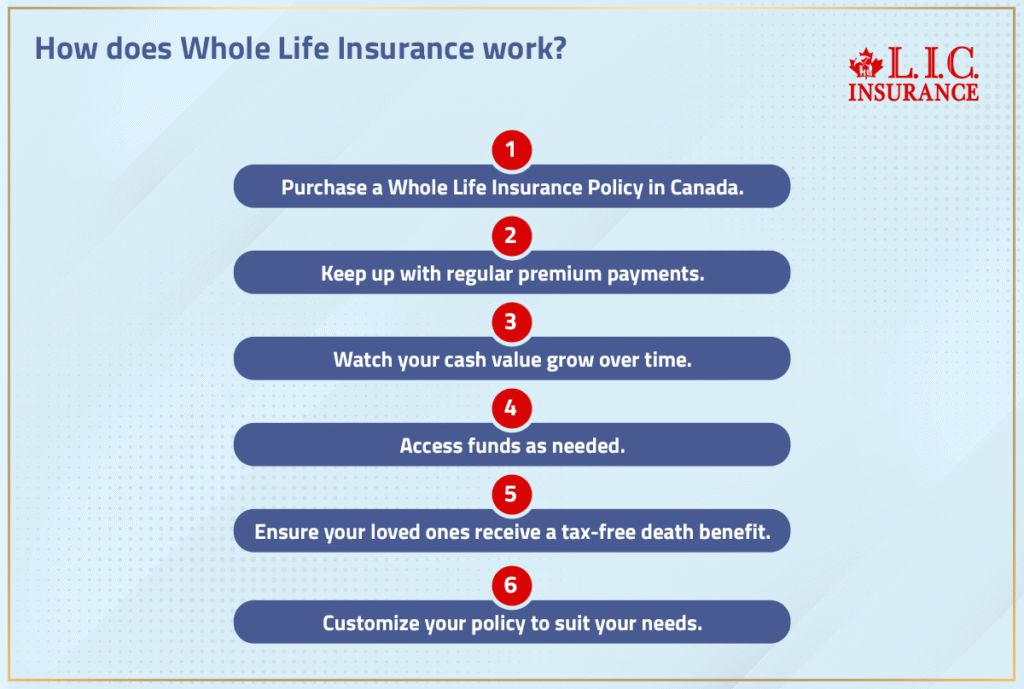
Whole life insurance functions as a contract where the insurer guarantees to pay a death benefit to designated beneficiaries upon the insured's death, provided all required premiums are paid. The policy is designed to remain in force for the insured's entire lifetime, differentiating it from term insurance which covers only a specified period. Premiums are fixed at the time of issue based on the insured's age and do not increase as they grow older. A portion of each premium payment is allocated to cover the cost of insurance, while the remainder contributes to the policy's cash value, which accumulates over time on a tax-deferred basis. Policyholders can access this cash value through policy loans or withdrawals, though outstanding loans reduce the death benefit if not repaid.
The policy reaches its maturity either upon the death of the insured or when the insured reaches the maturity age specified in the contract. Historically, the maturity age was 100, but policies issued since 2009 commonly use age 120 to reflect increased life expectancies. If the insured survives past this maturity age, the policy becomes a matured endowment, and the policy owner receives the face amount in cash. This payout may have different tax implications compared to a death benefit, as a matured endowment payout may incur income tax obligations. The level premium system ensures that early-year premiums are higher than the actual mortality cost, building a reserve that offsets the higher costs of insurance at advanced ages.
Types and Variations of Whole Life Policies
Whole life insurance policies in Canada come in several variations, primarily distinguished by how dividends are handled and the premium payment schedule. The two main types based on dividend participation are participating and non-participating policies. Participating policies, often issued by mutual insurance companies, allow policyholders to share in the insurer's divisible surplus through annual policy dividends. These dividends, considered a non-taxable return of premium, can be taken as cash, used to reduce premiums, or reinvested to purchase additional paid-up coverage, thereby increasing both cash value and the death benefit.
Non-participating policies have all values, including premiums, cash values, and death benefits, fixed at issue. The insurer assumes all actuarial risk regarding mortality, costs, and investment performance. Another variation is the indeterminate premium policy, which features adjustable premium rates based on current economic assumptions but with a maximum guaranteed premium cap defined in the contract. Beyond dividend structures, the premium payment schedule offers further variations. Limited-pay policies allow premiums to be paid over a shorter period, such as 10, 20, or 30 years, or until a specific age like 65, after which the policy remains in force for life without further payments.
- Participating Whole Life: Earns dividends based on company performance.
- Non-Participating Whole Life: All values are fixed and guaranteed at issue.
- Limited Pay Whole Life: Premiums paid for a set period (e.g., 10, 20 years).
- Lifetime Pay Whole Life: Premiums are paid for the insured's entire life.
- Single Premium Whole Life: Fully funded by one large upfront payment, typically between $25,000 and $500,000.
- Interest-Sensitive Whole Life: Credits interest based on market conditions with a guaranteed minimum floor rate.
Single premium whole life insurance involves a single lump-sum premium paid at inception, which fully funds the policy immediately. Interest-sensitive whole life policies credit interest based on prevailing market conditions instead of using a fixed dividend schedule. These policies also preserve guaranteed minimum floor rates and a fixed death benefit. The choice among these variations, such as limited pay or participating policies, depends on an individual's financial goals and cash flow. Some individuals may seek potential dividend income, while others may prefer guaranteed fixed values.
Cash Value, Loans, and Policy Access
The cash value is a fundamental component of a whole life policy, representing the legal reserves allocated to maintain the policy's guarantees. It accumulates at a contractually guaranteed interest rate in traditional policies, with participating policies having the potential for additional growth through dividends. Under standard non-forfeiture regulations, a policyholder who surrenders a policy is entitled to its accumulated surrender value, which can be received as a cash payout, used to purchase reduced paid-up insurance, or converted to extended term insurance. This cash value grows tax-deferred, meaning no tax is paid on the growth until it is withdrawn.
Policyholders can access the accumulated cash value on demand through policy loans or by surrendering the contract for its cash value. Policy loans are generally non-taxable as long as the policy remains active, making them a common method for accessing funds. However, these loans accrue interest, and if an outstanding loan balance exists at the time of the insured's death, the principal and accrued interest are subtracted from the total death benefit paid to the beneficiary. If a policy lapses or is surrendered with outstanding loans, any loan amount exceeding the cumulative premium basis becomes subject to income tax. This access provides liquidity, but it directly reduces the ultimate benefit for heirs.
Taxation Rules in Canada
The death benefit paid from a whole life insurance policy to a beneficiary is generally exempt from ordinary income tax in Canada. This tax-free status also extends to the internal gain accumulated within the cash value prior to the payout. However, different tax rules apply if the policy is accessed during the insured's lifetime. If a policy is surrendered prior to death, any proceeds received that exceed the total premiums paid into the policy are taxable as ordinary income. This is why policy loans are often preferred for accessing cash value, as loan proceeds are typically non-taxable provided the policy remains in force.
While death benefits are typically exempt from income tax, they may be subject to estate taxes if the insured retains incidents of ownership in the policy at the time of death. Irrevocable life insurance trusts, or ILITs, are commonly utilized in estate planning to exclude policy proceeds from the gross estate. It is crucial for policyholders to understand the tax implications of a policy maturing as an endowment. If the insured survives to the maturity age, the payout of the face amount may incur income tax obligations. This is different from a death benefit payout, which is generally exempt from ordinary income tax.
Primary Uses and Applications
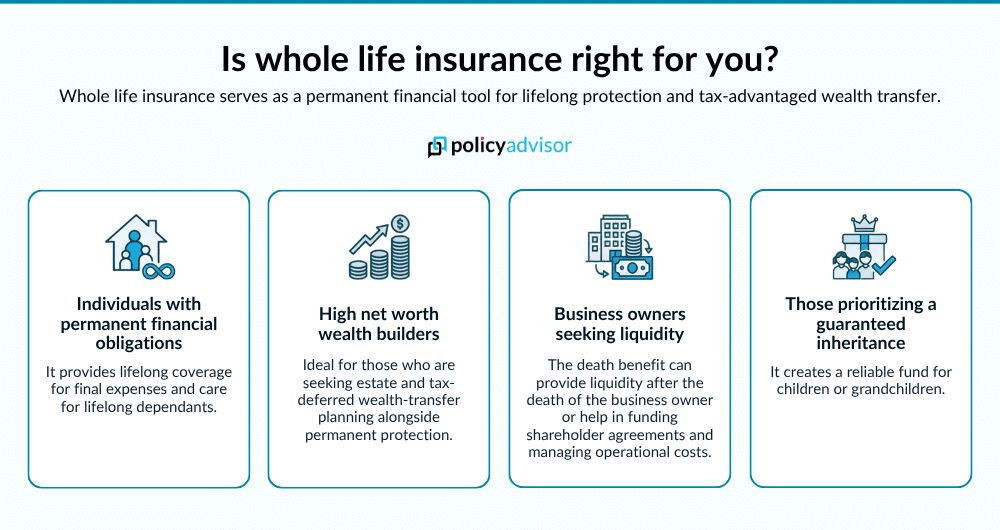
Whole life insurance is primarily used to cover permanent or long-term financial obligations where lifelong coverage is essential. For personal and family planning, common uses include covering funeral and final administrative expenses, providing estate liquidity to pay taxes or other liabilities, replacing income for a surviving spouse, and supplementing retirement planning. Due to its relatively high initial premium cost compared to term life insurance, it is less commonly recommended for short-term needs like covering temporary debt or income protection during child-rearing years. Its role is often more aligned with wealth preservation and transfer.
Businesses utilize whole life insurance for specific structural and executive planning purposes. Common commercial applications include funding buy-sell agreements among business partners to facilitate ownership transitions, key person insurance to indemnify the company against the financial loss from the death of a critical employee, and Supplemental Executive Retirement Plans (SERPs) or non-qualified deferred compensation plans. The cash value accumulation can also serve as a corporate investment asset. The guaranteed death benefit provides certainty for business succession plans, while the policy's cash value can offer corporate liquidity options.
Costs and Considerations for Canadians
The cost of whole life insurance in Canada is significantly higher than term life insurance, with premiums often cited as being up to 7.5 times more expensive for comparable coverage amounts. Premiums are based on factors including the insured's age, health, gender, and lifestyle habits such as smoking. Premiums are fixed at issue and remain level for the life of the policy, or for the designated payment period in a limited-pay plan. The high cost means individuals often must purchase less coverage to fit premiums into their budget, which can leave families with less protection than they might need.
Sample monthly premium quotes illustrate the cost differential. For instance, a whole life policy with $500,000 of coverage for a 28-year-old, non-smoking male can cost approximately $238 per month. In contrast, a term life policy for the same individual would be a fraction of that cost. For children, premiums are much lower, such as $58 per month for a $100,000 policy on a healthy 5-month-old girl, compared to $204 per month for a healthy, non-smoking 45-year-old woman seeking the same coverage. While the policy includes a savings component, it is not designed as a short-term investment, and policyholders are unlikely to get back the full amount of premiums paid if they surrender the policy early. The cash value grows slowly in the early years, and accessing it reduces the death benefit.
Whole life insurance premiums are fixed at issue and do not increase as the insured ages. For adults, the initial premiums are typically higher than those for term life insurance, with costs being a major consideration. Due to the relatively high initial premium requirements, whole life is less commonly used for short-term or temporary financial needs. Many financial advisors suggest whole life insurance is generally not the right choice for the average Canadian family. It is often considered better suited for high-net-worth individuals with specific estate planning or business needs.
Comparing Whole Life to Other Insurance Types
When comparing life insurance options in Canada, whole life is one form of permanent insurance, alongside universal life and term to 100. Term life insurance, by contrast, provides temporary coverage for a set period like 10, 20, or 30 years and has no cash value component. Term premiums are substantially lower, making it the most affordable type of life insurance and often recommended for covering temporary needs like a mortgage or dependent children. Whole life provides lifelong coverage with fixed premiums and guaranteed cash value growth, but at a much higher cost.
Universal life insurance is another type of permanent coverage but offers more flexibility than whole life. Universal life policies typically feature adjustable premiums and death benefits, and the cash value is invested in a tax-advantaged account where the policyholder often bears the investment risk. Whole life offers more predictability with its guaranteed cash value growth rate and fixed premiums. Term to 100 is a simpler form of permanent insurance that provides lifelong coverage but usually has no cash value or a minimal savings element, resulting in premiums that are higher than term but lower than traditional whole life. The choice between these products hinges on an individual's need for flexibility, risk tolerance, desire for savings, and budget.
Risks and Common Debates
A primary debate surrounding whole life insurance in Canada concerns its cost-effectiveness as a savings or investment vehicle. Critics argue that the high premiums could be more efficiently deployed by purchasing lower-cost term life insurance and investing the difference independently. The cash value inside a whole life policy grows at a guaranteed but often conservative rate, which may underperform potential returns from other investments over the long term, especially when fees and the cost of insurance are considered. Furthermore, the complexity of these policies, with features like dividends, loan provisions, and tax rules, can make them difficult for consumers to fully understand and manage.
Key risks for policyholders include the potential for the policy to lapse if premiums are not paid, resulting in the loss of coverage and possibly taxable income if the cash surrender value exceeds the premium basis. Policy loans, while useful, reduce the death benefit and can jeopardize the policy if not managed carefully. There is also insurer risk, as the financial strength of the company backing the policy is crucial for fulfilling long-term guarantees and paying dividends. While participating policies offer the potential for dividends, these are not guaranteed and can fluctuate based on the company's investment performance, expenses, and mortality experience. Consumers are advised to carefully assess their long-term financial goals and consult with a qualified advisor to determine if the guarantees and structure of whole life insurance align with their needs.
Frequently asked questions
What is the main difference between whole life and term life insurance?
The main difference is the duration of coverage. Whole life insurance provides permanent, lifelong coverage as long as premiums are paid, while term life insurance provides coverage only for a specific period, such as 10, 20, or 30 years. Whole life also includes a cash value savings component that grows tax-deferred, whereas term life has no savings element. Consequently, premiums for whole life insurance are significantly higher, often up to 7.5 times more expensive than term life for the same amount of coverage.
Is the death benefit from a whole life policy taxable in Canada?
No, the death benefit paid from a whole life insurance policy to a named beneficiary is generally exempt from ordinary income tax in Canada. This tax-free status also applies to any internal investment growth within the policy's cash value that is paid out as part of the death benefit. However, if the policy is surrendered during the insured's lifetime, any cash value received that exceeds the total premiums paid is subject to income tax. Furthermore, the death benefit may be subject to estate taxes or probate fees if the insured retains ownership of the policy.
What does 'participating' mean in whole life insurance?
A participating whole life insurance policy is one where the policyholder may receive annual dividends from the insurance company. These dividends represent a share of the company's surplus earnings from its participating account, based on investment performance, expenses, and mortality experience. Dividends are not guaranteed and can change annually. Policyholders can typically choose to receive dividends as cash, use them to reduce premium payments, or reinvest them to purchase additional paid-up insurance, which increases both the cash value and the death benefit.
Can I get my money back from a whole life insurance policy?
You can access the money accumulated in a whole life policy through policy loans or by surrendering the contract for its cash surrender value. However, you are unlikely to receive back the full total of premiums you paid, especially in the policy's early years, as a portion of each premium pays for the cost of insurance coverage. If you surrender the policy, you receive the cash value, which may be less than your total premiums. Policy loans are not taxable and do not require repayment, but any outstanding loan balance plus interest will be deducted from the death benefit paid to your beneficiaries.
What is a limited-pay whole life policy?
A limited-pay whole life policy allows you to pay premiums for a specified, shorter period rather than for your entire life. Common payment periods are 10 years, 20 years, or until a specific age like 65. After this period ends, the policy is considered paid up, and no further premiums are required, but the lifelong coverage and death benefit remain in force. The premiums during the payment period are higher than for a lifetime pay policy to compensate for the condensed payment schedule, but this option can be attractive for those who want to complete their financial obligation to the policy earlier in life.
Who is whole life insurance best suited for in Canada?
Whole life insurance is often best suited for Canadians who have long-term estate planning needs and are financially secure. Typical candidates include individuals with assets that may face significant taxes or fees upon death, those who have maximized contributions to other registered savings plans like RRSPs and TFSAs, and people seeking a guaranteed, tax-advantaged vehicle for wealth transfer to heirs. It is also used in business contexts for buy-sell agreements or key person insurance. Due to its high cost, it is generally not recommended as the first choice for average families seeking basic income replacement or debt coverage, where term life insurance is usually more appropriate.
Sources and further reading
- Whole life insurance (Wikipedia) en.wikipedia.org
- Guide to Whole Life Insurance in Canada policyme.com
- Comparing life insurance plans: Term, whole, or universal? bluecross.ca
- What is Whole Life Insurance and How Does it Work? serenialife.ca
- Whole Life Insurance in Canada rbcinsurance.com
- Compare Whole Life Insurance Quotes in Canada ratehub.ca
This article explains how things work and is not financial, tax or legal advice. Rules, limits and rates change, so check the current figures with the Canada Revenue Agency, your province or your financial institution before you act.