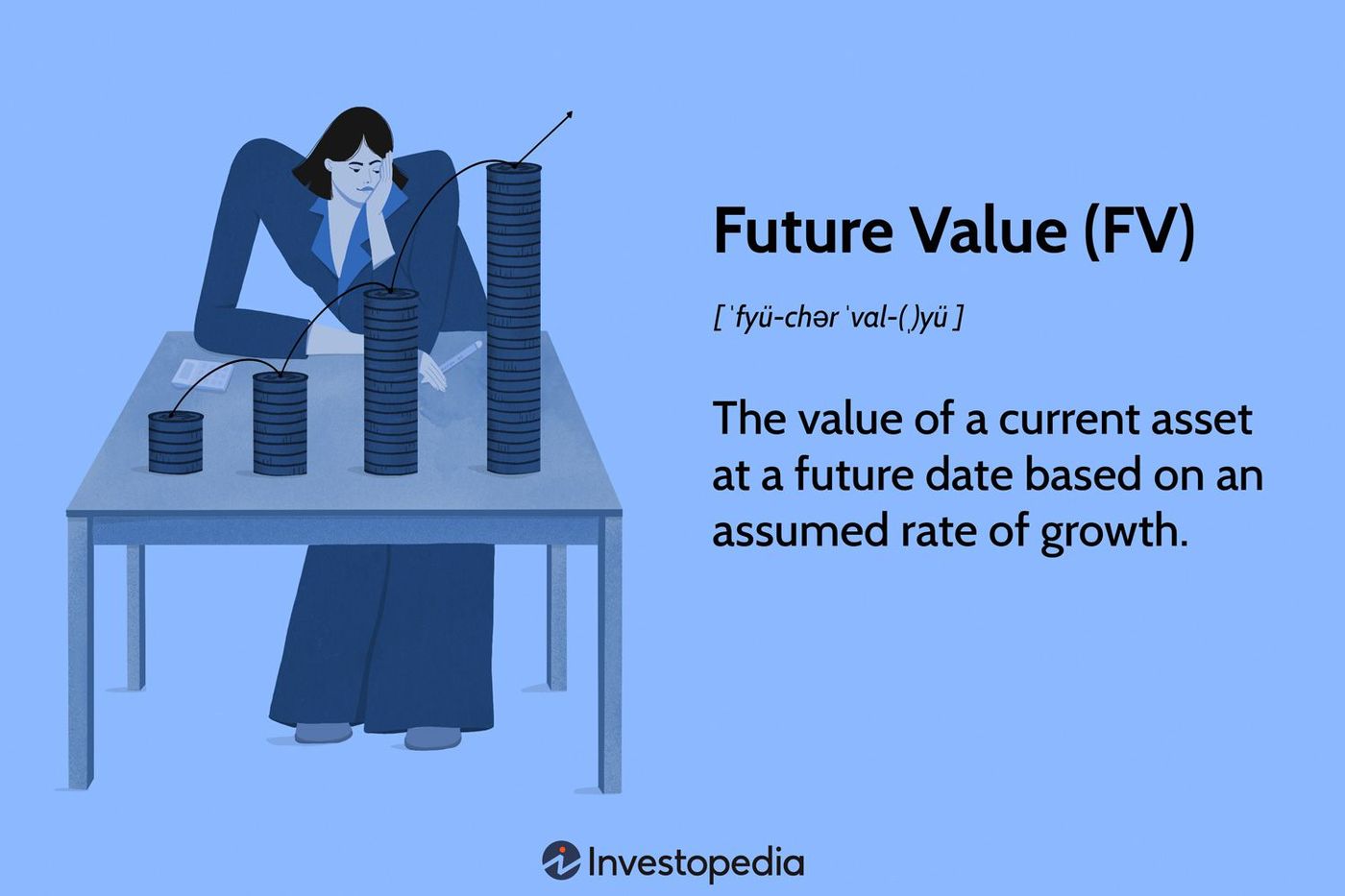
Future value is the projected worth of a current sum of money or series of cash flows at a specified future date, based on an assumed rate of return or interest rate. It is a core financial concept that illustrates the time value of money, which holds that money available today is worth more than the same amount in the future because it can be invested to earn a return. For Canadians, understanding future value is essential for planning savings goals, retirement, and major purchases by estimating how investments in accounts like TFSAs or RRSPs may grow over time. This principle is fundamental to personal financial decisions, loan agreements, and corporate investment analysis across the country.
Definition and Core Principles
Future value is a financial metric used to predict the amount an investment will grow to over a specified period, based on a projected rate of return. It is the value of a current sum of money or stream of cash flows at a specified date in the future, given an assumed interest rate. This concept directly reflects the time value of money, which holds that a sum of money has different value at different points in time because it can earn a return if invested. For instance, if 100 dollars is placed in a bank account that pays 5 percent interest per year, the balance after one year will be 105 dollars, making the future value 105 dollars. The idea helps individuals and firms decide whether to spend money now or defer spending by saving or investing, highlighting the opportunity cost of immediate consumption. In corporate and investment finance, future values are used together with present value to analyse long term projects and securities such as bonds and annuities.
Calculating Future Value with Simple and Compound Interest
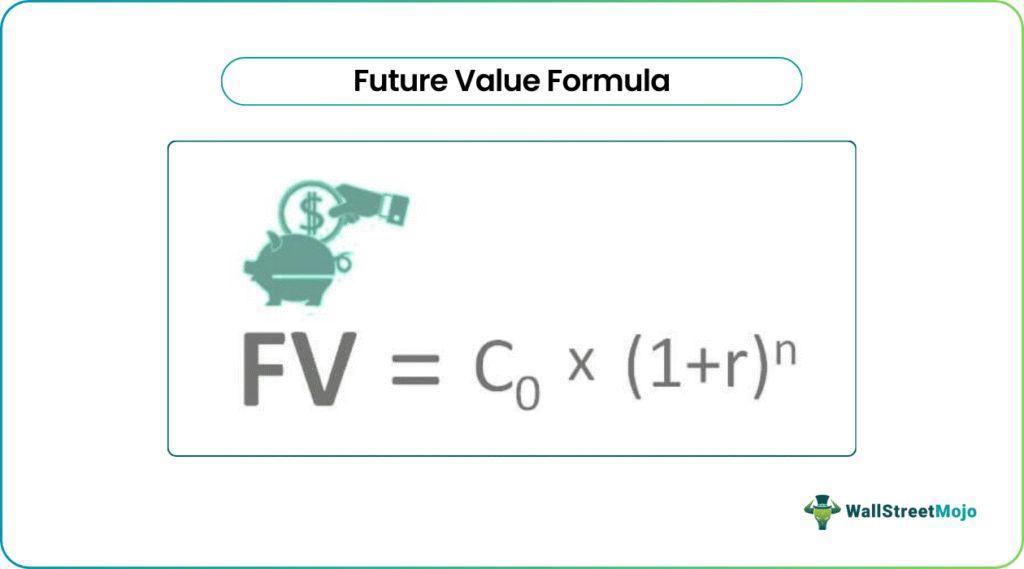
The method for calculating future value depends on whether interest is applied in a simple or compound manner. Simple interest is calculated only on the principal amount. The future value using simple interest is given by the formula FV = PV (1 + rt), where PV is the present value, r is the simple interest rate per time period in decimal form, and t is the number of time periods. For example, if 100 dollars earns simple interest at 5 percent per year for three years, the future value is 100 (1 + 0.05 × 3) = 115 dollars. The total interest earned is 15 dollars, and the growth is a linear function of time. Compound interest, which is far more common in modern finance, applies interest to both the principal and previously accrued interest. The future value under compound interest is calculated with the formula FV = PV (1 + i)^n, where i is the interest rate per compounding period and n is the number of compounding periods. For a given present value and interest rate, future value increases as the number of compounding periods increases, resulting in exponential growth over time. At an interest rate of 5 percent per year, a lump sum doubles in value in a little over fourteen years, a relationship approximated by rules like the Rule of 72.
Compounding Periods and Effective Rates
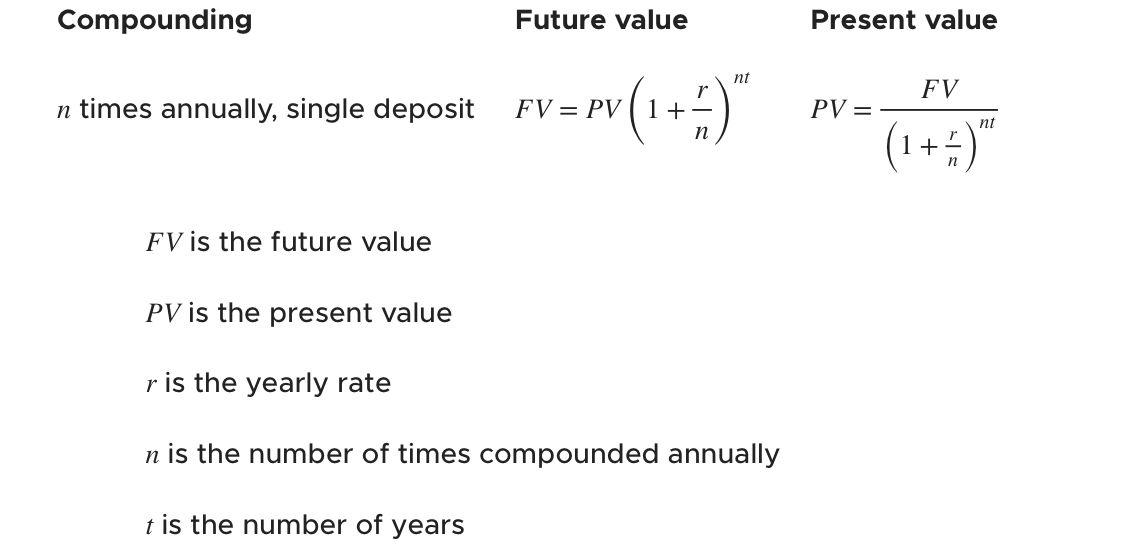
The frequency of compounding significantly impacts the final future value of an investment. If a stated nominal annual interest rate is j and interest is compounded m times per year, the interest rate per compounding period is j/m. The future value formula then becomes FV = PV (1 + j/m)^(mt), where t is the time in years. For example, an account with a nominal rate of 6 percent per year compounded twice a year has a periodic rate of 3 percent. The effective annual rate, which reflects the actual annual growth, is (1 + 0.03)^2 - 1, or approximately 6.1 percent. The general formula for the effective annual rate r when compounding m times per year is r = (1 + j/m)^m - 1. As compounding becomes more frequent, the effective rate increases. In the theoretical limit of continuous compounding at a nominal annual rate j, the effective annual rate is e^j - 1, and the future value formula is FV = PV × e^(jt). This represents the maximum growth possible for a given nominal rate.
Future Value of Annuities and Regular Contributions
Many savings plans involve making a series of regular payments, not just a single lump sum. The future value of an ordinary annuity calculates the worth of a stream of level payments made at the end of each period. The formula is FV_annuity = PMT × [(1 + r)^n - 1] / r, where PMT is the fixed payment amount, r is the interest rate per period, and n is the number of payments. This formula is central to planning for goals like retirement, where regular contributions are made to accounts like a Registered Retirement Savings Plan (RRSP) or a Tax Free Savings Account (TFSA). Calculators widely available online from Canadian financial institutions allow users to input an initial deposit, periodic deposit amount, frequency, rate of return, and compounding method to model these scenarios. It is important to note that these calculations are based on assumed rates of return, which cannot be predicted with certainty.
Key inputs for a future value calculation of an annuity or savings plan include the present value, the periodic interest rate, and the number of compounding periods. For an ordinary annuity, the future value formula also requires the fixed payment amount made at the end of each period. These inputs allow the calculation of how much a series of equal contributions to a savings or retirement account will be worth in the future. In personal finance, households use these variables to estimate how much money will be available at a target date from regular deposits.
- Initial Deposit: The present account balance or starting lump sum.
- Periodic Deposit (PMT): The fixed amount added regularly (e.g., monthly).
- Deposit Frequency: Options like weekly, bi weekly, monthly, quarterly, or annually.
- Timing of Deposits: Whether deposits are made at the beginning or end of each period.
- Rate of Return: The projected interest or investment yield per period.
- Compounding Frequency: How often interest is calculated and added (daily, monthly, annually).
- Time Horizon (n): The total number of periods until the target future date.
These variables allow individuals to model different savings strategies and compare potential outcomes for their financial goals. For example, a family saving towards a house deposit may compare different contribution amounts and time horizons by calculating the future value of regular monthly payments. In corporate finance, projected cash flows can be compounded to a common future date to compare investment alternatives. The concept helps individuals and firms decide whether to spend money now or to defer spending by saving or investing.
Applications in Canadian Personal Finance
Future value calculations are deeply integrated into personal financial planning in Canada. Households use them to estimate growth for savings goals like a house down payment, future education costs, or retirement. The future value of a single deposit or a series of regular deposits helps determine how much to save monthly to reach a target amount. Registered accounts like TFSAs and RRSPs are common vehicles for these calculations, as they offer tax advantages that can enhance effective returns. Canadian banks and investment firms provide online calculators to help clients project the future value of investments in these accounts. For example, a calculator might use historical data noting that the S&P 500 had an average annual compounded rate of return of approximately 11.3 percent from 1970 to 2025, though it stresses that past performance does not guarantee future results and that higher returns generally come with higher risk. These tools are for illustrative purposes only and are not specific financial advice. In consumer credit, future value concepts determine the outstanding balance of loans or the size of a final balloon payment, based on the interest rate and compounding terms in the loan agreement.
Important Considerations and Limitations
While future value is a powerful planning tool, several real world factors limit its predictive accuracy. A fundamental consideration is inflation, which erodes the purchasing power of money over time. A calculation using a nominal interest rate yields a nominal future value that does not adjust for inflation. For example, if 100 dollars earns a nominal 5 percent interest, the future value after one year is 105 dollars, but if inflation is 2 percent, the real value in terms of today's purchasing power is only about 103 dollars. Analysts often use real interest rates, adjusted for inflation, for more meaningful long term planning. Taxes are another critical factor, as investment returns in non registered accounts are subject to income tax, reducing the net future value. The assumed rate of return is itself a major source of uncertainty, as investment returns can vary widely. As noted in Canadian financial disclosures, the actual rate of return cannot be predicted with certainty, and investments offering higher potential returns are generally subject to higher risk and volatility, including the potential loss of principal. Future value calculations typically assume a constant interest rate over time, which rarely holds true in dynamic markets.
Historical Context and Financial Theory
The concept of future value is not new, it is a foundational element of finance and economics rooted in the understanding of the time value of money. The mathematical formulas for compound interest have been developed and refined over centuries. The core relationship FV = PV (1 + i)^n expresses exponential growth and is fundamental to discounted cash flow analysis, which is used to evaluate investment projects and securities. The development of formulas for annuities allowed for the analysis of structured payment streams, which became crucial for retirement and insurance products. In modern times, the proliferation of digital calculators and financial software has democratized access to these calculations. Canadian financial institutions routinely provide these tools to educate clients, though they accompany them with disclaimers noting the calculations are for general information and illustrative purposes only, not intended as specific financial advice. The underlying theory remains essential for understanding everything from mortgage amortization to the pricing of government bonds.
Using Future Value Calculators in Canada
Many online resources are available for Canadians to perform future value calculations. These calculators typically require inputs such as the initial investment amount, periodic contribution, contribution frequency, annual interest rate, number of years, and compounding frequency. The results show the projected future value, often accompanied by a growth chart. It is standard for these tools to include important disclosures about their limitations. For instance, they state that results are based on the accuracy of entered data, are for illustrative purposes only, and are not financial advice. They caution that users should consult with professional advisors before making decisions. Calculators may also provide context on historical returns, such as referencing the S&P 500's average annual compounded rate of return of 11.3 percent over a long period, while clearly noting the variability and risk involved. These tools are valuable for exploratory planning but are not a substitute for personalized financial advice that considers an individual's complete circumstances, risk tolerance, and tax situation.
Common features in Canadian future value calculators include the ability to calculate the future value of a single deposit or a stream of periodic deposits. These calculators typically request inputs such as the starting amount, an annual interest rate, the number of years, and a periodic deposit amount. They often produce a growth chart to display how an investment could grow over time. These tools are described as being for persons in Canada only and are for illustrative purposes based on the accuracy of the data entered.
- Inputs for initial deposit, periodic deposit, rate, time, and compounding.
- Options for deposit timing (beginning or end of period).
- Graphical displays of growth over time.
- Disclaimers that results are illustrative and not guaranteed.
- Notices that past performance does not predict future results.
- Warnings about investment risk and potential loss of principal.
- Recommendations to seek professional advice.
- Clarification that the provider is not liable for decisions based on the tool.
Understanding these tools and their limitations is key to using them effectively as part of a broader financial planning process. Basic future value calculations usually assume a constant interest rate over time and do not directly incorporate inflation, taxes, or uncertainty. The calculation is based on the accuracy and completeness of the data entered. For more complex planning, individuals may seek answers to financial questions and advice to help make the most of their money.
Frequently asked questions
How do you calculate future value in Canada for regular savings?
To calculate the future value of regular savings, like monthly contributions to a TFSA, you use the future value of an annuity formula: FV = PMT × [(1 + r)^n - 1] / r. PMT is your regular deposit amount, r is the interest rate per period (e.g., monthly rate if depositing monthly), and n is the total number of deposits. Many Canadian banks and financial websites offer online calculators that do this math for you. You input your initial deposit, regular contribution amount, contribution frequency, estimated annual rate of return, and time horizon. The calculator then projects the total future value, helping you plan for goals like retirement or a major purchase.
What is the difference between future value and present value?
Future value and present value are two sides of the same coin, both based on the time value of money. Future value calculates what a current amount of money will be worth at a specific future date, given a rate of return. Present value does the reverse, it determines the current worth of a sum of money to be received in the future, discounted by a rate of return. While future value compounds money forward in time, present value discounts it backward. Both concepts are essential for comparing investment options, evaluating loans, and making long term financial decisions, and they form the backbone of discounted cash flow analysis in corporate finance.
How does inflation affect future value calculations?
Inflation reduces the purchasing power of money over time, which means a nominal future value amount will buy less in the future than it could today. Standard future value calculations using a nominal interest rate do not account for inflation, they show the raw dollar amount. To understand the real future value, or purchasing power, you must consider the real interest rate, which is approximately the nominal rate minus the inflation rate. For instance, if your investment earns a nominal 5 percent but inflation is 2 percent, your real rate of return is about 3 percent. Some advanced calculators allow you to input an inflation rate to see the future value in today's dollars, providing a more realistic picture of your savings' future worth.
Why is the compounding frequency important for future value?
The compounding frequency, or how often interest is calculated and added to the account, directly impacts the final future value. More frequent compounding leads to a higher effective annual rate and greater growth. For example, an investment with a 6 percent nominal annual rate will grow more if interest is compounded monthly instead of annually, because interest earned in earlier months starts earning its own interest sooner. The formula FV = PV (1 + j/m)^(mt) accounts for this, where m is the number of compounding periods per year. In Canada, savings accounts, guaranteed investment certificates (GICs), and other products specify their compounding frequency, which investors should consider when comparing options.
Are online future value calculators accurate for financial planning?
Online future value calculators are useful tools for illustration and initial planning, but their accuracy for real world financial planning is limited. They provide projections based on the inputs you supply, most critically the assumed rate of return, which is uncertain and cannot be predicted. Canadian financial institutions clearly state that calculator results are for general information purposes only, are not guaranteed, and do not constitute financial advice. They do not account for individual factors like taxes, changing income, variable market returns, or investment fees. For accurate financial planning, Canadians should use these calculators as a starting point and then consult with a qualified financial advisor who can consider their full personal circumstances and the risks involved.
What is the future value formula for compound interest?
The fundamental formula for the future value (FV) of a single lump sum using compound interest is FV = PV (1 + i)^n. In this formula, PV represents the present value or initial principal, i is the interest rate per compounding period expressed as a decimal, and n is the total number of compounding periods. This formula reflects exponential growth because interest is earned on both the principal and previously accrued interest. For example, at an interest rate of 5 percent per year, a lump sum doubles in value when (1 + 0.05)^n = 2, which corresponds to a doubling time of a little over fourteen years. The formula can be adapted for multiple compounding periods per year, written as FV = PV (1 + j/m)^(mt), where j is the nominal annual rate and m is the number of compounding periods per year. This core calculation is widely used in personal finance for savings goals and in corporate finance for analysing long term investments.
Sources and further reading
- Future value (Wikipedia) en.wikipedia.org
- Future Value Calculator calculator.net
- Future Value Calculator rbcroyalbank.com
- Investment Calculator bankofcanada.ca
- Future Value Calculator dinkytown.net
- Compound Interest Calculator | Saving & Investing td.com
This article explains how things work and is not financial, tax or legal advice. Rules, limits and rates change, so check the current figures with the Canada Revenue Agency, your province or your financial institution before you act.