Compound interest is the interest calculated on the initial principal sum and on the accumulated interest from previous periods. It is a fundamental financial concept that allows savings and investments to grow exponentially over time. In Canada, compound interest is central to many financial products, including savings accounts, Guaranteed Investment Certificates (GICs), and mortgage loans. Understanding how it works is crucial for personal financial planning, as the frequency of compounding and the time horizon significantly impact growth. This article explains the mechanics, history, and specific Canadian applications of compound interest.
What is Compound Interest?
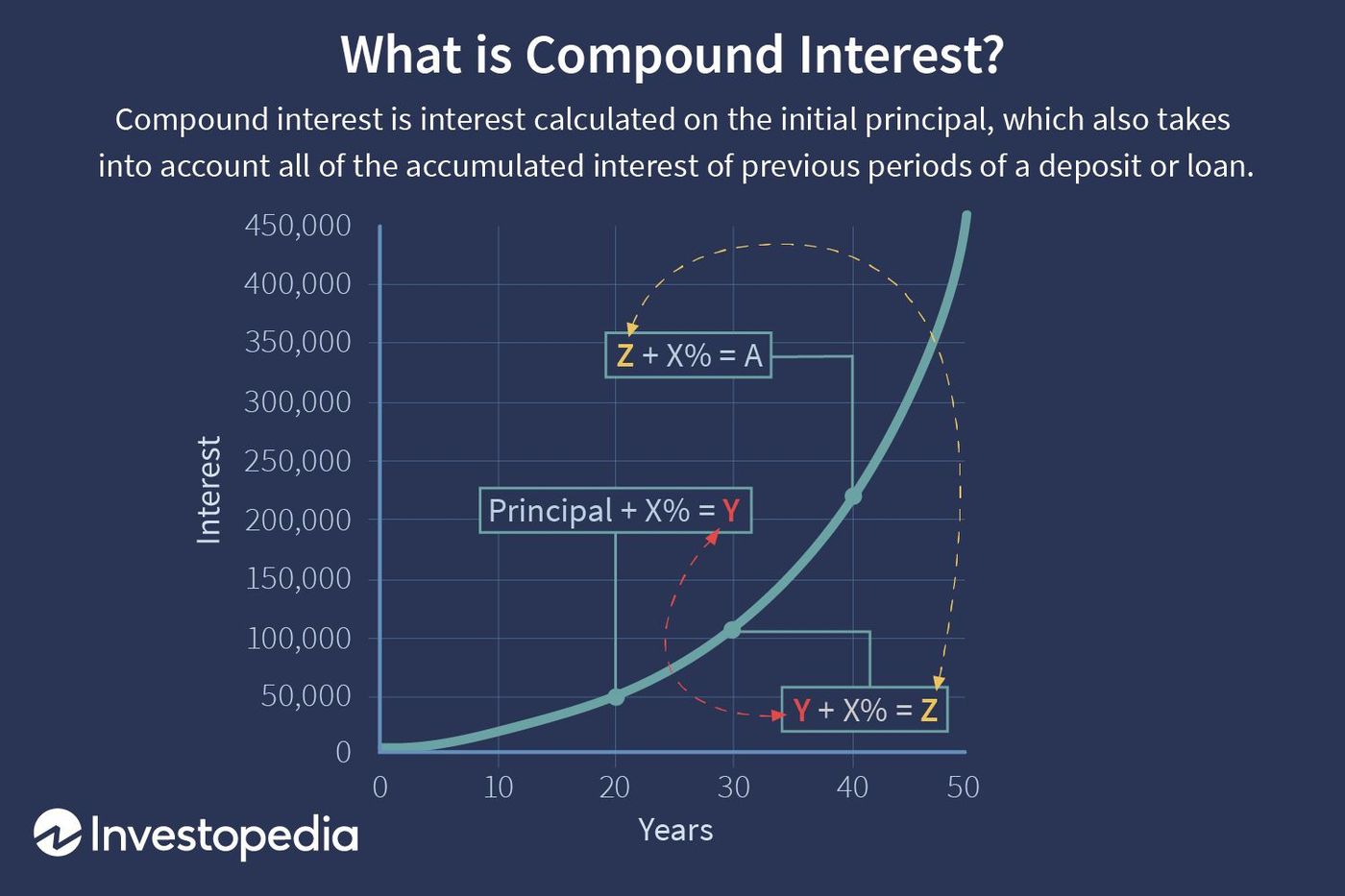
Compound interest, historically called anatocism, is interest accumulated from a principal sum plus previously accumulated interest. It is the result of reinvesting or retaining interest that would otherwise be paid out, allowing the total balance to grow at an accelerating rate. This concept is contrasted with simple interest, where interest is calculated only on the original principal amount for each period. The power of compound interest lies in the 'interest on interest' effect, which can turn modest savings into significant sums over long periods. In the Canadian context, compound interest is a powerful force in finance, fundamental to products like savings accounts, GICs, and long-term investment growth.
The process of compounding depends on two key factors: the simple interest rate applied and the frequency at which the interest is compounded. When interest is compounded, it is added to the principal balance, and future interest calculations are based on this larger amount. This creates a snowball effect where growth builds upon itself. For investors and savers, this means that the longer money remains invested and the more frequently interest compounds, the greater the final accumulation will be. Compound interest is often described as the eighth wonder of the world due to its powerful long-term effects.
In everyday Canadian finance, a common example of compound interest is a savings account where interest earned each month is added to the account balance. This increases the principal sum used for calculating the next month's interest. For a non-cashable Guaranteed Investment Certificate (GIC), interest is typically calculated on the original deposit and compounded on an annual basis. The total accumulated amount, including all compounded interest, is then paid out at the instrument's maturity.
How Compound Interest Works: The Formula and Calculation
The mathematical formula for calculating compound interest is A = P(1 + r/n)^(nt). In this formula, A represents the final accumulated amount, including principal and interest. P is the original principal sum, or the initial amount of money invested or saved. The variable r is the nominal annual interest rate expressed as a decimal, for instance, 5% becomes 0.05. The letter n stands for the compounding frequency, which is the number of times per year that interest is calculated and added to the principal. Finally, t is the overall length of time the interest is applied, usually measured in years.
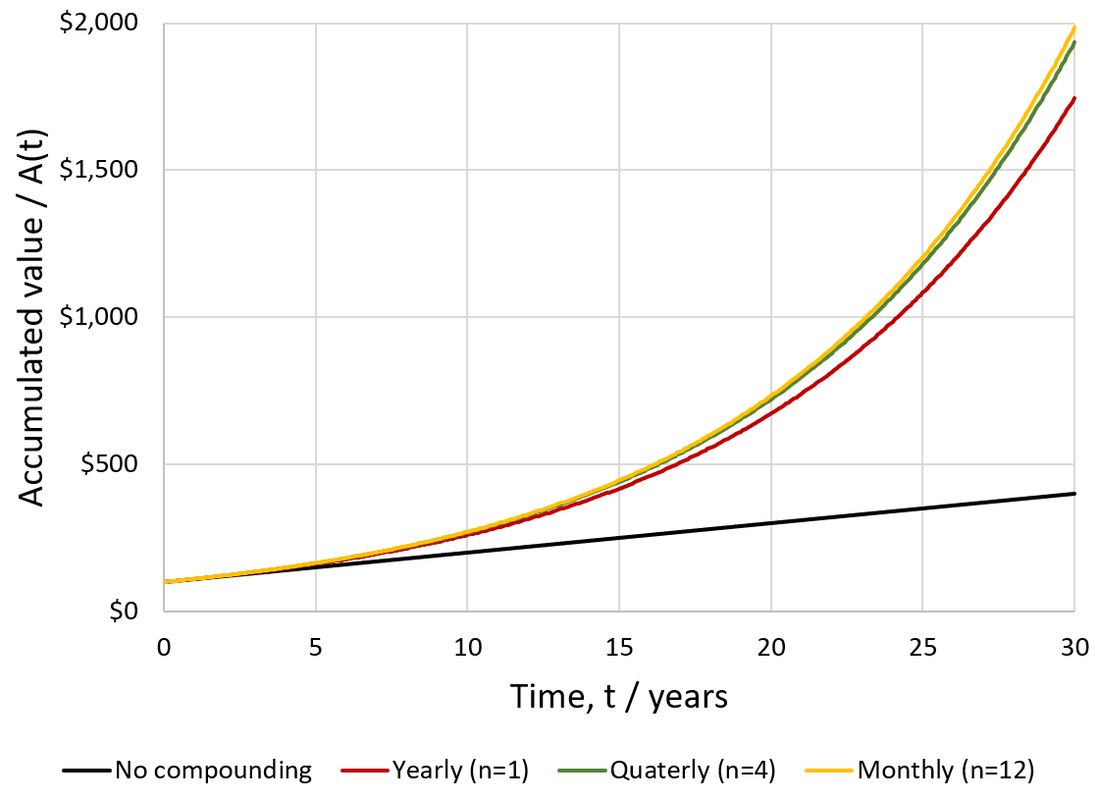
To find the total compound interest generated alone, you subtract the initial principal from the final amount: I = P(1 + r/n)^(nt) - P. For example, if you invest $1,000 at a 5% annual interest rate compounded annually for two years, the calculation is A = 1000(1 + 0.05/1)^(1*2) = $1,102.50. This demonstrates how the second year's interest is calculated on $1,050, not just the original $1,000. While this formula can be used manually, most people use online compound interest calculators to quickly estimate growth based on rate, frequency, and time. The compounding frequency (n) has a significant impact on the final amount. Common frequencies include annual (n=1), semi-annual (n=2), quarterly (n=4), monthly (n=12), weekly (n=52), and daily (n=365). Generally, the more frequently interest is compounded within a given year, the higher the effective yield will be. For instance, $5,000 invested at 5% interest would grow to slightly more after one year if compounded monthly versus compounded annually. To compare products with different compounding schedules, financial institutions in Canada are required to disclose an annual equivalent rate.
Annual Equivalent Rate and Compounding Frequency
To allow consumers to compare retail financial products fairly, Canadian regulations require the disclosure of an annualized compound interest rate on a comparable basis. This rate is known by several names, including the Annual Equivalent Rate (AER), Effective Annual Percentage Rate (EAPR), Effective Annual Rate, and Annual Percentage Yield (APY). The effective annual rate is the total accumulated interest payable up to the end of one year, divided by the principal sum. It provides a standardized way to understand the true annual return, accounting for the compounding frequency and any associated fees or charges other than interest.
The relationship between the stated nominal rate and the effective annual rate depends entirely on how often interest is compounded. A nominal annual rate of 5% compounded monthly will yield a higher effective annual rate than the same nominal rate compounded annually. The formula to convert a nominal rate with a given compounding frequency to an equivalent rate with a different frequency is r2 = [(1 + r1/n1)^(n1/n2) - 1] * n2. This allows for direct comparison between, for example, a monthly-compounding savings account and a quarterly-compounding GIC. For consumers, looking at the AER or APY is the best way to assess which savings or investment product offers the better return.
Common compounding frequencies for Canadian financial products include annual, semi-annual, monthly, and daily compounding. Interest compounded annually is calculated and added once per year, common for some GICs and bonds. Semi-annual compounding, used twice a year, is the standard for Canadian fixed-rate mortgage loans. Monthly compounding is typical for high-interest savings accounts, while daily compounding, though sometimes paid monthly, is used by some savings accounts to maximize growth. The choice of frequency can affect the speed at which an investment grows, with more frequent compounding generally leading to faster accumulation, all else being equal.
History of Compound Interest
The concept of compound interest was known to ancient civilisations. The first traces of mathematical analysis of it are from the medieval era, with a potential example being a Babylonian clay tablet from about 2000 to 1700 B.C. In many societies, compound interest when charged by lenders was once regarded as the worst kind of usury. It was severely condemned under Roman law and the common laws of many other countries. The Florentine merchant Francesco Balducci Pegolotti provided a table of compound interest in his book Pratica della mercatura from about 1340. His table gives the interest on 100 lire for rates from 1 percent to 8 percent for up to 20 years.
A major milestone came in 1494 with Luca Pacioli's *Summa de arithmetica*, which included the Rule of 72 for estimating the time required for an investment to double at a given compound interest rate. The first book wholly devoted to the subject was Richard Witt's *Arithmeticall Questions*, published in London in 1613. Witt's work was a landmark for its clarity, depth, and accuracy, featuring 124 worked examples and tables based on 10% interest, which was then the legal maximum rate on loans. Later, in 1683, Jacob Bernoulli discovered the mathematical constant *e* through studying a question about continuous compound interest. In the 19th century, and possibly earlier, Persian merchants used a slightly modified linear Taylor approximation to the monthly payment formula that could be computed easily in their heads.
Compound Interest in Canadian Financial Products
Compound interest is a foundational element across a wide range of Canadian financial products and regulations. Its application varies by product type, influencing how consumers save, borrow, and invest. Understanding these applications is key to making informed financial decisions within the Canadian market. Savings accounts and Guaranteed Investment Certificates (GICs) operate on compound interest, with interest calculated on the principal and on previously earned interest, typically compounded monthly or annually. GIC interest rates are set by financial institutions based on market conditions, including the prime rate, and are usually fixed for the term.
Tax-advantaged accounts like Tax-Free Savings Accounts (TFSAs) and Registered Retirement Savings Plans (RRSPs) use the power of compound interest to grow savings without the drag of annual taxes on investment income. Canadian fixed-rate mortgage loans are generally compounded semi-annually, not in advance, which means the annual interest rate is divided by two for each compounding period. Payments are typically made monthly or more frequently, and these payments are applied to both interest and principal in an amortizing schedule. For other loans like personal loans or lines of credit, interest may be compounded monthly, increasing the cost of borrowing if the interest is not paid promptly. The following table illustrates how different compounding frequencies affect a $10,000 investment at a 5% nominal annual rate over one year. This table shows that while differences may seem small in the short term, they become magnified over longer periods and with larger principal amounts.
Key Rules and Tools for Estimation
Several rules and mathematical concepts help simplify the understanding and estimation of compound interest effects. The most famous of these is the Rule of 72, a handy mental shortcut for estimating the time required for an investment to double at a given annual compound interest rate. To use the rule, you divide 72 by the annual interest rate. The result is the approximate number of years needed to double the money. For example, at a 6% return, it would take roughly 12 years (72 ÷ 6) to double an investment. This rule is useful for quick comparisons and for visualizing the long-term power of compounding.
Another important concept is continuous compounding, which represents the theoretical limit as the number of compounding periods per year increases infinitely. While not commonly used in consumer banking, continuous compounding is a mathematical model applied in certain advanced financial fields, such as the valuation of derivatives. The force of interest, denoted by the Greek letter delta (δ), is the continuously compounded interest rate and is related to the annual rate by δ = ln(1 + r). For calculating loan payments, such as for an amortized mortgage, a different formula is used: c = rP / (1 - (1 + r)^-n), where c is the periodic payment, P is the principal, r is the periodic interest rate, and n is the total number of payments. This formula determines the level payment needed to pay off both interest and principal over the loan term. In spreadsheets, the PMT function performs this calculation. An approximate formula for typical interest rates is c ≈ Pr / (1 - e^(-nr)), which is accurate for most Canadian mortgage scenarios.
Risks, Considerations, and Common Debates
While compound interest is a powerful tool for wealth accumulation, it also carries risks and considerations, particularly in the context of debt. When applied to loans and credit products, compound interest can cause debts to balloon rapidly if payments are missed or only minimum payments are made. This is because unpaid interest is added to the principal balance, and future interest is calculated on this higher amount. Credit card debt is a prime example of how compound interest can work against consumers, making it crucial to understand the compounding frequency and annual percentage rate on any borrowed funds.
Another key consideration is the impact of fees and taxes, which can erode the benefits of compounding. Management fees on investment funds, transaction costs, and annual account fees reduce the effective net return. Similarly, taxes on interest, dividends, or capital gains, unless sheltered within a TFSA or RRSP, diminish the principal amount available for future compounding. Inflation is a further silent risk. For compounding to generate real wealth, the rate of return must outpace the rate of inflation over the long term. Otherwise, the purchasing power of the accumulated savings may decline even as the nominal balance grows.
Debates often centre on the ethical and regulatory history of compound interest, given its past condemnation as usury. Modern regulations, including Canada's requirement to disclose the Annual Equivalent Rate (AER), aim to provide transparency and protect consumers. A practical debate for investors is the trade-off between seeking higher compounding frequencies and the actual difference it makes in returns, especially when weighed against other factors like liquidity, risk, and investment flexibility. Ultimately, the most significant factor in harnessing compound interest is time, making an early start one of the most effective strategies for long-term financial growth.
Essential Factors for Maximizing Compound Growth
Long-term investment growth with compounding depends on several key variables that investors can influence. These factors determine how quickly savings can accumulate and are central to financial planning strategies in Canada. The rate of return is the primary driver, as higher rates accelerate growth exponentially. The length of time you stay invested is equally critical, as compounding needs years or decades to reach its full potential. How often earnings are reinvested, known as the compounding frequency, also plays a role, with more frequent compounding generally yielding better results. Finally, the consistency of your contributions can dramatically increase the final amount by continually adding to the principal base that earns interest.
- Rate of Return: The higher the interest or investment return, the faster the accumulation.
- Time Horizon: The longer money remains invested, the more powerful the compounding effect.
- Compounding Frequency: More frequent compounding (e.g., monthly vs. annually) increases growth.
- Consistent Contributions: Regular additions to the principal amplify the base for future compounding.
- Low Fees and Taxes: Minimizing costs preserves more capital to compound.
- Inflation Rate: Returns must outpace inflation to generate real wealth growth.
- Market Participation: Staying invested through market cycles allows returns to build on themselves.
- Early Start: Beginning to save or invest early maximizes the time factor.
Growth accelerates most effectively when these factors align, such as when fees and taxes are low and returns consistently outpace inflation. The process works best when you stay invested through market ups and downs so your returns can build on themselves over time. Using registered accounts like TFSAs and RRSPs can address the tax factor, while choosing low-cost investment vehicles helps manage fees. Ultimately, understanding and optimizing these factors can help Canadians harness the full power of compound interest for their financial goals.
Comparison with Simple Interest and Practical Examples
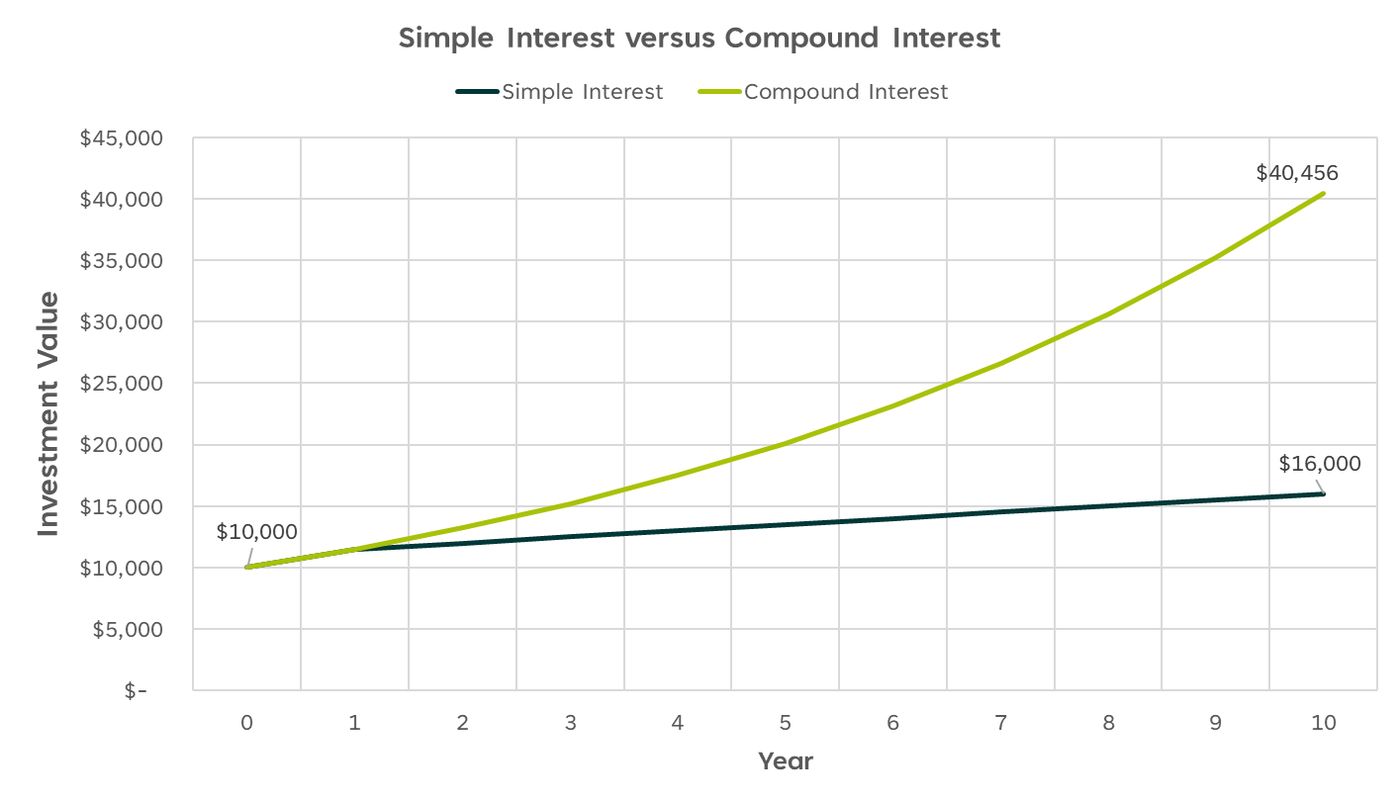
Understanding compound interest requires a clear contrast with its foundational counterpart, simple interest. Simple interest is calculated only on the original principal amount throughout the entire investment or loan term. It is found by multiplying the daily interest rate by the original amount, then by the number of days between payments. Simple interest is common for basic loans and is usually measured with the Annual Percentage Rate (APR), which shows the interest for a whole year. Unlike compound interest, compounding periods have no effect on simple interest, as there is no compounding frequency to increase or decrease the total.
Here is a detailed comparison of how $100 grows at a 5% annual rate over three years under both systems. With compound interest compounded annually, the growth is different. After the first year, the balance is $105, earning $5 in interest. After the second year, interest is calculated on $105, yielding $5.25 for a new total of $110.25. After the third year, interest is calculated on $110.25, earning $5.51 and resulting in a final balance of $115.76. Over time, this difference becomes vast, demonstrating why compound interest yields significantly more.
The key differences between the two systems can be summarized in a list of defining characteristics. Compound interest is calculated on the initial principal and all accumulated interest from prior periods, leading to exponential growth. Its effective yield increases with a higher compounding frequency. In contrast, simple interest is calculated solely on the original principal amount, resulting in linear growth that is unaffected by compounding frequency. Compound interest is typically expressed using the Annual Equivalent Rate (AER) or Annual Percentage Yield (APY), while simple interest is typically expressed using the Annual Percentage Rate (APR). Compound interest is fundamental to savings, investments, and most loans in Canada, whereas simple interest is more common for short-term or informal lending arrangements.
Frequently asked questions
What is the compound interest formula?
The formula for the total accumulated value with periodic compounding is A = P(1 + r/n)^(tn). In this formula, A is the final amount, P is the original principal sum, r is the nominal annual interest rate, n is the compounding frequency, and t is the overall length of time the interest is applied. The total compound interest generated is the final amount minus the initial principal. Therefore, the interest I can be calculated as I = P(1 + r/n)^(tn) - P.
How does compound interest work in Canada?
In Canada, compound interest is applied to many financial products. Savings accounts and Guaranteed Investment Certificates (GICs) typically compound interest monthly or annually. Canadian fixed-rate mortgage loans are generally compounded semi-annually, with payments made monthly. Registered accounts like TFSAs and RRSPs leverage compound interest for long-term growth by reinvesting earnings. Financial institutions must disclose an Annual Equivalent Rate (AER) to help consumers compare products fairly.
What is the difference between compound interest and simple interest?
Compound interest is calculated on the initial principal and also on the accumulated interest from previous periods, leading to exponential growth. Simple interest is calculated only on the original principal amount throughout the entire term. For example, $100 at 5% simple interest earns $5 each year. With compound interest at 5% annually, the first year earns $5, the second year earns $5.25 (on $105), and the third year earns $5.51 (on $110.25). Over time, compound interest yields significantly more.
How do I calculate compound interest on a savings account?
To calculate compound interest on a savings account, you need the principal amount, the annual interest rate, the compounding frequency, and the time period. Use the formula A = P(1 + r/n)^(nt). For instance, for $15,000 earning 5% annual interest compounded monthly for 30 years, you would calculate A = 15000(1 + 0.05/12)^(12*30). Most people use an online compound interest calculator, entering these details to quickly see the projected growth of their savings.
What is the Rule of 72?
The Rule of 72 is a simple way to estimate how long it will take for an investment to double at a given annual compound interest rate. You divide 72 by the annual interest rate percentage. For example, at a 6% return, it would take about 12 years (72 ÷ 6) for your money to double. This rule highlights the power of compounding and is useful for quick mental estimates when planning long-term savings or comparing investment returns.
Can you give a simple compound interest example?
A simple example is investing $1,000 at a 5% annual interest rate compounded annually for 3 years. This demonstrates the core principle of compound interest, where interest is earned on both the initial principal and the accumulated interest from prior periods. After the first year, the value grows to $1,050. In the second year, interest is calculated on this new amount, yielding $1,102.50. The process repeats in the third year, leading to the final total.
Sources and further reading
- Compound interest (Wikipedia) en.wikipedia.org
- Compound Interest Calculator | Saving & Investing td.com
- Compound Interest Calculator investor.gov
- Investment Calculator bankofcanada.ca
- Compound Interest Calculator ratehub.ca
- What is compound interest? How it works wealthsimple.com
This article explains how things work and is not financial, tax or legal advice. Rules, limits and rates change, so check the current figures with the Canada Revenue Agency, your province or your financial institution before you act.