A charitable gift annuity is a planned giving arrangement where a donor makes an irrevocable gift to a registered charity in exchange for a guaranteed lifetime income stream and a charitable tax receipt. In Canada, this vehicle allows individuals, typically aged 65 and older, to support causes they care for while securing a stable, often tax-advantaged income. The remaining funds after the donor's death go to the charity, creating a lasting legacy. This tool blends philanthropy with personal financial planning, offering a structured way to give while receiving.
How a Charitable Gift Annuity Works
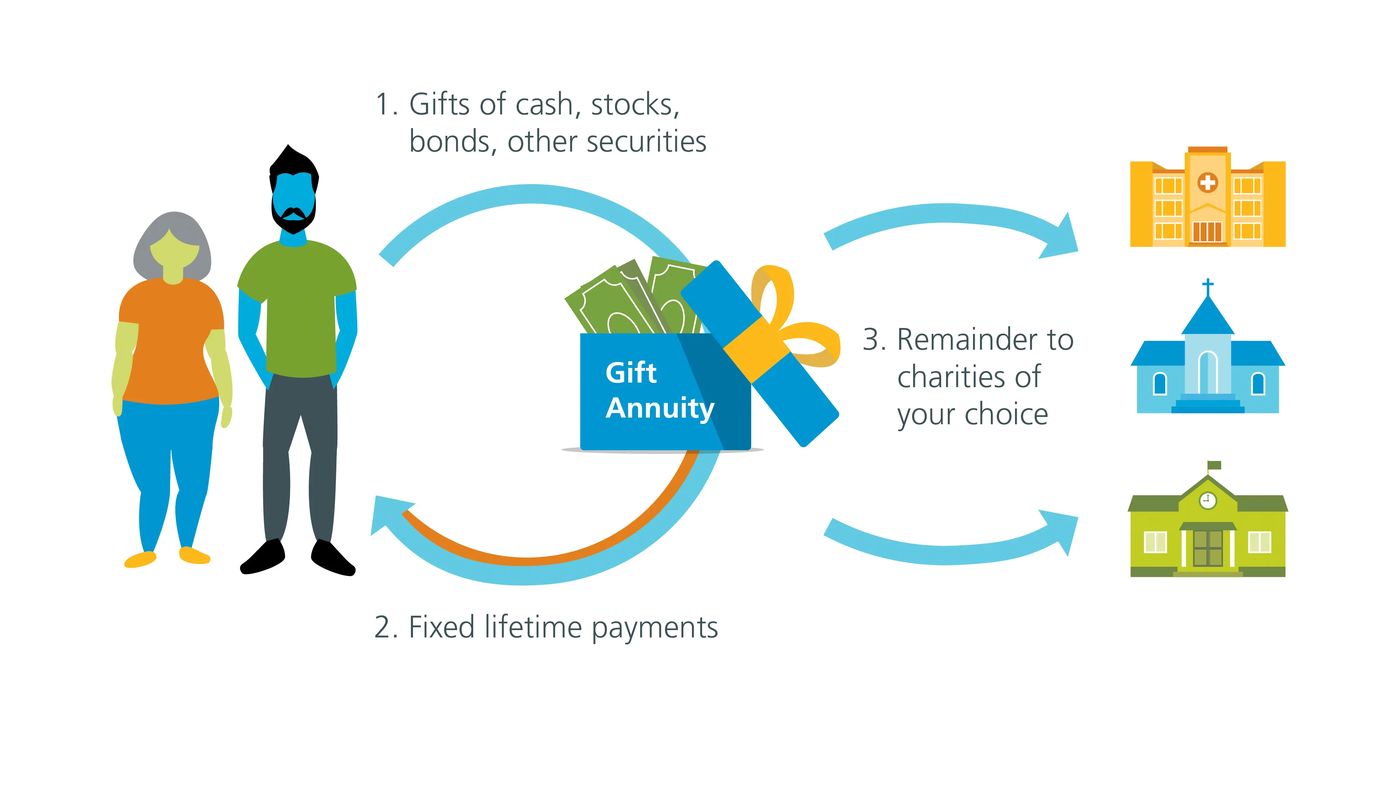
A charitable gift annuity is a contract between a donor and a registered charity. The donor transfers a lump sum of cash or marketable securities to the charity. In exchange, the charity agrees to make fixed, guaranteed payments to the donor for the rest of their life, or for the lives of two individuals in a joint arrangement. The annuity payments are calculated based on the donor's age, the annuity payout rate, and the amount of the contribution, typically yielding an annual income of between 5% and 10% of the initial gift. The start of payments is usually immediate, though some charities offer deferred annuities where payments begin at a future date. Upon the death of the annuitant or the second annuitant in a joint plan, the charity retains the remaining value of the contributed assets, known as the residuum, for its charitable purposes.
The financial mechanics involve splitting the donor's contribution into two parts. A portion is used to fund the lifetime income stream, while the remainder constitutes an immediate charitable gift. For example, with a $100,000 contribution, approximately $52,000 might be used to purchase the annuity that generates the lifetime payments, while the remaining $48,000 is the charitable donation. The donor receives an immediate charitable income tax receipt for the gift portion, which is a minimum of 20% of the total contribution. The older the donor is at the time of the gift, the larger the charitable receipt tends to be, as the estimated cost of the lifetime payments is lower.
The annuity payments themselves have a favourable tax structure in Canada. All or a substantial portion of each annuity payment is considered a tax-free return of capital. Only the interest portion of the payment is taxable as income. This structure often results in a higher after-tax income compared to fully taxable investments like Guaranteed Investment Certificates. The donor is relieved of investment management duties, as the charity handles the funds and sends payments automatically at regular intervals such as quarterly, semi-annually, or annually.

History and Structure in Canada
Charitable gift annuities have a history spanning one hundred years in Canada. They are offered by various registered charities, including major organizations like the Canadian Red Cross, Diabetes Canada, universities, and religious institutions such as The Presbyterian Church in Canada. The Canadian Charitable Annuity Association is the national organization that sets recommended standards and rates for these agreements, and member charities like Link Charity adhere to its ethics and guidelines. The federal government has introduced numerous pieces of tax legislation since 1995 to facilitate charitable giving, which supports the use of tools like gift annuities.
There are two primary structures for administering charitable gift annuities in Canada: self-insured and reinsured arrangements. In a self-insured annuity, the charity itself invests the contributed assets and uses its own resources to guarantee the lifetime payments to the donor. This model is common among larger, often religious, institutions that have the financial capacity and authority to issue such contracts. The charity pledges its assets as security for the payments. Upon the donor's death, the charity retains whatever remains of the original contribution after fulfilling the payment obligations, which can be 50% or more depending on investment performance and the donor's longevity.
The reinsured model, sometimes called a Gift Plus Annuity, involves the charity using a portion of the donation to purchase a commercial life annuity from a top-rated insurance company on the donor's behalf. In this case, the charity typically retains 25% to 30% of the contributed amount for its immediate charitable purposes. The balance is used to buy the commercial annuity, which then provides the guaranteed lifetime payments to the donor. If the charity purchases an annuity with a guarantee period and the donor dies before its end, the charity receives the remaining payments. The tax benefits to the donor are identical under either the self-insured or reinsured model.
Financial Benefits and Tax Treatment
The financial appeal of a charitable gift annuity in Canada rests on three pillars: guaranteed lifetime income, significant tax savings, and philanthropic impact. The guaranteed income is fixed and does not fluctuate with market conditions, providing peace of mind. Annuity payout rates are often higher than the interest rates paid on GICs and Canada Savings Bonds. For instance, a life annuity might provide a return rate of about 5%, which was noted as being much higher than bank rates on a 10-year GIC. This reliable income is especially valuable for individuals on a fixed income.
The tax treatment is highly advantageous. The donor receives an immediate charitable donation receipt for the gift portion of the contribution. This receipt can be used to claim a non-refundable tax credit. For a donor in a 50% tax bracket, a $48,000 receipt could translate into approximately $24,000 of tax savings. The receipt does not have to be used all in one year. It can be carried forward and applied against income for up to five years, depending on the donation amount. Furthermore, a large portion of each annuity payment is tax-exempt because it is classified as a return of capital. The older the annuitant, the greater the tax-exempt portion of each payment can be, often resulting in 100% of the payment being tax-free.
This combination often leads to a significant increase in the donor's after-tax income compared to holding the assets in a fully taxable investment. The structure also provides estate benefits. The gift avoids probate fees and other estate settlement costs that would apply if the assets were passed through a will. For those considering larger gifts, some strategies involve using the annuity payments to fund a joint-last-to-die life insurance policy, further leveraging the gift to provide an additional future donation to the charity upon the death of the second spouse.

Key Rules and Considerations for Donors
Prospective donors must understand several important rules and considerations before entering a charitable gift annuity agreement. The commitment is irrevocable. Once the capital is transferred, the donor cannot get it back and has no control over how it is invested. The annuity payments are fixed for life and cannot be increased even if interest rates or inflation rise. Charitable gift annuities are generally most suitable for people aged 65 and over, with the optimum age group being 75 to 90, though deferred annuities can be set up by those under 60. The typical minimum contribution amount is $10,000.
The charitable gift portion must be a minimum of 20% of the total donation. The exact percentage of the contribution that is receipted as a gift depends on the donor's age and life expectancy, with older donors receiving a larger receipt. Charities that are private foundations face specific restrictions, as the Canada Revenue Agency may view gift annuity obligations as debt, which foundations are generally prohibited from incurring except for limited purposes. Therefore, most gift annuities are offered by public charities and religious organizations. Donors should also note that not all charities offer gift annuities, as they require specific administrative resources and financial stability to manage the long-term payment obligations.
- The gift is irrevocable. Capital cannot be retrieved.
- Payments are fixed and do not adjust for inflation.
- Optimum for donors aged 75 to 90, suitable from age 65.
- Minimum contribution is typically $10,000.
- Charitable gift portion must be at least 20% of the total.
- Not all charities offer them due to administrative requirements.
- Foundations may be restricted from offering self-insured annuities.
- Agreement is a legal contract specifying payment terms and charitable purpose.
It is recommended that donors consult with their own legal and financial advisors before proceeding with a charitable gift annuity. The agreement is a legal contract that details the size of the fixed payment and the frequency of annuity payments. The contract also specifies the charitable purposes for the eventual residuum, which is the remaining balance after the donor dies. A donor can contribute by writing a cheque or by transferring assets like cash or marketable securities to the charity to establish the annuity.
Types of Charitable Gift Annuities
Charities in Canada typically offer several variations of gift annuities to meet different donor needs. The most common is the single-life gift annuity, which provides income for the duration of the life of one named individual, the annuitant. Upon that person's death, payments cease and the remaining capital goes to the charity. The joint gift annuity is designed for two people, often spouses or siblings. It continues payments at the same level for the life of the surviving person after the first annuitant dies. Only after the second annuitant's death does the charity receive the residuum.
Deferred gift annuities offer another option, which can be set up on either a single or joint basis. With a deferred annuity, the donor establishes the contract and receives all associated tax benefits immediately, but elects to start receiving the income payments at a future date, sometimes years later. This can be useful for individuals who are still working but want to lock in a future income stream and a current tax receipt. Deferred annuities are the only type generally considered suitable for people under the age of 60. Some charitable organizations, like Link Charity, offer a streamlined model that allows a donor to support multiple charities through a single annuity agreement. Instead of setting up separate, smaller annuities with each charity, the donor makes one larger gift to the intermediary organization, which then disperses the eventual residuum to a list of charities chosen by the donor. This can save on administrative costs and complexity for both the donor and the participating charities.
Risks and Debates
While charitable gift annuities offer many benefits, they are not without risks and are subject to certain debates within the philanthropic and financial planning communities. The primary risk for the donor is the irrevocable nature of the gift and the fixed payments. If inflation rises significantly, the purchasing power of the fixed annuity income will erode over time. Furthermore, if a donor's financial circumstances change unexpectedly, they cannot access the lump-sum capital they have contributed. The donor also assumes the credit risk of the charity in a self-insured arrangement, meaning the charity's ability to make payments depends on its ongoing financial health.
For the charity, offering self-insured annuities carries the risk of longevity. If an annuitant lives far beyond statistical life expectancy, the cost of the payments could exceed the investment returns on the contributed assets, potentially drawing on other charitable resources. Reputable charities mitigate this risk by maintaining special reserves, as Link Charity does, to ensure payments continue no matter how long the annuitant lives. There is also administrative complexity and cost. A key debate surrounds the comparison between self-insured and reinsured annuities. Proponents of the reinsured model argue it transfers the longevity and investment risk to a large insurance company, protecting the charity's assets.
Advocates for the self-insured model argue that it allows a larger portion of the original gift to ultimately flow to charity. In this model, the charity invests the contributed assets itself and guarantees the payments. For example, Link Charity reports its self-insured program has averaged an 85 percent return of capital to charitable beneficiaries upon maturity. This is stated to be generally two to three times higher than the national average for reinsured programs. The choice between a self-insured or reinsured model depends on the charity's resources and risk tolerance.
Administrative and Cost Details
The administration of a charitable gift annuity involves specific costs and operational details. Charities that administer these plans internally incur costs for investment management, payment processing, and donor accounting. It is common for the charity to charge an annual administration fee, which is deducted from the investment income generated by the annuity assets. Some charities also have programs to reimburse expenses for other charities that refer donors. Each annuity agreement is tracked in a separate bookkeeping account for the life of the annuitant.
Charities that are members of the Canadian Charitable Annuity Association adhere to recommended annuity rates and ethical standards set by the association. These recommended rates are designed to balance a fair income for the donor with a reasonable residuum for the charity. The rates are not guaranteed by the CCAA but provide a benchmark. Charities must use correct life expectancy tables, as prescribed by the Canada Revenue Agency, when calculating the donation receipt and the tax-free portion of annuity payments to ensure compliance. The ultimate success of a self-insured program from a charitable perspective depends on wise and careful investing. The goal is to generate sufficient returns to cover the lifetime payments and leave a meaningful residuum.
| Administrative Aspect | Typical Detail |
|---|---|
| Minimum Contribution | $10,000 |
| Charitable Residuum (Self-insured) | Can be 50% or more of original gift |
| Charitable Residuum (Reinsured) | Typically 25%-30% of original gift |
| Governing Standards Body | Canadian Charitable Annuity Association (CCAA) |
Performance can vary between different charitable organizations. Some organizations, however, report strong results from their programs. For instance, Link Charity states its program has realized that on average, 85 percent of the original annuity amount is retained for charity when the agreement matures. This outcome highlights the potential efficiency of the self-insured model when it is managed effectively. This model does require the charity to have strong investment management capabilities to achieve such results.
Frequently asked questions
What is a charitable gift annuity?
A charitable gift annuity is a contract with a registered charity where you make an irrevocable lump-sum donation. In return, the charity guarantees you fixed periodic payments for life. A portion of your donation is used to fund these payments, and the remainder is an immediate charitable gift for which you receive a tax receipt. When you die, the charity keeps any remaining funds.
What are the tax benefits of a charitable gift annuity in Canada?
You receive two main tax benefits. First, you get an immediate charitable donation tax receipt for the gift portion of your contribution, which is at least 20% of the total. This receipt can be used to reduce your income tax. Second, the annuity payments you receive are largely tax-free, as a significant portion is considered a return of your original capital, not taxable income.
How much income will I receive from a charitable gift annuity?
You will receive a guaranteed lifetime annual income based on a percentage of your initial gift, typically between 5 and 10 percent. The exact payout rate is determined primarily by your age at the time of the gift. For example, a rate might be around 5 percent for a $100,000 deposit, providing a stable income stream for life. The charity sets the rate based on factors like the donor's age and its own policy.
Can I set up a charitable gift annuity for my spouse and me?
Yes. A joint charitable gift annuity is a common option. It provides lifetime payments for two individuals, such as you and your spouse. The payments continue at the same level for the survivor after the first annuitant dies. Only after the second annuitant passes away does the remaining capital transfer to the charity.
What happens to the money when I die?
When you die, the charity retains the remaining value of the assets, known as the residuum. This remaining amount is used for the charitable purposes designated in your agreement. This transfer occurs outside of your estate, which avoids probate fees. The funds then directly support the charity's mission.
Are charitable gift annuities safe?
The income payments are guaranteed by the charity for your lifetime. Reputable charities that are members of the Canadian Charitable Annuity Association follow strict standards. Some charities self-insure, using their own resources, while others reinsure by purchasing an annuity from a top-rated insurance company. There is an inherent credit risk with the charity in a self-insured model, so it is important to choose a well-established, financially stable organization.
Sources and further reading
- Charitable gift annuity (Wikipedia) en.wikipedia.org
- Charitable Annuity | Benefits Of A Charity Gift ... linkcharity.ca
- Charitable Gift Annuities in Canada wealthinsurance.com
- Introduction to Charitable Gift Annuities, RRU Moodle oer.royalroads.ca
- Ways of Giving: Charitable Gift Annuities presbyterian.ca
- Charitable Gift Annuities givegreencanada.ca
This article explains how things work and is not financial, tax or legal advice. Rules, limits and rates change, so check the current figures with the Canada Revenue Agency, your province or your financial institution before you act.