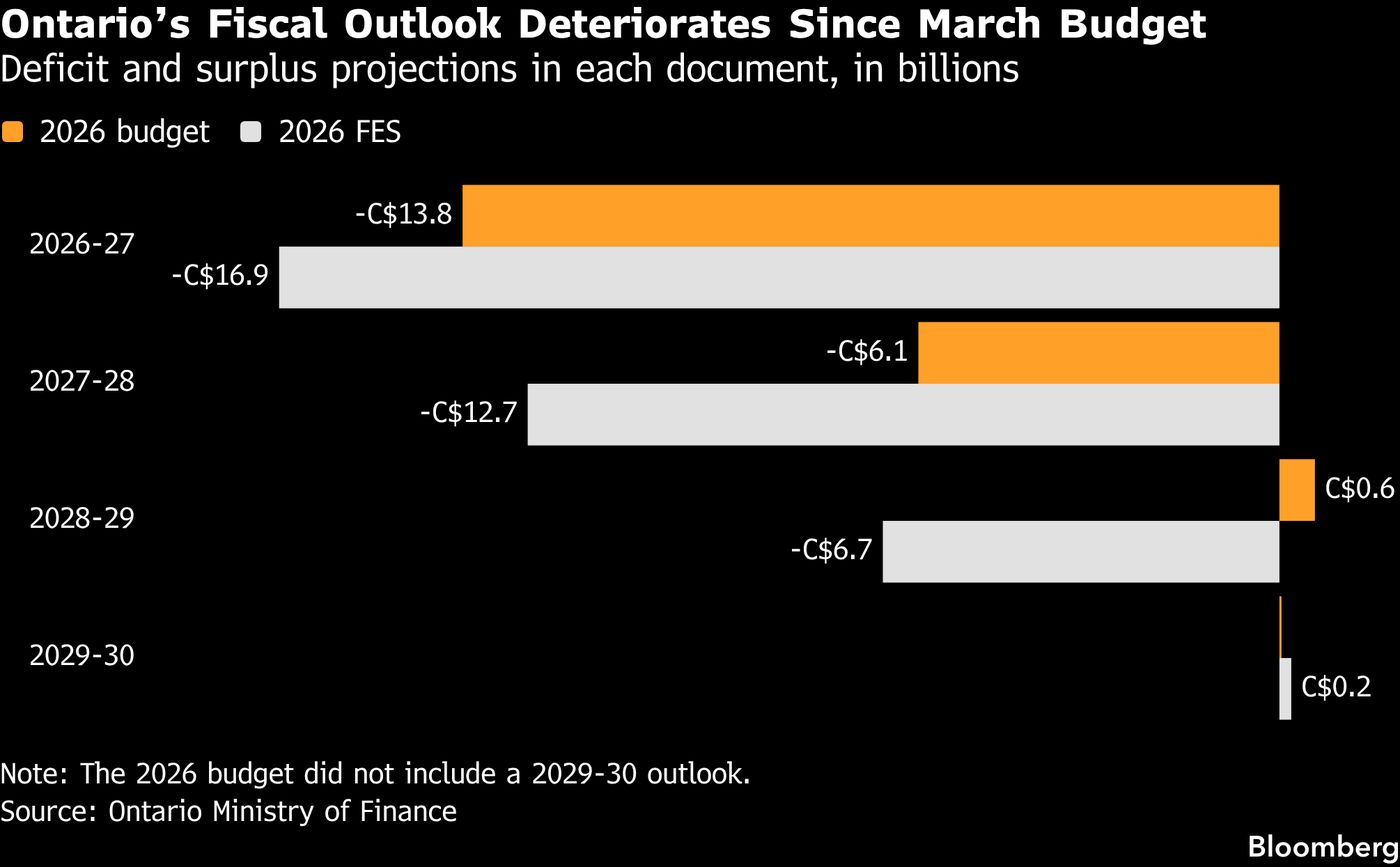
The Ontario government now projects a deficit of $16.9 billion for the current fiscal year, a $3.1 billion increase from its spring budget forecast.
Finance Minister Peter Bethlenfalvy delivered the fall economic statement on Thursday, blaming U.S. tariffs and global unrest for cutting the province’s projected economic growth in half.
“The impact of U.S. tariffs, which affect, among others, our steel, our auto and our manufacturing sectors, and global unrest impacting the price of gas has risen the cost of goods and has driven a sea of uncertainty,” Bethlenfalvy said.
The province now expects real GDP to grow by just 0.5 per cent in 2026, down from the one per cent forecast in March.
A significant portion of the higher deficit stems from a $3.8 billion top-up to the province’s contingency fund, bringing it to $4.9 billion, and an increase to the fiscal reserve fund from $1.5 billion to $2.2 billion.
Bethlenfalvy called the move “prudent” given the uncertainty, including the threat of additional U.S. tariffs taking effect Jan. 1.
“When we tabled the plan in March, we didn’t have Section 338 tariffs in place. These are the new tariffs that the president put on Canada,” he told reporters.
The statement details the damage already done, with steel exports to the U.S. down more than 50 per cent in the first eight months of 2026 compared to the same period in 2024, and auto exports down 13.7 per cent.
Despite the larger deficit, overall government revenue is projected to be $2 billion higher than forecast, due to higher federal transfers and corporate tax revenue.
However, personal income tax revenue is $1.7 billion lower than expected, and land transfer tax revenue is down $497 million due to a sluggish housing market.
The province now plans to borrow $3.9 billion more this year, bringing long-term borrowing to $51.1 billion.
Net debt is projected to surpass $483.8 billion this year and clear the half-trillion mark next year at $514.7 billion.
The government’s net debt-to-GDP ratio is now projected to be 37.4 per cent, down slightly from 37.7 per cent in the spring budget.
The deficit for 2027-28 is now projected at $12.7 billion, more than double the March forecast, followed by a $6.7 billion deficit in 2028-29.
A small surplus of $200 million is now projected for 2029-30, a year later than previously planned.
Opposition parties at Queen’s Park criticized the update for lacking affordability measures.
“Never have I seen a fall economic statement this mediocre,” said Ontario NDP finance critic Jessica Bell. “I was shocked to see this fall economic statement does not do anything significant to address affordability.”
Interim Ontario Liberal Leader John Fraser said the update represents poor fiscal management. “The premier can’t keep blaming Trump. At some point, he’s got to look at his choices,” Fraser said.
Bethlenfalvy defended the government’s spending, saying it is needed for health care and social services. “While I’d like to balance today, I am also a realist of the world we’re in,” he said.
The update confirms previously announced measures, including Ontario’s commitment to match the federal “productivity mega deduction,” a tax break expected to cost $8 billion over five years. e2gold.ca reported last week the province would match the federal tax break in its fall update.
Unemployment in the province is projected to be 7.2 per cent in 2026, decreasing to 6.1 per cent by 2029.
This story was written by the e2gold.ca newsroom from reporting by BNN Bloomberg and The Globe and Mail. Quotes are checked word for word against that reporting.