Scotiabank line of credit interest rates are typically expressed as the Scotiabank Prime Rate plus a margin. As of October 2026, the Scotiabank Prime Rate is 4.45%, which is standard across major Canadian banks. The specific interest rate a customer receives depends on the type of line of credit, their creditworthiness, and whether the borrowing is secured or unsecured. Understanding how these rates are structured is important for Canadians considering this form of revolving credit for purposes like home renovations or debt consolidation.
How Scotiabank Line of Credit Rates Are Set
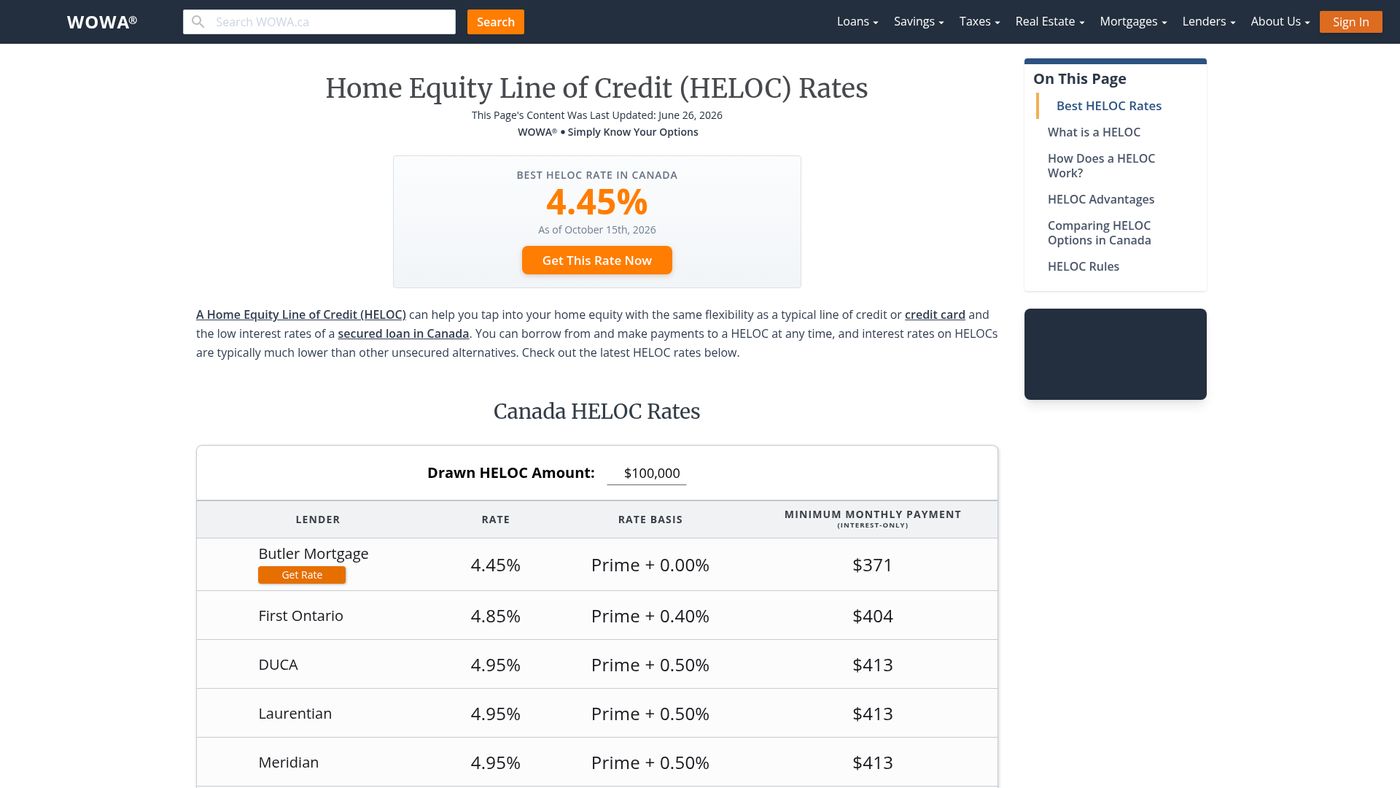
Scotiabank line of credit interest rates are variable and based on the bank's prime lending rate. The prime rate is the benchmark rate used by Canadian financial institutions to set interest rates for variable loans and lines of credit. As of October 2026, the Scotiabank prime rate is 4.45%. This rate is usually adjusted in response to changes made by the Bank of Canada to its key policy rate, known as the target for the overnight rate. For example, if the Bank of Canada raises its rate by 25 basis points, Scotiabank will typically raise its prime rate by the same amount. There have been historical instances where the bank did not fully pass on a Bank of Canada rate cut, such as lowering its prime rate by only 15 basis points following a 25 basis point cut. A customer's final interest rate is the prime rate plus a predetermined margin, which can vary based on the product and the borrower's financial profile. The prime rate can change at any time, though changes independent of Bank of Canada announcements are unusual.

Types of Scotiabank Lines of Credit and Their Rates
Scotiabank offers several lines of credit, each with different rate structures and purposes. Its interest rate is variable, expressed as Scotiabank Prime plus a margin that is determined at application. For example, a customer reported a pre-approved offer with a rate of Prime plus 4.85%, which resulted in a total rate of 10.05% when the prime rate was 5.20%. The Scotia RSP Catch-Up Line of Credit, designed for Registered Retirement Savings Plan contributions, has an interest rate set at Scotiabank Prime plus 1%. The ScotiaLine Personal Line of Credit for Students also has a variable rate that changes with the prime rate. Secured lines of credit, like those within the Scotia Total Equity Plan, generally have lower margins, such as Prime plus 1%, because they are backed by real estate collateral. A line of credit is a revolving borrowing solution that provides flexibility to withdraw funds up to the credit limit and pay down at convenience, provided minimum payments are made.
The Scotia Total Equity Plan for Homeowners
The Scotia Total Equity Plan is a secured borrowing solution that allows homeowners to access the equity in their property. When initially set up, the STEP can have a total borrowing limit of up to 80% of the home's appraised value. Within that total limit, up to 65% can be allocated to line of credit products. Over a 25-year period, the overall borrowing limit gradually decreases to 65% of the home's value. The interest rate for a line of credit within the STEP is typically lower than for unsecured products. A sample calculation from 2021 used an interest rate of 3.450%, which was based on a Scotiabank prime rate of 2.450% plus a 1% margin. This secured rate is significantly lower than typical unsecured borrowing rates, such as credit card rates which can be around 19.99%. The plan is designed to help homeowners consolidate higher-interest debt or fund major expenses while managing their overall borrowing level over the long term. Available Borrowing Power in the first year is based on 80% of the home value minus the total of the mortgage balance and any other debt secured by real estate.
In subsequent years, the Available Borrowing Power calculation factors in the borrowing limit at that point in time. The calculations for the STEP assume that interest rates for any mortgage and other secured debt will remain constant over the entire amortization period, though actual rates may vary. The plan enables you to gradually reduce your overall borrowing level while still having access to your equity along the way. All STEP and mortgage applications are subject to credit approval, Scotiabank residential mortgage standards, and maximum permitted loan amounts. The rate used in any calculation is a sample and is not a rate guarantee, and interest for mortgages within the plan is compounded semi-annually, not in advance.
Interest Calculation and Payment Rules
Interest on a Scotiabank line of credit is calculated on the daily outstanding balance but is added to the account once per month. The daily interest amount is determined by multiplying the unpaid balance by the interest rate and then dividing by 12 months. Customers are required to make a minimum monthly payment, which is calculated as the greater of 3% of the statement balance or $50. This minimum payment cannot exceed the total outstanding balance on the statement date. The calculations used for illustrations assume all payments are made on the statement date and that only the minimum payment is made each period. For the Scotia Total Equity Plan, calculations assume the interest rate and prime rate remain constant until the debt is fully repaid, though actual rates will vary. It is important to note that making payments more frequently than monthly, such as weekly or biweekly, can reduce the principal faster and shorten the overall repayment period. Making weekly or biweekly payments has the effect of making an extra monthly payment every year, which accelerates the payoff of the debt.
The amount of daily interest is calculated by subtracting any payments and then multiplying the unpaid balance by the interest rate, then dividing by 12 months. For mortgage products within a STEP, interest is compounded semi-annually, not in advance. This calculation assumes repayment of a debt consolidation amount as a lump sum at each of the two different interest rates. All calculation results are approximations based on entered data and are not intended to provide financial advice, and Scotiabank does not make any representations or warranties regarding them.
Eligibility and Application Process
Eligibility for a Scotiabank line of credit is subject to the bank's credit approval process and lending standards. Applicants must meet criteria related to income, credit history, and debt service ratios. For secured products like the Scotia Total Equity Plan, the property used as collateral must meet Scotiabank's residential mortgage standards, and the loan amount cannot exceed the maximum permitted limits. The application for a ScotiaLine Personal Line of Credit can be started online through Scotia Online. For all products, the specific interest rate margin offered to an applicant is not guaranteed and is determined based on the bank's assessment at the time of application. Existing customers may receive pre-approved offers, but these are still subject to final verification and approval. It is advisable to contact Scotiabank directly at the provided phone numbers to get current rate information and details on any applicable fees before applying. For the Scotia RSP Catch-Up Line of Credit or general ScotiaLine rates, customers are directed to call 1-888-882- or 1-888- for current information.
Common Considerations and Potential Changes
When considering a Scotiabank line of credit, customers should be aware of several key factors. The interest rate is variable and will change whenever Scotiabank adjusts its prime rate, which can happen at any time, though it usually follows Bank of Canada announcements. Unlike variable-rate mortgages, fixed-rate mortgages are not immediately affected by changes in the prime rate, but lines of credit are always variable. If you get a variable-rate product, your rate will change by the same amount as any change to the Scotiabank prime rate. Scotiabank offers Line of Credit Protection insurance, which can help cover payments under certain unforeseen circumstances and lighten the financial burden if the unexpected happens. It is also important to understand that a notice of change issued by the bank, effective August 17, 2025, confirmed that interest rates on existing line of credit accounts were not changing as a result of that particular update. Customers should regularly review their account statements to track their balance, interest charges, and minimum payment due. Using a line of credit responsibly by not maxing out the limit and paying more than the minimum can help manage costs and maintain a healthy credit score. Everything you need to know about what happens when you miss a credit card or line of credit payment, your credit score, and what options you may have is available from the bank.
Comparing home equity loans and home equity lines of credit is a useful step for homeowners considering a STEP. The bank provides personal loan and auto loan calculators to help estimate payments for other financial needs, but a line of credit offers revolving access without needing to reapply once the balance is paid down. With a line of credit, you don't need to reapply as credit is available again once the balance is paid, which differentiates it from a term loan. Let's take a closer look at the differences between loans and lines of credit and find out which solution is right for you, as suggested by the bank's own materials.
Key Differences Between Loans and Lines of Credit
Understanding the distinction between a loan and a line of credit is crucial when choosing a borrowing product. A line of credit is a revolving borrowing solution that allows customers the flexibility and convenience of accessing funds to meet diverse needs, typically at a lower interest rate than unsecured loans or credit cards. Whether you are renovating your home or consolidating debt, a line of credit allows you to withdraw funds up to the credit limit and pay down at your convenience, provided monthly minimum payments are made. With a line of credit, you do not need to reapply for credit as it becomes available again once the balance is paid down. In contrast, a personal loan provides a lump sum of money upfront with a fixed repayment schedule over a set term. The interest rate on a variable-rate line of credit will fluctuate with the prime rate, while a fixed-rate loan's interest rate is locked in for the term. Lines of credit are well-suited for ongoing or unpredictable expenses, while loans are often better for one-time, specific purchases with a known total cost.
Comparison of Sample Rates and Costs
The cost of borrowing with a line of credit can vary widely depending on whether it is secured or unsecured. For example, a secured line of credit like the Scotia Total Equity Plan historically used an illustrative interest rate of 3.450 percent. This rate was based on a Scotiabank prime rate of 2.450 percent as of April 14, 2021 plus 1 percent. In contrast, an unsecured borrowing interest rate for illustration purposes can be as high as 19.99 percent, which is a typical interest rate on a credit card. The following table illustrates sample rates and structures based on historical and illustrative data from Scotiabank materials. These calculations are approximations for information purposes only and are not intended to provide financial advice.
| Borrowing Type | Rate Structure (Sample) | Illustrative Total Rate | Key Feature |
|---|---|---|---|
| Scotia RSP Catch-Up Line of Credit | Prime + 1% | Varies with Prime | For RRSP contributions |
| ScotiaLine for Students | Prime + Margin | Varies with Prime | Variable student product |
| L'earn Visa Card | Fixed rate | 19.99% (Purchase), 22.99% (Cash Adv.) | Unsecured credit card |
| Scotiabank Passport Visa Infinite Business Card | Fixed rate | 20.99% (Purchase), 22.99% (Cash Adv.) | Business credit card |
The significant difference between a secured line of credit rate and a typical credit card rate highlights the potential interest savings from debt consolidation. However, the secured rate is not a guarantee and depends on the current prime rate and the borrower's qualification. The unsecured personal line of credit rate example shows how the margin added to prime can substantially affect the total borrowing cost. For comparison, credit card interest rates from Scotiabank, such as for the L'earn Visa Card at 19.99% for purchases, are fixed and not tied to prime, making them generally more expensive for carrying a balance. The Scotiabank Passport Visa Infinite Business Card has a purchase interest rate of 20.99% and a cash advance rate of 22.99%, which are also fixed rates.
Frequently asked questions
What is the current Scotiabank prime rate?
As of October 2026, the Scotiabank prime rate is 4.45%. This is the standard prime rate used by most major Canadian banks to set interest rates for variable-rate products like lines of credit and mortgages. The bank typically changes this rate in response to adjustments made by the Bank of Canada to its policy rate. While changes usually match the Bank of Canada's moves, there have been historical exceptions where the change was not a full pass-through, such as a 15 basis point cut following a 25 basis point Bank of Canada reduction.
How is the interest rate on a ScotiaLine determined?
The interest rate on a ScotiaLine Personal Line of Credit is variable and is set as the Scotiabank Prime Rate plus a margin. The specific margin added to prime is determined by Scotiabank at the time of application based on factors like the borrower's creditworthiness and the product type. For example, a customer might be offered a rate of Prime plus 4.85%. The rate will fluctuate whenever Scotiabank changes its prime rate, and the interest is calculated on the daily outstanding balance but added to the account monthly.
What is the Scotia Total Equity Plan?
The Scotia Total Equity Plan is a secured borrowing product that allows homeowners to access the equity in their home. It can be set up with an initial total borrowing limit of up to 80% of the home's value, with up to 65% available as a line of credit. Over a 25-year period, the total borrowing limit gradually decreases to 65%. The interest rate for the line of credit portion is typically lower, such as Prime plus 1%, because it is secured by real estate. Available Borrowing Power is calculated based on the home value, existing mortgage balance, and other secured debt.
What is the minimum payment on a Scotiabank line of credit?
The minimum monthly payment on a Scotiabank line of credit is the greater of 3% of the outstanding statement balance or $50. This payment cannot exceed the full balance owed on the statement date. Interest is calculated daily on the outstanding balance and added to the account monthly. Making only the minimum payment will extend the repayment period and increase the total interest paid over time, while more frequent payments can shorten the amortization.
Can I get a line of credit for RRSP contributions?
Yes, Scotiabank offers the Scotia RSP Catch-Up Line of Credit specifically for making contributions to a Registered Retirement Savings Plan. The interest rate for this product is set at the Scotiabank Prime Rate plus 1 percent. For current rates and information on fees and interest cost, customers should call 1-888-. This is a specialized product designed to help Canadians invest in their retirement savings.
Are Scotiabank line of credit rates changing in 2025?
According to a Scotiabank notice of change, modifications effective August 17, 2025, do not alter the interest rates on existing line of credit accounts. This means that for existing customers, their agreed-upon rate formula remains in effect. The variable part of the rate, the prime rate, can still change at any time based on broader economic conditions and Bank of Canada actions. Changes to the prime rate can happen at any time, though it is unusual for any bank to change its prime rate independent of Bank of Canada interest rate announcements.
Sources and further reading
- Lines of credit, Loans scotiabank.com
- Scotia Total Equity ® Plan Calculator dmts.scotiabank.com
- Scotiabank Prime Rate ratehub.ca
This article explains how things work and is not financial, tax or legal advice. Rules, limits and rates change, so check the current figures with the Canada Revenue Agency, your province or your financial institution before you act.