The best interest rates in Canada for 2026 are found by comparing high-interest savings accounts, mortgages, and guaranteed investment certificates. For savings, promotional rates can exceed 4.60%, while standard rates typically range from 1% to 2.50%. Mortgage rates vary by term, with fixed rates from 2.49% for six months to 4.59% for five years. Understanding these rates and how they are influenced by the Bank of Canada helps Canadians make informed decisions about saving and borrowing.
How Interest Rates Are Determined in Canada
The Bank of Canada sets the target for the overnight rate, which is its key policy interest rate, on eight fixed announcement dates each year. This overnight rate directly influences the prime rate that commercial banks offer to their most creditworthy customers. As of October 19, 2026, the Bank of Canada's policy rate sits at 2.25%, and an example prime rate from a lender is 4.45%. Changes to the overnight rate dictate movements in the prime rate, which then affects the interest earned on savings products like high-interest savings accounts and the cost of borrowing for variable-rate mortgages and loans. The Bank uses this tool to carry out monetary policy, aiming to keep inflation low and stable. When the Bank holds its rate, as it did most recently on September 2, 2026, interest rates on savings and lending products generally remain stable.

High-Interest Savings Account Rates
A high-interest savings account in Canada pays a higher interest rate than a standard savings account while keeping funds fully accessible and protected from market risk. Interest is calculated daily and compounds monthly, helping savings grow steadily. The main benefit of a HISA is earning a competitive return on money earmarked for short-term goals or emergency funds without locking it in. Promotional savings rates as of October 2026 can be over 4.60%, though these are often temporary offers. Standard ongoing interest rates for HISAs in Canada typically range from 1% to 2.50%, depending on the financial institution and market conditions. Many accounts, like the EQ Bank Personal Account noted for 2026, have no monthly fees and no minimum balance requirements, making them accessible.
When selecting a HISA, it is important to look beyond the promotional rate. Some accounts may limit monthly transactions or charge fees if you exceed withdrawal limits. Others may require a high minimum balance to qualify for the advertised rate or for free transactions. Financial institutions offering these accounts include traditional banks, online banks, and credit unions, each with different terms. Over 50 financial institutions are evaluated by specialists when comparing these products. Your savings are protected by deposit insurance, but the provider and coverage limits depend on the type of institution you choose.
- EQ Bank Personal Account: Consistently offers competitive everyday interest rates.
- PC Money Account: Offers a 2.20% rate with no minimum balance.
- RBC High Interest eSavings: Advertises rates up to 4.60%.
- Peoples Bank e-Savings Account: Offers a 1.20% rate.
- Simplii Financial High Interest Savings Account: A widely available option.
- WealthONE Bank of Canada High Interest Savings Account: Another national provider.
Some accounts are restricted to residents of specific provinces. For example, the ATB Financial High Interest Savings Account is for Alberta residents only, and the FirstOntario Credit Union High Interest eSavings Account is for Ontario only. The Island Savings High Interest Savings Account is available only in British Columbia. It is crucial to check eligibility based on your province of residence when comparing options.
Mortgage Interest Rates by Term
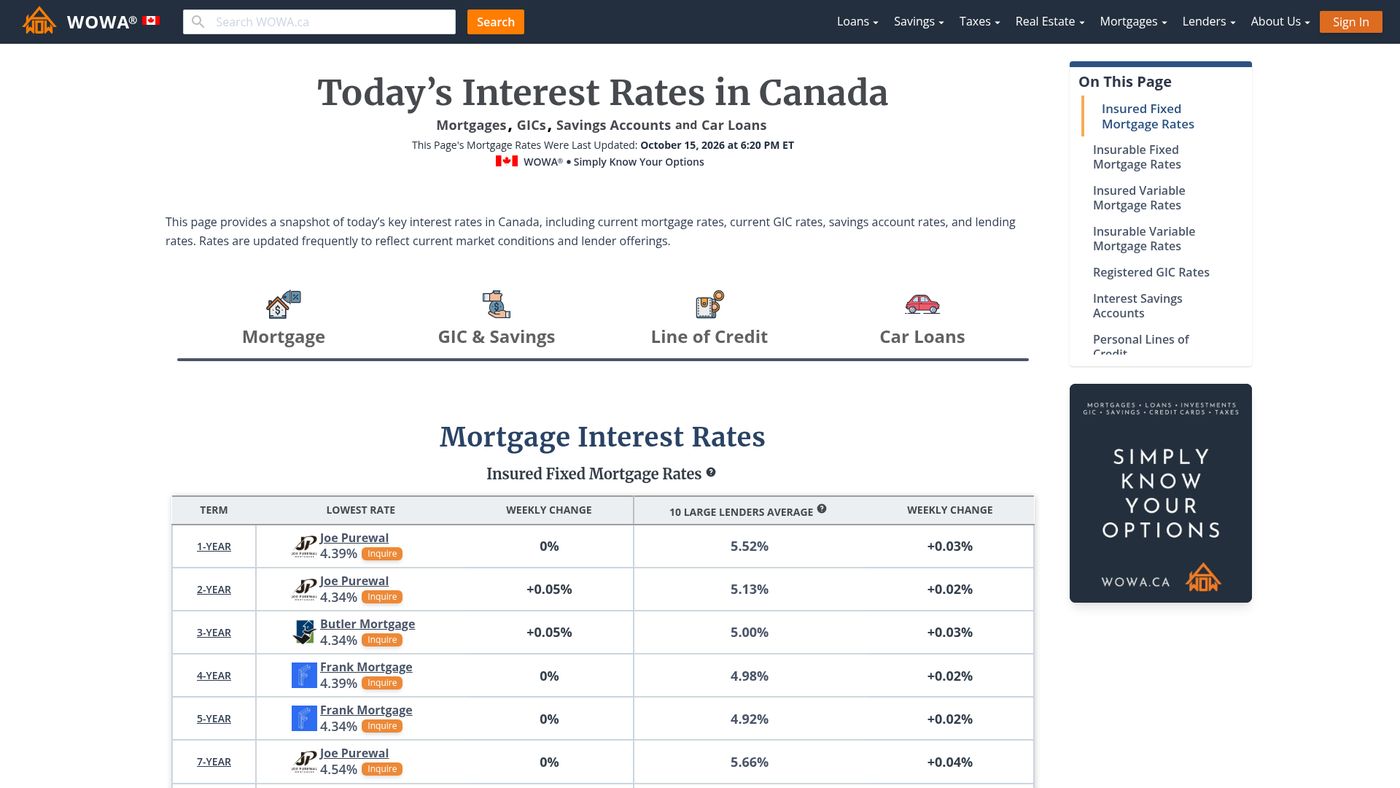
Mortgage rates in Canada vary significantly based on the term length and whether the rate is fixed or variable. Lenders set these rates based on the cost of borrowing in the bond market and the Bank of Canada's policy. As of 2026, examples of available mortgage rates include a 6-month fixed rate at 2.49% and a 5-year fixed rate at 4.59%. A 5-year variable rate may be available at 3.49%. One-year and three-year fixed rates are also available, with an example rate for both at 4.54%. Borrowers should compare rates from multiple lenders, as institutions like True North Mortgage offer access to rates from various sources and may buy down rates for clients.
The right mortgage product depends on individual financial circumstances and tolerance for interest rate risk. Fixed-rate mortgages provide payment certainty for the entire term, while variable-rate mortgages fluctuate with the lender's prime rate. Some lenders offer specialized products like Rate Relief, a short-term product designed to provide six months of budget room. Alternative mortgage products like Compass Mortgage consider non-traditional income sources for greater approval flexibility. It is essential to use mortgage calculators to estimate payments and understand the total cost of borrowing over different terms.

Guaranteed Investment Certificate Rates
Guaranteed investment certificates offer fixed, guaranteed interest rates for locking in money for a predetermined term. GICs typically provide higher interest rates than high-interest savings accounts in exchange for the loss of liquidity. For 2026, the best GIC rates in Canada range from 2.45% to 4.40% for terms between one and five years. These products are considered very low-risk, as the principal is guaranteed if held to maturity. Over 280 currently available fixed-rate, non-registered, and non-redeemable GICs are examined by evaluators when comparing options.
Whether a GIC is better than a HISA depends entirely on your need for access to your funds. GICs lock in your money for a fixed term, and early withdrawal may result in penalties or loss of interest. For long-term savings goals where immediate access is not required, a GIC can provide a predictable return. For short-term savings or an emergency fund, the flexibility of a HISA is usually more appropriate. After the Bank of Canada's rate hold in September 2026, GIC interest rates were expected to continue hovering around their current levels at least until the end of October.
Deposit Insurance and Safety of Funds
The safety of your savings in Canada is backed by deposit insurance programs, but the specific provider and coverage limits depend on the type of financial institution. Federally regulated banks are members of the Canada Deposit Insurance Corporation, which insures eligible deposits up to $100,000 per insured category, per institution. This coverage applies to savings accounts, chequing accounts, and GICs. Credit unions are regulated provincially and are covered by provincial agencies with their own limits.
For example, in Ontario, credit unions are overseen by the Financial Services Regulatory Authority of Ontario. In Manitoba, the Deposit Guarantee Corporation of Manitoba provides coverage. Some savings products offered through investment firms may be protected by the Canadian Investor Protection Fund, which safeguards client assets if a member firm fails. It is important to confirm the insurance status of your institution and understand that coverage is per depositor, per category, which means holding multiple account types at the same bank can affect your total protected amount.
Common Features and Pitfalls of Savings Accounts
When evaluating high-interest savings accounts, several common features define the best options. These include better interest rates than standard accounts, easy access to funds with no early withdrawal penalties, and no minimum deposit requirements to open the account. Many top accounts also have no monthly fees, which helps preserve your interest earnings. Automated savings tools, like those offered by some banks, can help make saving a regular habit by scheduling transfers. Digital experience and the ease of moving money are also important factors for many users.
There are also common pitfalls to watch for that can reduce your effective return. Some accounts limit the number of monthly withdrawals or transactions, and exceeding these limits can trigger fees. Certain accounts require a high minimum balance to qualify for the advertised interest rate or to avoid monthly maintenance charges. Perhaps the most significant pitfall is temporary promotional rates. An attractive bonus rate may only last for a limited period, after which the interest rate can drop significantly to a much lower standard rate. Always check the terms to see how long a promotional rate lasts and what the ongoing rate will be.
Comparing Interest Rates at Major Banks
Interest rate structures can vary greatly between major financial institutions, often using tiered systems based on account balance. For example, the TD ePremium Savings Account offers different rates for different balance tiers. A balance from $0 to $9,999.99 earns 0.000%, while a balance from $10,000.00 to $49,999.99 earns 0.450%. The same 0.450% rate applies to balances up to $249,999.99. For balances of $1,000,000.01 and over, a different rate applies. Other banks may use a single rate for the entire balance or have different qualifying criteria.
| Financial Institution | Account Example | Notable Rate or Feature |
|---|---|---|
| TD Canada Trust | TD Growth Savings Account | Boosted rate for balances over $5,000 with qualifying transactions |
| RBC Royal Bank | RBC High Interest eSavings | Promotional rates up to 4.60% |
| EQ Bank | Personal Account | Consistently competitive everyday rate, no fees |
| National Bank of Canada | High Interest Savings Account | Available nationally |
| Simplii Financial | High Interest Savings Account | No-minimum balance online account |
Some accounts incentivize certain behaviours. The TD Growth Savings Account offers a boosted rate on balances of $5,000 or more if the client has an eligible TD chequing account and completes at least two out of three qualifying monthly transactions. These can include pre-authorized debits, bill payments, or a recurring direct deposit. This structure encourages a broader banking relationship with the institution. When comparing, look at the ongoing standard rate after any promotion and the effort required to earn the highest possible yield.
Frequently asked questions
How does the Bank of Canada affect my savings interest rate?
The Bank of Canada influences savings rates through its target for the overnight rate, which is set on eight fixed dates each year. This rate affects the prime rate that banks use to set interest rates on products like high-interest savings accounts and GICs. When the Bank raises its rate, HISA and GIC rates often rise. When it holds or cuts rates, savings rates generally stabilize or fall.
Are my savings safe in a high-interest savings account?
Savings in a HISA are considered low-risk. Deposits at federally regulated banks are protected by the Canada Deposit Insurance Corporation for up to $100,000 per insured category. Credit unions are covered by provincial deposit insurance programs, such as the Financial Services Regulatory Authority of Ontario. This insurance protects your principal and interest if the financial institution fails.
What is the best high-interest savings account rate in Canada?
The best high interest savings account rates in Canada as of late 2026 feature promotional offers above 4.60 percent, with RBC and others advertising such rates. Standard ongoing rates typically range from 1 percent to 2.50 percent across most institutions. The EQ Bank Personal Account is highlighted for consistently offering one of the most competitive everyday interest rates on the market. It is crucial for savers to distinguish between limited time promotional rates and the permanent standard rate when comparing accounts. Shopping around is essential to secure the best return, especially after the Bank of Canada's rate hold in September 2026.
What is the difference between a GIC and a HISA?
A guaranteed investment certificate offers a fixed, guaranteed interest rate for a locked in term, with rates ranging from 2.45 percent to 4.40 percent for one to five year terms in 2026. In contrast, a high interest savings account provides a variable interest rate with full liquidity, allowing withdrawals at any time without penalty. GICs generally offer higher interest rates in exchange for sacrificing access to your funds for the agreed term. A HISA is better suited for short term savings or emergency funds due to its flexibility, while GICs may be optimal for longer term goals where immediate access is not required.
What mortgage rate can I get in Canada?
Mortgage rates in Canada vary by term and product type. As of 2026, examples include a six month fixed rate at 2.49 percent, a five year fixed rate at 4.59 percent, and a five year variable rate at 3.49 percent. Your actual offered rate will depend on factors such as your creditworthiness, the loan to value ratio, and the specific lender. The Bank of Canada's policy rate was 2.25 percent in October 2026, influencing lender prime rates. It is recommended to compare rates from multiple lenders, including brokers who can access rates from various institutions, to find the best deal.
Do I need a minimum balance for a high-interest savings account?
Many top tier high interest savings accounts, such as the EQ Bank Personal Account and the PC Money Account, have no minimum balance requirement to open or maintain the account. However, some accounts, particularly from traditional banks, use balance tiers to determine the interest rate earned. For example, the TD ePremium Savings Account pays different rates for balances below ten thousand dollars compared to higher tiers. It is important to read the specific terms, as some accounts may also require a minimum balance to qualify for free transactions or to avoid monthly fees.
Sources and further reading
- Best high interest savings accounts in Canada 2026 ratehub.ca
- Best High-Interest Savings Accounts in Canada for 2026 nerdwallet.com
- Canada Mortgage Rates from 2.49% | 19,000 Five Star Reviews truenorthmortgage.ca
- Interest rates bankofcanada.ca
- Bank Account Interest Rates | TD Canada Trust td.com
This article explains how things work and is not financial, tax or legal advice. Rules, limits and rates change, so check the current figures with the Canada Revenue Agency, your province or your financial institution before you act.