A savings withdrawal calculator helps you understand how long your investment portfolio or savings will last when you take regular withdrawals, a critical question for retirement planning. This tool projects your final balance by accounting for your starting amount, withdrawal rate, investment return, and the effects of compounding. For Canadians managing RRSPs, TFSAs, or other nest eggs, it provides a clear picture of sustainability under different scenarios. Using such a calculator is a foundational step in creating a resilient financial plan for your post-work years.
What a Savings Withdrawal Calculator Does
A savings withdrawal calculator is a financial modelling tool designed to answer a central question for retirees and investors: how long will my money last? It projects the lifespan of a savings or investment portfolio given a plan of regular withdrawals. The calculator takes your initial nest egg and simulates its depletion or growth over time as you take money out and as the remaining balance potentially earns a return. This projection helps in planning retirement income, managing systematic investment payouts, or understanding the long-term impact of drawing down savings. The core function is to provide a data-driven estimate, allowing you to test different scenarios before committing to a withdrawal strategy in real life. The tool is particularly valuable for comparing the outcomes of different financial decisions, such as how increasing your withdrawal amount shortens the portfolio's lifespan or how achieving a higher rate of return can extend it.
For Canadians, this is directly applicable to planning withdrawals from Registered Retirement Savings Plans (RRSPs), Registered Retirement Income Funds (RRIFs), Tax-Free Savings Accounts (TFSAs), and non-registered investment accounts. By using a calculator, you move from guesswork to a structured analysis of your retirement income plan. It helps visualize the trade-off between income today and financial security tomorrow, making it an essential component of a thorough financial review. The projections are based on the information and assumptions you provide regarding your goals, expectations and financial situation, and they do not infer that the company assumes any fiduciary duties.

Key Inputs and How They Affect the Result
The accuracy and usefulness of the calculator's projection depend entirely on the inputs you provide. Each variable plays a distinct role in determining the final outcome, which is typically the remaining balance after a set period or the number of years until the balance reaches zero. Understanding how each lever works allows you to create more realistic and personalized scenarios. The primary inputs are your starting balance, the withdrawal amount and frequency, the investment's annual rate of return, the compounding frequency, and the total time horizon for the withdrawals. Changing any single input will directly alter the projected result, which is why careful consideration of each is required.
A higher starting balance provides a larger financial cushion, allowing for higher withdrawals or a longer withdrawal period before depletion. A higher withdrawal amount drains the principal more quickly, reducing the portfolio's lifespan unless offset by very high investment returns. The annual rate of return is a critical assumption. A higher projected return allows the portfolio to grow faster, counteracting the impact of withdrawals and preserving capital for longer. It is crucial to input a realistic rate of return based on your investment mix, as overly optimistic assumptions can lead to a flawed plan. The actual rate of return on investments can vary widely over time, especially for long-term investments, and includes the potential loss of principal.
The frequency of withdrawals and compounding also influences the outcome. Withdrawals made more frequently, such as monthly instead of annually, mean the money is removed from the portfolio sooner, reducing the amount of capital available to generate investment returns throughout the year. Conversely, more frequent compounding of investment earnings means your returns begin generating their own returns sooner, which can boost the overall growth of the portfolio over time. Most calculators operate on the standard assumption that withdrawals are made at the beginning of each period, which is common for retirement income planning. For stock and mutual fund investments, you should typically choose 'Annual' compounding, while for savings accounts you need to check with your financial institution.
Understanding the Rate of Return and Compounding
The annual rate of return is perhaps the most variable and assumption-dependent input in a withdrawal calculation. It represents the expected yearly percentage gain on your investments after accounting for management fees. This rate is not guaranteed and is largely dependent on your asset allocation. For context, the total return including dividends of the S&P/TSX Composite Index for the ten-year period ending December 31, 2025, was 12.5%. This serves as a historical benchmark for a diversified Canadian equity portfolio, though past performance does not guarantee future results. On the lower-risk end of the spectrum, savings accounts at a bank or credit union may pay as little as 2% or less.
It is important to remember that investments offering the potential for higher rates of return are also subject to higher risk and volatility. The actual rate of return can vary widely over time, especially for long-term investments, and includes the potential loss of principal. When using the calculator, selecting a conservative rate of return can provide a more stress-tested and potentially safer projection for your retirement income plan. Future investment results are not guaranteed, and financial projections are based on assumptions that may vary over time with significant impact on the planning projections.
Compounding refers to earning returns on your investment's previous earnings, plus the original principal. This calculator allows you to choose the frequency that your investment's interest or income is added to your account, such as annually, monthly, or daily. The more frequently compounding occurs, the sooner your accumulated interest will generate additional interest, leading to greater growth over long periods. For stock and mutual fund investments where returns are typically calculated on an annual basis, you should choose 'Annual' compounding. For savings accounts and Guaranteed Investment Certificates (GICs), all frequency options are valid, but you should confirm the compounding period with your financial institution to ensure your model is accurate.

Common Rules and Guidelines for Withdrawals
Financial planning for retirement involves established guidelines to help make savings last. One widely cited rule of thumb is the 4% withdrawal rule. This guideline suggests that to give yourself the best chance of outliving your money, you should withdraw no more than 4% of your total nest egg in the first year of retirement. In subsequent years, you would adjust that dollar amount for inflation. Many advanced calculators incorporate an inflation adjustment feature to automate this test.
They assume withdrawals are indexed to inflation, often at a default rate of 2% per year. This means your withdrawal amount increases each year to maintain your purchasing power, which creates a more realistic but also more demanding scenario for your portfolio. It is vital to check if the calculator you are using includes this feature, as it significantly impacts how long your savings will last. Another standard assumption in these tools is that withdrawals are made at the beginning of each payment period, aligning with how most retirees receive their income. These built-in rules help standardize the projections for comparison.
It is equally important to understand what these calculators typically do not include. Most do not take into account any taxation. This means the projection shows gross withdrawals, not the net amount you would receive after income tax is deducted from RRSP or RRIF payments, for example. The calculations also do not infer that the provider assumes any fiduciary duties and should not be construed as formal financial, legal, or tax advice. They are illustrative tools based on the information and assumptions you provide, and the results should be one source among many in your planning process. The information is supplied from sources believed to be reliable but its accuracy cannot be guaranteed.
Strategies If Your Savings May Not Last
If a calculator projection shows your nest egg may not last as long as your retirement, it is a signal to adjust your plan. There are several strategies Canadians can consider to stretch their assets or increase their income. First, you can revisit your withdrawal rate. Reducing your annual withdrawals, even slightly, can dramatically extend the lifespan of your portfolio. Second, you could adjust your investment strategy to seek a higher potential return, though this must be balanced against your personal risk tolerance and the understanding that higher returns are not guaranteed. Beyond adjusting the portfolio itself, lifestyle and income changes can provide solutions.
Taking a full- or part-time job in retirement, even for a few years, can provide crucial income that allows your savings to continue growing untouched. Another option is to access equity from your home. If you are age 62 or older, you can convert home equity into tax-free retirement income through a reverse mortgage, though this requires thorough research to understand the costs and long-term implications. Moving to a less expensive area in Canada or abroad can also reduce your cost of living, thereby reducing the required withdrawal amount from your savings each year.
- Reduce your planned annual withdrawal amount.
- Consider a part-time job to supplement retirement income.
- Explore a reverse mortgage to access home equity (age 62+).
- Relocate to a region with a lower cost of living.
- Delay the start of withdrawals to allow more time for growth.
- Review your investment mix for an appropriate risk/return balance.
These strategies highlight that a withdrawal calculator is not just a predictor but a planning tool. It allows you to see the potential outcome of your current plan and then model the impact of changes before you implement them. This proactive approach is far more effective than discovering a shortfall after you have already begun retirement. The calculator helps you analyze your financial needs based on your own goals and financial situation.
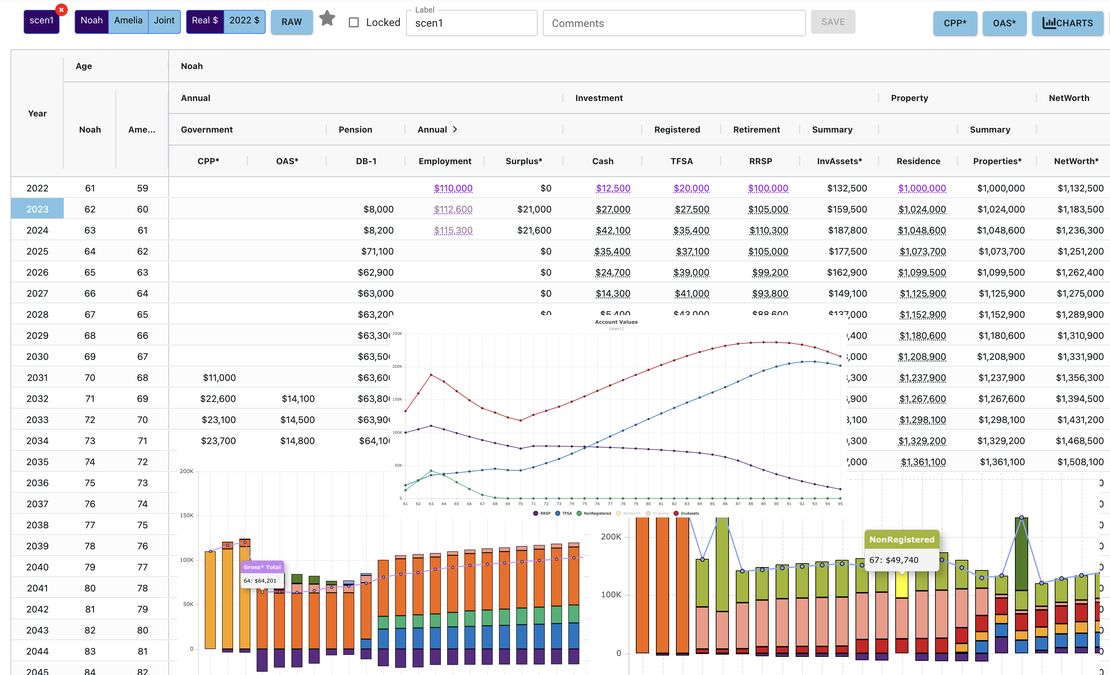
A Worked Example Using Common Figures
To illustrate how the inputs interact, consider a hypothetical scenario using figures commonly discussed in retirement planning. They expect their portfolio to generate an average annual return of 5%, with interest compounding annually. This new amount is withdrawn at the start of year two, and the process repeats. If the assumed 5% return is consistently achieved and exceeds the withdrawal rate plus inflation, the portfolio may maintain or even grow its value. However, if the return assumption is lower, or if higher inflation rapidly increases withdrawal amounts, the portfolio could be depleted sooner. This example underscores why the rate of return and inflation assumptions are so important. Trying different return scenarios, such as a conservative 3% or the historical S&P/TSX return of 12.5%, would show vastly different outcomes, emphasizing the need for realistic inputs. The actual rate of return is largely dependent on the type of investments you select.
Limitations and Important Disclaimers
While extremely useful, savings withdrawal calculators have important limitations that users must acknowledge. The projections are entirely based on the assumptions you input, particularly the annual rate of return. Future investment results are not guaranteed, and financial projections are based on assumptions that may vary over time with significant impact. The calculations do not account for transaction fees, management fees on investments, or changes in tax legislation, all of which can reduce your net returns. The information generated by the calculator is for illustrative and informational purposes only and should not be relied upon as the sole source of information for making financial decisions.
The calculations do not constitute financial, legal, or tax advice. For registered accounts like RRSPs and RRIFs, government-mandated minimum withdrawal rules are not typically modelled in basic calculators, which is a critical omission for older retirees. Furthermore, the tool cannot predict market volatility. A major downturn early in retirement can have a disproportionately negative effect on a portfolio's longevity, a risk known as sequence of returns risk. Providers of these calculators, such as financial institutions under brand names like ATB Wealth, include clear disclaimers about these limitations.
They state that while information comes from sources believed to be reliable, no representation or warranty is made as to its accuracy or completeness, and they do not accept liability for any loss arising from its use. The document may not be reproduced without prior consent. This underscores that the tool is a starting point for conversation and planning, not a definitive guarantee of future financial security. The calculations provided should not be construed as financial, legal or tax advice, and such information should not be relied upon as the only source of information.
Frequently asked questions
How long will my retirement savings last?
The length of time your savings will last depends on four main factors: the size of your starting balance, the amount you withdraw each period, the frequency of withdrawals, and the annual rate of return your remaining investments earn. A savings withdrawal calculator uses these inputs to project your balance over time. By testing different scenarios, you can see how adjusting your withdrawal rate or investment strategy changes the outcome. There is no one-size-fits-all answer, as it is unique to your financial situation. The calculator helps determine how long those funds will last given regular withdrawals.
Does the calculator account for inflation?
Many advanced savings withdrawal calculators do account for inflation by allowing you to index your withdrawals. A common default assumption is an annual inflation rate of 2%. When this feature is enabled, your withdrawal amount increases each year by the inflation rate to maintain your purchasing power. This creates a more realistic but also more demanding projection on your portfolio. It is important to check the settings of the specific calculator you are using to see if and how it incorporates inflation, as this has a major effect on the long-term result.
What is a good rate of return to assume?
A good rate of return to assume is one that is realistic for your specific investment mix. For context, the total return of the S&P/TSX Composite Index was 12.5% for the 10 years ending December 31, 2025. A conservative balanced portfolio might aim for 4-6%, while a savings account may only pay 2% or less. Remember that higher potential returns come with higher risk and volatility. Using a conservative estimate can help stress-test your plan, but you should align your assumption with your actual investment strategy and understand that future rates of return cannot be predicted with certainty.
Are taxes considered in the calculation?
Most standard savings withdrawal calculators do not take into account any taxation. The results show gross withdrawal amounts and portfolio values before taxes. This is a significant limitation, especially for withdrawals from taxable accounts or registered plans like RRSPs and RRIFs, where withdrawals are treated as taxable income. To understand your net, after-tax income, you would need to manually apply estimated tax rates to the calculator's results or seek a more advanced tool or professional advice. The calculator's disclaimer typically states it does not provide tax advice.
What can I do if my savings won't last long enough?
If a calculator shows your savings may be depleted too soon, you have several options. You can reduce your planned annual withdrawal amount to a more sustainable rate. Consider supplementing your income with part-time work in retirement. For homeowners aged 62 or older, a reverse mortgage can convert home equity into tax-free income. Relocating to an area with a lower cost of living can also reduce your expenses. Finally, reviewing your investment strategy to ensure it aligns with your needed return, while understanding the risks, is a key step. The calculator helps you analyze these alternatives by modelling different inputs.
What is the 4% withdrawal rule?
Financial experts recommend you withdraw no more than 4% of your total nest egg every year to give yourself the best chance of outliving your money. This guideline is a common starting point for retirement planning. You can use a savings withdrawal calculator to test this rule and see how long your retirement savings will last with regular withdrawals. The calculator helps you figure out if your nest egg is large enough to afford those withdrawals. If it is not, you might consider options like taking a part time job or moving to a less expensive area. This rule is based on assumptions and future investment results are not guaranteed.
Sources and further reading
- Savings Distribution Calculator (Canadian) dinkytown.net
- How long will my money last with systematic withdrawals? calcxml.com
- Investment Withdrawal Calculator atb.com
- Savings withdrawal calculator | CNN Business cnn.com
This article explains how things work and is not financial, tax or legal advice. Rules, limits and rates change, so check the current figures with the Canada Revenue Agency, your province or your financial institution before you act.