A line of credit calculator is a financial tool that helps you estimate your monthly payments and total interest costs for a revolving credit account. For Canadians, using such a calculator is crucial for budgeting and understanding the long-term cost of borrowing. It allows you to compare different interest rate scenarios and repayment strategies before you commit to a financial product. This planning can help you manage your debt more effectively and choose the borrowing option that aligns with your financial goals.
What a Line of Credit Calculator Does
A line of credit calculator provides an estimate of your potential monthly payments and the total interest you would pay over time. It helps you visualize the cost of borrowing a specific amount under a given interest rate and repayment plan. The calculator is designed for illustrative and general information purposes, as actual results and payment amounts may vary based on your specific agreement with the lender. Using this tool allows you to budget smarter by comparing different borrowing scenarios before you apply for credit. It is a critical step in financial planning for major expenses or debt consolidation.
The calculator requires you to input several key pieces of information about your proposed line of credit. These inputs include the amount you plan to borrow, the annual interest rate, and your chosen repayment strategy. Based on these inputs, the calculator performs the necessary mathematical computations to output an estimated monthly payment. It also shows the total interest paid over the life of the borrowing period. This output helps you understand the long-term financial commitment you are considering.
Most calculators operate on the assumption that the interest rate will remain constant over the entire repayment period, though in reality, variable rates can fluctuate. The calculations also assume that all payments are made when due, without any missed payments or additional fees. It is important to remember that these calculators provide approximations and should not be relied upon as specific financial advice. For precise figures, you should speak directly with a banking specialist from your chosen financial institution.

Key Inputs and How They Affect Your Results
Every input in a line of credit calculator directly influences the estimated monthly payment and total interest cost. Changing any one variable can significantly alter the outcome, which is why it is useful to test different scenarios. The primary inputs are the current or proposed outstanding balance, the annual interest rate, and your repayment goal or payment amount. Understanding how each factor works is essential for using the calculator effectively to plan your finances.
The outstanding balance is the principal amount upon which interest is calculated. A higher balance will naturally result in larger monthly payments and more total interest paid over time. The annual percentage rate (APR) is the cost of borrowing expressed as a yearly rate. A higher interest rate increases both the monthly payment and the total interest paid dramatically, even on the same balance. It is crucial to use a realistic interest rate based on current market conditions and your credit profile for an accurate estimate.
Your repayment strategy is a major determinant of your results. You can input either a target payoff timeline in months or a fixed monthly payment amount you are comfortable with. A shorter payoff goal requires higher monthly payments but results in paying less total interest. Conversely, making only the minimum payment, often interest-only or a small percentage of the balance, extends the repayment period and increases total interest costs. Some calculators also allow you to input expected new charges per month, which models the effect of continuing to use the line of credit while paying it down.
Canadian Rules for Lines of Credit
Lines of credit in Canada operate under specific rules and structures set by financial institutions and governed by federal financial regulations. A fundamental rule is that interest is only charged on the amount you actually use, not your full approved credit limit. The interest is typically calculated daily on your outstanding balance and then charged to you monthly. This differs from a traditional loan where interest is charged on the entire principal from the day you receive it.
Monthly statements outline the total accrued interest for the period and the minimum payment due. For most personal lines of credit, the minimum payment is either 2% of the outstanding balance or $50, whichever amount is greater. This minimum payment often goes toward covering the interest charges only, meaning the principal balance does not decrease unless you pay more than the minimum. You have the flexibility to set up a fixed repayment amount on a recurring schedule, such as weekly, bi-weekly, semi-monthly, or monthly, to systematically pay down your balance.
Canadian lenders typically allow you to pay off your line of credit in full at any time without any prepayment penalty. You can manage this through online banking, by visiting a branch, or by calling an advisor. Lines of credit can come with either a fixed or a variable interest rate. A variable rate fluctuates based on changes in the lender's prime rate, meaning your interest costs can rise and fall over time. You generally have the option to switch between fixed and variable rate structures on your line of credit.
Payment Frequency and Its Impact on Interest
Your chosen payment frequency directly impacts the total interest you will pay over the life of your line of credit balance. Making more frequent payments reduces the principal balance more quickly, which in turn reduces the amount of interest that accrues daily. This approach can also effectively shorten the time it takes to repay the borrowed funds if your payments equal one or more extra monthly payments per year. Financial institutions in Canada commonly offer payment frequency options of monthly, semi-monthly, bi-weekly, or weekly. When you opt for bi-weekly or weekly payments, you are making more payments per year compared to a standard monthly schedule. This extra payment amount goes directly toward reducing your principal faster. The calculator can demonstrate how switching from a monthly to a bi-weekly payment schedule affects your total interest paid and payoff timeline.
It is important to coordinate your payment frequency with your income schedule for effective cash flow management. Setting up recurring payments aligned with your paydays can help ensure you always have funds available and avoid missed payments. You can usually adjust your payment amount, schedule, and due date through your financial institution's online banking platform. Using the line of credit calculator to model different payment frequencies provides a clear picture of the potential interest savings, empowering you to choose the most cost-effective repayment strategy.
Line of Credit Versus a Personal Loan
Understanding the differences between a line of credit and a personal loan is key to choosing the right borrowing product for your needs. A personal loan provides a single lump sum of money upfront, which you repay with fixed monthly payments over a set term. Interest on a personal loan is charged on the whole principal amount from the day you borrow it. This structure offers predictability, making it suitable for a well-defined borrowing need with a specific end goal, such as buying a car or consolidating debt into a single payment.
A line of credit, in contrast, offers a revolving pool of funds up to an approved credit limit. You can draw from it as needed, repay it, and draw again without reapplying. Interest is charged only on the amount you actually use, not the full limit. The minimum payment is often interest-only, providing flexibility but requiring discipline to pay down the principal. This makes a line of credit a better option if you need flexibility for a variety of needs over time without a single, large upfront sum.
- A personal loan gives you a lump sum with fixed payments.
- A line of credit offers a revolving credit limit you can use repeatedly.
- Loan interest is charged on the full principal from day one.
- Line of credit interest is charged only on the amount you use.
- Loans are ideal for one-time, defined expenses.
- Lines of credit suit ongoing or variable borrowing needs.
- Both products can offer fixed or variable interest rates.
- Both typically allow full prepayment without penalty.
The choice between the two often comes down to the purpose of the funds and your preferred repayment structure. If you value predictable, consistent payments to eliminate debt by a certain date, a loan may be preferable. If you need ongoing access to funds for unexpected costs or projects where the total cost is unknown, a line of credit provides necessary flexibility. Using a calculator to model both options with your specific numbers can highlight the cost differences and help inform your decision.
Worked Example Using Common Figures
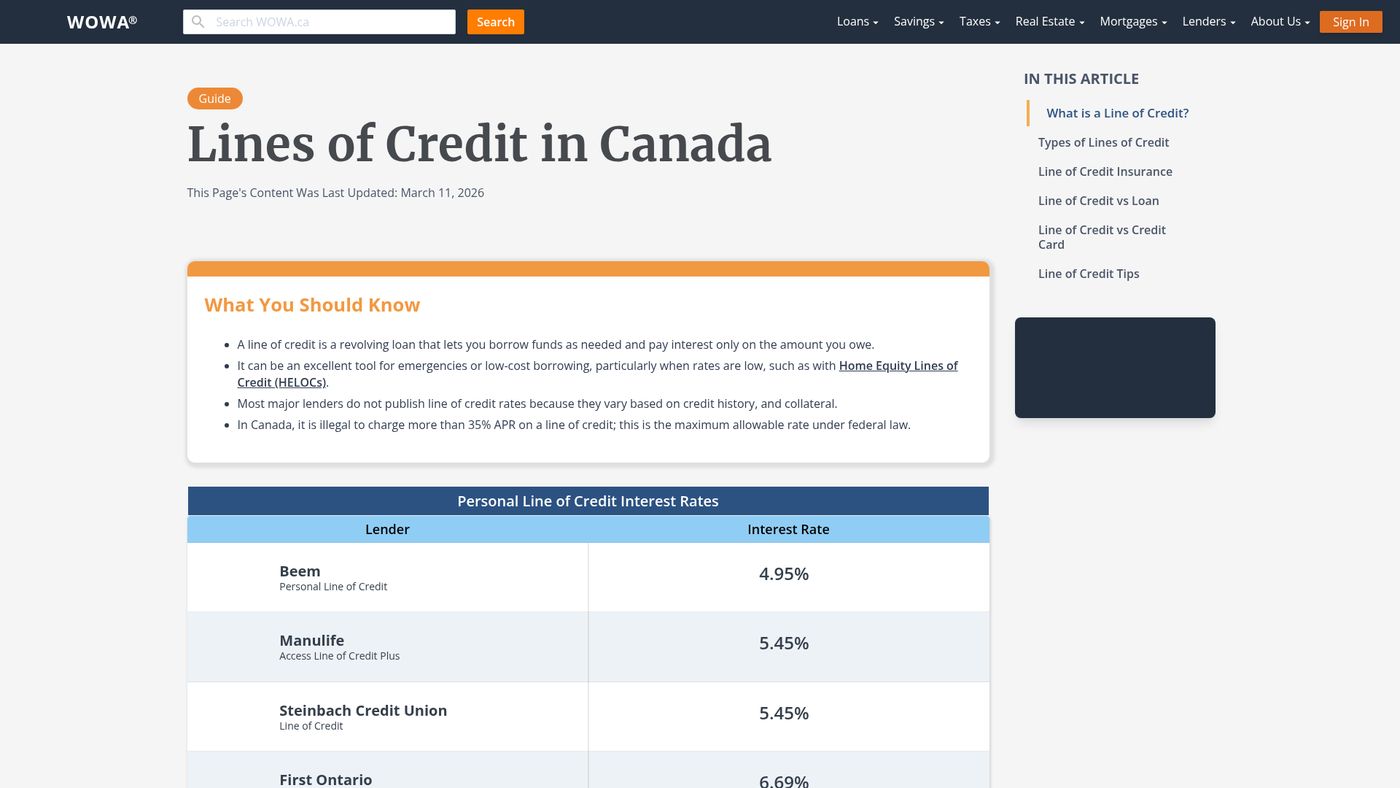
The annual interest rate is 7%, and you are currently making the minimum monthly payment. According to common Canadian rules, the minimum payment would be 2% of the balance or $50, whichever is greater. If this payment only covers the interest accrued that month, the principal balance would not decrease. The calculator would then compute the required fixed monthly payment needed to achieve that goal, which would be higher than the minimum but result in paying less total interest. This accelerated schedule could reduce the total interest paid and potentially shorten the payoff period slightly further. This example illustrates how adjusting your payment strategy within the calculator can reveal significant savings and help you set a realistic budget.
Insurance and Protection Options
Many Canadian financial institutions offer optional insurance products to protect your line of credit. These are designed to help manage the debt in case of unforeseen life events. Creditor insurance for personal lines of credit can help pay off or reduce your balance in the event of death. It can also cover your minimum payments in the event of a disability, preventing your balance from growing due to missed payments during a period of lost income. The specific insurance offerings can include critical illness insurance, life insurance, and disability insurance.
These products are underwritten by insurance companies like The Canada Life Assurance Company. It is important to review the terms, conditions, and costs of any insurance product to determine if it meets your personal needs. Adding insurance will increase your monthly costs, as premiums are typically added to your line of credit balance or payment. You should speak with a banking or insurance specialist to get full details on the coverage, exclusions, and eligibility for these optional protections.
They can help you understand how the insurance integrates with your line of credit payments and how premiums are calculated. Choosing appropriate insurance is a personal decision based on your financial situation, dependents, and risk tolerance. Insurance provides a safety net but represents an additional ongoing cost that should be factored into your overall budget when using a line of credit. These products are a key part of comprehensive financial planning for borrowers.
Frequently asked questions
What is the minimum payment on a line of credit in Canada?
The minimum payment on most personal lines of credit in Canada is 2% of the outstanding balance or $50, whichever amount is greater. This payment is typically due monthly. It is crucial to understand that this minimum payment often covers only the accrued interest for the period. To actually reduce your principal debt, you need to pay more than the minimum amount required.
How is interest calculated on a Canadian line of credit?
Interest on a line of credit is calculated daily on your outstanding balance, the amount you have actually borrowed from your limit. The daily interest amount is accrued and then totalled and charged to you on your monthly statement. This method means interest costs can change daily as your balance changes. Because it compounds, paying down your balance quickly reduces the interest you will pay over time.
Can I pay off my line of credit early without penalty?
Yes, you can generally pay off your line of credit in full at any time without any prepayment penalty. This is a standard feature offered by major Canadian financial institutions. You can make this lump-sum payment through online banking, by visiting a branch, or by calling an advisor. Paying off the balance early stops all future interest charges, saving you money.
What is the difference between a fixed and variable rate line of credit?
A variable rate line of credit has an interest rate that fluctuates based on changes in the lender's prime rate. This means your interest costs and minimum payments can rise or fall over time. A fixed rate line of credit locks in the interest rate for a period, offering predictable payments. Many lenders allow you to switch between fixed and variable rate options on your existing line of credit.
Should I choose a line of credit or a personal loan?
A personal loan is a good choice for a well defined borrowing need with a particular end goal, such as buying a car or consolidating debt. It provides a lump sum of money up front with predictable, stable payments over a fixed timeframe. A line of credit is better for flexible borrowing for a variety of needs without having to reapply each time, as you have access to funds up to your approved limit. You only pay interest on the amount you actually use, and as you repay what you have borrowed, that money becomes available to you again.
How can a calculator help me manage my line of credit?
A line of credit calculator helps you estimate your monthly payments and total interest under different scenarios. You can test the effects of higher payments, different interest rates, or various payoff timelines. This allows you to create a realistic repayment plan and budget before you borrow. It is a valuable tool for comparing the cost of a line of credit against other borrowing options like personal loans.
Sources and further reading
- Personal Loan & Line of Credit Payment Calculator rbcroyalbank.com
- Personal Loan and Line of Credit Payment Calculator td.com
- Loan and Line of Credit Calculator cibc.com
- Personal Loan Calculator scotiabank.com
- Line of Credit Payoff Calculator (Canadian) dinkytown.net
This article explains how things work and is not financial, tax or legal advice. Rules, limits and rates change, so check the current figures with the Canada Revenue Agency, your province or your financial institution before you act.