A debt payment calculator is a financial tool that helps Canadians estimate how long it will take to become debt-free based on their current balances, interest rates, and monthly payments. It allows you to compare different repayment strategies, such as the avalanche or snowball methods, to see which could save you the most money in interest or provide the fastest psychological wins. Using this calculator is a crucial step in taking control of personal finances, as it provides a clear timeline and cost analysis for paying off obligations like credit cards, lines of credit, and personal loans. By inputting your specific details, you can visualize the impact of extra payments and make informed decisions to accelerate your journey out of debt.
How a Debt Payment Calculator Works
A debt payment calculator functions by taking the specific details of your debts and your planned repayment amount to model the future. You input the outstanding balance and annual interest rate for each of your debts, excluding mortgage debt in many calculators designed for consumer credit. The next critical input is the total amount of money you can afford to allocate toward debt repayment each month. The calculator then processes this data using amortization formulas to project your payoff timeline. It shows you how long it will take to reach a zero balance if you only make minimum payments, which for credit cards is often calculated at 2.5% of the outstanding balance. The real power of the tool lies in its ability to model accelerated repayment scenarios, demonstrating how increasing your monthly payment can dramatically reduce both the repayment period and the total interest paid over the life of the debts.
Advanced calculators allow you to specify a one-time extra payment or schedule recurring additional payments beyond the minimum. These extra payments are applied directly to the principal balance of your debts, which is the core amount owed before interest. By reducing the principal faster, you accrue less interest each day, creating a compounding effect that shortens your debt sentence. The calculator recalculates the amortization schedule with each extra payment, providing an updated payoff date. It is important to note that calculation results are approximations for information purposes, as they assume the interest rate will remain constant over the entire repayment period, though actual rates on variable products may change. All calculators emphasize that their results are not a guarantee but a projection to aid in financial planning.
Key Inputs and Their Impact on Results
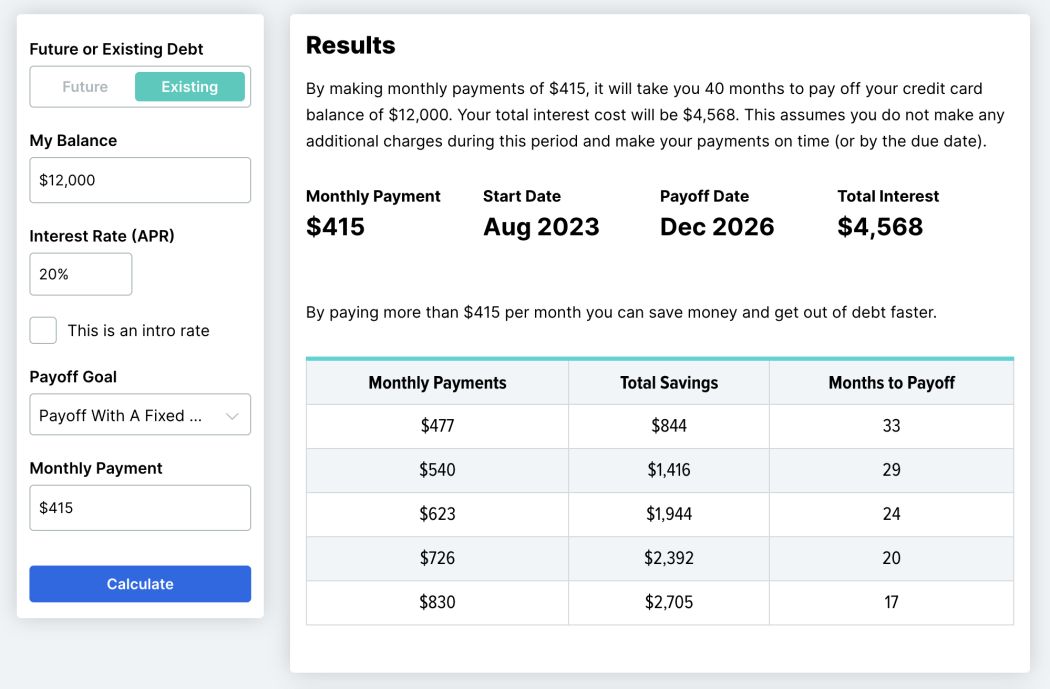
Every figure you enter into a debt payment calculator directly influences the final outcome, making accuracy essential for a useful plan. The debt balance is the starting point. A higher total balance naturally requires more time or larger payments to eliminate. The annual interest rate attached to each debt is perhaps the most powerful driver of cost, as it determines how much extra you pay for borrowing the money. Entering a higher interest rate, such as the 18% common on some credit cards, will show a much larger total interest cost compared to a lower-rate product like a line of credit at 8%. The calculator uses this rate to calculate the interest portion of each payment, which is highest at the beginning of the repayment period. Your planned monthly payment is the variable you control most directly, and even a small increase can lead to significant long-term savings.
If you input only the minimum required payment, the calculator will reveal a lengthy, often discouraging timeline where you pay a substantial sum in interest. For example, making just the minimum payment on credit card debt could take many years and result in paying over double the original borrowed amount in interest charges. By increasing your monthly payment input, you immediately see the payoff date move closer and the total interest cost drop. Some calculators also have a field for a debt consolidation loan interest rate, allowing you to compare your current situation to a new loan at a potentially lower rate, such as 8%. The calculator will show the new monthly payment and total cost if you used that loan to pay off all existing balances, providing a clear comparison for a consolidation strategy. This side-by-side analysis is crucial for making an informed decision about whether to seek a new loan or focus on repaying existing debts as they are.
Comparing Debt Repayment Strategies
Canadian debt payment calculators typically illustrate several common repayment methods, each with distinct psychological and financial outcomes. The avalanche method is mathematically the most cost-efficient strategy. It prioritizes paying off the debt with the highest interest rate first while making minimum payments on all others. Once the highest-rate debt is paid, you redirect its payment amount to the debt with the next highest rate, creating a cascading effect. This method minimizes the total interest paid over time because you attack the most expensive debts first. For instance, a credit card at 18% would be targeted before a personal loan at 12%, regardless of their balances. Using this method, you save more in interest compared to other approaches, though it may take longer to fully pay off your first individual debt if it has a large balance.
The snowball method focuses on behavioural motivation rather than pure math. With this strategy, you list your debts from smallest to largest balance and focus on eliminating the smallest debt first while maintaining minimum payments on the rest. The quick win of paying off an entire balance provides a psychological boost that can help maintain motivation for the longer journey. However, because it does not prioritize interest rates, you might end up paying more in total interest, especially if your smaller-balance debts have lower rates than your larger ones. Some individuals find the emotional momentum invaluable. A third common strategy modelled is debt consolidation, which involves taking out a new loan, often at a lower interest rate like 8%, to pay off multiple existing debts. This simplifies finances into one monthly payment and can reduce interest costs, but it requires credit approval. For those who cannot get a bank loan, a non-profit credit counselling Debt Consolidation Program may offer a structured plan with a fixed monthly payment and sometimes 0% interest, leading to a defined payoff period, such as four years.
Canadian Context for Debt Repayment
Understanding the typical financial products and rules in Canada helps when using a debt payment calculator. Credit card minimum payments are frequently calculated as a percentage of the outstanding balance, with 2.5% being a common benchmark used in calculator examples. Personal loans and lines of credit from major Canadian banks like RBC, TD, and Scotiabank are common tools for debt consolidation. These loans can range from $2,000 up to $50,000, with interest rates that can be fixed or variable. It is important to know that the Annual Percentage Rate (APR) on these products may be the same as the interest rate if there are no additional fees or charges, simplifying comparison.
When considering a line of credit versus a loan for consolidation, the key difference is flexibility. A loan provides a single lump sum with a fixed repayment schedule, suitable for a defined goal like debt consolidation. A line of credit offers revolving access to funds up to a limit, where you only pay interest on what you use. Calculators from Canadian banks often include features to estimate payments for both. Furthermore, borrowers should be aware that early payoff penalties may apply to some loan products, though this is less common with standard personal loans and lines of credit. The calculators assume all payments are made when due and that interest is accrued daily and charged according to the payment frequency, whether weekly, biweekly, or monthly. This daily accrual is a standard feature of Canadian lending products and is accurately reflected in the calculations performed by these tools.
Steps to Use Your Calculator Results Effectively
After receiving your calculation results, taking structured action is the next critical step toward financial freedom. First, review the detailed amortization tables or report that many calculators generate, which show the exact payoff dates and how each payment is split between principal and interest over time. This report serves as a blueprint for your repayment journey. Second, based on the strategy comparison, decide which method aligns with your financial personality and goals, whether it’s the interest-saving avalanche method or the motivational snowball method. Third, if the calculator indicates a very long payoff period with minimum payments, actively look for ways to increase your monthly debt allocation by creating a budget and cutting unnecessary spending.
- Obtain and review the full amortization schedule showing exact payoff dates.
- Choose a repayment strategy (avalanche, snowball, consolidation) based on your calculator's comparison.
- Create a monthly budget to free up more money for debt payments beyond the minimum.
- Investigate debt consolidation options if the calculator shows significant interest savings, such as with an 8% loan.
- Consider speaking with a non-profit credit counsellor if traditional consolidation is not available to you.
- Set up automatic payments to ensure you never miss a due date and derail your plan.
Fourth, if consolidation appears beneficial, use a bank’s specific consolidation calculator to see the potential savings and then speak with a banking specialist to discuss your eligibility. Fifth, for those struggling with approval or multiple debts, meeting with a certified non-profit credit counsellor can provide access to a formal Debt Consolidation Program, which may offer a manageable single payment and interest relief. Finally, protect your progress by considering insurance options for your loan or line of credit, such as life or disability insurance, to ensure your debt does not become a burden for your family in case of unforeseen circumstances. Consistent follow-through on these steps transforms the calculator's projection into a tangible financial reality.
Limitations and Important Considerations
While debt payment calculators are powerful planning tools, users must understand their limitations to avoid misplaced expectations. The calculations are approximations based on the data you provide and assume that interest rates remain constant throughout the repayment period. In reality, variable interest rates on lines of credit or some loans can fluctuate, which would alter the actual payoff timeline and cost. The calculator also assumes you will make every payment on schedule without missing any. A single missed payment can incur fees and interest, disrupting the plan. Furthermore, the calculator does not account for potential early payoff penalties that some loan agreements might contain, so it is essential to review your loan contracts before accelerating payments.
Another critical consideration is opportunity cost. The calculator shows the benefit of putting extra money toward debt, but it does not compare that action to other uses for your funds. Financial wisdom suggests that building an emergency fund for medical or car emergencies should be a parallel priority, as it prevents new high-interest debt. Similarly, investing extra funds in well-performing stocks during good market years might offer a greater long-term return than making extra payments on a low-interest debt like a mortgage. Therefore, the calculator's output is one piece of a broader financial picture. It is most strongly recommended for high-interest debt like credit cards, where the interest savings are substantial and guaranteed, unlike investment returns. Before deciding to pay off a debt early, borrowers should evaluate whether it is a wise decision financially given their overall situation and goals.
A Worked Example Using Common Canadian Figures
Inputting these figures into a debt payment calculator that uses the avalanche method would prioritize the 18% credit card first. While making minimum payments on the other two debts, the extra funds are directed to the credit card. If the borrower only made minimum payments, the calculator might show it taking over a decade to become debt-free, with interest costs exceeding the original amounts borrowed. This consolidated payment might be lower than the total of the previous separate minimums, and the total interest cost would be reduced because the high 18% rate is eliminated. This example illustrates how different strategies can yield vastly different financial and temporal outcomes for the same initial debt load.
Frequently asked questions
What is a debt consolidation program in Canada?
A debt consolidation program is often administered by a non-profit credit counselling agency. It involves combining multiple debts into a single monthly payment to the agency, which then distributes funds to your creditors. These programs sometimes negotiate with creditors to lower or waive interest rates, potentially to 0%, as noted in one example. They provide a structured plan, often over a set period like four years, for individuals who may not qualify for a traditional bank consolidation loan.
Should I pay off debt or invest my extra money?
This decision involves evaluating opportunity cost. Conventional financial wisdom suggests prioritizing the repayment of high-interest debt, like credit cards, because the interest cost is a guaranteed drain on your finances. For lower-interest debt, such as a mortgage or a student loan, it may be more beneficial to invest extra funds if you expect a higher rate of return from the market. However, building an emergency fund should also be a key consideration to avoid future debt when unexpected expenses arise.
What is a debt payment calculator?
A debt payment calculator is a free online tool that helps you determine how long it will take to become debt free. You enter the balances and interest rates for each of your debts, excluding mortgage debt, along with your affordable monthly payment. The calculator then shows you the timeline and total interest paid using different repayment strategies. It is designed to help Canadians plan a path to debt relief for various obligations like credit cards and loans.
How does a debt repayment calculator work in Canada?
A debt repayment calculator works by having you input the details of your debts, such as balances and interest rates, and your planned monthly payment. It then processes this information to show you the payoff timeline and interest costs. The calculator can illustrate results using five different debt repayment strategies, including the snowball and avalanche methods. This allows you to compare how different approaches affect your total interest paid and time to debt freedom. Many Canadian financial institutions and websites offer these tools for free.
What is the snowball method of debt repayment?
The snowball method is a debt repayment strategy where you focus on paying off the debts with the smallest balances first while maintaining minimum payments on others. This approach can provide an emotional boost by creating quick wins as smaller debts are eliminated. However, it may result in paying more total interest compared to the avalanche method because it does not prioritize higher interest rates. The method is designed to help maintain motivation throughout the debt repayment journey.
What details do I need to use a debt payment calculator?
To use a debt payment calculator, you need the balances and interest rates for each of your debts, such as credit cards, loans, or lines of credit. You also need to know the amount of money you can afford to put toward debt repayment each month. The calculator typically excludes mortgage debt from its calculations. With this information, the tool can generate a detailed report showing payoff dates and total interest under various strategies. Some calculators can handle up to eight different credit cards or loans.
Sources and further reading
- Free Debt Payment Calculator creditcanada.com
- Loan Calculators and Tools | RBC Royal Bank of Canada rbcroyalbank.com
- Personal Loan and Line of Credit Payment Calculator td.com
- Personal Loan Calculator scotiabank.com
- Debt Payoff Calculator calculator.net
This article explains how things work and is not financial, tax or legal advice. Rules, limits and rates change, so check the current figures with the Canada Revenue Agency, your province or your financial institution before you act.