A car lease calculator is a tool used to estimate the monthly payments for leasing a vehicle. It helps Canadians compare the long-term costs of leasing versus financing a purchase. By inputting variables like the vehicle price, lease term, and interest rate, you can project your payments before taxes and after taxes, on a monthly or bi-weekly basis. Understanding these calculations is crucial for budgeting and making an informed decision on acquiring a new vehicle.
What a Car Lease Calculator Does
A car lease calculator provides a detailed estimate of your periodic payments for leasing a vehicle. It translates the total cost of a lease into regular payment amounts, which can be viewed before and after applicable taxes. The calculator can show results for monthly or bi-weekly payment schedules, helping you align the expense with your cash flow. Many calculators also function as comparative tools, allowing you to see the cost of two consecutive leases versus the cost of a single loan to own a vehicle outright. These figures typically include estimated taxes and interest charges over the term but do not include potential costs for maintenance, repairs, or end-of-lease penalties. Using such a calculator is the first step in understanding the full financial commitment of a car lease. The results are approximations for informational purposes and assume interest rates remain constant, though actual rates may vary over the amortization period.
Inputs Required for the Calculation
Several specific variables are required to calculate a monthly lease payment accurately. The net lease amount or total vehicle price is the starting point, representing the agreed-upon cost of the car. The down payment, which can include cash and any rebates or trade-in allowance from your current vehicle, reduces the amount being financed. The interest rate, often called the cost of credit as a yearly rate, is a critical factor that directly influences the finance charges added to the lease. The lease term, usually measured in months, defines the length of the contract, with most leases running between two and four years. The residual value is the projected value of the vehicle at the end of the lease and is set by the lessor. A higher residual value typically leads to lower monthly payments. Additional inputs may include the annual mileage allowance and any applicable incentive discounts from the manufacturer or province. For a bi-weekly payment calculation, the tool will account for 26 pay periods in 12 consecutive months.
How Each Input Affects Your Payment
Changing any input in a lease calculator will directly alter the estimated monthly payment. A larger down payment reduces the net amount being financed, which lowers the monthly payment. A higher interest rate increases the cost of borrowing, resulting in a higher monthly payment. Extending the lease term spreads the cost over more payments, which can reduce each individual payment but increases the total interest paid over the life of the lease. The residual value has an inverse relationship with the payment. A vehicle with a higher projected residual value depreciates less over the lease term, leading to a lower monthly payment. Choosing a bi-weekly payment frequency instead of monthly results in more payments per year, which can reduce the principal faster if the payment amount is equivalent, but the calculator will show the adjusted per-payment amount. Provincial rebates for electric vehicles, when applied as a reduction to the after-tax price, will also lower the calculated payments. Manufacturer incentives like Nissan Canada Finance (NCF) Lease Cash, which are applicable to subvented lease contracts only, directly reduce the capitalized cost and thus the payment.
Standard Canadian Lease Rules and Structures
Car leases in Canada are structured as contracts allowing the use of a vehicle for a fixed period in return for periodic payments. Standard lease programs often include an annual kilometre allowance, with a common maximum of 24,000 kilometres per year. Exceeding this limit incurs an excess kilometre charge as defined in the lease agreement. Leases are taxed monthly on each payment, unlike finance contracts where tax is often paid in a lump sum upfront. At the end of the lease, the lessee must return the vehicle or can exercise a purchase option to buy it at the predetermined residual value. Including a purchase option at the beginning of the lease will typically add a small amount to the monthly payment. The vehicle must be returned in reasonable condition, subject to an inspection for excessive wear and tear or damage attributable to the lessee. Lessees are generally required to perform regular upkeep and servicing of the vehicle, with proof, as failure to do so can result in penalties or voided warranties.
A standard vehicle lease in Canada includes a maximum annual kilometre allowance, such as 24,000 km per year. Lessees must pay an excess kilometre charge if they drive beyond the limits set in the lease agreement. The lease contract requires the lessee to perform and provide proof of regular vehicle servicing and maintenance. At the end of the lease, the vehicle must be returned in reasonable condition, subject to an inspection for excessive wear and tear.
- The lessee must adhere to the annual kilometre limit specified in the contract, often 24,000 km/year.
- Regular vehicle servicing and maintenance are required, with proof.
- The lessee is responsible for any damage beyond normal wear and tear.
- Modifications to the vehicle are typically restricted.
- A purchase option can be included, allowing the lessee to buy the car at lease end.
- Provincial incentive rebates for electric vehicles may apply and reduce the net cost.
- Lease contracts require the lessee to maintain appropriate insurance coverage.
- Accessories installed by the dealer are added to the vehicle price but not to the residual value.
Lease-Specific Costs and Considerations
Beyond the base monthly payment, several other costs are inherent to a car lease. An excess kilometre charge applies if you drive beyond the contracted annual limit, which is a per-kilometre fee. At lease end, charges may be levied for excessive wear and tear, which is damage beyond what is expected from normal use. Maintenance costs for items like oil changes, tires, and brakes are the lessee's responsibility and are not included in lease payment calculations. Some manufacturers offer subvented lease programs with incentivized interest rates, which are reflected in the calculator as a lower rate. It is important to note that lease payments do not build equity. At the end of the term, you do not own an asset unless you purchase the vehicle. Furthermore, lease contracts require you to maintain proper insurance coverage on the vehicle for the entire term. Wear and tear insurance is available for lessees concerned about potential end-of-lease charges. Lessees can also avoid excess kilometre or wear and tear penalties by choosing to purchase the vehicle at the end of the lease.
Comparing Leasing to Financing a Purchase
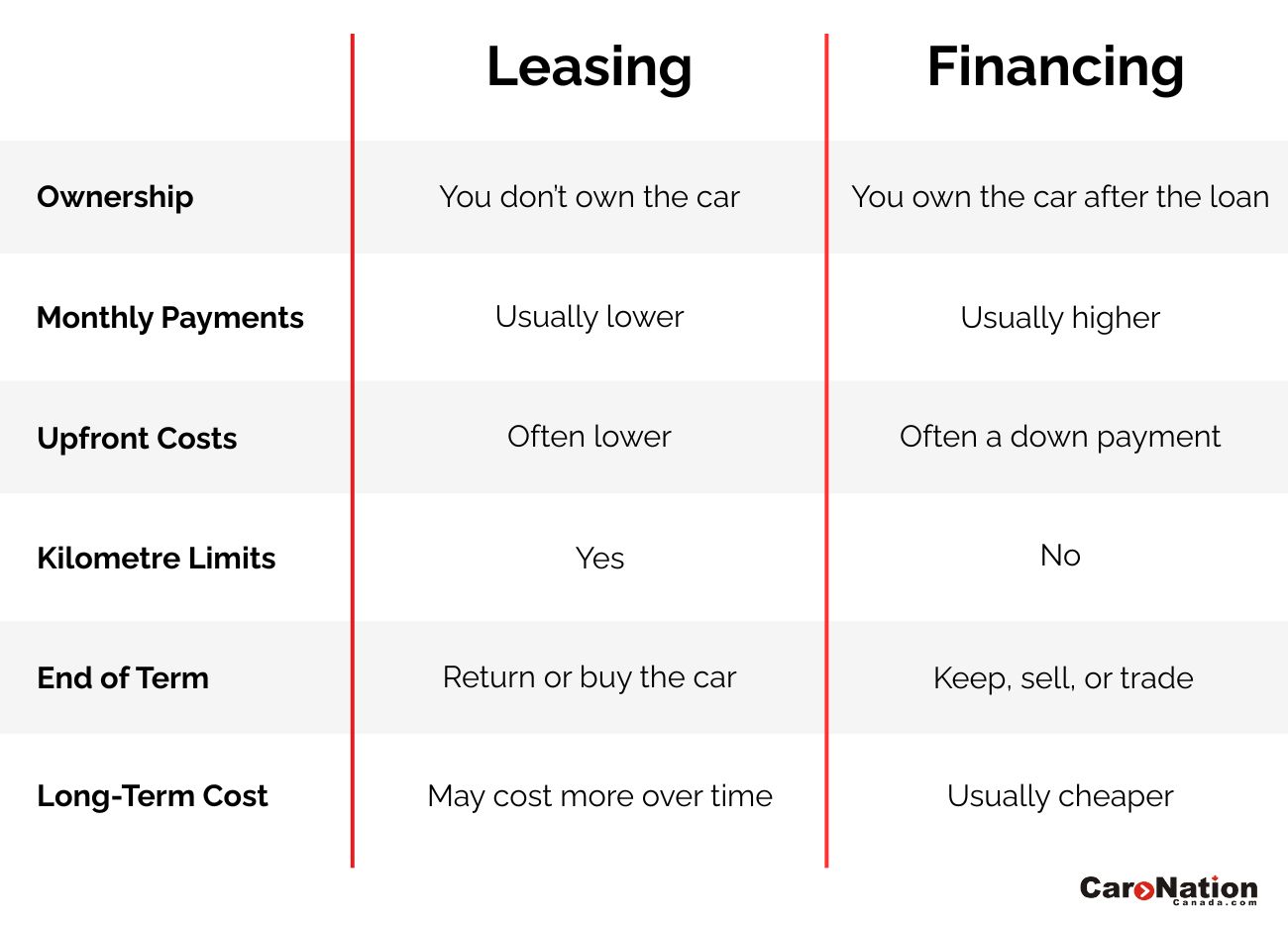
Using a comparative calculator reveals the long-term financial differences between leasing and taking a loan to buy. A lease calculation shows the cost of two consecutive leases, including taxes and interest, over several years. A loan calculation shows the total cost to possess a vehicle until the loan is paid in full, after which you own the vehicle with no further payments. The loan column includes all monthly payments plus interest and taxes until the term ends. Neither calculation includes potential costs for maintenance and repairs, which should be budgeted separately. For individuals who prefer driving a new vehicle every few years and want lower monthly payments, leasing can be attractive. For those aiming to build ownership and avoid perpetual payments, financing a purchase may be more suitable, especially after the loan term concludes. The Financial Consumer Agency of Canada’s Financial Goal Calculator can illustrate how savings could grow if you continued to set aside your former car payment after a loan is paid off. It is also possible to consider redirecting those funds to a Registered Retirement Savings Plan (RRSP) or a Registered Education Savings Plan (RESP).
Worked Example Using Common Figures
The lease term is 48 months, or four years. The annual kilometre allowance is 24,000 kilometres. A car lease calculator would use these inputs to determine the monthly finance portion of the payment. Since leases are taxed monthly, the calculator would then apply your provincial sales tax rate to that monthly amount to show the after-tax payment. For a bi-weekly schedule, it would divide the monthly figures appropriately, with payments due every 14 days. The result would show you the estimated periodic payment required, helping you assess affordability. This example does not include any manufacturer lease cash incentives or provincial electric vehicle rebates, which would further alter the calculation if applicable.
Provincial Variations and Incentives
Lease calculations in Canada can be affected by provincial programs, particularly for electric vehicles. Many provinces offer incentive rebates to encourage the adoption of electric vehicles. These rebates are applied to the after-tax value of the vehicle and can reduce the net amount being financed or leased. The actual rebate amount varies by the vehicle model and the term of the finance or lease agreement. It is crucial to confirm the details of these incentives with your dealer, as they are administered by provincial governments and are subject to change. The sales tax rate applied monthly to the lease payment also varies by province, altering the final after-tax payment amount. Dealers have the most current information on available incentives and how they integrate with manufacturer offers. These provincial incentives are not within the manufacturer's control, and interested parties should confirm the accuracy of the information before relying on it to make a purchase.
Understanding Calculator Results and Limitations
The results provided by a car lease calculator are estimates for informational and illustrative purposes only. The calculations assume that the interest rate will remain constant over the entire lease term, though actual interest rates may vary. All displayed options are based on the information you provide and current automotive borrowing product offerings. The tool does not constitute financial advice, and you are advised to speak with an automotive dealer or a financial advisor for a more in-depth discussion of your borrowing needs. Calculations do not include maintenance and repair costs, which are potential extra costs that should be considered. The estimated total cost shown is the amount owed over the total term of the contract, including any down payment made at the dealership. Payment results are subject to standard credit approval by the lending institution. For the most accurate and binding figures, you must visit a dealership and obtain a formal lease quote based on your specific credit profile and the exact vehicle configuration. Manufacturer incentives like NCF Finance Cash or Lease Cash are applicable to retail customers only and are not combinable with fleet discounts.
Frequently asked questions
What is a car lease calculator used for?
A car lease calculator is used to estimate your monthly or bi-weekly payments before and after tax for leasing a vehicle. It helps you understand the financial commitment by processing inputs like the vehicle price, down payment, interest rate, and lease term. The tool often allows for comparisons between the cost of leasing and the cost of financing a purchase over time. It provides essential figures for budgeting before you visit a dealership. Results are approximations and assume a constant interest rate.
What is the standard kilometre allowance on a Canadian lease?
A standard lease program in Canada often allows a maximum of 24,000 kilometres per year. This allowance is specified in the lease contract. If you drive the vehicle beyond this limit, an excess kilometre charge will apply at the end of the lease agreement. Some programs may offer different allowances, so it is important to confirm the terms before signing. High mileage leases are available but typically come with higher monthly payments.
How does a down payment affect my lease payment?
A down payment reduces the net amount being financed through the lease. This lower financed amount results in a lower monthly lease payment. The down payment can consist of cash, a rebate, or the trade-in value of your current vehicle. A larger down payment will have a more significant effect on reducing your periodic payments. Manufacturer incentives like Purchase Cash discounts for cash deals also act as a down payment by reducing the selling price before taxes.
What is a residual value in a car lease?
The residual value is the projected value of the vehicle at the end of the lease term. It is set by the lessor and is not negotiable. A higher residual value means the vehicle depreciates less during your lease, which typically leads to lower monthly payments. This value varies based on the lease term, mileage allowance, and the vehicle's make and model. Vehicles with high resale value generally have higher residual values.
Are lease payments taxed differently than loan payments?
Yes, lease payments are taxed monthly in Canada. The applicable provincial sales tax is calculated and added to each individual lease payment. In contrast, for a financed purchase, the sales tax is usually calculated and paid in a lump sum at the beginning of the loan, often rolled into the total financed amount. This monthly tax treatment is a key structural difference between leasing and financing.
Can I buy the car at the end of my lease?
Most leases include a purchase option agreement that allows you to buy the vehicle at the end of the lease term at a specified price, which is the residual value. Choosing to add this option at the beginning of the lease will typically add a small amount to your monthly payments. This option provides a path to ownership if you decide you want to keep the car. Lessees also have the option to buy the vehicle to avoid excess kilometre or wear and tear penalties.
Sources and further reading
- Vehicle Lease or Loan Calculator, Innova CMS ised-isde.canada.ca
- Auto Lease Calculator calculator.net
- Vehicle Lease & Finance Payment Calculator nissan.ca
- Auto Loan Payment Calculator scotiabank.com
- Buy vs Lease Calculator servus.ca
This article explains how things work and is not financial, tax or legal advice. Rules, limits and rates change, so check the current figures with the Canada Revenue Agency, your province or your financial institution before you act.