United States Treasury securities are debt instruments issued by the U.S. Department of the Treasury to finance government spending. Known for their low risk and backed by the full faith and credit of the U.S. government, they are a fundamental part of global finance. Understanding Treasuries is key for investors monitoring yields and managing portfolios.
What Are U.S. Treasury Securities?
United States Treasury securities are government debt instruments issued to finance federal spending as a supplement to taxation. They are obligations of the U.S. government, backed by its full faith and credit, which promises to raise money by any legally available means for repayment. This backing, combined with a strong historical record of repayment, has given Treasuries a global reputation as one of the world's lowest-risk investments. Their perceived safety grants them a unique role in the financial system, where they are often used as cash equivalents by institutions, corporations, and wealthy investors. The debt has been managed by the Bureau of the Fiscal Service since 2012, succeeding the Bureau of the Public Debt. These securities are divided into two broad categories: marketable securities, which can be traded between investors, and non-marketable securities, which are generally held until maturity by the original purchaser. The government sells marketable securities in auctions conducted by the Federal Reserve Bank of New York, after which they can be traded in secondary markets.
Types and Features of Marketable Treasuries
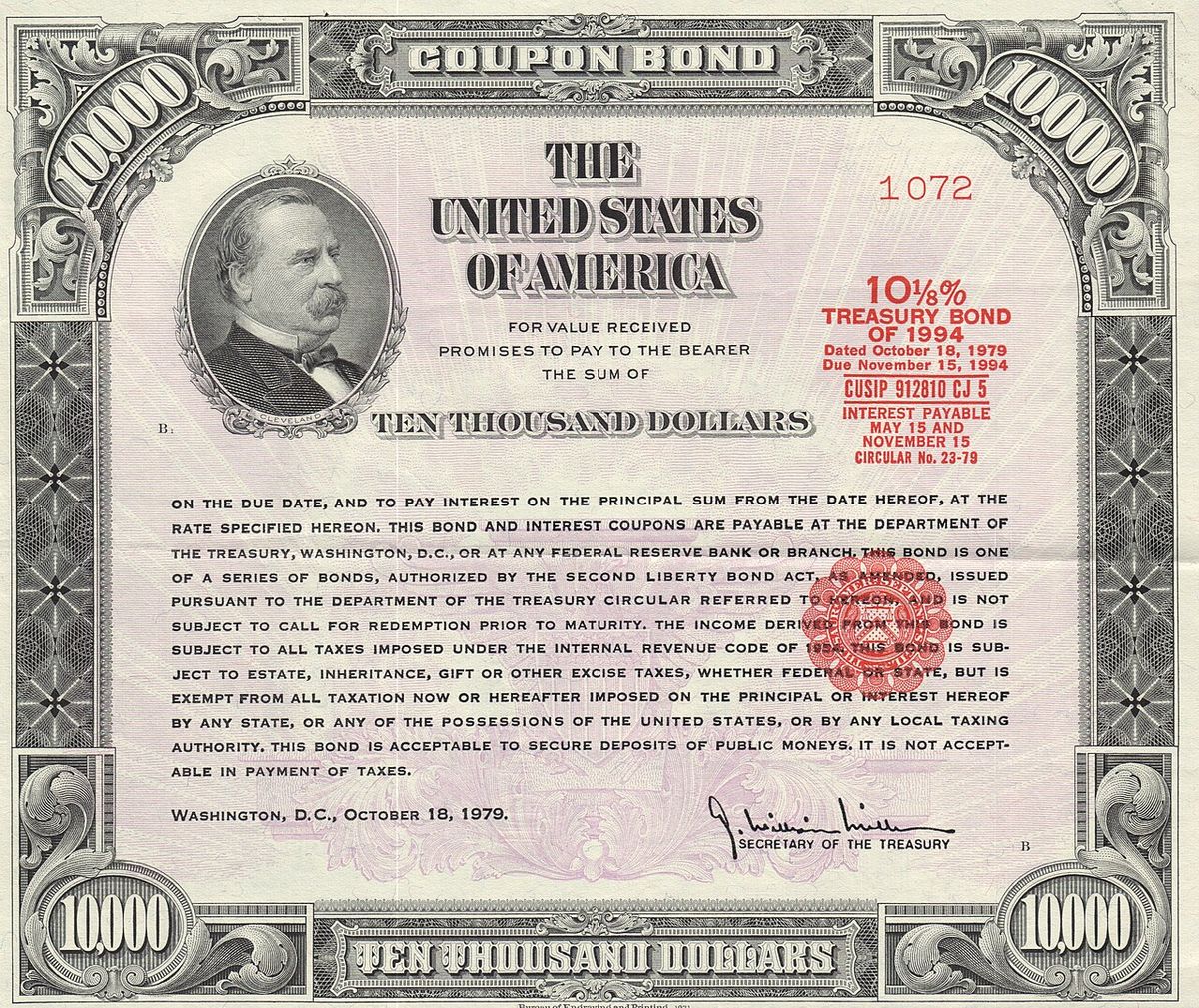
The U.S. Treasury issues four primary types of marketable securities, each with distinct characteristics and maturities. Treasury bills are zero-coupon bonds that mature in one year or less and are bought at a discount to their par value. Regular T-bills are issued with maturities of 4, 6, 8, 13, 17, 26, and 52 weeks through weekly or monthly auctions. The minimum purchase amount for a T-bill is $100, a threshold lowered from $1,000 in April 2008. During periods of low cash balances, the Treasury may also issue irregular cash management bills. Treasury notes have maturities of 2, 3, 5, 7, or 10 years and pay a fixed interest coupon every six months. They are sold in increments of $100, and the yield on the 10-year note is a closely watched benchmark for long-term interest rates and economic expectations. T-note prices are quoted on the secondary market as a percentage of the par value in thirty-seconds of a dollar.
Treasury bonds, often called long bonds, have the longest maturities at twenty or thirty years and also pay semi-annual coupons. The government suspended issuing 30-year bonds from February 18, 2002, to February 9, 2006, but reintroduced them due to demand from pension funds and other long-term investors. The 30-year bond is now issued quarterly. Treasury Inflation-Protected Securities provide protection against inflation by adjusting the principal value based on the Consumer Price Index for All Urban Consumers. TIPS have maturities of 5, 10, or 30 years and pay a fixed rate on the adjusted principal, guaranteeing a real return above inflation. At maturity, the holder receives the inflation-adjusted principal or the original principal, whichever is greater. Another type, the floating rate note, pays interest quarterly based on rates set in periodic auctions of 13-week Treasury bills and has a two-year term.
Primary Marketable Treasury Securities- Treasury Bills (T-bills): Zero-coupon. Maturities of 4, 6, 8, 13, 17, 26, 52 weeks. Minimum $100.
- Treasury Notes (T-notes): Fixed coupon every six months. Maturities of 2, 3, 5, 7, or 10 years.
- Treasury Bonds (T-bonds): Fixed coupon every six months. Maturities of 20 or 30 years.
- TIPS: Inflation-adjusted principal. Maturities of 5, 10, or 30 years. Pays fixed rate on adjusted principal.
- Floating Rate Notes (FRNs): Quarterly interest tied to T-bill rates. 2-year maturity.
A practice in the secondary market involves coupon stripping, where the interest and principal portions of notes, bonds, and TIPS are separated for individual sale. The modern versions are known as Separate Trading of Registered Interest and Principal Securities. STRIPS are not issued directly by the Treasury but are registered in its book-entry system and must be purchased through a broker. This practice derives from the days before computerization when paper bearer bonds had their coupons physically separated for resale.
Auction Process and Market History
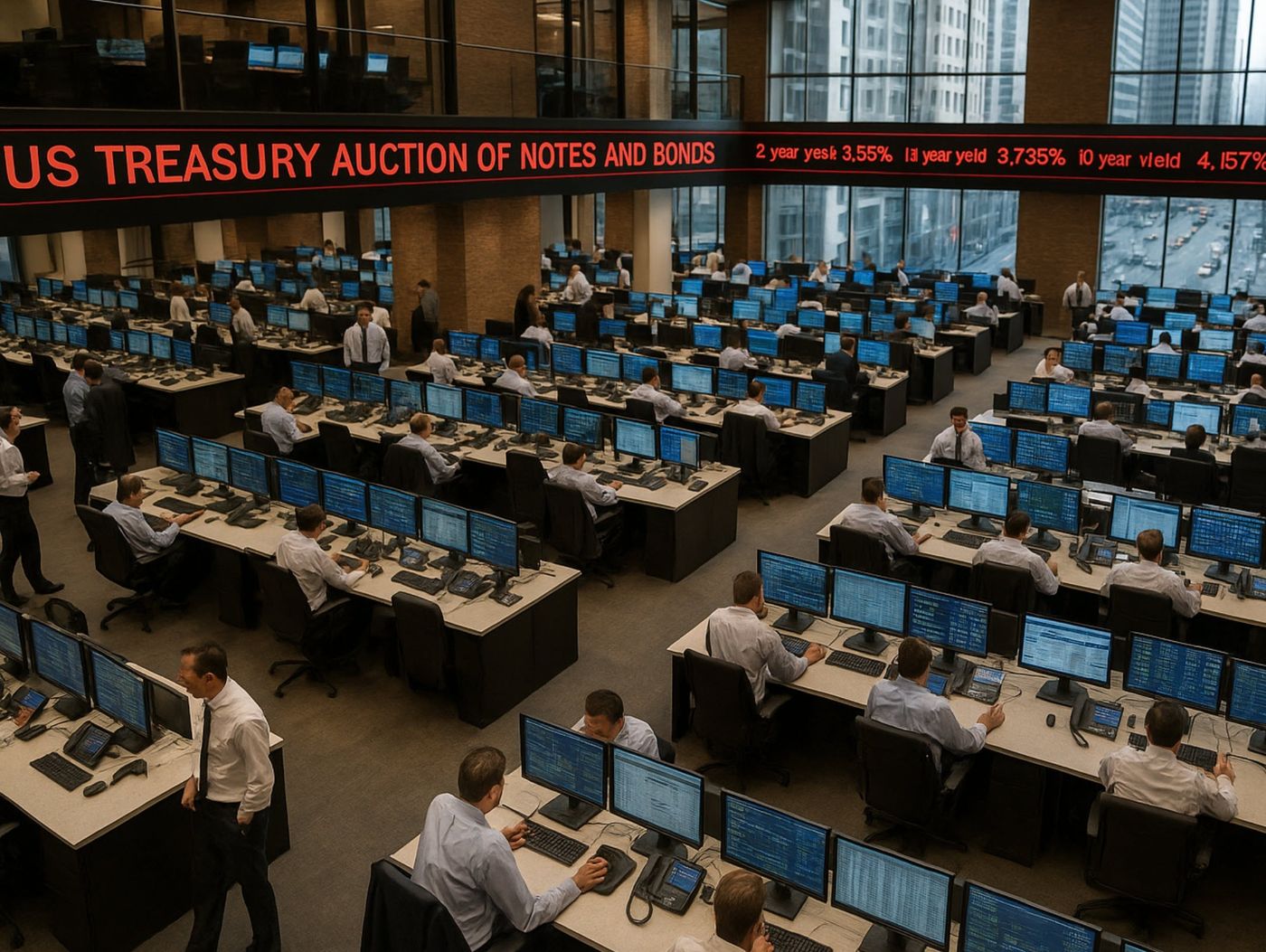
The U.S. government sells marketable Treasury securities through auctions conducted by the Federal Reserve Bank of New York. This system, where securities are sold to the highest bidders, was adopted in 1929, replacing a fixed-price subscription model that often led to chronic over-subscription. The first auction on December 13, 1929, issued $100 million in zero-interest three-month bills, with total bids aggregating $224 million. Until the 1970s, long-term securities were offered at irregular intervals based on market surveys, but the Treasury shifted to regular and predictable offerings to reduce market uncertainty as the federal deficit grew. The auction process for notes and bonds was later standardized based on the bill auction model. During World War I, the government financed costs by selling $21.5 billion in Liberty bonds through subscription at par value. After the war, the Treasury refinanced the maturing Liberty bond debt with variable short and medium-term maturities using the same fixed-price subscription system, which led to the government paying too much for its debt.
Non-Marketable Securities and Special Issues
Non-marketable Treasury securities cannot be traded on secondary markets and are typically redeemable only by the original holder. U.S. savings bonds, created in 1935, are the most familiar type. Series EE bonds pay a fixed rate and are guaranteed to double in value if held for 20 years. They continue to pay interest until 30 years. Series I bonds have a variable interest rate consisting of a fixed component and a variable inflation-adjusted component reset every six months based on the CPI-U. The combined rate cannot fall below 0 percent, so the bond will not lose value. Paper savings bonds were largely phased out after 2011, with electronic purchases now made through TreasuryDirect. The State and Local Government Series is a special non-marketable security issued to state and local governments that have raised cash through tax-exempt bond sales. SLGS securities are exempt from rules that would otherwise prohibit investing that cash in higher-yielding instruments. The Treasury issues SLGS at its discretion and has suspended sales on several occasions to adhere to the federal debt ceiling.
The Treasury also issues Government Account Series securities to federal agencies for investing excess funds, forming the principal form of intragovernmental debt holdings. Another instrument, the Zero-Percent Certificate of Indebtedness, is issued only through TreasuryDirect. It is an automatically renewed security with a one-day maturity that can be purchased in any amount up to $1000 and does not earn interest, functioning as a holding account for future security purchases. As of June 2025, approximately $7.2 trillion, or 20 percent of the public debt, was held by federal government agencies in intragovernmental holdings like the Government Account Series.
Canadian Investment and Holdings of U.S. Treasuries
Canada has emerged as a major holder of U.S. Treasury securities, with holdings reaching US$464.6 billion in August 2026, up from US$426.3 billion in July of that year. This represents an increase of over 300 percent from the US$106 billion held in 2021. Canadian investors have shown strong appetite, purchasing US$9.2 billion of U.S. government bonds in April 2025, the largest such investment since November 2023. In the same month, investors also bought $1.1 billion of U.S. Treasury bills. This activity contributed to a net acquisition of US$4.1 billion in foreign securities by Canadian investors that month, even as foreign investors reduced their holdings of Canadian bonds by US$25.1 billion. The surge in Canadian-held U.S. debt has positioned the country on track to become a top-three foreign holder, potentially surpassing China before 2028. Experts note that the rise in yields on U.S. bonds compared to domestic alternatives has been a key driver for Canadian investment. The yield on 10-year Chinese government bonds was 1.66 percent in 2026, compared with 5.11 percent for the U.S. 10-year bond, creating a significant spread.
However, the official data attributing holdings to Canada includes all securities held in Canadian-domiciled accounts, regardless of the ultimate owner's nationality. This custodial bias means that a portion of the rapid growth may be due to foreign entities, particularly from China, using Canadian financial intermediaries to hold U.S. debt. Officially, Chinese holdings have fallen roughly 40 percent to about US$600 billion from over US$1 trillion in 2021. It is widely known that China uses intermediaries in other countries, such as Belgium, for its treasury investments. Chinese law classifies plans to adjust foreign reserves as a state secret, which may motivate the use of intermediaries. This activity is not illegal but can obscure the true geographical distribution of ownership. Regardless of the source, the scale of holdings underscores the deep financial integration between Canada and the United States and the importance of U.S. debt in Canadian portfolios. As of June 2025, domestic U.S. holders owned approximately $27 trillion of outstanding Treasury securities, representing 75 percent of the public debt.
| Period | Key Activity and Context |
|---|---|
| January 2026 (Est.) | Reported by U.S. Treasury Department for end of January. |
| July 2026 | Monthly holding, showing rapid increase. |
| August 2026 | Latest reported holding from Treasury data. |
| April 2025 | Month Canadians bought $9.2B in US gov't bonds. |

Risks, Debates, and Market Dynamics
While U.S. Treasuries are considered low-risk, they are not without vulnerabilities. As a sovereign issuer, the United States could theoretically default, though it has a strong repayment record. Market dynamics can create significant volatility, as seen in September 2026 when the $32 trillion U.S. Treasury market endured its sharpest one-day sell-off since the onset of the Trump trade war. During that period, the yield on the 10-year Treasury note climbed above 5.2 percent, its highest level since 2007, while the 30-year yield exceeded 5.5 percent for the first time since 2004. Such yield spikes increase borrowing costs broadly, exemplified by the 30-year mortgage rate reaching 7 percent, its highest level in nearly two years. The sheer scale of the market also presents systemic risks, with the net U.S. debt pile surpassing $40 trillion. Debates persist about the market's structure, including the potential for hedge funds and other non-traditional actors to influence stability.
Another area of discussion is the potential for arbitrage and mispricing. A 2014 study found that conventional U.S. Treasury bonds were persistently mispriced relative to TIPS, creating arbitrage opportunities and posing a major puzzle to classical asset pricing theory. Finance scholars have noted that inflation-indexed securities like TIPS provide efficient instruments to diversify portfolios because they have a weak correlation with stocks and fixed-coupon bonds. Furthermore, the U.S. government has periodically considered extending debt maturities, with Treasury Secretary Steven Mnuchin suggesting the potential for 50-year or even 100-year bonds in 2019, though this did not materialize. For Canadian investors and the global market, these dynamics highlight that Treasuries are subject to interest rate risk, inflation expectations, and geopolitical factors that can affect prices and yields in the secondary market. The Federal Reserve Bank of New York itself held about $4.5 trillion in Treasuries as of June 2025, representing roughly 12.5 percent of the public debt held domestically.
Calculating Treasury Bill Yields
Treasury bills are quoted for purchase and sale in the secondary market on an annualized discount percentage, or basis. The general calculation for the discount yield for Treasury bills uses a specific formula. The discount yield percentage is equal to the face value minus the purchase value, divided by the face value. This result is then multiplied by 360 divided by the days till maturity, and finally multiplied by 100 percent. This method uses a 360-day year convention common in money markets. This quoted yield allows investors to compare returns across different T-bill issues and maturities. It is distinct from a bond equivalent yield, which would adjust for the actual day count. The bills are sold by single-price auctions that are held every four weeks for the 52-week bill and every week for the other maturities.
Frequently asked questions
What is the current yield on the 10-year US Treasury note?
The yield on the 10-year US Treasury note fluctuates daily based on market conditions. It serves as a key benchmark for long-term interest rates and investor sentiment. In September 2026, yields climbed above 5.2 percent, reaching their highest level since 2007. This yield is widely monitored by investors globally as a proxy for macroeconomic expectations and borrowing costs. Current yields on the 10-year Treasury note are followed to monitor the performance of the U.S. government bond market.
How can Canadians buy US Treasury securities?
Canadian investors can purchase marketable US Treasury securities like bills, notes, and bonds through brokerage firms or investment banks that provide access to the US bond market. They cannot be bought directly from the US Treasury's TreasuryDirect system unless the purchaser has a US social security number. Non-marketable securities like Series I savings bonds were previously available as paper bonds using a US tax refund but are now primarily electronic. Canadians typically invest through their financial institutions or investment accounts. STRIPS, or stripped securities, must also be purchased through a broker.
What are the differences between Treasury bills, notes, and bonds?
Treasury bills are short-term, zero-coupon securities with maturities of one year or less, purchased at a discount. Regular maturities include 4, 8, 13, 26, and 52 weeks. Treasury notes have maturities of 2, 3, 5, 7, or 10 years and pay a fixed interest coupon every six months. Treasury bonds are the longest-term, with maturities of 20 or 30 years, also paying semi-annual coupons. Each serves different investment horizons, with T-bills for short-term cash management and bonds for long-term, income-focused portfolios. The 30-year bond was reintroduced in February 2006 and is now issued quarterly.
Why are US Treasury securities considered a safe investment?
US Treasury securities are considered safe because they are backed by the full faith and credit of the United States government, which has a strong historical record of meeting its debt obligations. This backing implies the government promises to use any legally available means to repay the debt. Their low default risk makes them a global benchmark for safety, often used as a risk-free rate in financial models and as a haven asset during market turmoil. This low risk gives Treasuries a unique place in the financial system as cash equivalents for institutions.
How much US debt does Canada own?
As of August 2026, Canada held US$464.6 billion in US Treasury securities. This represents a significant increase from US$106 billion in 2021. These holdings include both marketable and non-marketable securities held in Canadian-domiciled accounts. This surge has positioned Canada to potentially become a top-three foreign holder of US debt, highlighting the depth of cross-border financial integration. The data includes all treasuries held in Canada-domiciled accounts, regardless of the ultimate owner's nationality.
What are TIPS and how do they protect against inflation?
Treasury Inflation-Protected Securities are marketable bonds whose principal value is adjusted based on changes in the Consumer Price Index for All Urban Consumers. The interest payment, which is a fixed rate, is applied to this adjusted principal, so payments rise with inflation and fall with deflation. At maturity, the investor receives the inflation-adjusted principal or the original principal, whichever is greater, virtually guaranteeing a real return above inflation. TIPS have maturities of 5, 10, or 30 years and pay interest every six months.
Sources and further reading
- United States Treasury security (Wikipedia) en.wikipedia.org
- Canada on track to become a top-three holder of U.S. ... theglobeandmail.com
- How Much US Treasury Bonds Does Canada Hold? A Guide startrader.com
- Canada's international transactions in securities, April 2025 www150.statcan.gc.ca
This article explains how things work and is not financial, tax or legal advice. Rules, limits and rates change, so check the current figures with the Canada Revenue Agency, your province or your financial institution before you act.