The South Korean won (KRW) is the official currency of South Korea, issued by the Bank of Korea. For Canadians, the won is relevant for travel, business, and investment, with exchange rates fluctuating against the Canadian dollar. Understanding the won's history, denominations, and security features helps in handling transactions and recognizing authentic banknotes. The currency's value and its conversion to Canadian dollars are key considerations for any financial dealings involving South Korea.
What Is the South Korean Won?
The South Korean won is the legal tender of South Korea, symbolized by ₩ and coded as KRW under the ISO 4217 standard. It is issued and regulated solely by the Bank of Korea, which is headquartered in Seoul. The basic unit is the won, which is theoretically subdivided into 100 jeon, although the jeon has no practical use in everyday transactions and appears only in foreign exchange rate calculations. The current series of won, introduced in 1962, is the second incarnation of the currency, following an earlier version and an interim currency called the hwan. Banknotes and coins are produced by the Korea Minting and Security Printing Corporation (KOMSCO), a government-owned entity operating under the central bank's guidance. After production, currency is bundled and stored in the Bank of Korea's vault before distribution to commercial banks, with increased circulation typically around major Korean holidays like Seollal and Chuseok.
History of the South Korean Won
The won's origins are tied to the Spanish-American silver dollar, a coin widely used in Asian trade from the 16th to 19th centuries. The name is derived from the Korean word for 'round', describing the shape of that silver dollar. During the Japanese colonial era from 1910 to 1945, the Korean yen replaced the won. After World War II and the division of Korea, separate won currencies were established for North and South in 1945, both replacing the yen at par. The first South Korean won was introduced in 1949, subdivided into 100 jeon, and initially pegged at 15 won to one US dollar. Devaluations followed, partly due to the Korean War, and this first won was replaced by the hwan on February 15, 1953, at a rate of 1 hwan = 100 won.
The modern South Korean won was reintroduced on June 10, 1962, at a rate of 1 won = 10 hwan, becoming the sole legal tender on March 22, 1975. Its initial peg was 125 won to one US dollar. The exchange rate was managed through a series of pegs until efforts to move to a floating rate began on February 27, 1980. The won was finally allowed to float on December 24, 1997, as part of an agreement with the International Monetary Fund during the Asian financial crisis, after which its value dropped by nearly half. There have been recurring proposals in the South Korean National Assembly to redenominate the won, introducing a new unit equal to 1,000 old won, but these have not progressed due to concerns about economic disruption and more pressing national issues.
Banknotes and Coins in Circulation
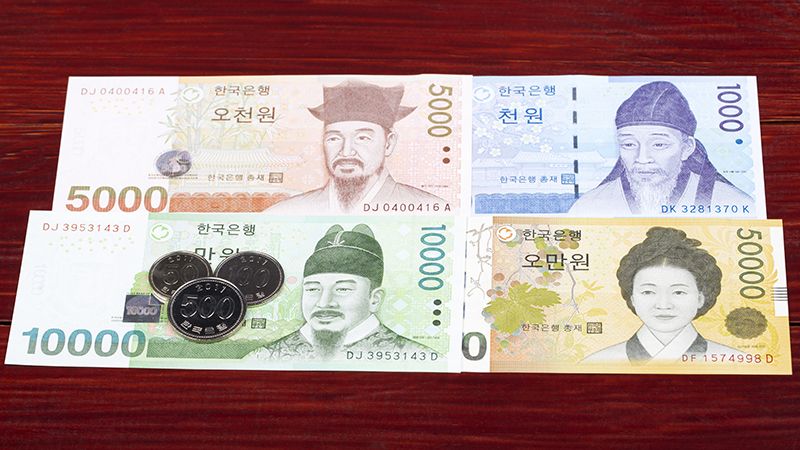
South Korean won banknotes are issued in denominations of ₩1,000, ₩5,000, ₩10,000, and ₩50,000. The Bank of Korea uses a unique series designation system, assigning a Korean letter in alphabetical order to each new design of a given denomination, not to groups of notes issued simultaneously. For example, the 1,000 won note issued in 1983 is series II because it was the second design for that denomination since 1962. Higher-denomination notes were introduced as the economy grew, with ₩5,000 notes in 1972 and ₩10,000 notes in 1973. The ₩50,000 note, featuring the portrait of 16th-century artist Shin Saimdang, was released on June 23, 2009, marking the first Korean banknote to depict a woman. Its release stirred controversy due to its color similarity to the ₩5,000 note. Plans for a ₩100,000 note were cancelled due to disputes over its imagery.
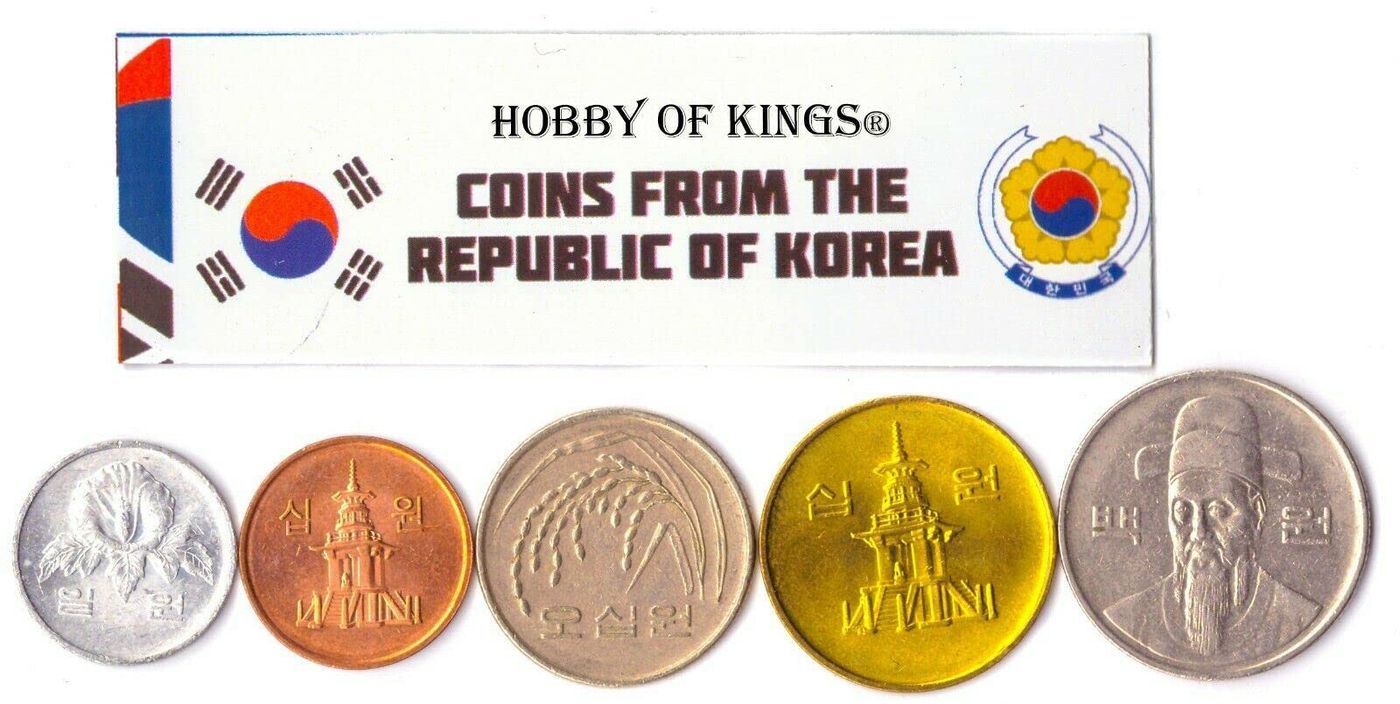
Coins in active circulation include the ₩10, ₩50, ₩100, and ₩500. The ₩1 and ₩5 coins are still minted in limited amounts for annual mint sets but are rarely used in daily transactions since 1992, with prices typically rounded to the nearest ₩10. Coin production has evolved due to cost. The brass ₩1 coin introduced in 1966 was replaced by an aluminium version in 1968 when its metal value exceeded its face value. New ₩5 and ₩10 coins in brass were issued in 1970. The ₩100 coin was introduced in cupronickel in 1970, followed by the ₩50 coin in 1972. The ₩500 coin entered circulation on June 12, 1982, driven by inflation and the popularity of vending machines. In 2006, the ₩10 coin was redesigned to copper-coated aluminium to reduce production costs, which had reached 38 won per coin.
Security Features and Anti-Counterfeiting
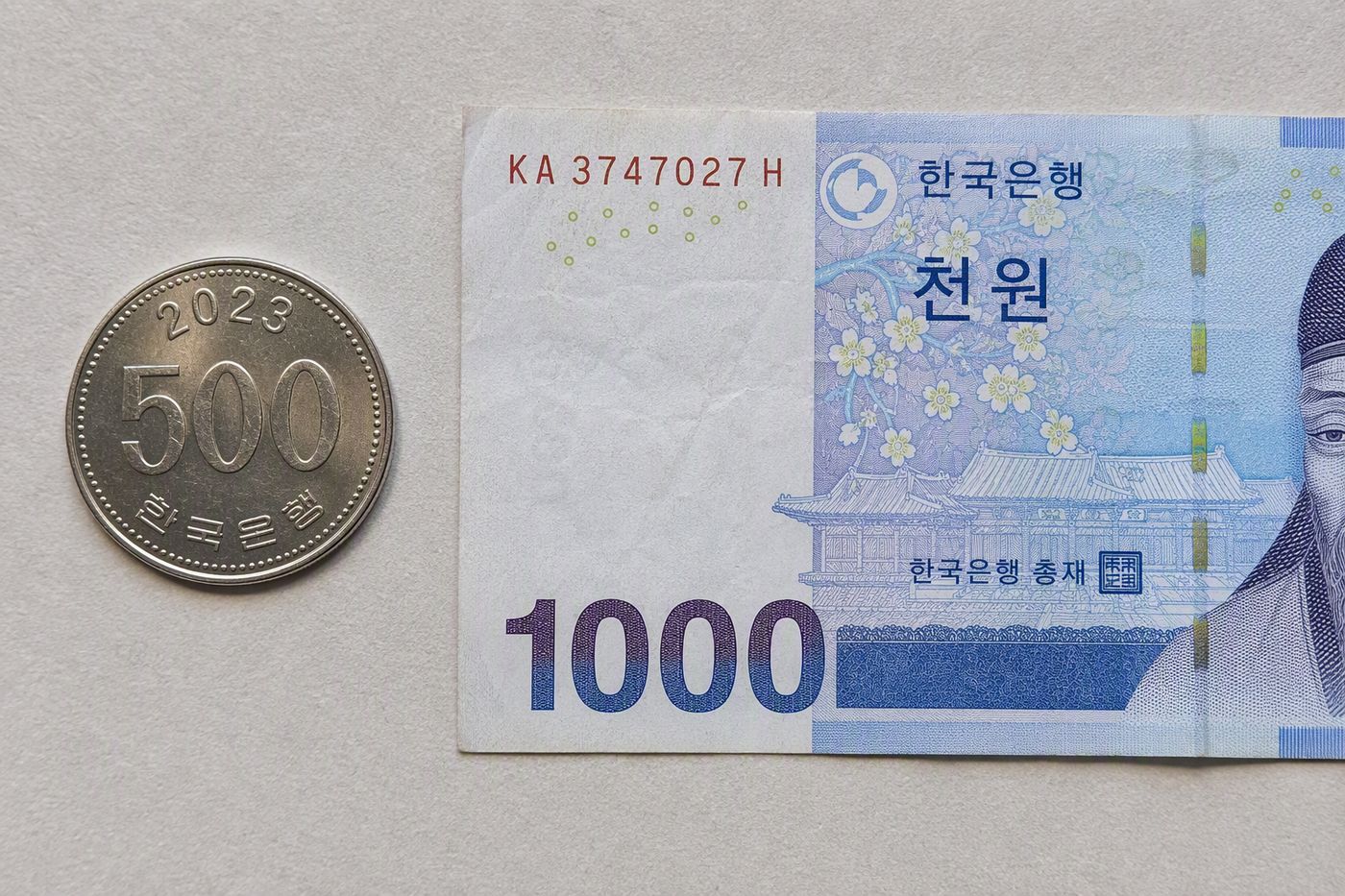
Counterfeiting concerns in 2006 led to a comprehensive redesign of South Korean won banknotes with advanced security features. The new series began with the ₩5,000 note in 2006, followed by the ₩1,000 and ₩10,000 notes in 2007. Each denomination incorporates a specific number of security features, with the ₩50,000 note having 22, the ₩10,000 note having 21, the ₩5,000 note having 17, and the ₩1,000 note having 19. These features are comparable to those found in major global currencies like the euro, pound sterling, Canadian dollar, and Japanese yen. Key security elements include holograms with three-dimensional colour-shifting images on the obverse side of most notes, a watermark portrait visible when held to light, and intaglio printing that creates a raised texture on certain elements.
A security thread is embedded on the right side of the obverse, bearing micro-printed text that reads '한국은행 Bank of Korea' and the denomination. Colour-shifting ink is used on the value number on the reverse of the notes. For the first time globally, KOMSCO inserted a new substance into the banknotes to aid in counterfeit detection, a technology that has since been exported to regions including Europe and North America. Earlier security upgrades between 1994 and 2002 introduced features like microprint, segmented metal thread, moiré patterns, and the EURion constellation to combat the deregulation of colour printer imports and increased use of computers and scanners.
The South Korean Won in Canada
For Canadians, the South Korean won is primarily encountered through currency exchange for travel, international money transfers, or trade. The exchange rate between the Canadian dollar (CAD) and the won (KRW) fluctuates based on global forex markets. As of recent data, the mid-market exchange rate is approximately 1 Canadian dollar to 941.96 South Korean won. The mid-market rate is the midpoint between global buy and sell prices and serves as a benchmark, though consumers typically receive a rate with a margin added by banks or currency services. Over a recent 90-day period, the KRW to CAD rate saw a high of 0.0011 and a low of 0.0010, with an average of 0.0010, representing a change of 11.19. Over 30 days, the average was 0.0011 with a change of 3.89.
Canadians looking to exchange currency can use banks, dedicated currency exchange kiosks, or online international money transfer services. These services often promote bank-beating exchange rates, low fees, and transparent pricing with no hidden charges. Many providers offer tools like real-time currency converters, rate alerts, and historical charts to help users monitor fluctuations. When sending money to South Korea, it is possible to transfer funds directly to Korean bank accounts in won, with delivery times ranging from minutes to hours. For travellers, obtaining won banknotes in Canada is common, though using credit cards or debit cards abroad is increasingly popular. It is important to check for foreign transaction fees and exchange rate margins applied by Canadian financial institutions.
Production Costs and Modern Usage Trends
The production of South Korean won involves significant costs, particularly for coins. In 1998, the cost to produce a single 10 won coin was 35 won, a 100 won coin cost 58 won, and a 500 won coin cost 77 won. By 2006, the cost to produce a 10 won coin had risen to 38 won, prompting its redesign to a cheaper copper-coated aluminium composition. These costs have contributed to the declining use of coins in South Korea's economy, which is rapidly adopting electronic payments. The Bank of Korea initiated a trial program to reduce coin usage by depositing change into prepaid cards, though public participation had decreased by 2019. The potential for a coinless society remains a topic of discussion, reflecting global trends towards digital finance.
The physical currency is printed and minted exclusively by KOMSCO under the Bank of Korea's guidance. After production, new banknotes and coins are bundled or rolled and shipped to the central bank's headquarters for storage in its vault. Distribution to commercial banks occurs upon request, with peak distributions around the major Korean holidays of Seollal and Chuseok to meet heightened demand for cash gifts and spending. Despite the growth of digital payments, cash remains in use, and the Bank of Korea continues to manage the supply and integrity of the physical currency.
Key Historical Dates and Denominations
The South Korean won was reintroduced on June 10, 1962, replacing the hwan at a rate of 1 won equals 10 hwan. It became the sole legal tender on March 22, 1975. The Bank of Korea introduced higher-denomination banknotes over time, with 5,000 won notes in 1972 and 10,000 won notes in 1973. A 50,000 won note was released on June 23, 2009, featuring the portrait of Shin Saimdang.
| Year | Event | Details |
|---|---|---|
| 1949 | First South Korean won issued | Pegged at 15 won = 1 USD. |
| 1953 | Won replaced by the hwan | 1 hwan = 100 won. |
| 1962 | Current won reintroduced | 1 won = 10 hwan. Pegged at 125 won = 1 USD. |
| 1972 | ₩5,000 banknote introduced | First high-denomination note. |
| 1973 | ₩10,000 banknote introduced | Followed the ₩5,000 note. |
| 1982 | ₩500 coin introduced | Replaced the ₩500 banknote. |
| 1997 | Won floated | December 24, following IMF agreement. |
| 2009 | ₩50,000 banknote introduced | First note to feature a woman (Shin Saimdang). |
Alongside these milestones, the composition and design of coins have changed. The first won coins in 1966 were 1, 5, and 10 won. The 100 won coin was introduced in 1970 and the 50 won coin in 1972. The 1 and 5 won coins became rarely used after 1992. Banknote series are designated sequentially by Korean letters for each denomination's design history, and the plates for the 5,000 won notes were produced in Japan while those for the 1,000 and 10,000 won notes were produced domestically by KOMSCO.
Future Considerations and Economic Context
The South Korean won operates in a dynamic economic environment. Its value against major currencies like the Canadian dollar is influenced by South Korea's export-driven economy, global investor sentiment, and monetary policy. Proposals to redenominate the won by introducing a new unit equal to 1,000 old won have surfaced periodically, aiming to create a currency unit with a higher face value similar to the US dollar. Proponents argue this would reflect the strength of the Korean economy, but opposition cites potential economic harm, limited cost savings, and more urgent national priorities. The debate highlights the balance between symbolic national prestige and practical economic management.
Technological advancements continue to shape currency usage. The trial for coinless transactions, though seeing reduced participation, indicates a direction towards digital payments. However, the Bank of Korea maintains its role as the sole issuer of physical currency, ensuring the won's stability and security. For Canadians engaging with South Korea, understanding these factors provides context for exchange rate movements and the practicalities of currency conversion. Monitoring economic news from South Korea and using reliable financial tools can aid in making informed decisions regarding the won.
Frequently asked questions
How much is 1 Canadian dollar in South Korean won?
The exchange rate fluctuates constantly. As of recent data, the mid-market rate is approximately 1 Canadian dollar (CAD) to 941.96 South Korean won (KRW). This means one Canadian dollar can be exchanged for about nine hundred and forty-two won. The actual rate you receive from banks or exchange services will include a margin.
What are the South Korean won banknote denominations?
Currently circulating South Korean won banknotes come in denominations of ₩1,000, ₩5,000, ₩10,000, and ₩50,000. The ₩50,000 note, introduced in 2009, features Shin Saimdang and was the first to depict a woman. Earlier plans for a ₩100,000 note were cancelled. Each denomination incorporates numerous advanced security features.
How has the South Korean won's value changed over time?
The won has undergone significant changes. First issued in 1949 pegged at 15 to the US dollar, it was replaced by the hwan in 1953. The modern won was reintroduced in 1962 at 125 to the dollar. After a series of managed pegs, it was floated in 1997, leading to a major devaluation during the Asian financial crisis. Its value now fluctuates freely on foreign exchange markets.
What is the South Korean won symbol and code?
The South Korean won uses the currency symbol ₩ and the three letter ISO code KRW. It is the official currency of South Korea, sometimes known as the Republic of Korea won. The currency is issued by the Bank of Korea, which is based in Seoul. While the won is technically divided into 100 jeon, this subunit is no longer used for everyday transactions and appears only in foreign exchange rates. The current South Korean won, which has been in use since 1962, is written exclusively in hangul and does not officially have any associated hanja characters.
Can I use South Korean coins in Canada?
South Korean coins are not legal tender in Canada and cannot be used for everyday purchases. To use their value in Canada, they must be exchanged for Canadian dollars through a currency exchange service, bank, or international money transfer provider. Commonly circulated South Korean coins include the 10, 50, 100, and 500 won denominations. The 1 and 5 won coins are rarely found in circulation as consumer prices are typically rounded to the nearest 10 won. These smaller coins are still minted in limited amounts annually for the Bank of Korea's mint sets.
Where can I exchange Canadian dollars for South Korean won?
Canadian dollars can be exchanged for South Korean won at major banks, dedicated foreign exchange kiosks, and through online international money transfer services. These providers offer varying exchange rates and fee structures, so it is advisable to compare the total cost, including any margins and transfer fees. Some services may deliver the won directly to a South Korean bank account, while others provide physical cash. The exchange rate fluctuates, and as of recent data, the mid market rate has been approximately 1 Canadian dollar to 941.96 South Korean won.
Sources and further reading
- South Korean won (Wikipedia) en.wikipedia.org
- 1 CAD to KRW, Canadian Dollars to South Korean Won ... xe.com
- South Korean wons to Canadian dollars Exchange Rate. ... wise.com
- Convert South Korean Won to Canadian Dollars currency.me.uk
- South Korean Won (KRW) to Canadian Dollar (CAD) remitbee.com
- Convert Canadian Dollar to South Korean Won instarem.com
This article explains how things work and is not financial, tax or legal advice. Rules, limits and rates change, so check the current figures with the Canada Revenue Agency, your province or your financial institution before you act.