A mutual fund is an investment vehicle that pools money from many investors to purchase a diversified portfolio of securities such as stocks, bonds, and money market instruments. In Canada, mutual funds are a popular choice for individual investors seeking professional management, diversification, and accessibility. They are a core component of many registered retirement savings plans (RRSPs) and tax-free savings accounts (TFSAs). The Canadian mutual fund industry held $1.8 trillion in assets at the end of 2023, reflecting its significant role in the national financial landscape.
What Is a Mutual Fund
A mutual fund is a type of investment fund that aggregates capital from numerous investors to buy a collective portfolio of securities. The term is commonly used in Canada, the United States, and India. The pooled funds are managed by professional portfolio managers who make investment decisions to achieve the fund's stated objectives. These objectives and the permitted types of investments are detailed in a legal document called a prospectus. Mutual funds provide investors with exposure to a wide array of assets, which can include equities, fixed income, and money market instruments, or a combination known as a hybrid fund. This structure allows individual investors to access a diversified portfolio that might otherwise be difficult or costly to assemble on their own.
The two primary structural types are open-end funds and closed-end funds. Open-end funds, which are far more common, issue and redeem shares directly with the fund company at the net asset value calculated at the end of each trading day. There is no limit to the number of shares an open-end fund can issue. Closed-end funds issue a fixed number of shares through an initial public offering, after which the shares trade on a stock exchange like any other stock, often at prices that differ from the net asset value. In Canada, the vast majority of mutual funds offered by banks and investment firms are open-end funds, providing daily liquidity to investors.
How Mutual Funds Work
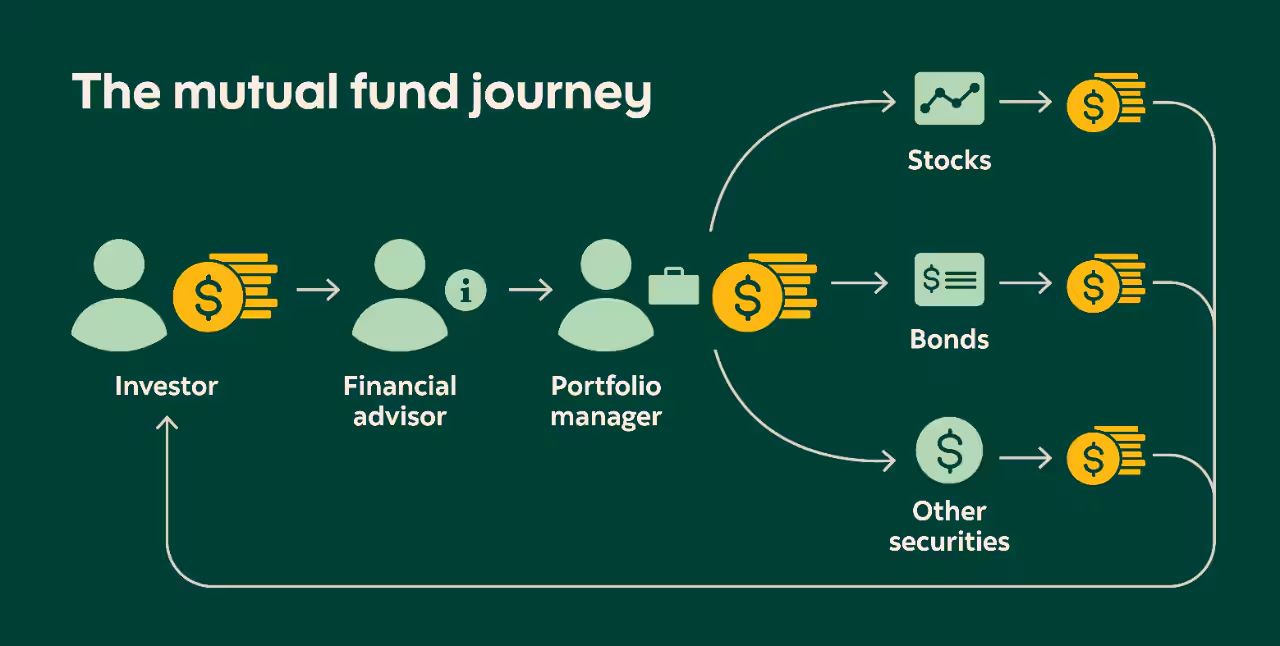
When an investor buys units or shares of a mutual fund, their money is combined with that of other investors. The fund's portfolio manager then invests this pooled capital according to the fund's mandate. The performance of the underlying securities determines the fund's net asset value, which is the total value of the fund's assets minus its liabilities, divided by the number of outstanding shares. Investors can typically buy or sell their shares at this NAV, but only once per day after the markets close. This differs from exchange-traded funds, which trade on an exchange throughout the day at fluctuating prices.
Mutual funds generate income and gains from their portfolio holdings. This can include dividends from stocks, interest from bonds, and capital gains from selling securities that have appreciated in value. Funds periodically distribute these earnings to shareholders, often in the form of cash payments or additional shares reinvested in the fund. These distributions are taxable to the investor in the year they are paid, regardless of whether they are taken in cash or reinvested. The frequency of distributions varies by fund, with some paying monthly, quarterly, or annually.
The operation of a fund incurs costs, which are borne by the investors. These expenses are captured in the management expense ratio, an annual percentage that represents the total costs of running the fund. The MER includes portfolio management fees, administrative costs, taxes, and trailing commissions paid to advisors. This ratio is deducted directly from the fund's assets, thereby reducing the returns received by investors. It is a critical figure for comparing the cost-efficiency of different funds.
History and Development
In the United States, the Boston Personal Property Trust was founded in 1893, though its purpose was initially a legal workaround. The modern open-end mutual fund structure began with the Massachusetts Investors Trust, established on March 21, 1924. Following the Wall Street Crash of 1929, the U.S. Congress enacted a series of laws that shaped the modern regulatory framework for mutual funds. These laws established rules for disclosure, operations, and taxation that encouraged the growth of open-end funds. The industry expanded significantly from the 1950s onward. The introduction of money market funds in the late 1970s and the advent of index funds in the early 1970s were important developments. The first S&P 500 index fund available to the general public was offered by Rex Sinquefield in 1973. John Bogle's First Index Investment Trust, launched in 1976, later became the Vanguard 500 Index Fund. The 1980s saw explosive growth driven by bull markets, new product types like international and sector funds, and the integration of mutual funds into employer-sponsored retirement plans.
Types and Classifications
Mutual funds are primarily categorized by their investment objectives and the assets they hold. The main classifications are stock funds, bond funds, money market funds, and hybrid funds. Stock funds invest primarily in equities and carry higher growth potential alongside greater risk. Bond funds focus on fixed-income securities and generally offer more stable income. Money market funds invest in short-term, high-quality debt instruments and aim for capital preservation. Hybrid funds, also known as balanced funds, mix stocks and bonds to provide a blend of growth and income.
Beyond asset class, funds are also distinguished by their management style. Actively managed funds employ portfolio managers and research teams who select securities with the goal of outperforming a specific market benchmark. This approach typically incurs higher fees. Passively managed funds, known as index funds, aim to replicate the performance of a market index, such as the S&P/TSX Composite Index, by holding all or a representative sample of the securities in that index. Index funds generally charge lower management fees due to their automated, low-turnover strategy.
- Stock Fund: Invests in equities. Seeks capital growth.
- Bond Fund: Invests in fixed-income securities. Seeks income.
- Money Market Fund: Invests in short-term debt. Seeks stability.
- Hybrid Fund: Invests in a mix of stocks and bonds.
- Index Fund: Passively tracks a market index.
- Actively Managed Fund: Seeks to outperform a benchmark.
- Sector Fund: Focuses on a specific industry.
- International Fund: Invests in securities outside Canada.
Mutual Funds in the Canadian Context
Mutual funds are a major part of the Canadian investment landscape, offered by major banks, credit unions, and independent investment firms. Canadian investors use mutual funds within various savings vehicles, including Registered Retirement Savings Plans (RRSPs), Tax-Free Savings Accounts (TFSAs), and Registered Education Savings Plans (RESPs). The funds provide an accessible path to diversification across asset classes, sectors, and global geographies. Major Canadian providers like CIBC, Scotiabank, and Fidelity Investments Canada offer extensive line-ups of funds, including domestic, international, and specialty products.
The Canadian mutual fund industry is substantial, with $1.8 trillion in assets under management at the end of 2023. This places Canada among the top ten countries globally for mutual fund assets. Funds are distributed through licensed advisors and financial planners, as well as directly through fund companies. Canadian regulations require clear disclosure of costs and risks through documents like the Fund Facts sheet, which must be provided before purchase. The industry is regulated by provincial securities commissions and overseen by the Canadian Investment Regulatory Organization.
Recent trends in Canada include a growing focus on sustainable investing. Many fund providers now offer ESG (environmental, social, and governance) strategies that integrate responsible investment principles. Additionally, professionally managed portfolio solutions, which are mutual funds that invest in a collection of other underlying funds, have gained popularity for providing automatic diversification and rebalancing. These are often marketed as a simplified way for investors to build a complete portfolio aligned with their risk tolerance.
Fees and Expenses
The costs associated with mutual funds are a critical consideration for investors, as they directly reduce net returns. Expenses are generally expressed as an annual percentage of the fund's assets, known as the management expense ratio. The MER encompasses the management fee paid to the fund company for investment management and administration, as well as operating costs like audit, legal, and custodial fees. It does not include one-time sales charges or trading commissions paid by the fund.
Sales charges, or loads, are another category of cost. A front-end load is a commission paid to a broker at the time of purchase, deducted from the initial investment. A back-end load, or contingent deferred sales charge, is paid upon redemption if the shares are sold within a specified period, often declining the longer the investor holds the fund. Some funds also charge ongoing distribution and service fees, sometimes called trailing commissions, which are included in the MER and paid to advisors for ongoing service.
| Fee Type | Description | Paid By |
|---|---|---|
| Management Fee | Covers portfolio management and advisory services | Fund (via MER) |
| Front-End Load | Sales commission on purchase | Investor |
| Back-End Load (CDSC) | Sales commission on redemption within a set period | Investor |
| 12b-1 / Trailing Commission | Ongoing distribution and shareholder service fee | Fund (via MER) |
| Redemption Fee | Fee paid to the fund for early redemption | Investor |
| Account Fee | Fee for maintaining small accounts | Investor |
Index funds are passively managed funds that track the performance of an index such as a stock market index. They generally charge a lower management fee than actively managed funds. Investors in a mutual fund pay the fund's expenses which reduce the value of an investor's account or the net asset value. Investors should review a fund's prospectus to understand its investment objective and all applicable fees.
Advantages and Disadvantages
Mutual funds offer several key benefits that explain their widespread use. The primary advantage is instant diversification. By holding a basket of many securities, a fund reduces the specific risk associated with any single company or bond. This diversification is difficult and expensive for an individual investor to achieve alone. Mutual funds also provide professional investment management, where experienced portfolio managers conduct research and make day-to-day investment decisions. Furthermore, they offer convenience through features like automatic investment plans, reinvestment of distributions, and consolidated reporting.
Daily liquidity is another significant advantage, particularly for open-end funds. Investors can generally redeem their shares at the net asset value on any business day, with proceeds often available within a short timeframe. Mutual funds are also subject to regulatory oversight, which mandates transparency through regular reporting of holdings, performance, and fees. This makes it easier for investors to compare different funds. Finally, mutual funds allow small investors to participate in markets and investment strategies that typically require large minimum capital, such as foreign markets or institutional-grade bond issues.
Despite these benefits, mutual funds have notable drawbacks. Costs are a primary concern, as management fees and sales charges can be high, especially for actively managed funds. These fees compound over time and can substantially lower net returns. Mutual funds also offer less control for the investor, who cannot dictate which specific securities are bought or sold within the portfolio. Tax efficiency can be lower than with direct investing, as investors may incur capital gains distributions triggered by trades within the fund, even if they did not sell any of their own shares. Additionally, shares can only be bought or sold once per day at the closing NAV, eliminating the possibility for intraday trading, limit orders, or shorting.
Regulation and Investor Protection
In Canada, mutual funds are regulated under provincial securities laws. The foundational principles of disclosure and investor protection are similar to those in the United States, where the Investment Company Act of 1940 provides the core regulatory framework. Key regulations require mutual funds to register with securities regulators and provide investors with a prospectus containing full, true, and plain disclosure of all material facts. A shorter document called Fund Facts must also be delivered to investors before a purchase, summarizing key information about risks, costs, and past performance.
Fund managers have a fiduciary duty to act in the best interests of the fund's unitholders. They must regularly publish detailed reports, including financial statements and management reports of fund performance. These reports must compare the fund's performance to an appropriate benchmark. Regulations also govern conflicts of interest, advertising, and the valuation of fund assets. The Canadian Investment Regulatory Organization is the national self-regulatory organization that oversees the mutual fund dealers and their representatives, ensuring compliance with industry rules.
The 2003 mutual fund scandal involved unequal treatment of fund shareholders whereby some fund management companies allowed favored investors to engage in prohibited late trading or market timing. The scandal was uncovered by former New York Attorney General Eliot Spitzer and led to an increase in regulation. Mutual funds are regulated by governmental bodies and are subject to securities laws. Fund managers are required to publish information including performance comparisons and fees charged.
Frequently asked questions
What is an S&P mutual fund?
An S&P mutual fund is typically an index fund that aims to replicate the performance of a Standard & Poor's market index, most commonly the S&P 500 Index of large U.S. companies. These are passively managed funds, meaning the portfolio manager buys the stocks in the index rather than trying to pick winners. The first S&P 500 index fund available to the general public was offered in 1973. Such funds generally have lower management fees than actively managed funds because they require less research and trading.
How are mutual funds taxed in Canada?
Mutual funds are treated as flow-through entities for tax purposes. This means the fund itself is not taxed on its income. Instead, the taxable income, including interest, dividends, and capital gains, is passed through to the investors. Investors must report these distributions on their annual tax returns, whether they receive them in cash or reinvest them to buy more units. The frequency of distributions varies by fund, but they can be paid monthly, quarterly, or annually. It is important for investors to keep records of their adjusted cost base for capital gains calculations when they eventually sell their fund units.
What is the difference between a mutual fund and an ETF?
Both mutual funds and exchange-traded funds pool investor money to buy a portfolio of securities. The key differences lie in how they trade and their cost structure. Mutual funds are priced once per day after markets close, and investors buy or sell shares directly with the fund company at the net asset value. ETFs trade on a stock exchange like a stock, with prices fluctuating throughout the trading day. ETFs typically have lower management expense ratios than actively managed mutual funds. However, buying ETFs may involve paying a brokerage commission, whereas many mutual fund purchases do not.
What does the management expense ratio (MER) include?
The management expense ratio is an annual percentage that represents the total costs of operating a mutual fund. It includes the management fee paid to the fund company for portfolio management and advisory services. It also includes operating costs such as legal and audit fees, custodial fees, and costs of preparing shareholder reports. For many funds, the MER also includes distribution and service fees, often called trailing commissions, which are paid to advisors. The MER is deducted directly from the fund's assets, reducing the returns paid to investors. It does not include one-time sales charges or redemption fees.
Can you lose money in a mutual fund?
Yes, investing in a mutual fund carries the risk of loss. The value of a mutual fund's units fluctuates with the market prices of the securities it holds. If those prices fall, the net asset value of the fund decreases, and an investor could lose money if they sell their units at a lower price than they paid. Mutual funds are not guaranteed or insured by the Canada Deposit Insurance Corporation. While diversification within a fund can reduce risk, it does not eliminate the possibility of loss, especially during broad market downturns. Past performance is not a reliable indicator of future results.
What is a load versus a no-load mutual fund?
A load refers to a sales commission charged when buying or selling shares of a mutual fund. A front-end load is charged at the time of purchase, reducing the amount of money actually invested. A back-end load, or contingent deferred sales charge, is charged when shares are sold, typically within a set number of years after purchase. A no-load fund does not charge these sales commissions. However, even no-load funds still have management fees and operating costs reflected in the MER. Some funds may also charge distribution fees of up to 0.25% annually and still be marketed as no-load.
Sources and further reading
- Mutual fund (Wikipedia) en.wikipedia.org
- CIBC Mutual Funds, Investments cibc.com
- What is a mutual fund and how does it work? td.com
- Mutual Funds, Investing | Scotiabank Canada scotiabank.com
- Mutual Fund and ETF Investing | Fidelity Investments Canada fidelity.ca
- Fund Library: Home Page fundlibrary.com
This article explains how things work and is not financial, tax or legal advice. Rules, limits and rates change, so check the current figures with the Canada Revenue Agency, your province or your financial institution before you act.