The Israeli new shekel (ILS) is the official currency of Israel and is also used in the Palestinian territories. Introduced in 1986 to replace a hyperinflated currency, it is divided into 100 agorot. For Canadians, the shekel is a convertible currency traded on global markets, with its exchange rate against the Canadian dollar subject to daily fluctuations influenced by economic and geopolitical factors. Understanding this currency is important for travel, business, and sending money to or from Israel.
What Is the Israeli New Shekel?
The Israeli new shekel is the legal tender of the State of Israel and is also used as a de facto currency in the West Bank and Gaza Strip. Its sign, ₪, is a combination of the first Hebrew letters of the words 'shekel' and 'new.' When the symbol is unavailable, the abbreviation NIS or the ISO code ILS is used. The base unit, the shekel, is subdivided into 100 agorot. The currency was introduced on 1 January 1986, replacing the old Israeli shekel at a ratio of 1,000 old shekels to 1 new shekel. This change was a key part of the 1985 Economic Stabilization Plan that ended a period of hyperinflation. Since 2003, the new shekel has been a freely convertible currency, and since 2008, it has been fully convertible through CLS Bank International.
Historical Development of Israeli Currency
The name 'shekel' originates from ancient Biblical units of weight and currency, with roots in the Hebrew word meaning 'to weigh.' An early Biblical reference is Abraham paying four hundred shekels of silver for the Cave of the Patriarchs. Modern Israel initially used the Palestine pound, pegged to the British pound sterling, after its founding in 1948. In 1952, the Anglo-Palestine Bank changed its name to Bank Leumi Le-Yisrael and the currency became the Israeli pound, or lira. This currency experienced frequent devaluations throughout the 1960s and 1970s. Due to debates over its non-Hebrew name, a law was passed to change the currency's name to the Hebrew 'shekel.' The first, or 'old,' shekel was introduced on 24 February 1980, replacing the Israeli pound at a rate of 10 pounds to 1 shekel. However, the old shekel quickly succumbed to hyperinflation in the early 1980s, leading to the economic reforms of 1985 and the introduction of the stable new shekel the following year.
The evolution of Israel's currency reflects its broader economic journey. The modern State of Israel initially used the Palestine pound after its formation in 1948. This was replaced by the Israeli pound in 1952, which was later succeeded by the old shekel in 1980. The old shekel was then replaced by the new Israeli shekel on 1 January 1986 due to hyperinflation.
- 1948 to 1952: Palestine pound, pegged to sterling.
- 1952 to 1980: Israeli pound (lira), with subdivision changed from 1,000 prutot to 100 agorot in 1960.
- 24 February 1980: Old Israeli shekel introduced.
- 1 January 1986: New Israeli shekel introduced at 1,000:1.
- 1 January 2003: New shekel becomes freely convertible.
- 7 May 2006: Shekel futures begin trading on the Chicago Mercantile Exchange.
- 26 May 2008: CLS Bank International begins settling payments in shekels, making it fully convertible.
Since the economic crisis of the 1980s, Israel has maintained careful fiscal and monetary policies. The country has introduced market based economic reforms and signed free trade agreements. It has also invested heavily in its industrial and scientific base. As a result, inflation has been relatively low and Israel maintained a current account surplus equivalent to about 3% of its GDP in 2010. Consequently, the new shekel rose approximately 20% in value relative to the US dollar from 2001 to 2011. The shekel in modern times is often highly volatile, caused by Israel's policies.
Coins and Banknotes in Circulation
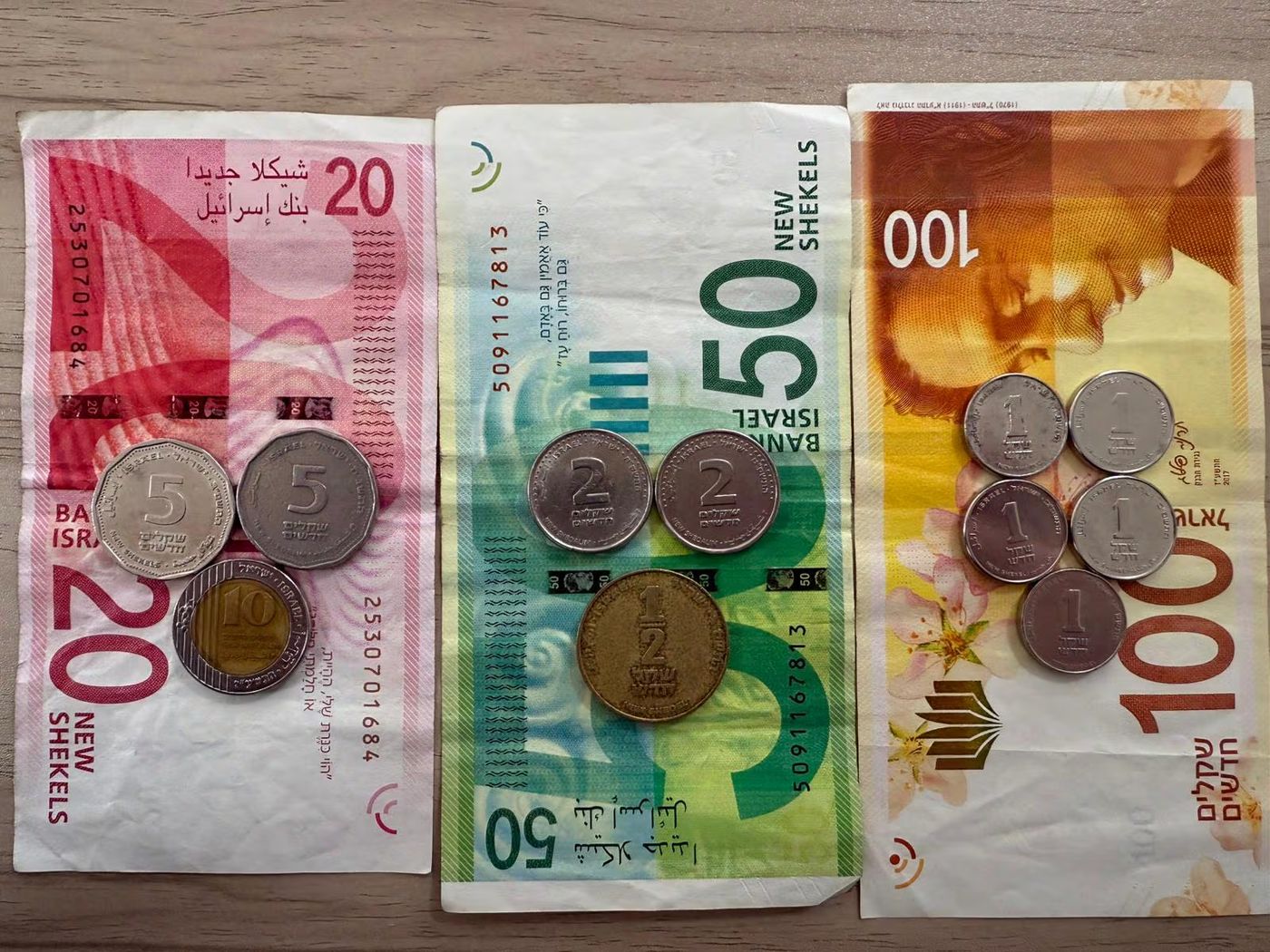
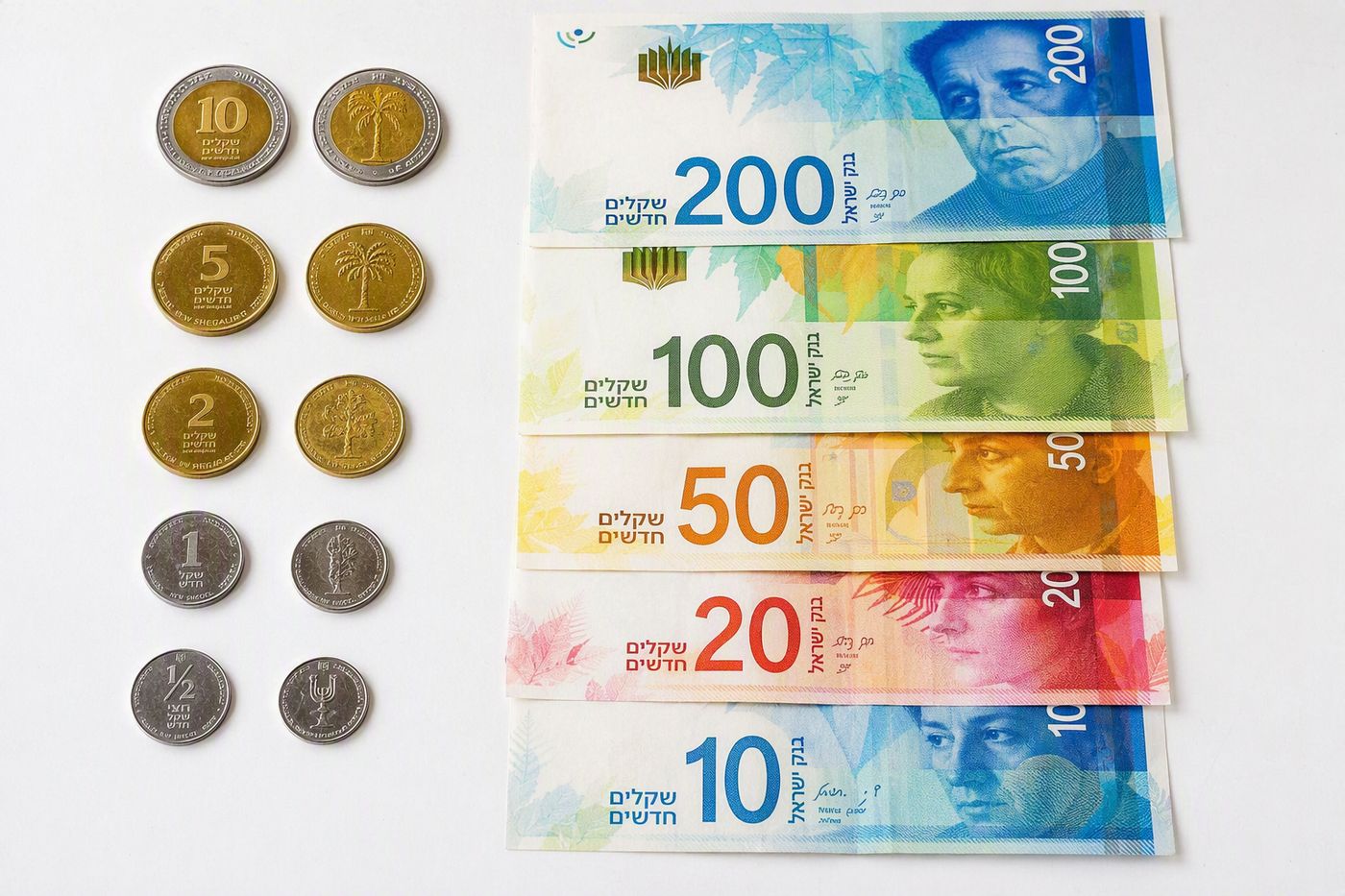
The Bank of Israel issues both coins and banknotes. The current series of coins, first introduced in 1985, includes denominations from 10 agorot up to ₪10. Initial coins in 1985 were 1 agora, 5 agorot, 10 agorot, ₪1⁄2, and ₪1. A ₪5 coin was introduced in 1990, followed by ₪10 in 1995, and a ₪2 coin on 9 December 2007. Smaller denominations like the 1 agora and 5 agorot coins have been phased out of circulation, with the 5 agorot coin last minted in 2007 and removed on 1 January 2008. Coins feature dates in the Hebrew calendar using Hebrew numerals. In 2022, the Bank of Israel announced a new series of coins with updated inscriptions, using 'new shekels' as the English text and including Arabic unit names on the 10 agorot and ₪1⁄2 coins. The coins are minted by the Korea Minting and Security Printing Corporation.
Banknotes have progressed through three main series. Series A notes were issued from 1985 to 1999 in denominations from ₪1 to ₪200. The ₪5, ₪10, and ₪50 notes began on 4 September 1985, the ₪1 note followed on 8 May 1986, the ₪100 on 19 August 1986, the ₪20 on 2 April 1988, and the ₪200 on 16 February 1992. The ₪1, ₪5 and ₪10 notes used designs from the earlier old shekel notes but with altered denominations and were later replaced by coins. Series B notes replaced the first series by 2005. A plan for a ₪500 note featuring Yitzhak Rabin was announced in 1995 but never issued due to low inflation. The current Series C, dubbed the 'Poets Series,' began circulation in 2014. It features prominent Hebrew poets after an initial plan to feature political figures was changed. The ₪50 note entered circulation on 16 September 2014, followed by the ₪200 on 23 December 2015, and the ₪20 and ₪100 on 23 November 2017. This series uses the standard English spelling 'shekel' and 'shekels,' and the Arabic inscription شيكل (šaykal) instead of the previous شيقل (šayqal). The banknotes are printed by Orell Füssli Security Printing in Switzerland.
The Shekel in International and Canadian Markets
The Israeli new shekel is traded on global foreign exchange markets. It is one of only about twenty world currencies with widely available currency futures contracts, traded on the Chicago Mercantile Exchange since 7 May 2006. Its value is influenced by Israel's monetary policy, economic performance, geopolitical events, and global risk sentiment. The currency is known for its volatility, which has been pronounced since 2023 amid changing international economic cooperation with Israel. For Canadians, the shekel is a convertible currency that can be exchanged at many financial institutions and specialized currency services. It is also a currency that can be exchanged by consumers in many parts of the world.
The exchange rate between the Israeli shekel and the Canadian dollar fluctuates continuously based on market conditions. Key factors affecting the ILS to CAD rate include differences in interest rates set by the Bank of Israel and the Bank of Canada, relative inflation rates, trade balances between the two countries, and broader global economic events. As these factors shift, the rate can change throughout the trading day. Monitoring these dynamics is important for anyone conducting transactions between the two currencies. The performance of ILS to CAD in the last 30 days saw a high of 0.4691 and a low of 0.4543, with an average of 0.4629 and a change of -2.43 percent. Over the last 90 days, the high was 0.4700 and the low was 0.4537, with an average of 0.4623 and a change of -0.94 percent.
Converting Israeli Shekels to Canadian Dollars
Converting ILS to CAD is a common need for travel, commerce, and personal remittances. The mid-market exchange rate is the benchmark rate between buyers and sellers in the global currency market. This rate is dynamic. For example, recent 30-day performance showed a high of 0.4691 CAD per ILS and a low of 0.4543 CAD per ILS, with an average of 0.4629. Over 90 days, the range was between 0.4537 and 0.4700. Consumers and businesses do not receive the pure mid-market rate when converting money, as providers add a margin or fee. The total cost of a transfer includes this exchange rate margin plus any stated transaction fees. Many services advertise that they use the real mid-market rate with no hidden markups, but they may still charge a separate transfer fee.
Several types of service providers facilitate ILS to CAD conversions. Banks and credit unions offer currency exchange, often with higher margins. Specialized foreign exchange brokers and online money transfer services frequently provide more competitive rates, especially for larger amounts. International money transfer operators like Western Union also offer conversion and sending services, which can be done online, via an app, or in person at an agent location. When choosing a provider, it is crucial to compare the total cost, which is the combination of the offered exchange rate and any transfer fees. Many services provide real-time quotes upfront so customers can see exactly how many Canadian dollars they will receive for their shekels. For larger transfers, such as for property or business payments, using a regulated foreign exchange specialist can secure better rates than standard bank offerings, and some services provide dedicated relationship managers for high-value transactions.
| Time Period | High (ILS to CAD) | Low (ILS to CAD) | Average Rate | Volatility |
|---|---|---|---|---|
| Last 7 Days | 0.4640 | 0.4536 | 0.4582 | 0.29% |
| Last 30 Days | 0.4690 | 0.4536 | 0.4630 | 0.47% |
| Last 90 Days | 0.4691 | 0.4536 | 0.4624 | 0.46% |
Transfer times for sending money from Israel to Canada typically range from one to two business days, depending on the provider and payment method. Some priority SWIFT transfers can arrive on the same day if submitted before cut-off times, such as before 14:00 GMT. The actual delivery time depends on the provider's processes, identity verification requirements, and banking hours in both countries. Providers may offer tracking using a Money Transfer Control Number (MTCN). For large transfers, such as those for property or business, using a regulated foreign exchange specialist can secure better rates than standard bank offerings, and these specialists are often connected through networks that provide access to multiple exchange rates from FCA-regulated partners.
Key Considerations and Risks for Canadians
Canadians interacting with the Israeli shekel should be aware of several practical and financial considerations. The shekel's volatility is a primary risk, as its value can change significantly due to regional geopolitical developments and shifts in global market sentiment. This volatility can impact the cost of travel to Israel, the value of investments, or the final amount received from a money transfer. When planning a transfer, locking in an exchange rate with a provider can mitigate the risk of adverse movements between the time of quote and the time of settlement. Many currency services allow you to set up a rate alert to be notified when a desired exchange rate is reached.
Regulatory and security aspects are also important. Reputable currency exchange and transfer providers in Canada are regulated by authorities such as the Financial Consumer Agency of Canada. When sending money, consumers should use services that offer transparency, showing all fees and the final exchange rate before confirmation. Security measures like encryption and fraud prevention are standard with major operators. It is advisable to send money only to known recipients and to safeguard transaction details. For transfers above certain thresholds, providers may require documentation regarding the source of funds to comply with anti-money laundering regulations. International transfers often require identity verification and source of funds documentation, and reporting requirements vary by jurisdiction and transfer amount.
Understanding the full cost structure is essential. Providers make money from currency exchange through margins on the rate and/or transaction fees. Some may advertise no fees but apply a wider margin on the exchange rate. Payment methods can also affect cost. Using a credit card for a transfer may incur cash advance fees and interest charges from the card issuer. Comparing the total amount of Canadian dollars that will be delivered for a given amount of shekels across multiple providers is the best way to find the most favourable deal. Many online tools and converters allow for this comparison using live mid-market rates as a baseline.
Future Outlook and Economic Context
The future trajectory of the Israeli new shekel is tied to Israel's economic policies and its integration into the global economy. Since the economic crisis of the 1980s, the Bank of Israel and the government have maintained careful fiscal and monetary policies and introduced market-based reforms. Heavy investment in industrial and scientific bases has allowed the country to leverage the global knowledge economy, increasing exports and opening new markets. These factors contribute to the currency's fundamental strength. However, the shekel in modern times is often highly volatile, caused by Israel's policies, with many countries since 2023 refusing to economically cooperate with Israel, which introduces ongoing risk.
For Canadians, the relationship between the Canadian and Israeli economies will continue to influence the ILS/CAD exchange rate. Factors such as comparative interest rate decisions, commodity price movements (which strongly affect the Canadian dollar), and relative economic growth will drive fluctuations. The shekel's status as a freely convertible and traded currency means it will remain sensitive to global investor sentiment. Those with ongoing financial exposure to Israel should monitor economic announcements from the Bank of Israel, geopolitical developments in the region, and broader trends in foreign exchange markets to make informed decisions regarding currency conversion and transfers. The exchange rate you see on Google is often the mid-market rate, but the rate offered by money transfer providers will differ due to applied margins and service fees.
Frequently asked questions
What is the Israeli new shekel?
The new Israeli shekel, also known as simply the Israeli shekel, is the currency of Israel and is also used as a de facto legal tender in the Palestinian territories of the West Bank and the Gaza Strip. Each shekel is divided into 100 agorot. The new shekel has been in use since 1 January 1986, when it replaced the hyperinflated old shekel at a ratio of 1000:1. Its currency sign is ₪ and its ISO code is ILS.
How much is one Israeli shekel in Canadian dollars?
The exchange rate between the Israeli new shekel and the Canadian dollar fluctuates. Recent data indicates one Israeli new shekel is approximately equal to 0.45 Canadian dollars. The performance over 30 days has seen a high of 0.4691 and a low of 0.4543, with an average of about 0.4629. The exact rate depends on live market conditions.
What are the denominations of Israeli shekel banknotes?
The current series of banknotes (Series C) includes denominations of ₪20, ₪50, ₪100, and ₪200. These notes feature portraits of prominent Hebrew poets. The Bank of Israel has adopted the standard English spelling of shekel and shekels on these notes. Earlier series included ₪1, ₪5, and ₪10 notes, but these were later replaced by coins.
What should I know before sending money from Canada to Israel?
Before sending money, compare the total cost from different providers, including the exchange rate offered and any transfer fees. Check the estimated delivery time, which can be one to two business days. Ensure the provider is reputable and regulated. Be prepared to provide identification and, for larger transfers, documentation regarding the source of funds as required by anti-money laundering regulations.
Where can I exchange Israeli shekels in Canada?
The new Israeli shekel is a freely convertible currency, which means it can be exchanged on the global foreign exchange market. Since 26 May 2008, CLS Bank International has settled payment instructions in new shekels, making the currency fully convertible. The notes state it is a currency that can be exchanged by consumers in many parts of the world. For specific services in Canada, one would need to consult local banks, currency exchange bureaus, or international money transfer services which handle the ILS to CAD conversion.
Is the Israeli shekel a stable currency?
The stability of the Israeli shekel has varied over time. Following the hyperinflation of the old shekel in the early 1980s, the new shekel was introduced in 1985. Since then, the Bank of Israel and the government have maintained careful and conservative fiscal and monetary policies, alongside market based economic reforms. These actions resulted in relatively low inflation and a strengthening currency over the long term, such as a 20 percent rise against the US dollar from 2001 to 2011. However, the notes also state that the shekel in modern times is often highly volatile, influenced by Israel's policies.
Sources and further reading
- Israeli new shekel (Wikipedia) en.wikipedia.org
- Israeli new sheqels to Canadian dollars today wise.com
- 1 ILS to CAD, Israeli New Shekels to Canadian Dollars ... xe.com
- CAD to ILS | Convert Canadian Dollar to Israeli New Shekel westernunion.com
- ILS to CAD: Convert Israeli Shekel to Canadian Dollar currencytransfer.com
- Israeli Shekel to CAD | 1 ILS to CAD | IFCM Canada ifcmarkets.com
This article explains how things work and is not financial, tax or legal advice. Rules, limits and rates change, so check the current figures with the Canada Revenue Agency, your province or your financial institution before you act.