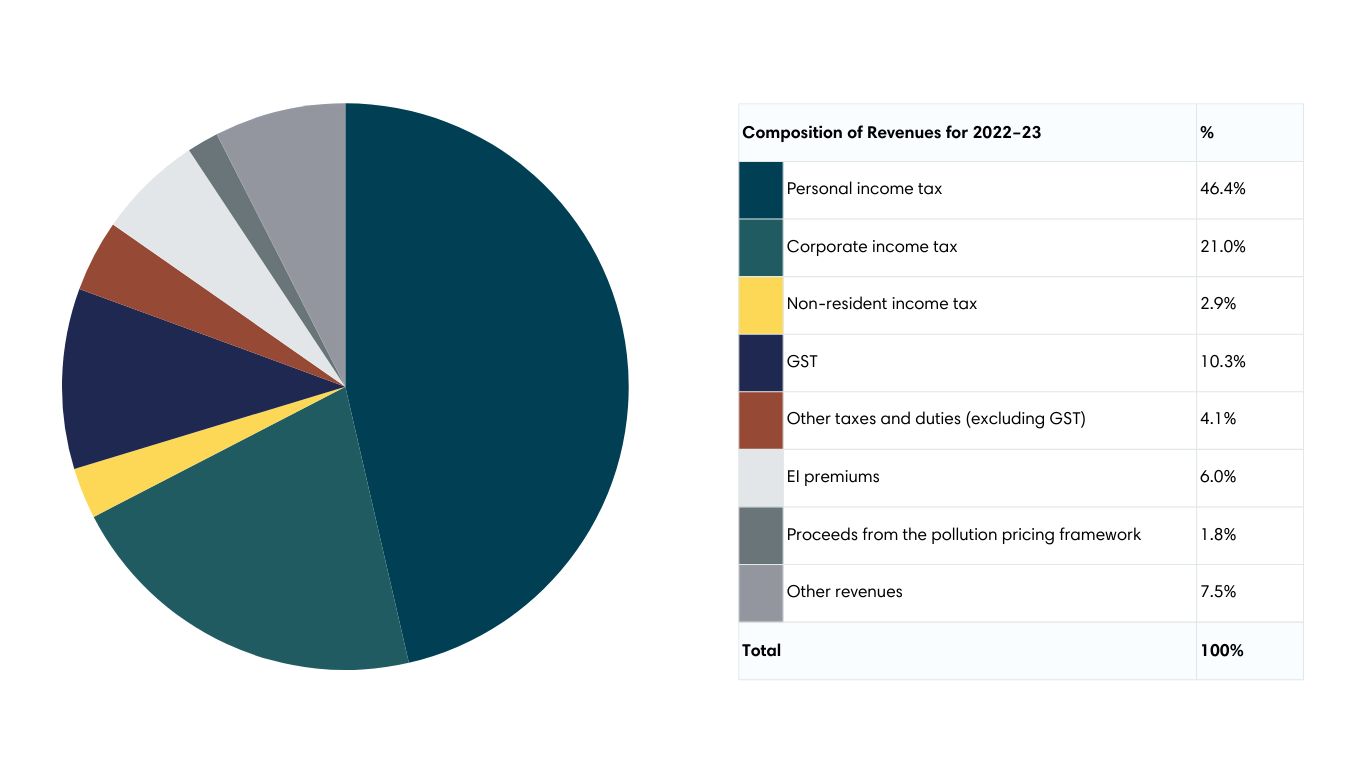
Income tax is the largest source of revenue for both the federal government and the provincial and territorial governments in Canada. The system is a self-assessment regime administered primarily by the Canada Revenue Agency (CRA), with residents taxed on their worldwide income. Federal and provincial income taxes are calculated using progressive tax brackets, meaning the rate increases as taxable income rises. Understanding how income tax works is essential for all Canadian taxpayers to fulfill their obligations and access applicable credits and benefits.
How the Canadian Income Tax System Works
The Canadian income tax system operates as a self-assessment regime where taxpayers calculate their own liability and file a return with the CRA by the required deadline. For most individuals, the deadline is April 30 following the tax year, though self-employed individuals and their spouses or common-law partners have until June 15 to file. Any balance of tax owing is due on or before April 30, with interest charges applied to late payments regardless of the filing deadline. The CRA assesses returns based on the information filed and data obtained from employers and financial institutions, correcting for obvious errors. Taxpayers who disagree with a CRA assessment can formally object by filing a T400A form, explaining their reasons in writing. The CRA's appeals branch reviews the objection and may confirm, vacate, or vary the assessment, with further appeals possible to the Tax Court of Canada and the Federal Court of Appeal.
Income tax is collected through several methods, with deduction at source from employment pay being the most common. Employers deduct income tax, along with Canada Pension Plan or Quebec Pension Plan contributions, Employment Insurance premiums, and sometimes Provincial Parental Insurance premiums, and remit them directly to the CRA. Individuals may also need to make instalment payments during the year if they have significant income not subject to withholding, such as investment or self-employment income. Payments can also be made when filing the annual return or as arrears payments after filing. The constitutional authority for federal income tax is found in the Constitution Act, 1867, which grants Parliament power over any mode of taxation. Provincial authority to levy direct taxation, such as income tax, for provincial purposes is also derived from the same act.
History of Income Tax in Canada
Unlike the United Kingdom and the United States, Canada avoided implementing a personal income tax until the First World War. The lack of an income tax was seen as a key incentive to attract immigrants, offering a lower tax regime compared to other countries. Federal governments before the war relied primarily on tariffs and customs revenue under the National Policy, while provincial governments sustained themselves through natural resource management. The Liberal Party had considered introducing an income tax in the early 20th century if a free trade agreement with the United States succeeded, but the Conservatives defeated them in 1911 by opposing free trade and the tax.
Wartime expenses ultimately forced the government's hand. Finance Minister Sir Thomas White introduced the Income War Tax Act bill in July 1917, and despite resistance, the wartime government under Sir Robert Borden imposed an income tax in 1918 to cover costs. The significant debts incurred during the war meant the government could not forgo this revenue source after the armistice. When the Liberal government of William Lyon Mackenzie King was elected and dismantled much of the National Policy, the income tax remained permanently in place, evolving into the modern system administered today.
Calculating Personal Income Tax
Canadian residents are taxed on their worldwide income, while non-residents are taxed only on certain types of Canadian-source income. The calculation begins with an individual's total income for the year. From this, deductions are made to arrive at net income, which includes items like contributions to Registered Retirement Savings Plans, union dues, child care expenses, and business investment losses. Net income is used to determine eligibility for various income-tested social benefits. Further deductions, such as capital losses or a special northern residents deduction, are applied to determine taxable income.
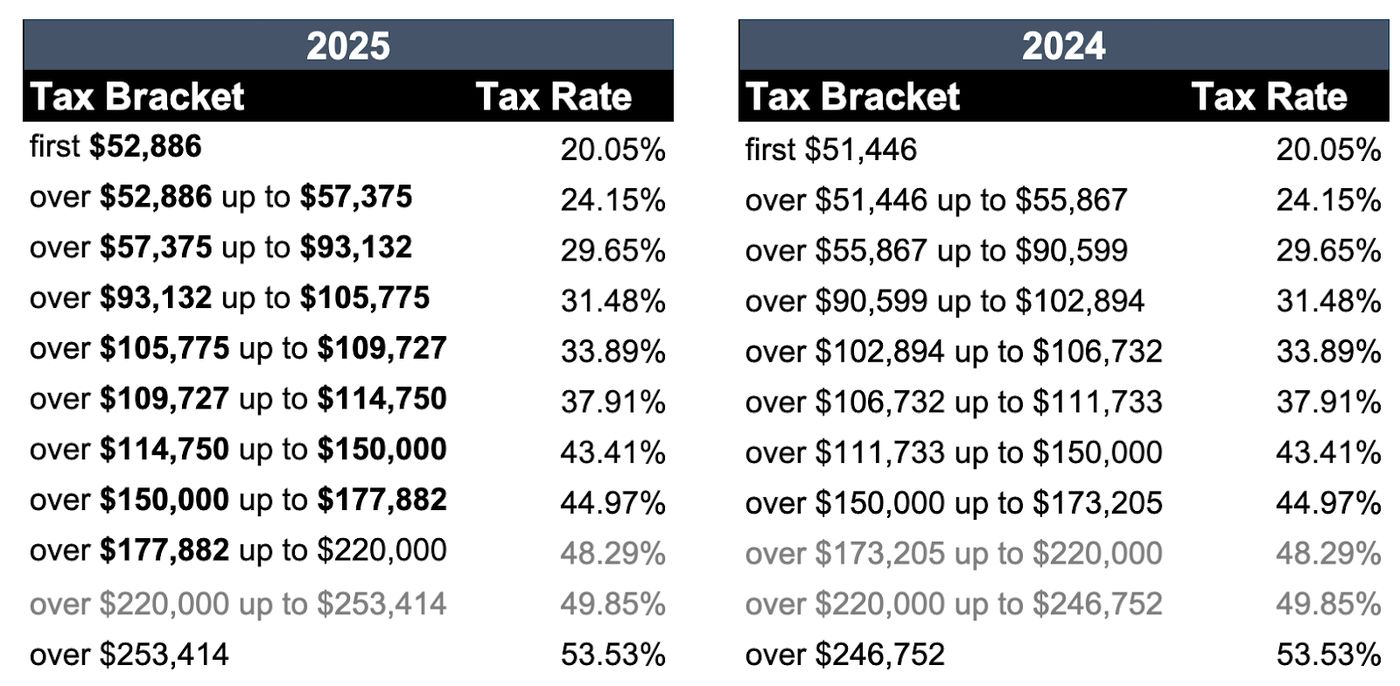
Tax payable before credits for an individual is determined using five tax brackets and tax rates. Non-refundable tax credits are then deducted from this amount. These credits are calculated by multiplying the credit amount by the lowest tax rate. This mechanism provides equal benefit to taxpayers regardless of their tax bracket.
| Taxable Income Bracket | Federal Tax Rate (2025) |
|---|---|
| $57,375 or less | 14.50% |
| $57,376 to $114,750 | 20.50% |
Non-refundable tax credits are then deducted from the tax payable. These credits, such as the basic personal amount, are calculated by multiplying the credit value by the lowest federal tax rate, ensuring equal benefit regardless of the taxpayer's bracket. For 2025, the federal basic personal amount is $16,129. Other credits exist for dependents, Canada Pension Plan contributions, Employment Insurance premiums, disabilities, tuition, education, and medical expenses. A special non-refundable credit for charitable donations applies at the lowest rate for the first $200 and at higher rates for amounts above that, effectively reducing taxes by 40 to 60 percent of the donation. Refundable credits and other mechanisms like the dividend tax credit and foreign tax credit prevent double taxation on income already taxed at the corporate or foreign government level.
Provincial and Territorial Income Taxes
All provinces and territories levy their own personal income tax, but most use a tax collection agreement with the federal government. Under these agreements, the CRA collects personal income taxes on behalf of all provinces and territories except Quebec, using the federal definition of taxable income as the common base. This means provincial governments cannot alter which deductions are allowed in calculating the income subject to provincial tax. Provincial and territorial governments set their own tax rates, brackets, and provide both non-refundable and refundable tax credits. They may also apply surtaxes and offer low-income tax reductions.
Individuals generally pay income tax to the province or territory where they reside on December 31 of the tax year. This rule simplifies filing for people who live in one province but work in another, or who move during the year, as they typically file only one return. Business income is taxed in the province where it was earned, with a formula allocating income if it was earned in more than one province. Ontario levies a surtax as a percentage of tax over a certain threshold, a practice Prince Edward Island also had prior to the 2024 tax season. Quebec administers its own personal income tax system and is free to determine its own definition of taxable income, though it parallels many federal definitions for simplicity. Quebec receives part of its federal health and social transfers as tax points, leading to a 16.5 percent reduction in federal tax on income earned in Quebec, known as the Quebec Abatement.
Income That Is Not Taxed
The following types of income are not taxed in Canada, though this list is not exhaustive. Examples include gifts, inheritances, lottery winnings, and strike pay. Income earned within a Tax-Free Savings Account and the Canada Child Benefit are also not taxed. The method by which these forms of income are not taxed can vary significantly.
- Gifts and inheritances.
- Death benefits paid from a life insurance policy.
- Lottery winnings and gambling winnings for simple recreation.
- Strike pay.
- Income earned within a Tax-Free Savings Account.
- Compensation paid by a province to a victim of a criminal act or motor vehicle accident.
- Certain civil and military service pensions.
- Income from certain international organizations like the United Nations.
- War disability pensions and RCMP pensions for injury, disability, or death.
- Income of First Nations individuals situated on a reserve.
- Capital gain on the sale of a taxpayer's principal residence.
- Provincial child tax benefits and the Canada Child Benefit.
- The Goods and Services Tax/Harmonized Sales Tax credit.
- The Working Income Tax Benefit.
Income which is declared and then deducted may create room for future Registered Retirement Savings Plan deductions. However, the RRSP contribution room may be reduced with a pension adjustment if the taxpayer is part of another plan. Deductions which are not directly linked to non-taxable income exist, such as RRSP contributions. These reduce overall taxable income and defer tax until withdrawal.
Corporate Income Taxes
Corporations in Canada are subject to tax on their worldwide income if they are resident for tax purposes. Non-resident corporations are taxed on certain types of Canadian-source income. Corporate taxes include federal and provincial income taxes as well as other levies like capital taxes, payroll taxes for Employment Insurance and pension plans, property taxes, and indirect taxes such as the Goods and Services Tax. The net federal corporate income tax rate was 15% as of 2012, or 11% for corporations claiming the small business deduction. Provincial corporate income tax rates vary from zero to 16 percent, depending on the province and business size.
The CRA collects corporate income taxes for all provinces and territories except Alberta and Quebec. The type of corporation determines its specific tax treatment. A Canadian-controlled private corporation is a private corporation resident in Canada that is not controlled by non-residents or public corporations and does not have shares listed on a prescribed stock exchange. A private corporation is resident in Canada and is not a public corporation. A public corporation is resident in Canada and has a class of shares listed on a prescribed Canadian stock exchange or has been designated as such. Other types include Canadian subsidiaries of public corporations, general insurers, and Crown corporations.
Key Tax Rules and Considerations
Several important rules shape the Canadian tax landscape beyond the basic calculation. The Alternative Minimum Tax (AMT) ensures that high-income individuals with significant deductions or exemptions pay a minimum amount of tax. Individuals must calculate an adjusted taxable income including certain tax preference items. If this amount exceeds the minimum tax exemption, a combined federal and provincial tax rate is applied, and the taxpayer pays the greater of this AMT or their regular tax. AMT paid can be credited against regular tax in any of the following seven years.
Rules exist to prevent certain forms of income splitting. The 'kiddie tax' applies to minor children who receive certain passive income under an income-splitting arrangement, taxing that income at the highest combined federal and provincial marginal rate, which can be up to 55 percent. Similarly, 'income sprinkling' rules restrict shifting income from a high-tax individual to low or nil tax rate adult family members through private corporations. Such 'split income' is also taxed at the top marginal rate, with limited credits available to reduce the liability. Residence status is crucial for determining tax liability. An individual resident in Canada is taxable on worldwide income, while a non-resident is taxed only on Canadian-source income. There is no statutory definition of residence. It is determined by factors like the location of one's home, spouse, and dependents. A non-resident who stays in Canada for 183 days or more in a calendar year is deemed a resident for the entire year unless a tax treaty determines otherwise.
Frequently asked questions
What are the federal tax brackets for 2025?
For the 2025 tax year, the federal income tax brackets are as follows. Income up to $57,375 is taxed at 14.5 percent. Income from $57,376 to $114,750 is taxed at 20.5 percent. Income from $114,751 to $177,882 is taxed at 26 percent. Any income over $253,414 is taxed at the top rate of 33 percent. These brackets are applied to your taxable income after deductions.
What is the basic personal amount for 2025?
The federal basic personal amount for the 2025 tax year is $16,129. This is a non-refundable tax credit, calculated by multiplying this amount by the lowest federal tax rate of 14.5 percent, resulting in a credit that reduces your federal tax payable. Provinces have their own basic personal amounts. For example, Ontario's for 2025 is $12,747. These amounts are indexed and will increase for 2026, with the federal amount rising to $16,452.
How does the Canada Revenue Agency collect taxes?
The Canada Revenue Agency administers the federal income tax system and collects personal income taxes on behalf of all provinces and territories except Quebec. It also collects corporate income taxes for all provinces and territories except Alberta and Quebec. The primary collection method is deduction at source, where employers withhold tax, CPP/QPP contributions, and EI premiums from employee pay and remit them to the CRA. The CRA processes annual tax returns, issues refunds for overpayments, and collects balances owing or instalment payments.
What income is not taxed in Canada?
Several types of income are not subject to tax in Canada. These include lottery winnings, gifts and inheritances, the capital gain on the sale of your principal residence, and income earned inside a Tax-Free Savings Account. Other exempt items are the Canada Child Benefit, GST/HST credits, strike pay, and certain compensation for victims of crime. The method of exemption varies. Some items are simply not reported, while others are declared and then deducted in full from taxable income.
What is the difference between federal and provincial tax rates?
Federal tax rates are set by the Government of Canada and apply to all residents. Provincial and territorial governments set their own separate tax rates and brackets, which are applied to the same federally-defined taxable income base. The combined total tax you pay is the sum of your federal and provincial tax liabilities. Rates vary significantly by province. For example, Ontario has its own set of brackets and a basic personal amount. The CRA collects both federal and provincial tax (except in Quebec) in a single payment when you file your return.
When is my income tax return due?
For most individuals, the deadline to file your T1 personal income tax return is April 30 following the tax year. If you or your spouse or common-law partner are self-employed, the filing deadline is extended to June 15. However, any balance of tax owing is still due on or before April 30 for everyone. Payments made after April 30 may be subject to interest charges, regardless of your filing deadline.
Sources and further reading
- Income tax in Canada (Wikipedia) en.wikipedia.org
- 2025-26 Ontario Income Tax Calculator, TurboTax® Canada turbotax.intuit.ca
- 2026 Canada Income Tax Calculator wealthsimple.com
- Tax in Canada | Canada Tax Guide, HSBC Expat expat.hsbc.com
- Canada, Individual, Taxes on personal income taxsummaries.pwc.com
- Canada's 2025 & 2026 Federal Tax Rates & Tax Brackets taxtips.ca
This article explains how things work and is not financial, tax or legal advice. Rules, limits and rates change, so check the current figures with the Canada Revenue Agency, your province or your financial institution before you act.