A reverse HST calculator is a tool that extracts the original pre-tax price and the tax amount from a total that already includes sales tax. This process is essential for Canadian businesses, freelancers, and consumers who need to verify receipts, prepare accurate accounting records, or claim expenses. The calculator automatically applies the correct combination of Harmonized Sales Tax (HST), Goods and Services Tax (GST), Provincial Sales Tax (PST), or Quebec Sales Tax (QST) based on the province or territory selected. Understanding how to reverse calculate sales tax ensures financial accuracy and compliance with Canada's tax system.
How a Reverse Sales Tax Calculator Works
A reverse sales tax calculator performs a backward calculation from a known total amount that includes tax. The core mathematical formula used is: Pre-tax amount equals the total amount divided by one plus the tax rate expressed as a decimal. For example, if the total is $113 and the tax rate is 13%, the pre-tax amount is $113 divided by 1.13, which equals $100. The tax amount is then found by subtracting the pre-tax amount from the total, resulting in $13. This method is correct because the tax rate is applied to the original price before tax, not to the final total. Multiplying the total by the tax rate, such as $113 by 13%, would incorrectly yield $14.69, which is not the actual tax paid. The calculator automates this precise division and subtraction, ensuring accurate results for any Canadian tax rate.
The calculator requires two primary inputs: the total amount including tax and the selection of a province or territory. The total amount is the final figure seen on a receipt or invoice after all applicable taxes have been added. Selecting a province triggers the calculator to apply the correct tax structure and rate for that jurisdiction. For instance, choosing Ontario applies a single 13% HST rate, while choosing Quebec applies a combined rate of 5% GST plus 9.975% QST. The result displays the calculated pre-tax price and the exact amount of tax that was included in the total. This process eliminates manual calculation errors and saves significant time for users dealing with multiple transactions.
Small rounding differences of approximately one cent can sometimes appear between the calculator's result and amounts on official receipts. This variation occurs because business accounting or point-of-sale systems may round tax calculations at different stages, such as at the line item level or the invoice subtotal level. The calculator itself uses precise mathematical formulas without intermediate rounding. A difference of plus or minus one cent is common and does not indicate an error in the applied tax rate. Users should be aware of this when reconciling the calculator's output with their own financial records or supplier invoices.
Canadian Sales Tax Structures and Rates
Canada employs three main types of sales taxes: the federal Goods and Services Tax, the Harmonized Sales Tax, and provincial sales taxes. The Goods and Services Tax is a federal tax of 5% applied to most goods and services sold across the country. In provinces that use the Harmonized Sales Tax, this 5% GST is combined with a provincial portion into a single, blended tax rate. Provincial Sales Tax and the Quebec Sales Tax are levied separately from the GST in provinces that have not harmonized. The reverse calculator handles all these structures by applying the correct total effective rate once a location is selected.
The specific rates vary significantly by province and have changed over time. As of 2026, Ontario applies a 13% HST. New Brunswick, Newfoundland and Labrador, and Prince Edward Island apply a 15% HST. Nova Scotia's HST rate was reduced from 15% to 14%, effective April 1, 2025. British Columbia, Saskatchewan, and Manitoba charge the 5% GST plus a separate PST. British Columbia's PST is 7%, Saskatchewan's is 6%, and Manitoba's was reduced from 8% to 7% in 2019. Quebec charges 5% GST plus a 9.975% QST. Alberta, Yukon, Northwest Territories, and Nunavut charge only the 5% GST with no provincial sales tax.
It is crucial to use the correct historical rate if dealing with receipts from past transactions. The calculator's rates are current as of 2026, but a transaction from before April 1, 2025, in Nova Scotia would have used the old 15% HST rate. Similarly, transactions in Manitoba before 2019 used an 8% PST rate. The tax charged can also depend on the type of supply, the place of supply, and the purchaser. For example, basic groceries are zero-rated, children's clothing in Ontario may qualify for a point-of-sale rebate, and residential rent is typically exempt. The calculator is designed for standard taxable supplies and applies the general rate.
Step-by-Step Manual Calculation Example
Performing a reverse tax calculation manually involves a few clear steps. First, identify the total amount that includes tax, such as the final amount on a receipt. Second, determine the correct total tax rate for the province where the purchase occurred. Third, convert that percentage rate into a decimal and add one to it. Finally, divide the total amount by this decimal figure to find the pre-tax price. The tax amount is simply the total minus the pre-tax price. This method works for any tax rate, whether it is a single HST or a combination of GST and PST.
Consider a detailed example using figures from Ontario. A receipt shows a total of $226.00. The HST rate in Ontario is 13%. To find the pre-tax price, convert 13% to a decimal (0.13) and add one, resulting in 1.13. Next, divide the total by this number: $226.00 divided by 1.13 equals $200.00. This $200.00 is the original price before tax was applied. To find the HST amount, subtract the pre-tax price from the total: $226.00 minus $200.00 equals $26.00. Therefore, the receipt includes $26.00 in HST. This confirms that the tax is 13% of the $200.00 pre-tax amount, not 13% of the $226.00 total.
A common mistake is to multiply the total by the tax rate. Using the same example, multiplying $226.00 by 13% (0.13) gives $29.38, which is incorrect. This error occurs because the tax rate is applied to the base price, not to the total that already contains the tax. The correct formula always uses division by one plus the rate. For a $113.00 receipt in Ontario, the HST is $13.00, found by $113.00 divided by 1.13 equals $100.00, then $113.00 minus $100.00 equals $13.00. The incorrect method would suggest $14.69, which is wrong. The reverse calculator automates this correct division to prevent such errors.
Key Historical Changes to Canadian Sales Taxes
Canadian sales tax rates and structures have evolved, with several important changes affecting reverse calculations for historical transactions. The federal Goods and Services Tax was introduced on January 1, 1991, at an initial rate of 7%. The 5% GST rate now applies uniformly across Canada, though it is collected either as part of HST or separately alongside provincial taxes. These federal rate changes are relevant for analyzing very old receipts or understanding the tax component in long-term contracts.
The Harmonized Sales Tax has its own complex history of adoption and rate adjustments. HST was first introduced in 1997 in three Atlantic provinces: New Brunswick, Newfoundland and Labrador, and Nova Scotia. Ontario and British Columbia implemented HST in 2010. Prince Edward Island harmonized its PST with the GST to implement HST in 2013, though British Columbia later reverted to a GST/PST system. Significant rate increases occurred on July 1, 2016, when the HST rate rose from 13% to 15% in New Brunswick and Newfoundland and Labrador. Prince Edward Island increased its HST rate from 14% to 15% on October 1, 2016.
More recent modifications continue to shape the tax landscape. Manitoba reduced its Provincial Sales Tax rate from 8% to 7% in 2019. Nova Scotia reduced its HST rate from 15% to 14%, effective April 1, 2025. A future change is scheduled for October 1, 2026, when selected professional services will become subject to British Columbia's 7% PST. These provincial adjustments mean that the applicable rate for a reverse calculation depends entirely on the transaction date and location. The calculator uses the most current rates but users must select the correct rate manually for historical transactions outside the current period. The following list details major federal GST rate changes:
Practical Applications and Who Uses the Calculator
The reverse HST calculator serves a wide range of users across Canada. Self-employed individuals and freelancers often receive payments that include HST or GST and need to separate the tax portion for accurate income reporting and remittance to the Canada Revenue Agency. Small business owners use the tool to verify supplier invoices, ensuring the correct tax has been charged before they claim input tax credits. Accountants and bookkeepers employ reverse calculations to reconcile bank statements, prepare financial records, and complete tax forms that require net amounts before tax. Anyone who needs to analyze receipts for expense claims or budgeting purposes will find the tool invaluable. Common real-world scenarios highlight its utility. Consumers who want to understand how much tax they paid on a large purchase, like furniture or electronics, can extract that information from their final receipt. The calculator provides immediate clarity without complex manual math.
The tool is particularly critical for compliance with the GST/HST small-supplier rules. Most Canadian businesses must register for GST/HST after their taxable revenues exceed the $30,000 threshold over four consecutive calendar quarters. Once registered, they must charge, collect, and remit tax. A reverse calculator helps these businesses accurately track the tax component of their gross sales, which is essential for filing returns. It also assists in verifying whether suppliers are correctly charging tax, which affects the business's ability to claim input tax credits. For businesses operating in multiple provinces, the calculator's automatic rate selection ensures correct calculations for each jurisdiction's rules. Key user groups include:
- Self-employed individuals and freelancers.
- Small business owners and operators.
- Accountants and bookkeepers.
- Consumers analyzing receipts.
- Online sellers managing cross-province sales.
Current Sales Tax Rates by Province and Territory
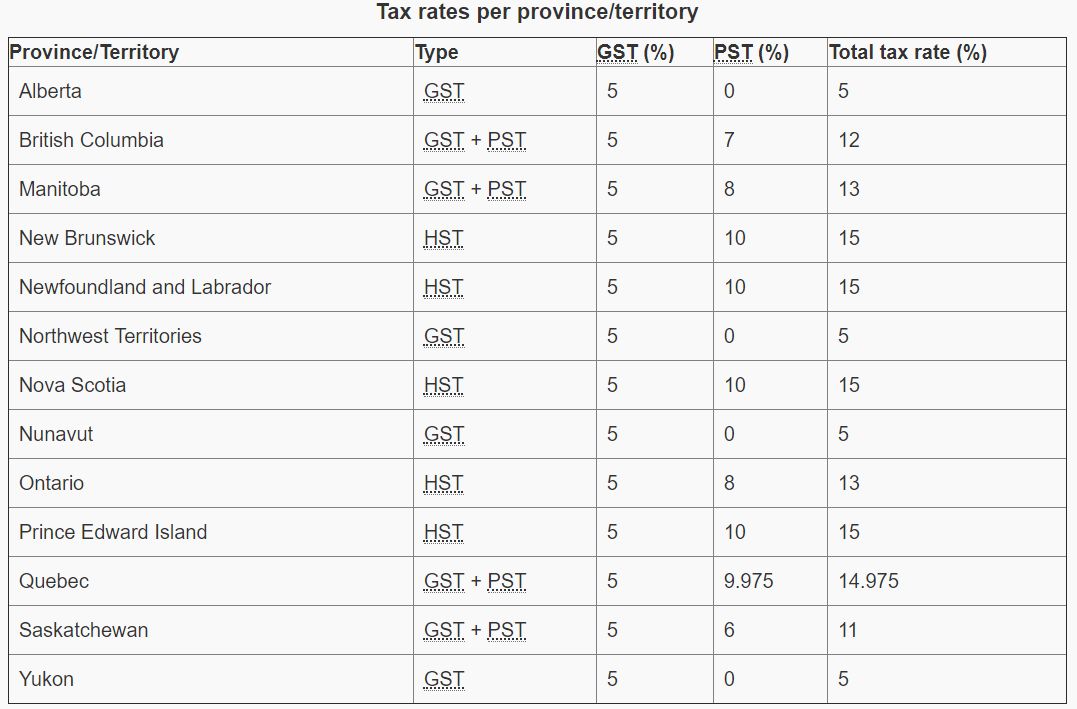
The following table outlines the sales tax structures and total effective rates for each Canadian province and territory as of 2026. These are the rates applied by the reverse calculator when the corresponding province is selected. Ontario uses a single Harmonized Sales Tax (HST) rate of 13 percent. Nova Scotia uses a 14 percent HST rate, which was reduced from 15 percent on April 1, 2025. British Columbia applies a 5 percent Goods and Services Tax (GST) plus a 7 percent Provincial Sales Tax (PST), and will apply PST to selected professional services starting October 1, 2026. Quebec uses a 5 percent GST plus a 9.975 percent Quebec Sales Tax (QST). Alberta and the territories charge only the 5 percent federal GST.
| Province/Territory | Tax Structure | Total Rate |
|---|---|---|
| Ontario | HST | 13% |
| New Brunswick | HST | 15% |
| Newfoundland and Labrador | HST | 15% |
| Nova Scotia (from Apr 1, 2025) | HST | 14% |
| Prince Edward Island | HST | 15% |
| British Columbia | GST + PST | 5% + 7% |
| Saskatchewan | GST + PST | 5% + 6% |
| Manitoba (from 2019) | GST + PST | 5% + 7% |
| Quebec | GST + QST | 5% + 9.975% |
| Alberta | GST only | 5% |
| Yukon, NWT, Nunavut | GST only | 5% |
Understanding Tax Exemptions and Zero-Rated Supplies
Not all goods and services in Canada are subject to the standard sales tax rates, which affects when a reverse calculation is applicable. Supplies are categorized as taxable, zero-rated, or exempt. Taxable supplies are subject to GST/HST/PST at the standard or a reduced rate. Zero-rated supplies are taxed at a 0% rate, meaning no tax is charged on the sale. Examples include basic groceries, prescription drugs, and certain medical devices. Exempt supplies are not subject to any GST/HST. Common examples include residential rent, most health and dental services, and certain educational services. Provincial rules may add further exemptions or rebates.
The reverse calculator is designed for standard taxable supplies. If a purchase is for a zero-rated or exempt item, the total amount on the receipt should equal the pre-tax price, as no tax was added. A reverse calculation is unnecessary. However, some receipts for mixed purchases may show a single total that includes tax for taxable items and no tax for exempt items, making extraction complex. In such cases, the calculator can only estimate based on the general rate. Users should consult official CRA guidance on zero-rated supplies and provincial tax authorities for specific rebate details, like Ontario's point-of-sale rebate on children's clothing.
Businesses must understand these distinctions for accurate tax remittance. Charging tax on an exempt supply is an error, while not charging tax on a taxable supply can lead to penalties. When using the reverse calculator for business accounting, ensure the original receipt was for a standard taxable transaction. If the total includes a mix of taxable and non-taxable items, the calculated pre-tax amount and tax amount will be approximate. For precise accounting, especially for input tax credits, businesses should maintain detailed records that separate taxable sales from exempt or zero-rated sales rather than relying solely on reverse calculations from lump-sum totals. The main categories of non-taxable supplies are:
- Zero-rated supplies: Taxed at 0% (e.g., basic groceries, prescription drugs).
- Exempt supplies: Not subject to GST/HST (e.g., residential rent, most health services).
- Supplies with point-of-sale rebates (e.g., children's clothing in Ontario).
Common Errors and Important Considerations
When using a reverse tax calculator, several common errors and considerations can impact the accuracy of the result. The most frequent mistake is attempting to find the tax amount by multiplying the total by the tax rate, which produces an incorrect figure. For example, multiplying a $113 total by 13% yields $14.69, whereas the correct HST is $13.00. This error occurs because the tax is a percentage of the pre-tax amount, not the total. The correct method always involves dividing the total by one plus the tax rate to find the base price first. Another consideration is the selection of the wrong provincial rate or historical rate, which will lead to an incorrect pre-tax calculation.
Users must also be mindful of the $30,000 small-supplier threshold for GST/HST registration. If a business has not exceeded this threshold in four consecutive calendar quarters, it may not be required to charge tax. Therefore, a total payment from such a supplier might not include any HST or GST, making a reverse calculation for tax inappropriate. Furthermore, the tax treatment of specific goods and services varies by province, with some items being zero-rated, exempt, or subject to point-of-sale rebates. Applying the standard reverse calculation to a receipt for these items will not reflect the true tax situation. It is essential to know the nature of the supply before using the calculator.
Rounding practices in different software systems can cause discrepancies of about one cent between the calculator's result and an official receipt. This is normal and not an error in the rate. For historical transactions, users must manually apply the tax rate that was in effect at the time of purchase, as the calculator defaults to current rates. For instance, a receipt from Nova Scotia dated March 2025 would use a 15% HST rate, not the current 14% rate. Finally, the calculator is a tool for estimation and verification. For official tax filing and financial reporting, businesses should rely on their detailed accounting records and consult with the Canada Revenue Agency or a tax professional.
Frequently asked questions
What does 'reverse' mean in a sales tax calculator?
In a sales tax calculator, 'reverse' means starting from the final total amount that already includes tax and working backward to determine the original price before tax and the exact amount of tax paid. This is the opposite of the more common forward calculation, where you add tax to a base price. The reverse method is essential when you only have the total from a receipt, invoice, or gross sales figure and need to extract the tax component for bookkeeping, expense claims, or verification. The calculation uses the formula: amount before tax equals the total amount divided by one plus the tax rate.
Does the calculator work for all Canadian provinces?
Yes, the reverse sales tax calculator works for all Canadian provinces and territories. It automatically applies the correct tax combination once you select your location. For Harmonized Sales Tax provinces like Ontario, it uses the single HST rate. For provinces like British Columbia and Saskatchewan, it calculates using the separate GST and PST rates. For Quebec, it applies the GST and QST combination, and for Alberta and the territories, it uses the GST-only rate. The tool is updated with current rates, including changes like Nova Scotia's reduction to 14% HST.
Why might my result be off by one cent compared to a receipt?
A difference of plus or minus one cent between the calculator's result and a receipt is common and usually due to rounding. Business accounting software and point-of-sale systems may round tax amounts at different stages, for example, rounding each line item individually versus rounding the final invoice subtotal. The calculator uses precise mathematical formulas without intermediate rounding. This slight variation does not indicate an error in the tax rate applied and is an accepted discrepancy in financial reconciliation.
How do I calculate HST backwards manually?
To manually calculate HST backwards, take the total amount including tax and divide it by one plus the tax rate expressed as a decimal. For Ontario's 13% HST, you would divide the total by 1.13. For example, a total of $113 divided by 1.13 equals a pre-tax price of $100. The HST amount is the total minus the pre-tax price, which is $13. Remember not to multiply the total by the tax rate, as this incorrect method would give $14.69 for a $113 total.
What is the small-supplier threshold for GST/HST?
The small-supplier threshold for GST/HST registration is $30,000. Most Canadian businesses must register for GST/HST once their total taxable revenues from worldwide supplies exceed $30,000 over four consecutive calendar quarters. Businesses below this threshold are generally not required to register, though they may choose to do so voluntarily. Upon registration, they must begin charging, collecting, and remitting the applicable GST/HST on their taxable supplies.
When did Nova Scotia's HST rate change to 14%?
Nova Scotia's Harmonized Sales Tax rate was reduced from 15% to 14%, effective April 1, 2025. This change applies to transactions occurring on or after that date. For receipts or invoices dated before April 1, 2025, the applicable HST rate for Nova Scotia would have been 15%. When performing a reverse calculation for a historical transaction, it is important to use the tax rate that was in effect at the time of the purchase.
Sources and further reading
- Reverse Sales Tax Calculator for Canada HST, GST & PST ... calculconversion.com
- Reverse HST Calculator, Remove Tax, Find Pre-Tax Price ibill.ca
- GST Calculator Canada | HST, PST & Reverse Sales Tax gstcalculator.ca
- HST Calculator, Add or Reverse GST, PST & QST (Canada ... chatgpt.ca
- HST Calculator / Harmonized Sales Tax Calculator hstcalculator.ca
This article explains how things work and is not financial, tax or legal advice. Rules, limits and rates change, so check the current figures with the Canada Revenue Agency, your province or your financial institution before you act.