The Canadian ten-dollar note is a common banknote of the Canadian dollar, currently featuring civil rights pioneer Viola Desmond. This vertical, purple polymer note, issued in 2018, represents a significant shift in Canadian currency by highlighting themes of social justice and human rights. Its design incorporates advanced security features and depicts the Canadian Museum for Human Rights on the reverse. The note is a key part of daily commerce and reflects evolving Canadian identity and values.
Design and Features of the Current $10 Note
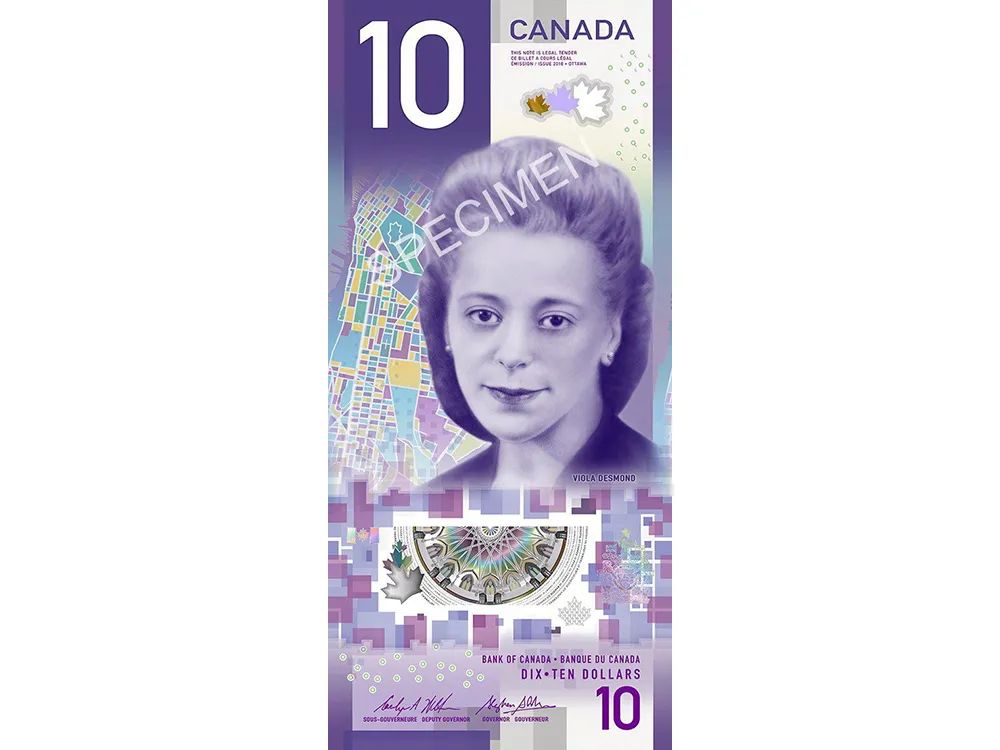
The current Canadian ten-dollar note, issued on November 19, 2018, is a vertical, purple polymer banknote. The obverse features a portrait of Viola Desmond, a Black Nova Scotian businesswoman who challenged racial segregation in 1946. The background is a colourful rendition of the street grid of Halifax, Nova Scotia, including the waterfront, Citadel and Gottingen Street, the location of Desmond's Studio of Beauty Culture. Foil features on this side include both the Flag and Coat of Arms of Canada. This design marks the first time a Canadian banknote features a solo portrait of someone who was neither a prime minister nor a royal, and the first to feature a solo female Canadian other than Queen Elizabeth II.
The reverse side of the note features an image of the Canadian Museum for Human Rights in Winnipeg, Manitoba. Part of the background pattern mirrors the museum's interior architecture and its connecting ramps. A prominent foil eagle feather is included, symbolizing ideals such as truth, power and freedom. A quotation from section 15 of the Canadian Charter of Rights and Freedoms appears in both English and French on this side. A key design element is the large transparent window at the base of the note, which includes an iridescent rendering of the Library of Parliament's vaulted dome ceiling, visible from both sides.
The note is manufactured from a single piece of biaxially oriented polypropylene polymer, making it more durable and harder to counterfeit than previous paper notes. The Bank of Canada promotes a four-step method to check the note's security features. Users are advised to feel the smooth, unique texture and the raised ink on the front in areas like the portrait, the word “Canada” and the large number. They should look at the detailed metallic images and symbols in and around the large transparent window, ensuring they appear sharp. Tilting the note reveals sharp colour changes in the metallic elements, and flipping it shows the metallic elements inside the large window repeated in the same colours and detail on the other side.

Historical Evolution of the $10 Note
The Bank of Canada, created in 1934, was given the exclusive right to issue bank notes in Canada, and chartered banks were forbidden from issuing their own notes in 1944. Since issuing its first series in 1935, the bank has released multiple series of ten-dollar notes, each reflecting technological advances and changing national identity. The first series issued by the new central bank went into circulation on the day it opened. The 1937 series was prompted by new legislation requiring bilingual notes following the death of King George V in 1936.
Significant design changes arrived with the 1954 series, which gave Canadian currency a new look. This series initially caused controversy because highlights in the Queen's hair on the portrait created an illusion often called the "Devil's Head," leading the Bank of Canada to modify the plates in 1956. The 1969 series represented a complete departure in design from earlier issues, introduced due to growing concerns over counterfeiting. The 1986 series, often called the "Birds of Canada" series, was designed with enhanced security features to counter developments in colour-copier technology.
The transition to polymer began with the Canadian Journey series. The new $10 note from this series was introduced in 2001, distinguished by new security features and a tactile feature for the visually impaired. This was part of a broader shift, with the Bank of Canada completing the issuance of a fully polymer series in the following years. The current vertical $10 note from 2018 continues this polymer tradition but with a radically different thematic focus on civil rights.
Commemorative and Special Issue $10 Notes
Throughout its history, the Bank of Canada has issued several commemorative bank notes to mark important milestones. The first was a unique note in 1935 commemorating the 25th anniversary of the reign of King George V and Queen Mary, featuring Windsor Castle on the back, which remains the only image from outside Canada used on Canadian government money. In 1967, a modified version of the 1954 $1 note was issued for the centennial of Confederation, but no special $10 note was released for that event. A major commemorative $10 note was issued more recently to celebrate the 150th anniversary of Canadian Confederation.
Unveiled on April 7, 2017, and put into circulation on June 1 of that year, this Canada 150 note featured enhanced security features and unique visual elements, including four portraits and the text “Canada 1867 to 2017”. It was part of the Frontiers series and included the latest in security technology at the time. These commemorative issues are distinct from regular circulation notes and are often sought after by collectors. The value of these and other Bank of Canada banknotes in the collector's market depends on factors such as rarity, quality, wear, mintage, and supply and demand.
- 1935: Commemorative note for King George V and Queen Mary's Silver Jubilee.
- 1967: Modified $1 note for Centennial of Confederation (no special $10).
- 2015: Commemorative $20 polymer note honouring Queen Elizabeth II as longest-reigning sovereign.
- 2017: Canada 150 commemorative $10 polymer note for 150th anniversary of Confederation.
Security Features and Anti-Counterfeiting Evolution
The security of Canadian banknotes has evolved dramatically, particularly with the shift to polymer. The current vertical $10 note incorporates a multi-layered suite of features designed for public verification and machine authentication. Key tactile features include raised ink on the front in areas such as the portrait, the word “Canada” and the large number at the bottom. The large transparent window is a central security element, containing complex metallic images that are repeated on both sides of the note.
Visual security features are prominent. The foil window at the base shows an iridescent rendering of the Library of Parliament's dome. Tilting the note causes the pattern in this window to move up and down, and the colour to shift from gold to green. The large maple leaf beside the window appears raised but is actually flat to the touch. Above the portrait, three maple leaves include a clear window in the largest leaf, and the shifting colours from the back can be seen through the smallest leaf when tilted. These features are part of the Bank of Canada's public education campaign, encouraging people to feel, look, tilt and flip their notes.
Historically, each new series introduced features to stay ahead of counterfeiters. The 1986 Birds series countered colour copiers. The 2001 Canadian Journey series added enhanced features and a tactile feature for the visually impaired. The first full polymer series, beginning in 2011, represented a state-of-the-art approach with transparent areas and layered colours that were harder to replicate. The layering of colours and elegant, twisting geometric patterns in subsequent series were specifically designed to foil increasingly sophisticated digital counterfeiting methods.
Cultural Significance and Symbolism
The current ten dollar note features a portrait of Viola Desmond, a Black Nova Scotian businesswoman. In 1946, she challenged racial segregation at a film theatre in New Glasgow, Nova Scotia. The background of her portrait features a colourful rendition of the street grid of Halifax, Nova Scotia, including Gottingen Street where her beauty studio was located. This is the first Canadian banknote to feature neither a prime minister nor a royal in its solo portrait.
The reverse side's depiction of the Canadian Museum for Human Rights in Winnipeg further reinforces the note's theme. The museum's architecture, including its ramps, is mirrored in the background pattern. The inclusion of a foil eagle feather symbolizes ideals of truth, power and freedom. The bilingual quotation from the Charter of Rights and Freedoms explicitly ties the physical note to Canada's foundational legal commitment to equality. This integrated design makes the $10 note a direct expression of the country's ongoing journey toward social justice.
This design direction represents a conscious effort to reflect a broader Canadian identity. Previous series, like the 1954 series, aimed to represent a Canadian vision of itself after the accession of Queen Elizabeth II, often through landscapes and symbols of state. The 1967 centennial note reflected growing nationalism. The current note continues this tradition of using currency as a narrative tool, but with a focus on inclusive history and contemporary values, making it a unique piece of cultural diplomacy in everyday transactions.
Collectibility and Market Value
Canadian ten-dollar notes, especially from older series or special issues, are collected both nationally and internationally. The value of a Bank of Canada banknote is not its face value but depends on several factors including rarity, quality and wear, mintage, and supply and demand. Notes from early series like 1935 or 1937, or those with printing errors or unique serial numbers, can command significant premiums. The 1954 series notes with the unmodified "Devil's Head" portrait are a famous example of a variety sought by collectors.
Commemorative notes are particularly collectible due to their limited issuance and symbolic importance. The 2017 Canada 150 $10 note, with its distinctive design marking the sesquicentennial, is a modern collectible. The 2015 commemorative $20 note honouring Queen Elizabeth II had a mintage of 40 million, providing a benchmark for scarcity. Collectors often use dedicated price guides and catalogues that list values and prices for banknotes from specific series and years, tracking market trends for notes from as early as 1935 up to the present 2018 to 2026 period.
| Series/Issue | Key Feature | Collector Interest |
|---|---|---|
| 1935 First Series | First Bank of Canada issue | High, especially in good condition |
| 1954 "Devil's Head" | Unmodified portrait of Queen | Very High, due to notoriety and recall |
| 1967 Centennial $1 | Modified design for Confederation | Moderate (not a $10 note) |
| 2017 Canada 150 $10 | Commemorative polymer note | Moderate to High, modern commemorative |
| 2018 Vertical $10 | Viola Desmond portrait | Moderate, as a circulating first |
The ten dollar note is one of the most common banknotes of the Canadian dollar. The Bank of Canada maintains a portfolio of every denomination from every series. This allows the public to explore banknotes as a part of Canadian history. Each note represents a bit of Canada and its heritage.
Frequently asked questions
Who is on the Canadian 10 dollar bill?
The current Canadian ten-dollar bill features Viola Desmond on the front. She was a Black Nova Scotian businesswoman who challenged racial segregation at a film theatre in New Glasgow, Nova Scotia, in 1946. She is the first Canadian woman other than a royal to be featured in a solo portrait on a regular circulation banknote. The back of the note features the Canadian Museum for Human Rights in Winnipeg.
What are the security features of the Canadian $10 note?
The polymer $10 note has multiple security features. You can feel the raised ink on the portrait, the word “Canada” and the large number. Look for the large transparent window with detailed metallic images that repeat on both sides. Tilt the note to see colour changes in the metallic elements and movement in the patterns. The note is made from a single piece of smooth polymer with unique textures.
What was on the old Canadian $10 bill?
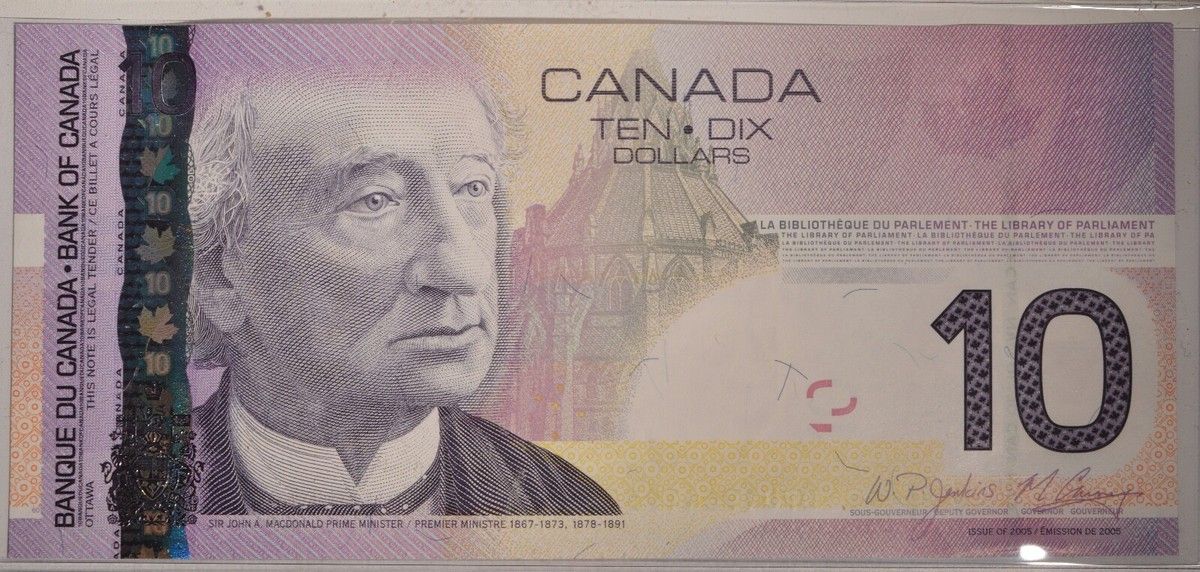
Previous Canadian ten-dollar bills featured different designs. The immediate predecessor to the current note, from the Canadian Journey series (2001), featured a portrait of Sir John A. Macdonald, Canada's first prime minister, on the front. The back depicted images related to remembrance and peacekeeping. Earlier series featured other prime ministers, landscapes, and, for many decades, portraits of the reigning monarch.
When did the new $10 bill come out in Canada?
The new vertical ten dollar note entered circulation on November 19, 2018. This note is part of the polymer series and features a distinct design focused on human rights. It was launched to highlight the story of Viola Desmond and the theme of social justice. The Bank of Canada issued this note as a permanent part of the currency series, not as a limited commemorative issue. Its release marked a significant update to the physical design and security features of the ten dollar denomination.
Is the Canadian $10 bill plastic?
Yes, the current Canadian ten dollar note is made from polymer. It is produced from a single piece of biaxially oriented polypropylene polymer, which gives it a smooth, unique texture. This advanced material was chosen to make the bills more durable and significantly harder to counterfeit compared to earlier paper notes. The polymer base also allows for innovative transparent security windows. This transition to polymer represents a modern approach to banknote production for enhanced resilience and security.
Is the Canadian $10 note vertical?
Yes, the current Canadian ten dollar note is vertical in its orientation. This design was introduced when the note entered circulation on November 19, 2018. The vertical format is a departure from traditional horizontal banknotes and is used for both the obverse and reverse sides. This orientation provides a distinct canvas for the portrait of Viola Desmond and the depiction of the Canadian Museum for Human Rights. It is the first vertical ten dollar note issued by the Bank of Canada.
Sources and further reading
- Canadian ten-dollar note (Wikipedia) en.wikipedia.org
- Vertical $10 note security features bankofcanada.ca
- Complete Bank Note Series bankofcanadamuseum.ca
- Canadian 10 Dollar Bill Stock Photos istockphoto.com
- Bank of Canada banknotes price guide and values coinsandcanada.com
This article explains how things work and is not financial, tax or legal advice. Rules, limits and rates change, so check the current figures with the Canada Revenue Agency, your province or your financial institution before you act.