The Canada Pension Plan (CPP) is a mandatory, earnings-based public pension program that provides partial income replacement for Canadian workers and their families upon retirement, disability, or death. It is a fundamental part of Canada's retirement income system alongside Old Age Security. The plan is funded by contributions from employees, employers, and the self-employed, and its investments are managed by one of the world's largest pension funds. Understanding the CPP is essential for most working Canadians planning their financial future.
What is the Canada Pension Plan?
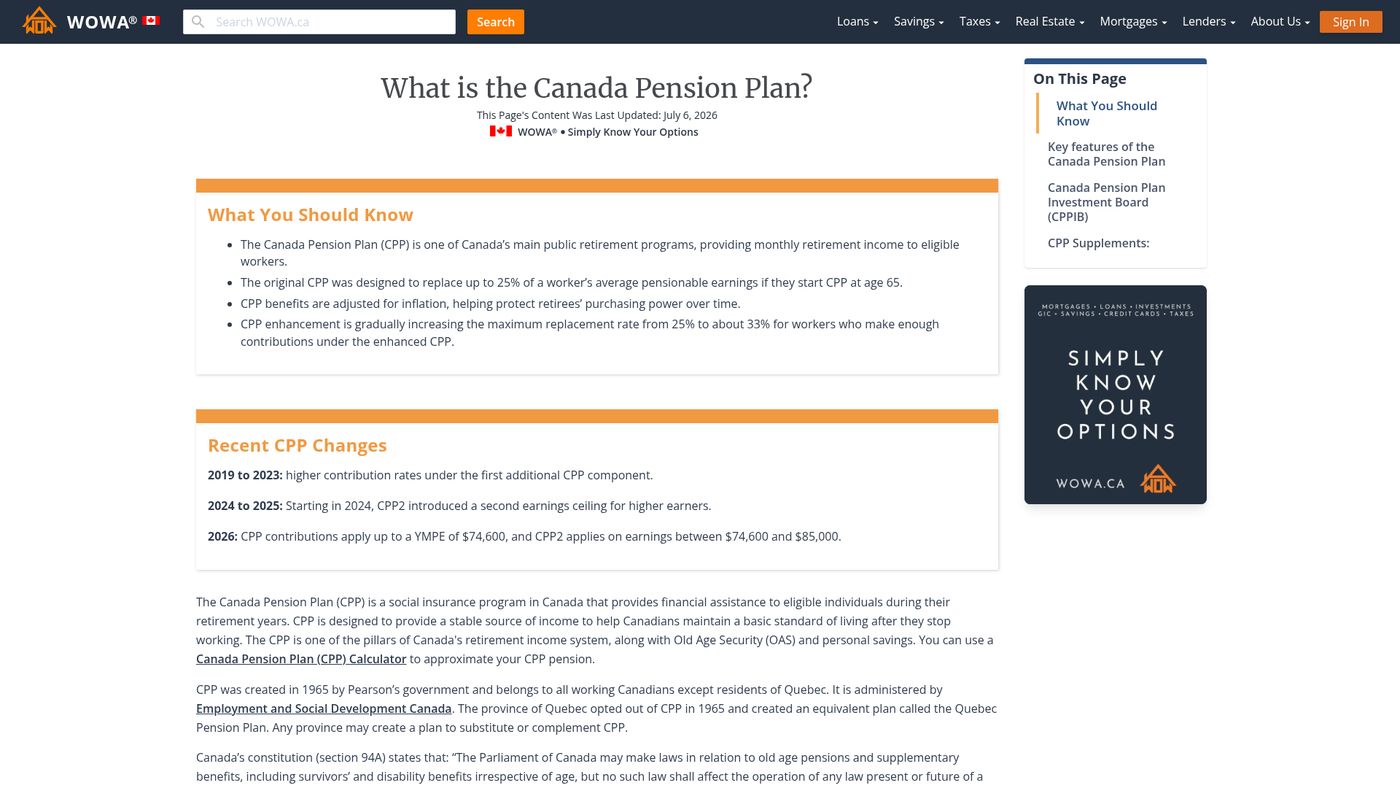
The Canada Pension Plan is a statutory social insurance program that requires contributions from most working Canadians to provide financial benefits later in life. It is designed to partially replace earnings lost due to retirement, severe disability, or the death of a contributor. The CPP is a central part of the country's public retirement system, which also includes Old Age Security and various private savings vehicles like Registered Retirement Savings Plans. The plan is administered federally by Employment and Social Development Canada for all provinces and territories except Quebec, which operates its own parallel Quebec Pension Plan. Major changes to the CPP require the approval of at least seven provinces representing two-thirds of Canada's population, reflecting the shared constitutional authority over pensions between federal and provincial governments.
History and Major Reforms
The Canada Pension Plan was established by an Act of Parliament in 1965 under Prime Minister Lester B. Pearson's government and began operating on January 1, 1966. Initially, workers and employers each contributed 1.8% of pensionable earnings, for a total of 3.6%. The plan was designed as a pay-as-you-go system, with full benefits becoming available after ten years of contributions. By the mid-1990s, demographic pressures from an aging population and increased life expectancy threatened the plan's long-term sustainability. This led to comprehensive reforms in 1997, which shifted the CPP to a partial-funding or steady-state model. These reforms created a large reserve fund managed by the newly established CPP Investments board, increased the total contribution rate to 9.9% by 2003, and froze certain benefits and the basic exemption to restore financial health.
A second major enhancement was agreed upon by federal and provincial governments in 2016, motivated by declining workplace pension coverage. This reform began a phased implementation in 2019 to increase the CPP's income replacement rate from 25% to 33.33% of a contributor's average covered earnings. It also raised the maximum amount of earnings covered by the plan by 14%. These changes are being incrementally funded by higher contributions and will be fully mature by 2065, at which point the maximum retirement pension is projected to be more than 50% higher than under the previous system. The enhancement was structured to ensure each generation pays for the additional benefits it receives.
How CPP Benefits Are Calculated and Paid
The amount of a CPP retirement pension is based on a contributor's earnings and contributions over their working life. The base CPP benefit calculates 25% of the average pensionable earnings from age 18 to 65, adjusted for inflation. A general drop-out provision excludes the lowest 17% of earnings from this calculation, which can account for up to eight years. For the enhanced CPP portion, benefits are calculated based on the best forty years of earnings, effectively dropping seven years for someone who contributes from age 18 to 65. The standard age to begin receiving a full, unreduced pension is 65, but individuals can start a permanently reduced pension as early as age 60 or defer for an increased pension up to age 70.
Starting benefits early reduces the monthly amount by 0.6% for each month before age 65, resulting in a maximum reduction of 36% at age 60. Conversely, deferring benefits increases the monthly amount by 0.7% for each month after 65, up to a maximum increase of 42% at age 70. There is no financial benefit to delaying past age 70. All CPP retirement pension payments are fully taxable as ordinary income, though tax is not automatically withheld unless requested. Monthly benefits are adjusted annually for inflation based on the Consumer Price Index. An application must be filed to start receiving benefits, which are not paid automatically.
- Early Start (Age 60): Reduction of 0.6% per month, max 36%.
- Standard Start (Age 65): Full, unreduced pension.
- Deferred Start (Age 70): Increase of 0.7% per month, max 42%.
- Benefit Calculation: Based on lifetime earnings, with drop-out provisions.
- Taxation: Fully taxable as income.
- Indexing: Adjusted annually for inflation (CPI).
Contribution Rules and Rates
Contributions to the CPP are mandatory for all employed and self-employed individuals in Canada aged 18 to 64 who earn more than the annual basic exemption of $3,500. Employees and their employers each contribute a percentage of the employee's pensionable earnings, which are earnings between the basic exemption and a yearly maximum. Self-employed individuals must pay both the employee and employer portions. Contributions are required until age 65, after which working individuals can choose to make voluntary contributions until age 70 to increase their future benefits. At age 70, contributions cease entirely regardless of employment status.
The contribution structure has two tiers. The first tier applies to earnings up to the yearly maximum pensionable earnings. The second tier, introduced as part of the CPP enhancement, applies to earnings above that first limit up to a higher ceiling. The rates have evolved significantly since the plan's inception, with major increases implemented in the 1997 and 2016 reforms to ensure sustainability and fund enhanced benefits.
| Year | Employee Rate | Employer Rate | Self-Employed Rate | Key Context |
|---|---|---|---|---|
| 1966 to 1986 | 1.8% | 1.8% | 3.6% | Initial rate, pay-as-you-go model. |
| 1997 to 2003 | Phased to 4.95% | Phased to 4.95% | Phased to 9.9% | Post-1997 reform, steady-state funding. |
| 2019 to 2023 | Phased to 5.95% | Phased to 5.95% | Phased to 11.9% | First tier rate for CPP enhancement phase-in. |
| 2024 onward | 4% on second tier earnings | 4% on second tier earnings | 8% on second tier earnings | Additional rate for earnings above first limit. |
Types of CPP Benefits
While the retirement pension is the most well-known benefit, the CPP provides several other important forms of support. The disability pension offers monthly payments to contributors under age 65 who have a severe and prolonged mental or physical disability that prevents them from working regularly. Survivor benefits include a monthly pension for the surviving spouse or common-law partner of a deceased contributor, as well as a one-time lump-sum death benefit. There is also a children's benefit available to the dependent children of a disabled or deceased contributor. The maximum death benefit has been frozen at $2,500 since the 1997 reforms. All these benefits have specific eligibility criteria based on the contributor's history of payments into the plan.
Funding, Investments, and Sustainability
The base CPP is funded on a steady-state basis, a hybrid model where current contributions and investment income from a large reserve fund are used to pay current benefits while keeping future contribution rates stable. The reserve fund is managed by CPP Investments, an independent Crown corporation that reports to the federal and provincial finance ministers. As of June 30, 2024, CPPIB managed over $646 billion in assets, making it one of the world's largest pension funds. The chief actuary of Canada reviews the plan's financial status every three years and has consistently reported that the CPP is sustainable at the current legislated contribution rates for at least the next 75 years.
The enhanced portion of the CPP is fully funded, meaning contributions made for the enhancement are set aside to pay specifically for those future benefits. Using a long-term 'open group' actuarial approach that includes all current and future contributors, the plan is reported to have assets exceeding $3.6 trillion when future contributions are considered. However, under a 'closed group' approach that considers only obligations to current contributors and beneficiaries, an unfunded liability exists, though it has been decreasing as a percentage of total liabilities since the 1996 reforms. The investment strategy focuses on long-term growth, diversification, and responsible investing to secure benefits for generations.
The Quebec Pension Plan
Quebec is the only province that opted out of the Canada Pension Plan at its inception in 1965. It administers the Quebec Pension Plan, a program that is broadly similar in design and purpose to the CPP. The QPP is managed by Retraite Québec, with investments handled by the Caisse de dépôt et placement du Québec. Contribution rates and benefit calculations for the QPP are slightly different, with historically slightly higher contribution rates. For example, in 2022 the employee/employer rate was 6.15% each, compared to 5.25% for the CPP at that time. The QPP was also enhanced in a coordinated manner with the CPP, increasing its replacement rate and earnings ceiling. Contributions made to either plan are coordinated, so Canadians who have worked in both Quebec and other provinces do not lose pension credits.
Current Figures and Common Questions
Benefit amounts are adjusted annually. For 2026, the maximum monthly retirement pension for someone starting at age 65 is $1,507.65. The average monthly amount for new retirees at 65 in 2026 was $877.01. The maximum pensionable earnings for 2026 is $74,600, with a second earnings ceiling for enhanced contributions. This results in a maximum annual employee contribution of $4,230.45 for 2026, while self-employed individuals have a maximum of $8,460.90. These figures illustrate that while the CPP provides a foundational income, it is designed to replace only a portion of pre-retirement earnings, typically necessitating additional personal savings for a comfortable retirement.
Frequently asked questions
What is the Canada Pension Plan (CPP)?
The Canada Pension Plan is a contributory, earnings related social insurance program that provides partial income replacement to contributors and their families in the event of retirement, disability, or death. It is one of the two major components of Canada's public retirement income system, the other being Old Age Security. The plan is funded by mandatory contributions from employed Canadians aged 18 and over and their employers, or by self employed individuals. As of June 2024, the CPP fund, managed by CPP Investments, holds over $646 billion in assets on behalf of 22 million Canadians. The plan is administered by Employment and Social Development Canada in all provinces and territories except Quebec, which operates its own comparable Quebec Pension Plan.
How much CPP will I get when I retire?
The amount of your CPP retirement pension depends on your earnings history, contributions, and the age you start receiving it. The base CPP pension is calculated as 25 percent of your average earnings on which you contributed over your working life, with a provision to drop out your lowest earning years. Under enhancements being phased in, this replacement rate will rise to 33.33 percent for earnings up to a higher limit. Monthly benefits are adjusted annually for inflation. Starting the pension early at age 60 results in a permanent reduction of 0.6 percent per month, while delaying to age 70 increases it by 0.7 percent per month.
When can I start taking my CPP pension?
You can start receiving a CPP retirement pension as early as age 60 or as late as age 70. The standard age to begin receiving the pension without adjustment is 65. If you start early, the pension is permanently reduced by 0.6 percent for each month you receive it before age 65, for a maximum reduction of 36 percent at age 60. If you defer, the pension increases by 0.7 percent for each month you delay after age 65, up to a maximum increase of 42 percent at age 70. There is no financial benefit to delaying the start of your pension beyond age 70. An application must be filed at least six months in advance to begin receiving benefits.
Do I have to stop working to collect CPP?
No, you do not have to stop working to collect your CPP retirement pension. You can begin receiving a reduced pension as early as age 60 while continuing to be employed. The CPP mandates contributions from all employed Canadians aged 18 and over, so if you continue working after starting your pension but are under the age of 70, you may still be required to make contributions. These continued contributions can result in a post retirement benefit which will increase your monthly pension amount.
How much do I contribute to the CPP?
For employees, the contribution rate is a prescribed percentage of pensionable earnings, which is matched by their employer. As of 2019, the employee contribution rate was 4.95 percent on earnings between $3,500 and $57,400. Self employed individuals pay both the employee and employer portions, for a total of 9.9 percent. Following the 2017 reforms, contribution rates are being increased to finance an enhanced CPP. Employees and employers will each eventually contribute 5.95 percent on the base earnings limit, plus an additional 4 percent each on earnings above that limit up to a new, higher ceiling.
Is the CPP the same in Quebec?
No, the Canada Pension Plan is not the same in Quebec. Quebec is the only province that opted out of the CPP upon its formation in 1965. It operates its own parallel program called the Quebec Pension Plan. The QPP is Quebec's version of the CPP and is very similar in design, providing comparable benefits for retirement, disability, and death. However, it is administered separately by Retraite Québec. The constitutional authority for pensions is shared, so major changes to the CPP require approval from provinces representing two thirds of Canada's population, which excludes Quebec for CPP matters.
Sources and further reading
- Canada Pension Plan (Wikipedia) en.wikipedia.org
- Understanding the Canadian Pension Plan (CPP) empire.ca
- Canada Pension Plan thecanadianencyclopedia.ca
- Top questions about Canada Pension Plan (CPP) edwardjones.ca
This article explains how things work and is not financial, tax or legal advice. Rules, limits and rates change, so check the current figures with the Canada Revenue Agency, your province or your financial institution before you act.