EI Sickness Benefits are a temporary income support program under Canada's Employment Insurance system, providing financial assistance to workers who cannot work due to illness, injury, or quarantine. The benefit provides up to 26 weeks of payments, calculated at 55% of the claimant's average insurable earnings. This program is a crucial safety net for Canadians facing medical crises, helping to cover essential living expenses during recovery. The benefit duration was permanently extended from 15 to 26 weeks in December 2022, following advocacy from patient groups.
What Are EI Sickness Benefits
EI Sickness Benefits are a form of Employment Insurance designed as temporary income replacement for Canadian workers who are unable to perform their job due to a medical condition. This program is not intended for long-term disability but provides crucial financial support during periods of illness, injury, or mandated quarantine. The benefits help cover basic needs like rent and groceries, reducing financial stress while a person focuses on recovery. To receive these benefits, a claimant must be medically incapable of work but would otherwise be available for employment.
The core principle is to provide a partial wage replacement, set at 55% of the claimant's average weekly insurable earnings. There is an annual maximum insurable earnings amount, which for 2023 results in a maximum weekly benefit of $650. The benefit is paid for a finite period, currently up to 26 weeks, after which other forms of long-term support may be needed. The program is funded through Employment Insurance premiums paid by employees and employers. It operates under the federal Employment Insurance Act and is administered nationally by Service Canada.

Eligibility and Qualification Rules
To qualify for EI Sickness Benefits, a claimant must meet several specific conditions set by the Employment Insurance program. The primary requirement is having accumulated at least 600 hours of insurable employment in the 52-week period preceding the claim. This qualifying period ensures that the individual has a recent and substantial attachment to the workforce. The claimant must also have experienced an interruption of earnings from their employment, meaning they are no longer receiving their regular salary or wages.
A critical condition is proving medical incapacity through a medical certificate signed by a doctor or other approved medical practitioner. This certificate must state that the illness, injury, or quarantine prevents the person from working and should indicate the expected duration. The claimant must demonstrate they would be available to work if not for this medical condition. It is also necessary to show that they are not receiving full pay from their employer during this period. Meeting all these criteria is essential for a successful application.
- Accumulate 600 insurable hours in the last 52 weeks.
- Experience an interruption of earnings from employment.
- Provide a medical certificate signed by a practitioner.
- Be incapable of work due to illness, injury, or quarantine.
- Be otherwise available for work if not for the medical condition.
- Not be in receipt of full pay from an employer.
Benefit Amount, Duration and Payment
The amount of EI Sickness Benefits a person receives is calculated as 55% of their average weekly insurable earnings, based on the best weeks of earnings in the last year. This calculation is subject to a maximum annual insurable earnings cap, which for 2023 results in a maximum weekly payment of $650. The benefit is intended to partially replace lost income, not to fully replicate a salary. Claimants can use the online EI benefit estimator tool provided by the Canada Revenue Agency to get a personal estimate before applying.
The maximum duration for which these benefits can be paid was permanently extended from 15 weeks to 26 weeks, effective for new claims established on or after December 18, 2022. The actual number of weeks paid depends on how long the medical professional certifies the claimant is unable to work. Benefits stop if the claimant recovers and returns to work, exhausts the maximum weeks, or no longer meets the eligibility criteria. Once all 26 weeks are used, a claimant must work another 600 insurable hours to qualify for sickness benefits again in the future.
There is a standard one-week waiting period at the start of a benefit period during which no benefits are paid. However, this waiting period was waived for new claimants who were in quarantine due to COVID-19 as a temporary measure. Payments are issued every two weeks after the claimant submits their mandatory bi-weekly reports to Service Canada, confirming they remain entitled. The first payment typically arrives within 28 days of applying if the application is complete and approved.
Application Process and Required Documents
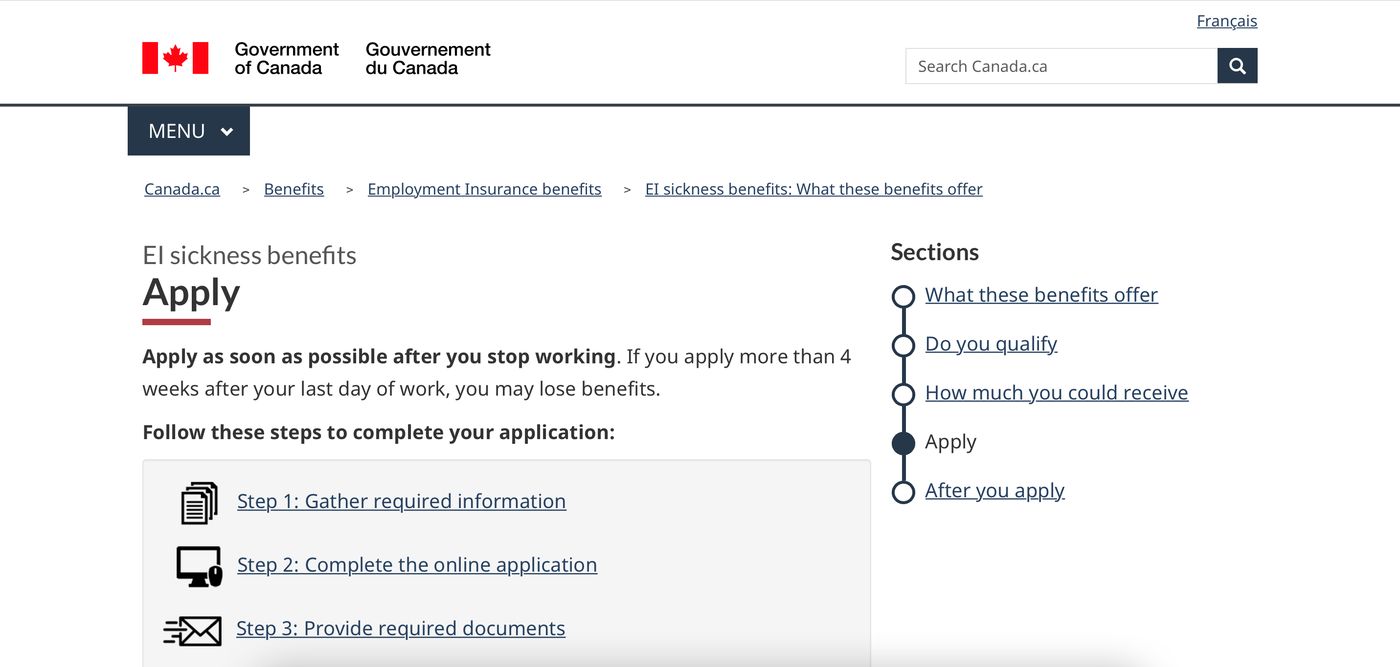
Applying for EI Sickness Benefits is done primarily online through the Government of Canada's website. It is recommended to apply as soon as possible after stopping work, even if all documents are not yet gathered, to avoid delays in payment. The application requires personal information, details about the claimant's employment history, and banking information for direct deposit. The applicant must also provide the reason for the claim, specifying it is for sickness benefits, and may need to submit supporting documents.
The most crucial document is the medical certificate, which must be completed and signed by the treating medical practitioner. The certificate should describe the illness or injury and state that it renders the person incapable of work. While the online application can be started without the certificate, it may be requested later by Service Canada. Other useful documents include a Record of Employment from the employer and personal identification. After submitting the application, the claimant must complete bi-weekly reports to continue receiving benefits.
- Complete the online application on the Government of Canada website.
- Provide personal details, Social Insurance Number, and banking information.
- Submit employment history and reason for claim (sickness).
- Obtain and submit a medical certificate from a practitioner.
- Provide a Record of Employment from the employer if available.
- Complete and submit bi-weekly reports to Service Canada after applying.
Impact of Work and Other Income
Income earned while receiving EI Sickness Benefits can significantly affect the benefit payment amount. If a claimant works or receives certain other payments during their benefit period, these amounts are deducted from their benefits. Earnings from employment or self-employment are deducted dollar for dollar from the weekly benefit payment. This rule is designed to ensure the benefit acts strictly as income replacement for time not working.
Several specific types of income must be reported and will be fully deducted from sickness benefits. These include commissions from employment, payments for lost wages from workers' compensation for a work accident, and payments from a group wage loss replacement plan. Retirement income from pensions, the Canada Pension Plan, or the Quebec Pension Plan is also deducted. Allowances paid under provincial legislation, such as benefits under the Quebec Parental Insurance Program, similarly reduce the EI benefit.
Conversely, some forms of income do not impact EI Sickness Benefits. Disability benefits, survivor benefits, and workers' compensation payments for specific costs like medical expenses are not deducted. Payments from a private wage loss replacement plan for sickness or disability are also excluded. Furthermore, under the Working While on Claim rules extended to sickness benefits in 2018, claimants can keep 50 cents of their benefits for every dollar earned, up to 90% of their previous weekly earnings, allowing for a gradual return to work.

Historical Context and Extension to 26 Weeks
The history of unemployment and sickness insurance in Canada is part of a broader international development of social safety nets. Modern unemployment benefit schemes originated in the United Kingdom with the National Insurance Act of 1911. Canada's Employment Insurance system, including sickness benefits, evolved as a contributory social insurance program funded by premiums from workers and employers. For many years, the EI sickness benefit provided a maximum of 15 weeks of financial support.
Advocacy from groups representing cancer patients and people with disabilities highlighted that 15 weeks was insufficient for many serious illnesses. A report noted that average treatment and recovery for breast cancer is 26 to 36 weeks, and for colon cancer it is 37 weeks. Stakeholders argued that the benefit length should align with the 26-week duration already established for compassionate care benefits. This led to significant political debate and legislative proposals to extend the benefit period.
Following a commitment in Budget 2021, the Government of Canada permanently extended EI sickness benefits from 15 to 26 weeks through an Order in Council. This change came into effect on December 18, 2022, and applies to new claims established on or after that date. Corresponding changes were made to the Canada Labour Code to support longer job-protected leaves. The extension was implemented on a forward-looking basis to new claims to avoid complications like overpayments for existing claimants.
| Year | Maximum Benefit Duration | Key Change |
|---|---|---|
| Pre-2022 | 15 weeks | Standard duration for decades. |
| 2021 | 15 weeks | Budget 2021 announces permanent extension. |
| 2022 (Dec 18) | 26 weeks | Extension implemented for new claims. |
| 2023 onward | 26 weeks | Permanent duration for new claimants. |
Usage Statistics and Program Scope
The EI Sickness Benefit program is a substantial component of Canada's social safety net. In the 2021 to 2022 fiscal year, the program provided $2.46 billion in financial support to 462,460 individual claimants. This demonstrates the significant demand for income support during periods of medical incapacity. The average claimant collected benefits for 9.1 weeks, suggesting many illnesses or injuries are resolved within a shorter timeframe.
However, the statistics also reveal that a substantial portion of claimants require the full benefit duration. Under the previous 15-week system, 35.3% of claimants used the entire 15 weeks available to them. This figure underscored the argument that for serious conditions like cancer, the existing benefit period was inadequate. The extension to 26 weeks is anticipated to better meet the needs of those with longer recovery periods. The program complements other federal and provincial long-term disability supports and employer-sponsored insurance plans.
Debates, Considerations and Economic Rationale
The design and generosity of unemployment and sickness benefits involve balancing support for individuals with economic incentives. A key economic rationale for such programs is that they act as automatic stabilizers during economic downturns, maintaining consumer spending. From a social policy perspective, they prevent individuals from falling into poverty due to temporary incapacity. However, debates often centre on potential moral hazard, where benefits might reduce the incentive to return to work.
In the context of EI Sickness Benefits, a primary debate has been the appropriate duration of support. While patient advocates pushed for 26 weeks or more, some legislators proposed extending it to 50 or 52 weeks. A Private Member's Bill, C-215, sought a 52-week extension but was dropped in 2023. Opponents of longer durations sometimes cite cost concerns and the program's funding model, which relies on premiums. Proponents argue that adequate recovery time leads to better long-term workforce attachment and match quality between workers and employers.
Another consideration is the program's funding and sustainability. Unemployment benefits are typically funded by payroll taxes on employers and employees, with possible government supplementation during recessions. The extension to 26 weeks represents a permanent increase in program costs. Policymakers must ensure the EI account remains balanced over time, which can involve adjusting premium rates or benefit parameters. The integration with other supports, like the Working While on Claim provisions, aims to encourage a gradual return to work and mitigate any work disincentives.
Frequently asked questions
How long can I receive EI sickness benefits?
You can receive EI sickness benefits for a maximum of 26 weeks. This permanent extension from the previous 15 weeks came into effect on December 18, 2022, for new claims. The actual number of weeks you receive depends on the duration certified by your medical practitioner. Benefits stop when you are able to return to work or when you reach the 26-week maximum.
How much money will I get from EI sickness benefits?
EI sickness benefits pay 55% of your average weekly insurable earnings, up to a maximum amount. For 2023, the maximum weekly benefit is $650. Your exact amount is calculated based on your earnings in the best weeks of the last year. You can use the online EI benefit estimator tool to get a personal estimate.
Can I work part-time while on EI sickness benefits?
Yes, you can work part-time while receiving benefits under the Working While on Claim rules. These rules allow you to keep 50 cents of your EI benefits for every dollar you earn, up to a maximum of 90% of your previous weekly earnings. This system is designed to support a gradual return to work. All earnings must be reported and will affect your benefit amount.
What is the waiting period for EI sickness benefits?
The standard waiting period for EI sickness benefits in Canada is one week. This one-week waiting period was waived for new claimants who were quarantined as a temporary measure. The current waiting period in Canada is seven days, as noted in the general unemployment benefits processes. If you have received Employment Insurance benefits in the past 52 weeks, you may not need to serve another waiting period.
What happens after my 26 weeks of EI sickness benefits end?
After 26 weeks, the EI sickness benefits conclude. You must return to work and accumulate sufficient insurable hours to qualify for a new claim if needed. The EI sickness benefit currently provides up to 26 weeks of coverage, which is noted as insufficient for many long term medical treatments. If you remain unable to work, you would need to seek other forms of support, as unemployment insurance is a temporary benefit designed for short term income replacement during periods of unemployment due to sickness.
Sources and further reading
- Employment Insurance (Wikipedia) en.wikipedia.org
- Fact Sheet EI Sick Benefits, Unifor unifor.org
- EI sickness benefits cancer.ca
- Question Period Note: EI Sickness Extension Eligibility search.open.canada.ca
- EI Sickness Benefits in Canada: Eligibility, Pay, & How to ... rutmanlaw.com
This article explains how things work and is not financial, tax or legal advice. Rules, limits and rates change, so check the current figures with the Canada Revenue Agency, your province or your financial institution before you act.