The Invesco QQQ Trust is a prominent US exchange-traded fund that tracks the NASDAQ-100 Index, providing concentrated exposure to leading innovative companies. For Canadian investors, it represents a popular route to invest in major US technology and growth stocks. The fund trades on the Nasdaq under the symbol QQQ, and Canadians can access it through various brokerage platforms. Understanding its structure, holdings, and the available Canadian-listed alternatives is crucial for making informed investment decisions.
What is the Invesco QQQ Trust?
The Invesco QQQ Trust, Series 1 is an exchange-traded fund that seeks to track the investment performance of the NASDAQ-100 Index. The fund uses a full replication technique, meaning under most circumstances it holds all the stocks in the index. The NASDAQ-100 Index includes 100 of the largest domestic and international non-financial companies listed on the Nasdaq Stock Market based on market capitalization. This provides investors with exposure to companies at the forefront of innovation across sectors like technology, consumer services, and healthcare. The fund is based in the United States and is listed on the Nasdaq exchange. Invesco, the global investment manager behind the fund, oversees more than USD 2.2 trillion in assets under management worldwide. The fund's objective is not to outperform the index but to replicate its performance before fees and expenses, and it is not actively managed, meaning it will not take defensive positions in declining markets.
History and Evolution of the Fund
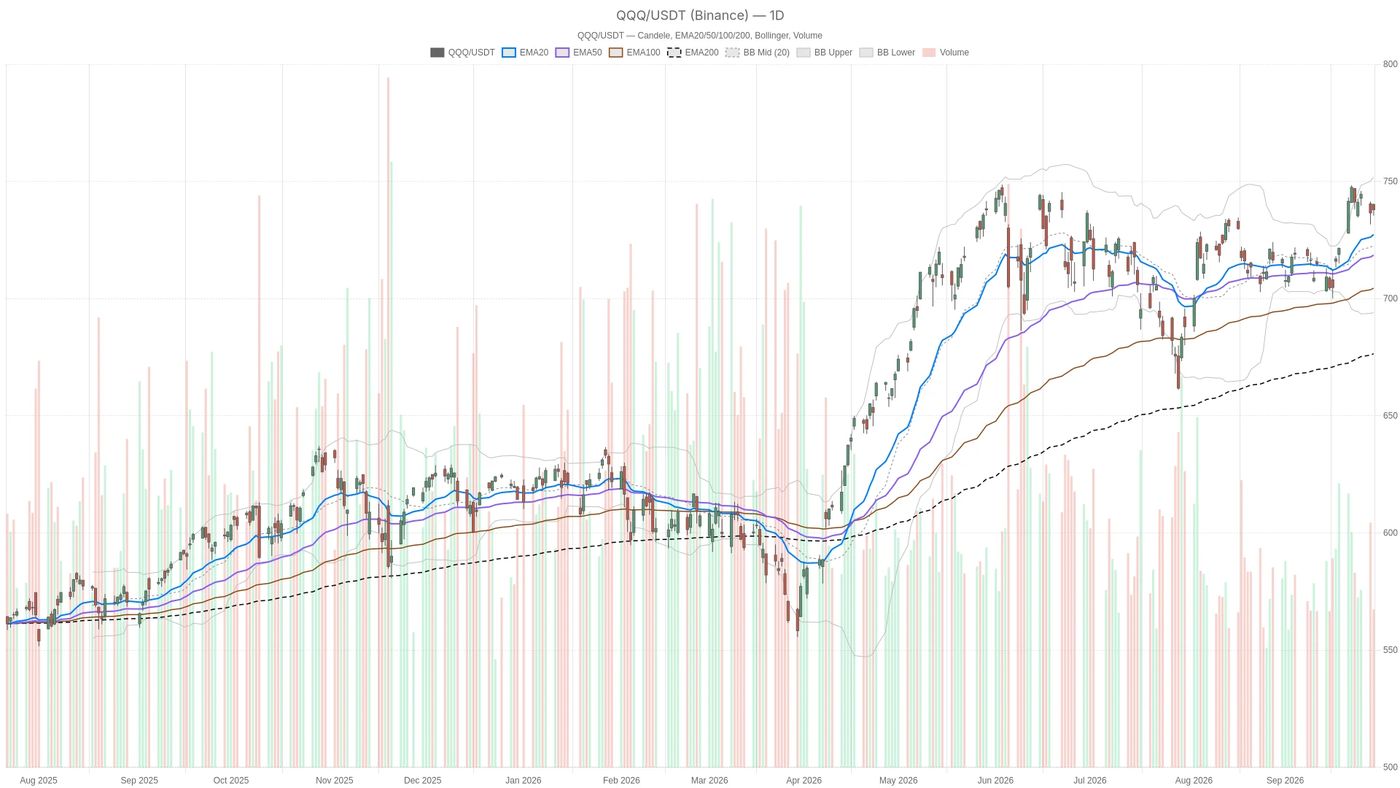
The Invesco QQQ Trust was launched to give investors a simple way to gain exposure to the performance of the NASDAQ-100 Index. Its history is intertwined with the growth of the technology sector and the index it tracks. A notable development for Canadian investors occurred in 2021 when Invesco Canada announced changes to its related Canadian fund. The Invesco QQQ Index ETF, which traded under the ticker QQC.F and held securities of the US QQQ trust, was renamed the Invesco NASDAQ 100 Index ETF. Concurrently, its investment strategy was adjusted to allow it to hold securities of either QQQ or the Invesco NASDAQ 100 ETF (QQQM), and its management fee was reduced from 0.25% to 0.20%. This change was effective on or about May 14, 2021. The parent company, Invesco Ltd., is a global independent investment management firm with offices in more than 20 countries, and it managed US$1.35 trillion in assets as of December 31, 2020.
Portfolio Composition and Key Holdings
The portfolio of the Invesco QQQ Trust is a direct reflection of the NASDAQ-100 Index, which is reconstituted annually and rebalanced quarterly. The fund invests in growth and value stocks of large-cap companies. The index methodology selects the largest non-financial companies listed on Nasdaq, leading to a heavy concentration in the technology sector, though it also includes companies from consumer discretionary, healthcare, industrials, and telecommunications. The fund's adviser adjusts the portfolio's composition and the weights of the securities from time to time to conform to periodic changes in the identity and relative weights of the index securities. This process of full replication aims to minimize tracking error between the fund's performance and the index it follows. The composition and weighting of the securities portion of a portfolio deposit are also adjusted to conform to changes in the index to maintain the correspondence between the trust and the index.
Trading and Dividend Information
The Invesco QQQ Trust trades on the Nasdaq exchange under the ticker symbol QQQ. It is not listed on the Toronto Stock Exchange. The fund is not expected to pay a dividend over the next 12 months. Any distributions from the trust would typically be based on the income generated by its underlying holdings, such as dividends from the constituent stocks, less the fund's expenses. For Canadian investors, it is important to note that commissions, management fees, and expenses are all associated with an investment in ETFs. When buying or selling units on an exchange, investors may pay more than the current net asset value when buying and may receive less when selling. The fund's value changes frequently, and past performance is not a guarantee of future results. The indicated rates of return are historical annual compounded total returns net of fees and expenses payable by the fund, including changes in security value and reinvestment of all dividends, but they do not take into account sales charges or income taxes payable by the securityholder.
How Canadians Can Invest
Canadian investors can buy shares of the US-listed Invesco QQQ Trust directly by opening a brokerage account with a Canadian platform that provides access to US exchanges like the Nasdaq. Most major Canadian online brokerages, such as Questrade, Wealthsimple, and Interactive Brokers, offer this access. Investors should be aware of potential currency exchange costs when converting Canadian dollars to US dollars to make the purchase. Some platforms also offer the option to buy fractional shares, allowing investment with an amount less than the price of a full share. As an alternative to the US listing, Canadians can invest in Canadian-dollar denominated ETFs that provide similar exposure, which may include currency hedging. Investments can be held in registered accounts like a Tax-Free Savings Account (TFSA) or a Registered Retirement Savings Plan (RRSP), though holding US securities may have specific tax implications for dividend income that should be reviewed with an advisor. It is essential to read the fund's prospectus before investing, as it contains important information about the ETF, including its risks. The CRA taxes investment income from stocks in Canada based on factors including the type of investment income, your marginal tax rate, and whether the investment is held in a registered account. You will usually pay brokerage fees to your dealer if you purchase or sell units of an ETF on recognized Canadian exchanges, and if the units are purchased or sold on these Canadian exchanges, investors may pay more than the current net asset value when buying units of the ETF and may receive less than the current net asset value when selling them.
- Open a brokerage account with a platform offering US market access like Questrade or Wealthsimple.
- Fund the account, considering currency conversion for US-dollar purchases.
- Place a trade for the QQQ ticker on the Nasdaq exchange.
- Consider Canadian-listed hedged alternatives like QQC.F for ease of trading in CAD.
- Be aware that you will usually pay brokerage fees to your dealer if you purchase or sell units on recognized Canadian exchanges.
- Understand that if you purchase or sell on these exchanges, you may pay more than the net asset value when buying and receive less when selling.
Canadian-Listed Alternatives and Detailed Comparisons
For investors seeking exposure to the NASDAQ-100 Index without directly dealing with US currency or exchanges, several Canadian-listed ETFs are available. The primary options are the Invesco NASDAQ 100 Index ETF (QQC.F), the BMO NASDAQ 100 Equity Hedged to CAD ETF (ZQQ), and the iShares NASDAQ 100 ETF (CAD-Hedged) (XQQ). These funds are passively managed and use currency hedging to minimize the impact of USD/CAD exchange rate fluctuations. A key difference among them is the management expense ratio, which directly impacts net returns for investors. The tracking difference is a key metric used to evaluate how well an ETF replicates the performance of its underlying index, calculated as the difference between the ETF's return and the index's return over a specific period. Generally, a smaller tracking difference indicates that the ETF more accurately tracks its index, helping investors gauge the efficiency of an ETF. Another point of comparison is the portfolio turnover rate, which from 2019 to 2023 was higher for XQQ than for ZQQ, with XQQ's 2023 turnover ratio reaching 50.0%. While a high turnover in a passive ETF is atypical, it's not necessarily negative if the strategy is well-executed and delivers value to investors, though closer scrutiny is warranted to understand the reasons behind the higher activity level and its impact on costs and performance.
| ETF Ticker | ETF Name | Management Expense Ratio (MER) | Tracking Difference (As of Sept 2024) | Notable Feature |
|---|---|---|---|---|
| QQC.F | Invesco NASDAQ 100 Index ETF | 0.20% | -0.41% | Lower MER and tracking difference |
| ZQQ | BMO NASDAQ 100 Equity Hedged to CAD ETF | 0.39% | -0.69% | Lower portfolio turnover in recent years |
| XQQ | iShares NASDAQ 100 ETF (CAD-Hedged) | 0.39% | -0.72% | Largest AUM of the three |
The table shows that QQC.F has a significantly lower Management Expense Ratio (MER) and a smaller tracking difference. This means it has historically replicated its index more closely after fees. While the performance of ZQQ and XQQ is very similar, the lower cost structure of QQC.F is an important consideration for long-term investors. The risk level of these funds is determined using a standardized methodology based on the fund's historical 10-year standard deviation of returns. For newer funds, the standard deviation of a reference index is used to determine the risk rating.
Risks and Considerations for Investors
Investing in the Invesco QQQ Trust or its Canadian equivalents involves several risks. The fund's risk level is classified based on its historical volatility, and it has a beta measurement of 1.26, indicating it is more volatile than the broader market, which has a beta of 1. This suggests a relatively higher risk profile, though with the potential for market-beating returns. The fund's performance is heavily tied to the technology and growth sectors, making it susceptible to downturns in those areas. As a passively managed fund that fully replicates its index, it will not take defensive positions during market declines. Currency risk is a factor for Canadians holding the US-listed QQQ, as fluctuations in the USD/CAD exchange rate can affect returns. This risk is mitigated in the Canadian-listed hedged alternatives like QQC.F, ZQQ, and XQQ. All ETFs carry standard risks including market risk, liquidity risk, and tracking error risk, where the fund's performance may not perfectly match its index. Commissions, management fees and expenses all may be associated with an investment in exchange-traded funds, and these costs reduce returns. The product(s) are not issued, endorsed, sold, or promoted by Nasdaq OMX and Nasdaq OMX makes no warranties and bears no liability with respect to the product.
Tax Implications for Canadian Holders
Canadian investors must consider the tax implications of holding the Invesco QQQ Trust, whether in a non-registered account or within a registered plan. The CRA taxes investment income from stocks based on three main factors: the type of investment income, your marginal tax rate, and whether the investment is held in a registered account. For the US-listed QQQ held in a non-registered account, any distributions would be subject to taxation. Depending on the underlying investments of the trust fund, distributions on units may consist of ordinary income, including foreign source income and taxable dividends from taxable Canadian corporations, interest, or net realized capital gains, less the expenses of that trust fund, and may include returns of capital. To the extent that the expenses of a trust fund exceed the income generated by such trust fund in any applicable distribution period, it is not expected that a distribution for that period will be made. Holding US securities in an RRSP or TFSA can shelter the growth from Canadian tax, but US-sourced dividends may be subject to a non-resident withholding tax, though this is often waived for holdings within an RRSP. It is essential to consult with a tax professional for advice tailored to your personal situation.
Frequently asked questions
What is the QQQ ETF?
The Invesco QQQ Trust is an exchange-traded fund based on the Nasdaq-100 Index. It invests in growth and value stocks of large-cap companies and seeks to track the performance of the index using a full replication technique. The fund provides exposure to companies at the forefront of innovation across diverse sectors. It is listed on the NASDAQ under the ticker symbol QQQ.
Can I buy QQQ stock in Canada?
Yes, you can buy Invesco QQQ Trust stock in Canada. You need to open a brokerage account with an online trading platform that supports stocks on the NASDAQ, such as Questrade or Wealthsimple. Invesco QQQ Trust stock is not listed on the TSX, as it trades on the NASDAQ under the symbol QQQ. Canadian investors can buy the stock directly through various Canadian brokerage platforms that offer access to US exchanges.
Is there a Canadian equivalent to the QQQ ETF?
Yes, QQC.F is the Canadian equivalent of QQQ. Its full name is the Invesco NASDAQ 100 Index ETF, and it trades on the TSX. QQC.F invests in securities of the Invesco QQQ Trust. From a fee perspective, it is lower than some other Canadian alternatives. Other options include ZQQ and XQQ, which also track the NASDAQ-100 Index.
Does QQQ pay a dividend?
Invesco QQQ Trust is not expected to pay a dividend over the next 12 months. The fund does not have a fixed distribution amount. Any ordinary cash distributions would be based on anticipated cash flow and expenses of the fund. Distributions may consist of ordinary income or capital gains, less the fund's expenses.
What are the risks of investing in QQQ?
The primary risks include high volatility, as indicated by its beta of 1.26, and concentration risk in technology and growth stocks. Market risk, currency risk for unhedged holdings, and tracking error are also considerations. The fund's value can fluctuate significantly, and as a passive fund, it will not attempt to avoid losses during market declines. All ETFs carry management fees and trading costs that reduce returns.
Can I hold QQQ in my TFSA or RRSP?
Yes, you can hold Invesco QQQ Trust stock or its Canadian-listed equivalents in a TFSA or RRSP. You would need to use a Canadian brokerage account that offers access to the relevant exchange. It is important to read the fund's prospectus and understand the risks, as ETFs are not guaranteed and their values change frequently. Commissions, management fees, and expenses are all associated with an investment in ETFs.
Sources and further reading
- Institutional Investors | Invesco Canada invesco.com
- CI Invesco NASDAQ 100 Index ETF funds.cifinancial.com
- Guide to buying Invesco QQQ Trust stock in Canada finder.com
- Invesco Canada announces changes to the Invesco QQQ ... newswire.ca
- Canadian ETF Comparison Series: ZQQ, XQQ, and QQC.F theglobeandmail.com
This article explains how things work and is not financial, tax or legal advice. Rules, limits and rates change, so check the current figures with the Canada Revenue Agency, your province or your financial institution before you act.