OTTAWA
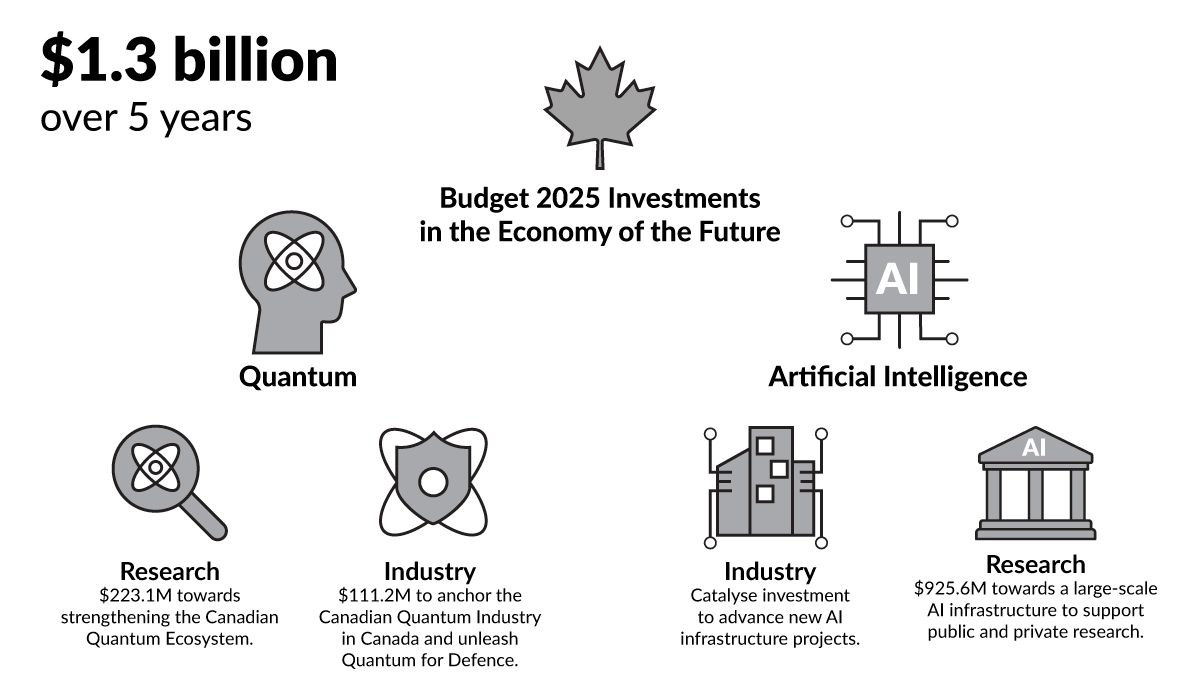
The federal government is promising to use loan backstops and purchase agreements to help create 500 megawatts of new artificial intelligence computing capacity for Canadian businesses.
Finance Minister François-Philippe Champagne listed AI infrastructure alongside mines, ports and dams as projects “that will power our future” in his budget speech on Thursday.
The plan aims to address a financing challenge where it is easier and less risky for data centre developers to build for deep-pocketed U.S. tech giants than for Canadian AI startups.
“You get this Catch-22 that you can’t buy what’s not going to get built,” said Sean Mullin, a former federal policy adviser who helped design Ottawa’s $2-billion AI compute strategy.
The budget proposes federal agencies could issue backstops and offtake agreements, essentially committing to buy a portion of the output of new data centres or to underwrite their debt.
By applying this approach, Ottawa can give developers and lenders the security to move forward “without directly subsidizing or putting taxpayer dollars on the table,” Mullin said.
U.S. technology companies are already expanding their cloud footprint in Canada, with Meta Platforms Inc. building a $13-billion data centre campus in Alberta and Anthropic leasing space at a facility in Nova Scotia.
Amazon.com Inc., Google and Microsoft are also adding capacity.
Developers have announced nearly 200 new data centres across the country, according to The Globe and Mail.
New capacity sponsored by Silicon Valley does not necessarily mean greater access for Canadian AI companies, however.
Ali Asaria, CEO of Toronto-based AI startup Transformer Lab, said U.S. tech giants are already using all the available specialized AI chips by placing huge orders and making long-term commitments.
His company has tried everything to get more capacity, citing unsuccessful conversations with more than 50 compute suppliers in recent weeks.
Data centre developers must borrow to fund projects, and lenders typically set interest rates based on the quality of their clients and contracts, said Simon Ahdoot, CEO of Montreal-based Hypertec Group Inc.
The U.S. tech giants have huge revenues and good credit ratings, so their compute suppliers can secure loans at a lower cost.
Providers that primarily work with Canadian AI startups must “aggregate a bunch of these smaller contracts together,” Mullin said.
As a result, they could find it much more expensive, or even impossible, to get financing, and their projects may stall out.
Some see an opportunity for Canada in recent U.S. challenges, where voters in dozens of municipalities approved bans on new compute facilities in the midterm elections.
“Data centres in Canada looking pretty appealing right now,” Lucy Hargreaves, CEO of tech group Build Canada, said in a post on X.
Others are not sold on Ottawa’s plan.
Craig McLellan, CEO of Toronto-based cloud services provider ThinkOn, Inc., said there is a risk the federal measures will lead to more capacity than domestic companies and organizations can support.
Demand from the Canadian market could be smaller than the 500 megawatts that Ottawa wants to help build.
“That is an estimate that is not based on any form of market analysis that goes beyond the speculators,” he said.
“It can get there, but I don’t think it’s there yet.”
Financial guarantees for more development also encourage speed over prudence, according to McLellan, causing companies to focus less on using the most efficient computing equipment possible.
“If you don’t promote efficiency at some point in time, then you may end up with an overbuilt infrastructure.”
Asaria backs the federal plan, which he hopes will give Canadian cloud providers the confidence to build the compute capacity companies like his need.
Still, he worries that data centre speculators “could abuse a federal offer that comes with guaranteed financing.”
The clearest working example of Ottawa’s approach is a project pairing AI company Cohere with U.S. cloud provider CoreWeave, where the government committed up to $240 million toward a $725 million build.
Mullin said Ottawa should ensure Canadian companies are not crowded out of new compute capacity, but the country could benefit from becoming an AI infrastructure supplier to the U.S. and Europe.
The budget did not include much new funding for artificial intelligence beyond the $2.04 billion already pledged for the national AI strategy.
This story was written by the e2gold.ca newsroom from reporting by The Globe and Mail, tech-insider.org and The Globe and Mail. Quotes are checked word for word against that reporting.