Canadian consumer debt reached a record $2.66 trillion in the third quarter of 2026, with non-mortgage debt growing fastest ahead of a major mortgage renewal wave expected in 2027, according to a new report from TransUnion.
Total outstanding credit debt rose 3.8 percent from a year earlier, with mortgage debt making up 74 percent of the total.
Non-mortgage debt, which includes credit cards, lines of credit, auto and personal loans, posted the fastest increase of 3.6 percent year-over-year compared to strictly mortgage debt.
"Financial pressures are beginning to build for some homeowners, particularly as higher borrowing costs and larger mortgage balances continue to affect household budgets," the credit reporting agency said in its third-quarter credit industry insights report released Wednesday.
On average, Canadians each owed $136,024 across all credit products, up 2.9 per cent compared to last year.
For non-mortgage debt, each Canadian consumer owed $28,083 on average, up 3.63 per cent year-over-year.
Consumers in B.C. and Ontario saw non-mortgage credit climb the fastest among the provinces and territories, with an average balance of $30,492 in B.C., up 3.87 per cent, and $29,197 in Ontario, up 3.2 per cent.
Matt Fabian, senior director of financial services research and consulting at TransUnion Canada, said the patterns differ across the country.
"In some provinces, balances have grown amid relatively strong economic and credit conditions, while in others, debt has increased against a more challenging backdrop for households," Fabian said in the report.
TransUnion says there were 32.8 million credit-active consumers in the third quarter, up 1.1 per cent overall.
The number of consumers categorized as Super Prime, meaning they typically have the highest credit scores and lowest risk, was up four per cent year over year. Meanwhile, Prime, which is considered the median category, fell 3.7 per cent, and the number of Subprime borrowers increased 1.5 per cent.
Mortgage debt growth in the quarter was not driven by an expanding pool of borrowers. Between September 2024 and September 2026, the average mortgage balance per consumer rose 8.6 percent, from $369,658 to $401,509, while the count of active mortgage holders grew by less than 1 percent.
"Rising debt is being driven by two distinct forces: non-mortgage balance growth has come from an increase in borrowers carrying moderately higher average debt levels, while mortgage balance growth has come from larger balances per borrower as borrower counts have remained flat," Fabian said.
Mortgage delinquency risk rising
TransUnion says mortgage delinquency risk is also high amid rising debt levels and household pressures.
Mortgage delinquency trended upward across all stages in Q3 2026, with balance-level delinquency rising 6 basis points year-over-year and serious delinquency (90-plus days) outpacing account-level increases.
A separate report from Equifax earlier this week showed the national 90-plus day mortgage delinquency rate reached 0.32 per cent, the highest since the credit agency started tracking the metric in 2013. That’s up 31.1 per cent year-over-year, mainly pushed higher by missed mortgage payments in Ontario and British Columbia.
Victor Tran, Rates.ca mortgage and real estate expert, told Canadian Mortgage Professional earlier this year that mortgage arrears remain far from crisis territory.
"But I think it's going to be a slow grind," Tran said. "It's not going to be a significant, drastic increase suddenly and I don't think we're going to see sudden mass foreclosures or power of sales."
Leah Zlatkin, a licensed mortgage broker and LowestRates.ca expert, said that financial pressure on homeowners is real even in the absence of a default crisis.
"Mortgage delinquency is often one of the last signs of financial strain, because most homeowners will cut back in other areas before missing a mortgage payment," she said.
Fabian added that warning signals typically surface elsewhere in a consumer's finances before a mortgage payment is skipped.
"Rising utilization, growing revolving balances, reduced payments and emerging delinquency on other products can signal weakening financial capacity before a mortgage payment is missed," he said.
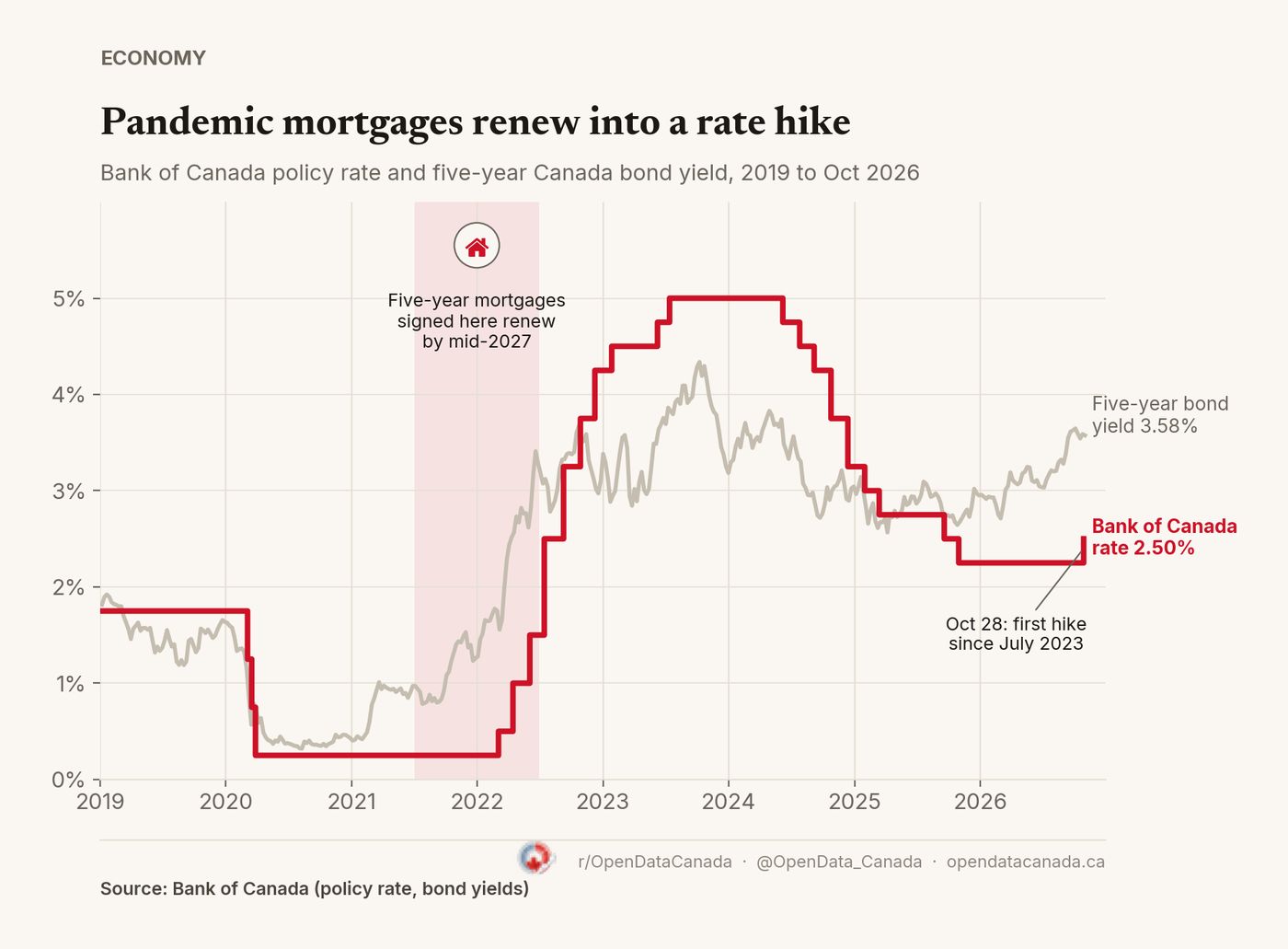
Many Canadian households will renew their mortgages in 2027 and face a major financial challenge as economists expect interest rates to rise in the months ahead.
Households that took out mortgages during or shortly after the pandemic may have had comparably lower interest rates. Plus, home prices have fallen from the post-pandemic peak, when interest rates were historically lower.
TransUnion says this will result in a higher loan-to-value ratio than when borrowers first purchased a home, leaving them with less equity and less financial leverage when it’s time to renew.
On October 28, the Bank of Canada raised its overnight rate by 25 basis points to 2.5 percent, its first rate increase since July 2023, adding immediate upward pressure on adjustable-rate mortgages and complicating renewal calculations.
TransUnion says it believes most households will still be able to make their mortgage payments on time in 2027, but it won’t be easy for many.
"Mortgage delinquency rates remained low, and most homeowners continued to make their payments on time. However, some borrowers could need to adjust household spending or reallocate other financial obligations to manage higher mortgage payments at renewal," the report said.
In July, August and September, 36,797 Canadians filed for insolvencies, according to the Canadian Association of Insolvency and Restructuring Professionals.
This story was written by the e2gold.ca newsroom from reporting by Global News, unpublished.ca and Mortgage Professional America. Quotes are checked word for word against that reporting.