A student line of credit in Canada is a flexible borrowing product offered by major banks to help fund post-secondary education costs like tuition, books, and living expenses. Unlike a government student loan, it is a revolving credit facility where you can borrow up to a set limit, pay it back, and borrow again without reapplying. It typically offers a lower interest rate than a regular line of credit or credit card, with repayment of the principal often deferred until after studies are complete. This tool is a common option for students who need additional financing beyond government assistance or personal savings.
How a Student Line of Credit Works
A student line of credit functions as a revolving pool of funds that you can access as needed throughout your academic program. You are approved for a maximum credit limit, which can sometimes be increased annually as you progress in your studies. You only pay interest on the amount of money you actually withdraw, not on the entire approved limit. This provides significant flexibility compared to a lump-sum loan. While you are enrolled in school, you are typically only required to make monthly payments covering the accrued interest on your outstanding balance. The principal amount you borrowed does not need to be repaid until after you have completed your program. This structure is designed to minimize financial pressure during your studies, allowing you to focus on your education while managing essential costs.

Credit Limits by Program and Study Level
The amount you can borrow through a student line of credit is not uniform. It is directly tied to your level of study and your specific field. Banks establish different maximum credit limits per year and aggregate maximum totals for the duration of your program. These limits are effective as of the date of publication and are subject to change based on the bank's policies and credit approval. For undergraduate students pursuing a bachelor's degree, certificate, or diploma, annual limits can be around $20,000, with a total maximum over four years of approximately $80,000. Graduate students in master's or PhD programs generally qualify for higher limits. Students enrolled in professional or specialized health sciences programs, such as medicine, dentistry, or veterinary medicine, can access the highest limits, with some banks offering up to $400,000 depending on the field of study. Your final approved limit is always subject to credit approval and may be influenced by your tuition fees and other individual conditions.
The following table outlines typical credit limit structures as offered by major Canadian banks, though individual amounts may vary. For undergraduate students, TD Bank offers up to $20,000 per year, with a maximum of $80,000 over four years of study. Graduate students can borrow up to $75,000 for their education, or $150,000 for professional designations. Your actual credit limit is based on your tuition fees and level of studies. All limits are effective as of the date of publication and are subject to change.
| Program Level | Maximum Credit Per Year | Maximum Total Credit |
|---|---|---|
| College/Undergraduate | Up to $20,000 | Up to $80,000 |
| Graduate (Master's/PhD) | Higher than undergraduate | Up to $75,000 - $150,000 |
| Professional (Medical, Dental, etc.) | Varies by program | Up to $400,000 |
It is important to understand that these are potential maximums. Your actual credit limit will be determined during the application process and is subject to credit approval. Your credit limit may be increased in each year of your program by up to the maximum credit limit per year amount. However, your total credit limit can never exceed the maximum total credit limit amount for your program. Some individual limits may vary based on credit approval or other conditions. For graduate students, this applies to individuals enrolled in a full or part time program pursuing a master's degree or PhD.
Eligibility and Application Requirements
Eligibility for a student line of credit in Canada depends primarily on your student status and residency. Domestic students must be Canadian citizens or permanent residents enrolled in a certificate, apprenticeship, degree, or diploma program at a Canadian or American post-secondary institution. You can be considered a full-time or part-time student. Part-time status includes those taking evening classes, distance learning, or carrying a lighter course load. International students enrolled in a Canadian graduate program can also apply, but they typically require a co-borrower or co-signer who is a Canadian citizen or permanent resident. Additional application requirements apply for international students. All applicants, regardless of status, must provide confirmation of enrollment from their educational institution. This document must include the student's full name, school name, study end date, and the duration of the enrolled program.
The application process requires gathering specific documentation and often involves a meeting with a bank advisor. You will need to provide proof of identity and may need a co-signer if your credit history is limited or if you are studying outside Canada. Banks also require an estimation of your education costs, which should include tuition, supplies, fees, accommodations, food, and travel. You must also provide a list of your financial resources, such as Registered Education Savings Plans (RESPs), scholarships, bursaries, government funding, and income from employment. Some banks require you to visit a branch once a year to update your file with current proof of enrollment and other documents. Applications are always subject to credit approval, and final terms are determined on a case-by-case basis. For students in Quebec, there may be specific coordination with the provincial Loans and Bursaries Program.

Interest Rates and Repayment Structure
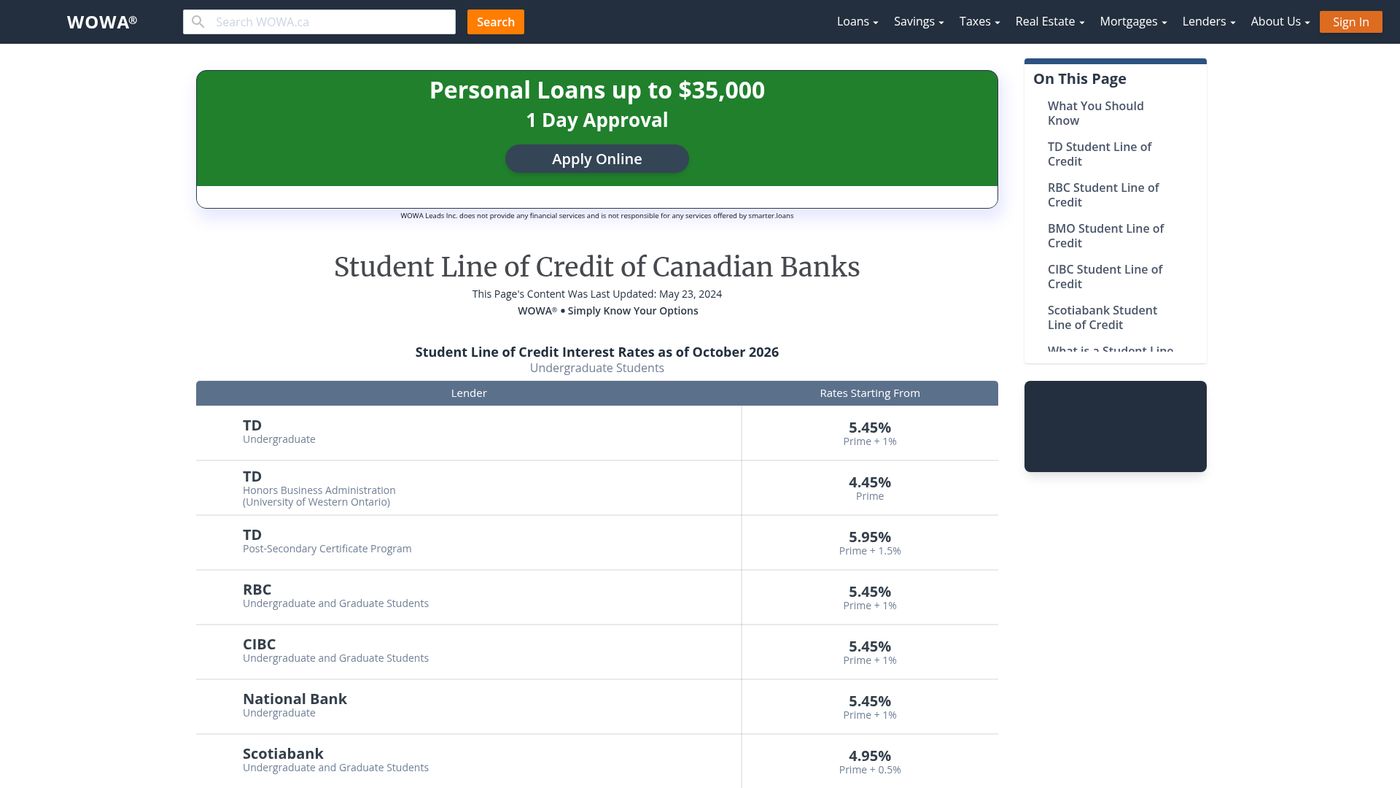
The interest rate on a student line of credit is almost always variable and is expressed as the bank's prime lending rate plus a premium. A common rate offered is the prime rate plus 0.50 percent. Interest begins to accrue immediately on any funds you withdraw and is typically payable on a monthly basis. A key feature of these products is the repayment grace period. While you are enrolled in your program, you are usually only required to make payments covering the accrued interest. After your studies end, a grace period on principal repayment begins. This grace period commonly lasts for 12 months, during which you continue to make interest-only payments. Some banks offer an extended grace period of up to 24 months after leaving school before principal repayment must begin. After this grace period concludes, your payments convert to fixed monthly amounts that cover both principal and interest, and you enter the full repayment phase, which can extend over many years.
Several key rules govern the repayment phase and interest calculations. The prime rate, which forms the basis for your interest rate, is the variable annual interest rate announced by the bank as a reference rate for commercial loans in Canada. It can change over time. Your required payments during the interest-only phase are calculated based on your outstanding balance. Making these payments on time is an effective way to begin establishing or building a positive credit history. If you have a balance owing, you must make the interest payment. If there is no balance, you will not pay anything. The transition to full repayment is automatic after the grace period, so you must be prepared to budget for higher monthly payments at that time. For Quebec student loans, the interest rate for Class B or E is set on the disbursement date and revised annually, providing a point of comparison.
Promotional Offers and Additional Features
Banks frequently use promotional offers to attract students to their line of credit products. These offers often include cash bonuses for new customers who apply and are approved within a specified timeframe. For example, one promotion offers up to $1,000 when you open a student line of credit, with the exact amount depending on your program of study. Another promotion provides a cash offer of $300 for college and undergraduate students, $550 for graduate students, and $1,000 for medical, dental, and veterinary professional students, provided the application is approved by October 31, 2026. These promotional periods have strict eligibility windows and terms. An offer from June 1, 2026, to October 31, 2026, is available only to students who do not have an existing line of credit with that bank at the start of the period. The funds from such bonuses are usually deposited into a linked chequing account after all conditions are met, which can take up to 16 weeks.
Beyond promotions, student lines of credit come with several ancillary features designed for convenience and financial management. Funds can be accessed through online banking, mobile apps, ATMs using your bank card, and by cheque. Some banks offer specialized mobile apps that provide budgeting tools, personalized insights, and easy fund transfers. Optional insurance products, such as line of credit protection insurance, may be available to help cover the outstanding balance in the event of critical illness, disability, job loss, or death. Partner programs, like student discount cards offering savings at various retailers, are also commonly bundled with these financial products to provide added value to student clients. These features, alongside tools like student budget calculators, aim to support comprehensive financial planning throughout your education.
Key Considerations and Common Requirements
When managing a student line of credit, several important rules and requirements must be followed to maintain the account in good standing. You must provide annual proof of enrollment to your bank to verify your continued student status, which is often required during a branch visit. The credit limit is not static. Subject to credit approval, it may be increased each year of your program up to a specified annual maximum, but your total borrowing can never exceed the lifetime maximum for your program. For international students or those with limited credit history, having a qualified co-signer who is a Canadian citizen or permanent resident is frequently a mandatory condition for approval. The co-signer is equally responsible for the debt and must also provide identification and proof of income during the application process.
It is crucial to understand the distinctions between different program classifications used by banks, as they determine your credit limits and potential promotional benefits. A General Program typically includes all undergraduate and graduate programs like a master's degree or PhD, excluding professional streams. A Professional Program refers to professional graduate or specialized health science programs. A Medical or Dental Program is specifically for those pursuing a Doctor of Medicine (MD) or Doctor of Dental Surgery (DDS). Your program classification must be confirmed with a bank advisor to ensure you receive the correct terms and offers. All amounts and rates are in Canadian dollars unless otherwise specified, and all limits and offers are subject to change by the financial institution. Meeting your required payments on time is a fundamental practice for establishing a credit history and building a strong financial future.
Frequently asked questions
What is the difference between a student line of credit and a government student loan?
A student line of credit is a revolving credit product from a bank where you borrow up to a limit and pay interest only on what you use. A government student loan is a fixed amount loan from federal or provincial governments. The line of credit typically offers more flexible access to funds but may have higher variable interest rates. Government loans often have defined repayment assistance programs and potentially lower interest rates for eligible borrowers.
How much can I borrow with a student line of credit?
The amount you can borrow depends on your level of study and program. Undergraduate students may access up to $20,000 per year with a total maximum around $80,000 over four years. Graduate students can often borrow more, with totals reaching $75,000 to $150,000. Students in professional programs like medicine or dentistry may qualify for limits up to $400,000. Your final approved limit is subject to credit approval and based on your tuition and individual circumstances.
Do I need a co-signer for a student line of credit?
Domestic students with established credit may not need a co-signer. However, international students enrolled in Canadian graduate programs typically require a co-borrower or co-signer who is a Canadian citizen or permanent resident. Students with limited credit history or those studying at an institution outside Canada may also be required to have a co-signer. The requirement is assessed on a case-by-case basis during credit approval.
When do I have to start repaying my student line of credit?
While in school, you generally only make monthly interest payments on the amount you have borrowed. After you finish your studies, a grace period begins, commonly lasting 12 months, during which you continue with interest-only payments. After this grace period ends, you must begin making fixed monthly payments that cover both the principal and interest. Some banks offer a longer grace period of up to 24 months before principal repayment starts.
Can I use a student line of credit for expenses beyond tuition?
Yes, student lines of credit are designed to cover a wide range of education related expenses. This includes tuition, books, and student housing. Funds can also help pay for supplies, fees, accommodations, food, and travel. The product helps you pay for expenses related to post secondary education, like tuition or books. It is a flexible borrowing option for these costs.
Are there any special offers for opening a student line of credit?
Yes, banks often run promotional offers. For example, one promotion offers up to $1,000 cash for opening a new student line of credit, with the amount depending on your program. Another provides cash offers of $300, $550, or $1,000 for college, graduate, and professional students, respectively, if you apply and are approved by October 31, 2026. These offers have specific terms, conditions, and eligibility periods that must be met.
Sources and further reading
- ScotiaLine® Personal Line of Credit for students scotiabank.com
- Student Line of Credit | Lending cibc.com
- Royal Credit Line for Students | RBC Royal Bank of Canada rbcroyalbank.com
- Student Line of Credit nbc.ca
- Student Line of Credit, Paying for School | TD Canada Trust td.com
This article explains how things work and is not financial, tax or legal advice. Rules, limits and rates change, so check the current figures with the Canada Revenue Agency, your province or your financial institution before you act.