Scotiabank car insurance is a personal auto insurance product offered through Scotia Insurance, a subsidiary of The Bank of Nova Scotia. The policies are underwritten by Belair Insurance Company Inc. and are available directly to consumers in several, but not all, Canadian provinces. For eligible drivers, Scotia Auto Insurance provides a range of mandatory and optional coverages, from basic liability to comprehensive all perils policies. Understanding the specifics of this offering, including its provincial availability and the nature of its partnership with Belairdirect, is important for Canadians considering this option for their vehicle insurance needs.
Provincial Availability and Underwriting Partnership
Scotiabank car insurance is not available nationwide. As of December 2025, the auto insurance product is offered directly to drivers in seven provinces: Alberta, Ontario, Quebec, New Brunswick, Nova Scotia, Newfoundland and Labrador, and Prince Edward Island. In British Columbia, Scotia Insurance offers home insurance but does not provide auto insurance. It is important for consumers to verify current availability in their specific province, as offerings can change. The insurance is arranged for by BNS Insurance Agency Inc., which operates under the Scotia Insurance trademark. All auto policies sold under the Scotia Home & Auto Insurance banner are underwritten by Belair Insurance Company Inc. This means Belairdirect, as the underwriter, assumes the financial risk and sets the terms of the policy. Services are provided by belairdirect Agency Inc., except in Quebec where services are provided directly by Belair Insurance Company Inc. This structure positions Scotiabank as a direct-to-consumer insurer rather than a broker that shops among multiple carriers.

Types of Car Insurance Coverage Offered
Scotia Auto Insurance provides the range of coverages required by provincial law alongside numerous optional protections. Mandatory coverages typically include Third-Party Liability, which covers damages or injuries you cause to others, and Direct Compensation, Property Damage in certain provinces. Uninsured Auto coverage is also a standard component in many regions, offering financial protection if you are injured by an uninsured or hit-and-run driver. Optional coverages allow policyholders to tailor their protection. Collision coverage pays for repairs to your vehicle after an at-fault accident and is often required by lenders if you finance or lease your car. Comprehensive coverage protects against non-collision events like theft, vandalism, fire, or hail damage. An All Perils policy combines both Collision and Comprehensive insurance and also includes coverage for theft of your vehicle by someone who lives in your household. Additional optional benefits can include Rental Vehicle Coverage, which is available if you have both Collision and Comprehensive on your policy, and it insures car rentals in Canada or the United States up to a specified limit.
Policy Features and Customer Service Tools
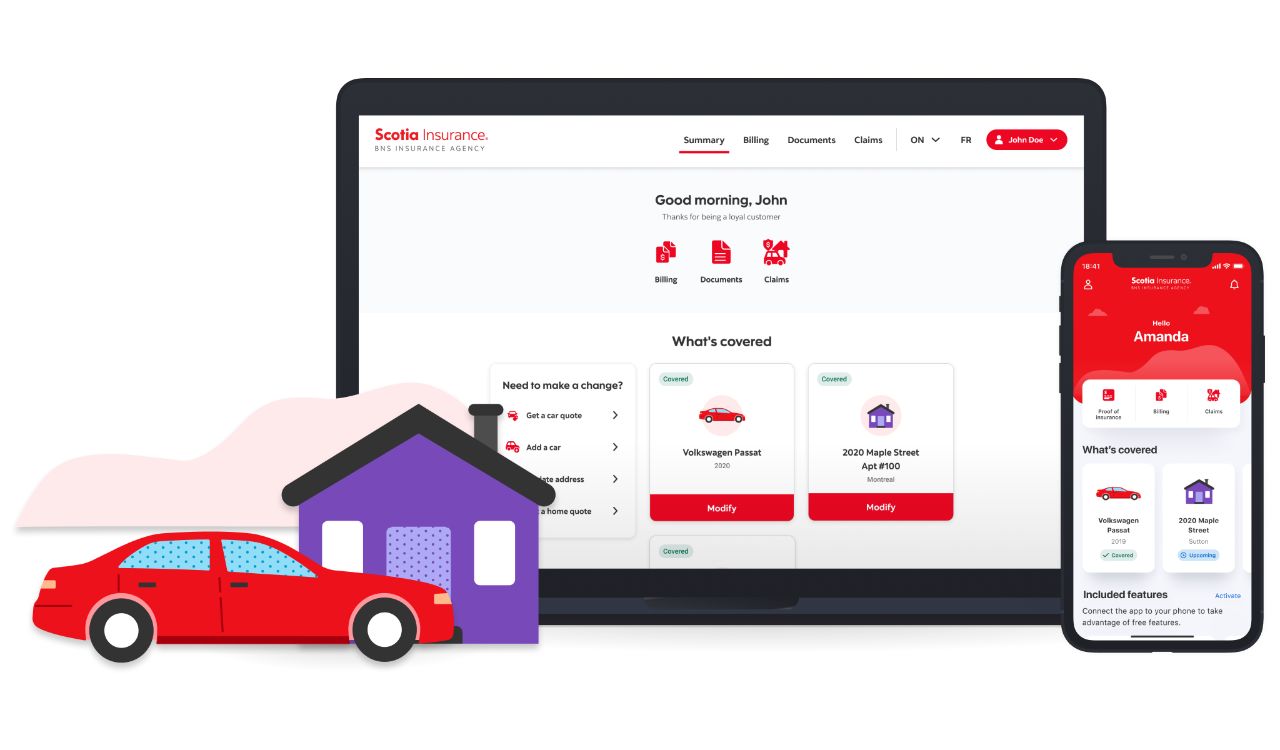
Scotia Insurance promotes several features designed to enhance the customer experience and provide value. One advertised feature is Auto Claims Forgiveness, which aims to protect your insurance premium from increasing after a claim. The Smarter Ride program offers a potential customized premium upon renewal based on driving behaviour and provides access to features like Crash Assist, Weather Alerts, and Car Care through a mobile app. The Scotia Insurance mobile app had ratings on the Apple App Store and Google Play store as of March 2025. For claims support, the company offers a 24/7 hotline for emergency reporting. Policyholders can file a claim by logging into their online account or by calling the dedicated claims number. The claims process requires submitting completed claim forms along with original invoices or receipts for out-of-pocket expenses, with customers advised to keep copies for their records. A chatbot is also available on the website to answer questions at any time. When filing a claim, it is useful to gather information such as a copy of your policy, towing or repair records, pictures of the vehicles and scene, and the police report number if applicable. You should also record the names and contact information of passengers, witnesses, and all other involved drivers, along with their insurance and vehicle details.
Bundling, Discounts, and Financial Considerations
Scotiabank advertises potential savings when customers bundle their home and auto insurance policies together. This bundling discount is a common offering within the insurance industry. Furthermore, Scotiabank has a partnership with the Scene+ loyalty program, which may provide members with additional perks or offers related to insurance products. For Scotiabank banking customers, there is a potential benefit when paying insurance premiums. Using a Scotiabank credit card for recurring bill payments, including Scotia Insurance premiums, can earn 4% cash back for every dollar spent. It is important to understand that while bundling with a single carrier like Scotia can offer savings, a mix-and-match approach using different providers for home and auto might sometimes yield greater overall cost-effectiveness. Customers are advised to review all coverage details and exclusions carefully, as the insurance contract itself prevails over any marketing materials, and eligibility requirements or limitations can vary by province. The company states that its goal is to process eligible claims in a prompt manner, and it has dedicated insurance advisors to provide personalized help and service.
Steps to Get a Quote and Purchase a Policy
Prospective customers can initiate the process of obtaining Scotiabank car insurance by requesting a quote online through the Scotia Insurance website. The quote process is described as quick and easy, though detailed information about specific coverages and limits may only become fully apparent during this process. To get an accurate quote, you will need to provide standard information about yourself, your vehicle, your driving history, and the coverages you desire. After receiving a quote, if you choose to proceed, you can purchase the policy directly. It is recommended to have all necessary documents on hand, such as your driver's licence, vehicle registration, and details of any previous insurance. Before finalizing a purchase, you can speak with a Service Specialist who can help estimate coverage needs and explain deductible options. The deductible is the amount you pay out of pocket before the insurance coverage applies to a claim. The specialist will also help you decide on the type of coverage you need based on your individual situation and budget.
To begin the purchase process, you can get a quote online quickly and easily by visiting the Request a Quote pages. A Service Specialist can help you estimate how much coverage you need and decide on the type of coverage and deductible. You will then receive your policy documents outlining all terms, conditions, and exclusions. After purchasing, you can manage your policy, make changes, and file claims through your online account or the mobile app.
- Visit the Scotia Insurance website and handle to the auto insurance quote page.
- Complete the online quote form with accurate personal, vehicle, and driving information.
- Review the generated quote, including the breakdown of coverages, limits, and premiums.
- Consult with a Service Specialist to clarify coverage options and deductible choices.
- If satisfied, proceed to purchase the policy online or over the phone.
- Make arrangements for payment, which can be set up as a recurring bill payment.
After purchasing, you will receive your policy documents outlining all terms, conditions, and exclusions. You can manage your policy, make changes, and file claims through your online account or the mobile app. Scotia Insurance states that its dedicated insurance advisors are there to provide personalized help and exceptional service. The company offers flexible and affordable coverage options at competitive rates through its partner carriers.
Comparison of Provincial Offerings
The availability and specific details of Scotiabank car insurance can vary significantly from one province to another due to differing provincial insurance regulations. While the core products like liability, collision, and comprehensive are offered in the available provinces, the mandatory minimum requirements, optional add-ons, and pricing structures are provincially regulated. For example, Ontario has a direct compensation system for property damage, while Alberta uses a tort-based system. Quebec has a unique hybrid system with public basic liability and private coverage for collision and comprehensive. The following table outlines the basic availability of Scotia Auto Insurance across Canada as of the information available.
| Province | Auto Insurance Available | Home Insurance Available |
|---|---|---|
| Alberta | Yes | Yes |
| Ontario | Yes | Yes |
| Quebec | Yes | Yes |
| New Brunswick | Yes | Yes |
| Nova Scotia | Yes | Yes |
| Newfoundland and Labrador | Yes | Yes |
| Prince Edward Island | Yes | Yes |
| British Columbia | No | Yes |
| Manitoba | No | No |
| Saskatchewan | No | No |
This provincial variation means that a driver in Ontario will interact with the same underwriter but under a different regulatory framework than a driver in Nova Scotia. Customers should always review their policy wording carefully to understand the provincially-mandated coverages and any specific exclusions that apply in their region. The company notes that eligibility requirements, limitations, exclusions, or additional costs may vary by province or territory. The insurance contract is the final authority, and it prevails at all times over general informational materials.
Common Considerations and Review Process
When evaluating Scotiabank car insurance, customers commonly consider the direct insurer model, where products and prices come from a single carrier, Belairdirect. This differs from using an insurance broker that can compare quotes from multiple companies. Online reviews and consumer experiences with Scotia Home & Auto Insurance are noted to be varied, which is typical for large insurance providers where service can depend on individual circumstances and provincial operations. A key consideration is ensuring the quoted coverage meets your specific needs beyond just the price, as the least expensive option may not provide the best overall value. Before making a decision, it can be prudent to compare the Scotiabank quote with offers from other providers to assess the market. Customers should also be aware of the claims process, which involves contacting the adjuster, providing documentation like police reports and witness information, and submitting original receipts for reimbursement. All coverage is subject to the terms, conditions, and exclusions in the actual insurance contract, which is the definitive document. The company advises that while it is tempting to compare quotes and take the lowest price, service and variations in coverages can make a big difference in the overall value received.
Related Insurance Products from Scotia Insurance
Beyond auto insurance, Scotia Insurance offers a suite of other personal insurance products through its insurer partners. Home insurance is available in all provinces where auto insurance is offered, plus in British Columbia. This coverage typically includes paying to repair or rebuild property against covered damage, protection for sheds and garages, and personal liability for accidental damage or injury to others. Condo insurance through Scotiabank includes special item protection as a standard feature, which is often an optional add-on with home insurance. Tenants can also obtain insurance for their rented dwellings. For life insurance, Scotiabank offers accidental-death and term life insurance through its partners, with term life policies potentially available in terms from 10 to 30 years, and these may include renewal and conversion options. Critical Illness Insurance is another product, which can include optional add-ons like Women's XtraProtect and Child Cancer Protect, and it typically does not require a medical questionnaire or exam. Health and Dental Insurance may be available at group rates, particularly for Scotiabank customers or their spouses. Scotia Insurance also provides three types of Travel Insurance: plans for Travelling Canadians, Student plans for Canadians studying abroad, and Visitor plans for people travelling to Canada from other countries, with note that Emergency Travel and Medical Assistance coverage ends at age 80.
Understanding the Claims and Support Structure
The claims process for Scotia Auto Insurance is managed by the underwriter, Belairdirect. Upon filing a claim, a claims adjuster from Belairdirect will be assigned to manage any repairs or replacements, review your policy coverage, and advise you of your options. You can initiate a claim at any time by logging into your online account or mobile app, or by calling the dedicated claims line. It is important to gather all necessary information at the scene of an incident to facilitate the claims process. This includes taking pictures of the vehicles and the scene, recording the licence plates of all involved vehicles, and noting the date, time, and exact location. You should also obtain the names and contact information of any passengers and witnesses, as well as the insurance and driver details for all other parties involved. If the police attended, you will need the officer's incident number or the police report number. For reimbursement of out-of-pocket expenses, you must submit the original invoices and receipts along with the completed claim forms, keeping copies for your own records. The company states its commitment to building strong relationships with its insurer partners to bring customers premium insurance products at competitive rates, and it emphasizes that its dedicated advisors are there to provide personalized help and exceptional service throughout the insurance journey.
Frequently asked questions
In which Canadian provinces is Scotiabank car insurance available?
As of December 2025, Scotiabank car insurance is available to drivers in Alberta, Ontario, Quebec, New Brunswick, Nova Scotia, Newfoundland and Labrador, and Prince Edward Island. It is important to note that coverage is not available in all provinces. For example, in British Columbia, only home insurance is offered through Scotia Insurance. The availability is specific to these listed provinces and policies are arranged by Scotia Insurance, which is a registered trademark of The Bank of Nova Scotia used under license.
What types of car insurance coverage does Scotiabank offer?
Scotiabank offers a range of auto insurance coverages from basic to comprehensive. Mandatory coverages include liability insurance, which covers damages or injury to others, available in $1 million or $2 million limits. Optional coverages include Collision, Comprehensive for non-collision damage like theft or hail, and Uninsured Auto coverage for accidents with uninsured drivers. An All Perils policy combines Comprehensive and Collision, and Rental Vehicle Coverage is available if you have both. Additional benefits like Auto Claims Forgiveness and the Smarter ride program are also offered.
How can I file a claim with Scotiabank car insurance?
You can file a claim with Scotiabank car insurance at any time by logging into your online account or mobile app, or by calling their dedicated claims line at 1-833-223-8743. The company provides a 24/7 hotline for emergency claims. To file a claim, you will need to submit completed claim forms along with original invoices or receipts for expenses, though you should keep copies for your records. It is recommended to gather information like a police report number, witness contacts, and photos of the scene. Their goal is to process eligible claims promptly.
Does Scotiabank offer discounts for bundling home and auto insurance?
Yes, Scotiabank advertises that you can take advantage of additional savings and benefits when you bundle your home and car insurance with them. However, it is important to note that bundling with a single carrier may not always offer the maximum possible savings. A mix and match approach, where you combine products from different carriers, can sometimes be more cost effective. Scotiabank Insurance teams up with trusted provider partners like Belair Insurance Company to offer these bundled products. The availability of these bundles varies by province.
What is the Smarter ride program offered by Scotiabank Auto Insurance?
The Smarter ride program is an additional benefit that allows drivers to receive a customized insurance premium upon renewal based on their driving behaviour. The program also provides access to features like Crash Assist, Weather Alerts, and Car Care through a mobile app. This app was rated based on Apple App Store and Google Play store ratings as of March 2025. The program is designed to reward smarter driving habits with potential premium adjustments. It is part of Scotiabank's suite of optional benefits to suit unique needs and lifestyles.
Who underwrites Scotiabank's car insurance policies?
Scotiabank's car insurance policies are underwritten by Belair Insurance Company Inc. Scotia Insurance, a subsidiary of The Bank of Nova Scotia, arranges for the insurance through its partner. This means when you purchase a policy, you are dealing with a direct to consumer insurer using a single carrier, not a broker that shops multiple companies. Home and auto policies are underwritten by Belair, and services are provided by belairdirect Agency Inc., except in Quebec. This partnership is part of how Scotia Insurance provides its insurance products.
Sources and further reading
- Car Insurance Canada, Get an Auto Insurance Quote Now scotiainsurance.com
- Scotia Insurance | Life, Car, Travel, Home, Health Insurance scotiabank.com
- Scotiabank Car Insurance vs. YouSet: Pros and Cons [2026] youset.ca
- Scotiabank Car Insurance Canada: Coverage Review mychoice.ca
This article explains how things work and is not financial, tax or legal advice. Rules, limits and rates change, so check the current figures with the Canada Revenue Agency, your province or your financial institution before you act.