Ontario tax brackets for 2026 define the provincial income tax rates you pay on different portions of your taxable income. The province uses a progressive system with five brackets, with rates ranging from 5.05% to 13.16%. Your provincial tax is calculated separately from federal tax and is based on your residency in Ontario as of December 31. Understanding these brackets is essential for estimating your tax liability and effective take-home pay as a resident of the province.
Ontario's 2026 Provincial Tax Brackets
The Ontario provincial income tax system for the 2026 tax year consists of five distinct brackets, each with its own tax rate. These brackets are applied to your taxable income, which is your total income from all sources minus any eligible deductions. The bracket thresholds for 2026 have been increased by an indexation factor of 1.019, representing a 1.9% adjustment for inflation, with the exception of the thresholds at $150,000 and $220,000 which are not indexed. The first $53,891 of taxable income is taxed at the rate of 5.05%. Income over $53,891 up to $107,785 is taxed at 9.15%. The portion of income over $107,785 up to $150,000 is taxed at 11.16%. Income over $150,001 up to $220,000 faces a rate of 12.16%. Any taxable income exceeding $220,000 is taxed at the top provincial rate of 13.16%. These rates are applied progressively, meaning only the income within each specific bracket is taxed at that bracket's rate.

How Provincial and Federal Taxes Work Together
Canadian residents pay income tax to both the federal government and their province of residence. These are two separate calculations that are combined to determine your total tax bill. Your provincial tax liability is determined by your province of residence as of December 31 of the tax year. For example, if you move to Ontario in October of 2026, you will be subject to Ontario provincial tax for the entire year, in addition to federal tax. All provinces except Quebec use the federal definition of taxable income as the starting point for their own calculations. Provincial taxes are calculated on the federal tax return and collected by the Canada Revenue Agency, which simplifies the filing process. It is crucial to calculate your federal tax first, then your provincial tax, and finally add the two amounts together to see your total income tax obligation before applying any credits.
Calculating Your Tax with a Progressive System
In a progressive tax system, your income tax payable is cumulative, meaning different portions of your income are taxed at different rates. To calculate your tax, you apply the rate for each bracket only to the income that falls within that bracket's range. For instance, with a taxable income of $60,000 in 2026, the first $53,891 is taxed at 5.05%, resulting in $2,721.50 of provincial tax. The remaining $6,109 of income falls into the next bracket and is taxed at 9.15%, adding $558.97. Your total provincial tax before credits would be $3,280.47. You would perform a similar calculation for federal tax using the federal brackets and rates. The two amounts are then added together. This method ensures that earning more money never results in a lower net income because only the income that crosses into a higher bracket is taxed at that higher rate. A full example using a $45,000 income shows a federal tax of $6,300 at 14% and a provincial tax of $2,272.50 at 5.05%, totaling $8,572.50 before credits.
Key Tax Credits and the Basic Personal Amount
Tax credits directly reduce the amount of tax you owe. The most significant credit for most individuals is the basic personal amount. For the 2025 tax year, Ontario's basic personal amount is $12,747, meaning you do not pay any provincial income tax on your first $12,747 of taxable income. There is also a separate federal basic personal amount. These credits do not combine into one total. Instead, each reduces its respective tax liability. The provincial credit is calculated by applying the lowest provincial tax rate of 5.05% to the $12,747 amount, yielding a credit of $655.94 that is subtracted from your Ontario tax payable. The federal basic personal tax credit for 2026 provides a federal tax break of $2,303.28, calculated by applying the lowest federal rate to the federal basic amount. Other personal tax credits, such as those for medical expenses or tuition, are also subtracted from your calculated tax to determine your final liability. Credits do not create a refund if your tax is already zero they only reduce the amount you owe.
Understanding Marginal vs. Average Tax Rates
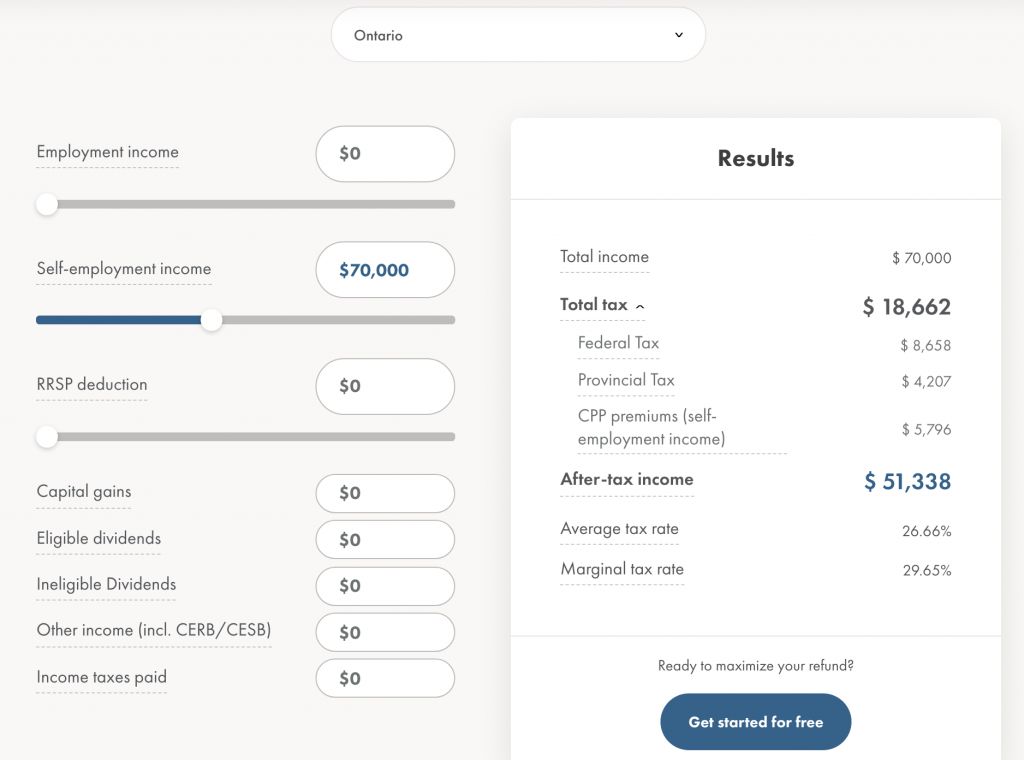
Two important concepts for understanding your tax burden are your marginal tax rate and your average tax rate. Your marginal tax rate is the rate applied to your next dollar of income. It is the rate of the highest tax bracket your income reaches. If your taxable income is $60,000 in 2026, your marginal provincial tax rate is 9.15%, as that is the rate applied to income above $53,891. Your average tax rate is the total tax you pay divided by your total income. This rate is always lower than your marginal rate because your first dollars of income are taxed at the lowest rates. For example, an individual with $45,000 in taxable income and only the basic personal credit might have a total combined tax of $5,613.28, resulting in an average tax rate of 12.5%. Knowing your marginal rate is useful for planning, as it shows the tax impact of an additional dollar of income from a raise or bonus. The average tax rate gives you a clearer picture of your overall tax burden as a percentage of your total earnings.
The Ontario Surtax and Other Important Considerations
Ontario applies a provincial surtax, which is an additional tax calculated on the base provincial tax you owe, not directly on your income. This surtax effectively increases the tax rate for middle and higher income earners beyond the stated bracket rates. Another key consideration is the Alternative Minimum Tax (AMT), which ensures that high-income individuals with significant deductions pay a minimum amount of tax. If your AMT calculation is higher than your regular tax, you must pay the AMT. You may claim a credit for the AMT paid in future years when your regular tax exceeds the AMT. Special rules like the 'kiddie tax' also apply, taxing certain passive income received by minor children at the highest combined federal and provincial marginal rate, which can be as high as 55%. Furthermore, rules restricting 'income sprinkling' to adult family members can also subject that split income to the top marginal rate, with limited credits available to reduce it.
Federal Tax Brackets for 2026
While provincial taxes are important, your total tax bill is dominated by federal tax. The federal government also uses a progressive bracket system, with rates for 2026 adjusted by a 2% indexation factor. The lowest federal rate has been reduced to 14% for 2026. The federal brackets determine a significant portion of your tax liability before provincial amounts are added. The following table outlines the confirmed federal tax brackets and rates for the 2026 tax year. To calculate your total tax, you apply these federal rates to your taxable income in the same cumulative, bracket-by-bracket manner as the provincial calculation. The result is your federal tax payable before credits. The federal basic personal amount for 2026 provides a credit calculated at the lowest federal rate against this amount. The federal tax brackets are increased for 2026 by an indexation factor of 1.02, which is separate from the provincial indexation factor.
Detailed Calculation Example for Higher Income
A detailed example illustrates how the progressive system works with both federal and provincial taxes for a higher income. Assume a taxable income of $60,000 for the 2026 tax year. First, calculate federal tax. The first $58,523 is taxed at 14%, which equals $8,193.22. The remaining $1,477 is taxed at the next bracket rate of 20.5%, adding $302.79. The total federal tax before credits is $8,496.01. Next, calculate Ontario provincial tax. The first $53,891 is taxed at 5.05%, resulting in $2,721.50. The remaining $6,109 is taxed at 9.15%, adding $558.97. The total Ontario tax before credits is $3,280.47. The combined federal and provincial tax before credits is $11,776.48. This step-by-step breakdown shows the cumulative nature of tax calculations and the impact of credits.
Common Filing Scenarios and Residency Rules
Your tax obligations depend heavily on your residency status. Individuals resident in Canada for the entire year are subject to tax on their worldwide income. If you are a resident for only part of the year, you are taxable in Canada only on worldwide income for the period you were resident. Non-residents are subject to Canadian tax only on specific types of Canadian-source income, such as employment income earned in Canada or capital gains from taxable Canadian property. The provincial tax you pay is determined by your province of residence on December 31. This rule is absolute for the tax year. If you earned income in Ontario but were a resident of another province on December 31, you would file a return for that other province. The Canada Revenue Agency administers the tax system for all provinces except Quebec, so most Canadians file a single T1 return that calculates both federal and provincial tax. Keeping accurate records of your income, deductions, and residency is fundamental to correct filing. Relief from double taxation on foreign income is provided through Canada's international tax treaties and foreign tax credits.
Indexation and How Tax Brackets Are Adjusted
To prevent 'bracket creep' where inflation pushes taxpayers into higher brackets without a real increase in purchasing power, both federal and provincial tax systems are indexed annually. The indexation factors are calculated based on inflation metrics. For the 2026 tax year, the federal indexation factor is 1.02, a 2% increase applied to federal tax brackets and personal tax credit amounts. The Ontario indexation factor for 2026 is 1.019, a 1.9% increase applied to most provincial tax brackets and credit amounts. It is important to note that not all bracket thresholds are indexed. In Ontario, the $150,000 and $220,000 bracket thresholds are fixed and do not increase with inflation. This means over time, more income may be taxed at the higher rates of 12.16% and 13.16% as general wages increase. The annual confirmation of these factors by the Canada Revenue Agency ensures taxpayers and software providers have the correct figures for the upcoming tax year.
Provincial Tax Rates Across Canada for 2026
While Ontario's rates are specific to its residents, it is useful to understand how they compare to other jurisdictions. Every province and territory sets its own tax rates, brackets, and credits, leading to significant variation in combined tax burdens across the country. Some provinces also impose surtaxes, similar to Ontario, which can increase the effective top rate. The following list highlights the top 2026 provincial or territorial tax rates and applicable surtax thresholds for several jurisdictions as confirmed by official budgets. These rates apply to taxable incomes above specific thresholds, which vary by province. When comparing job offers or considering a move, using a detailed tax calculator that incorporates both federal and provincial rates, brackets, and surtaxes is essential for an accurate financial picture.
- Quebec: Has its own separate tax administration and return.
- Other provinces like Alberta and British Columbia set their own rates without a surtax.
- The combined federal/provincial top marginal tax rate for Ontario in 2026, including surtax, is among the highest in Canada.
- These differences mean the same salary can result in thousands of dollars difference in take-home pay depending on your province of residence.
Frequently asked questions
What are the Ontario tax brackets for 2026?
For the 2026 tax year, Ontario has five tax brackets. Income up to $53,891 is taxed at 5.05%. Income over $53,891 up to $107,785 is taxed at 9.15%. Income over $107,785 up to $150,000 is taxed at 11.16%. Income over $150,001 up to $220,000 is taxed at 12.16%. Any income over $220,000 is taxed at the top rate of 13.16%. These brackets are indexed for inflation, increasing the thresholds by 1.9% for 2026, except for the $150,000 and $220,000 levels.
How do I calculate my Ontario income tax?
Calculate your Ontario tax by applying the provincial rates to your taxable income in a cumulative way. First, calculate tax on the portion of income in the first bracket at 5.05%. Then, apply the 9.15% rate only to the income that falls between $53,891.01 and $107,785, and so on through the higher brackets. Add these amounts to get your total provincial tax before credits. Then, subtract applicable tax credits, such as the basic personal amount credit, which for 2025 is $655.94. Finally, add your calculated federal tax to your provincial tax to find your total income tax liability.
What is the basic personal amount for Ontario?
For the 2025 tax year, the Ontario basic personal amount is $12,747. This means you do not pay any provincial income tax on your first $12,747 of taxable income. The value of this credit is calculated by multiplying the amount by the lowest provincial tax rate of 5.05%, resulting in a credit of $655.94 that reduces your provincial tax payable. This is separate from the federal basic personal amount, and each credit is applied to its respective federal or provincial tax calculation.
What is the difference between marginal and average tax rate?
Your marginal tax rate is the rate of tax applied to your next dollar of earned income. It corresponds to the highest provincial or federal tax bracket that your current income level reaches. In contrast, your average tax rate is calculated by dividing the total amount of tax you pay by your total income. Due to Canada's progressive tax system, where income is taxed at increasing rates, the average tax rate is always lower than the marginal rate. For instance, an Ontario resident with a taxable income of $60,000 would have a marginal provincial tax rate of 9.15% on income above $53,891, but their average rate would be lower because their first $53,891 was taxed at only 5.05%.
Does Ontario have a provincial surtax?
Yes, Ontario imposes a provincial surtax in addition to its regular income tax. For the 2026 tax year, this surtax consists of two tiers. A 20% surtax applies to the amount of provincial tax owed that exceeds $5,818. It is crucial to understand that this surtax is calculated based on the provincial tax liability itself, not directly on taxable income. This mechanism increases the effective provincial tax rate for individuals with higher provincial tax obligations.
What happens if I move provinces during the tax year?
Your provincial tax liability for the entire year is based on your province of residence as of December 31. If you move to Ontario from another province during the year, you will be considered an Ontario resident for tax purposes for the whole year and will file your return using Ontario's tax rates and brackets. You do not file partial-year returns for each province. The Canada Revenue Agency uses this single residency date to determine which province's tax rules apply to your annual income.
Sources and further reading
- Ontario Tax Brackets for 2026: Rates, Credits & Deductions wealthsimple.com
- 2025-26 Ontario Income Tax Calculator, TurboTax® Canada turbotax.intuit.ca
- Ontario 2025 and 2026 Tax Rates & Tax Brackets taxtips.ca
- Personal income tax rates and credits, Dataset data.ontario.ca
- Canada, Individual, Taxes on personal income taxsummaries.pwc.com
This article explains how things work and is not financial, tax or legal advice. Rules, limits and rates change, so check the current figures with the Canada Revenue Agency, your province or your financial institution before you act.