Nova Scotia's personal income tax is calculated using a progressive system with five provincial brackets, each with its own rate applied to specific portions of your taxable income. These brackets are indexed annually for inflation, with rates confirmed for the 2025 and 2026 tax years. Your total tax payable is the sum of federal tax, calculated using federal brackets, and provincial tax, calculated using Nova Scotia's brackets. Understanding how these brackets work is essential for accurate tax filing and financial planning for residents of the province.
How Nova Scotia's Progressive Tax System Works
Nova Scotia's personal income tax is levied on a graduated or progressive scale, meaning different portions of your taxable income are taxed at different rates. The provincial government sets the income brackets and corresponding tax rates, which are applied after you calculate your federal taxable income. This system is designed so that individuals with higher incomes pay a higher percentage of tax on the portions of their income that fall into the upper brackets. The Canada Revenue Agency collects both the federal and provincial income tax simultaneously when you file your annual return. Your total tax liability is the sum of the tax calculated under the federal brackets and the tax calculated under the Nova Scotia provincial brackets.
The calculation begins with your gross income from all sources, including employment, self-employment, investments, and other earnings. From this gross income, you subtract any eligible deductions to arrive at your net income, and then further subtract specific deductions to determine your taxable income. It is this final taxable income figure that is used against the provincial tax brackets. The system ensures that only income exceeding a threshold is taxed at the next higher rate, not your entire income. This structure is a fundamental aspect of Canada's tax system and is administered under the authority of the provincial Income Tax Act.
Nova Scotia Provincial Tax Brackets for 2025 and 2026
The provincial government has confirmed the tax brackets and rates for the 2025 and 2026 taxation years, incorporating annual indexation for inflation. For the 2025 tax year, the personal income tax system was indexed at a rate of 3.1 percent. For the 2026 tax year, the indexation factor is 1.6 percent, which increases the bracket thresholds and certain credit amounts. This indexation is calculated using a 12-month consumer price index average ending in August, which is a different calculation period than the federal government and most other provinces use. The brackets define the income ranges to which each of the five provincial tax rates apply.
The following table outlines the Nova Scotia taxable income brackets and corresponding tax rates for the 2026 tax year. The Government of Nova Scotia sets these tax rates and taxable income brackets. For the 2026 taxation year the personal income tax system is indexed at a rate of 1.6 percent. These figures show the thresholds after this indexation has been applied. It is important to use the correct year's brackets when calculating your tax liability for a specific return. Nova Scotia's personal income tax is collected by the Canada Revenue Agency at the same time federal income tax is collected.
| 2026 Taxable Income | 2026 Nova Scotia Tax Rate |
|---|---|
| First $30,995 | 8.79% |
| Over $30,995 up to $61,991 | 14.95% |
| Over $61,991 up to $97,417 | 16.67% |
| Over $97,417 up to $157,124 | 17.5% |
| Over $157,124 | 21.0% |
Combined Federal and Provincial Marginal Tax Rates
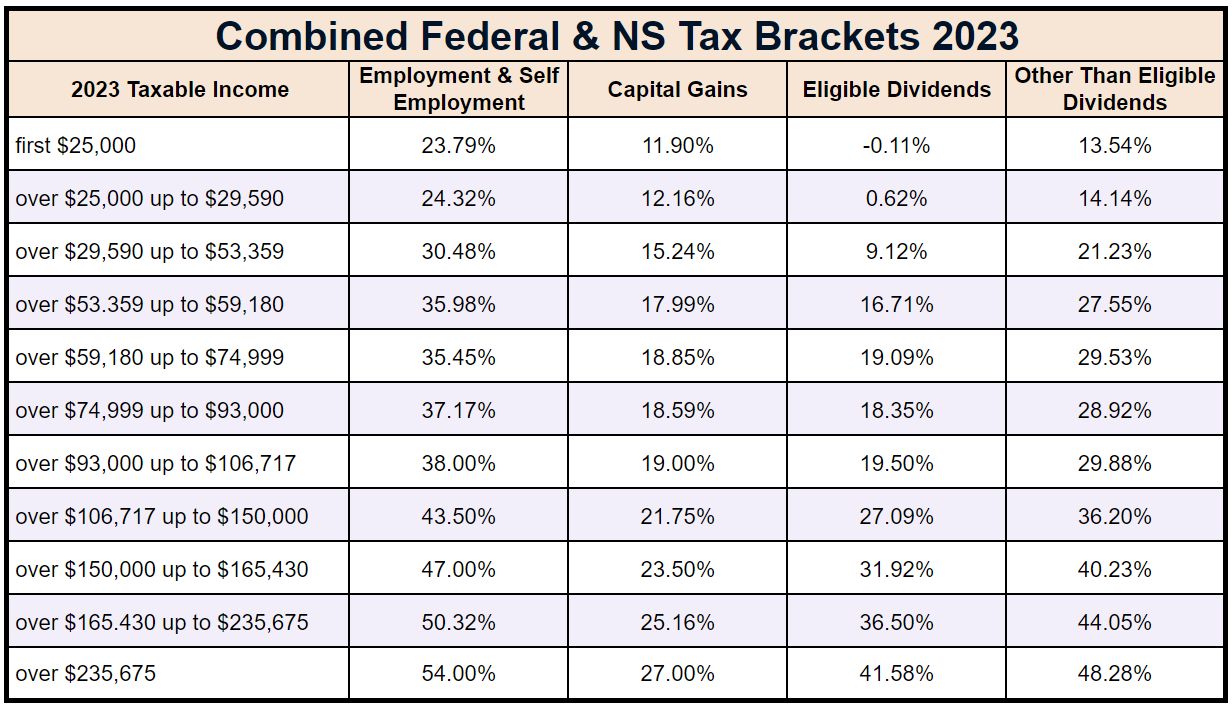
Your marginal tax rate is the rate of tax you pay on your next dollar of income, and in Nova Scotia it is the sum of the federal and provincial rates for your income level. Because both governments use progressive brackets, your combined marginal rate increases as your income rises. These combined rates are crucial for understanding the real tax impact of financial decisions, such as earning extra income or making an RRSP contribution. The federal brackets are also indexed annually, with a 2 percent factor applied for the 2026 tax year. The federal basic personal amount for 2025 is $16,129, which operates independently from the Nova Scotia amount.
For illustration, consider the combined tax rates for a Nova Scotia resident in 2026. On the first portion of income, the combined rate includes the 8.79 percent provincial rate plus the applicable federal rate. For example, on taxable income between $16,453 and $30,995, the combined marginal tax rate is 22.79 percent. On income between $30,996 and $58,523, the combined rate is 28.95 percent. For income between $58,524 and $61,991, the combined marginal rate reaches 35.45 percent. These figures demonstrate how provincial and federal taxes interact to determine your total tax obligation. It is this combined rate that ultimately affects your take-home pay and any tax refund or balance owing.
Key Provincial Tax Credits and the Indexation System
Nova Scotia offers several non-refundable tax credits that directly reduce the amount of provincial tax you owe. The most significant is the basic personal amount, which was $11,744 for the 2025 tax year. This credit is calculated by applying the lowest provincial tax rate of 8.79 percent to the amount, effectively sheltering that income from provincial tax. Other provincial credits, such as those for medical expenses or charitable donations, are administered by the Canada Revenue Agency on behalf of the province. The maximum amounts for these non-refundable tax credits are also increased each year through the indexation system.
The indexation of taxable income brackets and certain non-refundable tax credits became effective starting with the 2025 tax year. This policy automatically adjusts the brackets and credit amounts for inflation, preventing bracket creep where individuals pay a higher proportion of tax simply due to cost-of-living increases. The indexation factor is prescribed by the Personal Income Tax Indexation Regulations under the Income Tax Act. For 2025, the factor is 3.1 percent, based on the consumer price index. For 2026, the confirmed indexation factor is 1.6 percent. This system ensures the tax structure maintains its fairness over time without requiring annual legislative changes.
Important Dates and Filing Procedures for Nova Scotia Residents
The deadline for most individuals to file their income tax return and pay any balance owing is April 30 of the year following the tax year. If you or your spouse or common-law partner had self-employment income in the tax year, the filing deadline is extended to June 15, although any amount owed must still be paid by April 30 to avoid interest charges. These deadlines apply to both your federal and Nova Scotia provincial tax obligations, as they are filed on a single T1 return. The Canada Revenue Agency processes all returns and issues notices of assessment that detail your federal and provincial calculations.
You have several options for filing your return. The fastest method is electronically using certified NETFILE software, which typically results in a refund within two weeks if you are eligible. Paper returns mailed to the Sudbury Tax Centre can take eight to twelve weeks to process. The CRA requires that you keep all supporting documents and records for a minimum of six years from the end of the tax year to which they relate. This includes receipts, T4 slips, and other documentation used to prepare your return. The CRA can take approximately twelve weeks to process a paper return, so electronic filing is strongly encouraged for faster service.
Common Calculations and Specific Tax Situations
Calculating your Nova Scotia tax manually involves applying the provincial rates to the applicable portions of your taxable income. First, you determine your taxable income after all federal and provincial deductions. Then, you apply the provincial rates step by step. You then subtract the provincial non-refundable tax credits, like the basic personal amount credit, to find your net provincial tax payable. This amount is added to your calculated federal tax to find your total liability.
For specific types of income, different rules apply. The tax on capital gains is then calculated at your marginal tax rates. Withholding tax rates in Nova Scotia for items like pension payments or non-resident income are the same as the regular provincial income tax rates. Nova Scotia has harmonized its sales tax with the federal GST, resulting in a combined HST rate of 14 percent, which is separate from income tax. The province does not have a standalone carbon tax but operates a cap-and-trade program to limit greenhouse gas emissions for industrial emitters.
Frequent Errors to Avoid When Dealing with Nova Scotia Tax
One common mistake is using the incorrect year's tax brackets or basic personal amount. Since these figures are indexed annually, the values for 2025 are different from those for 2026, and using outdated numbers will lead to an inaccurate calculation. Always verify you are using the CRA-confirmed figures for the specific tax year you are filing. Another error is misunderstanding how the basic personal amount works. The Nova Scotia amount of $11,744 for 2025 and the federal amount of $16,129 do not combine into a single deduction. Each is applied separately to reduce its respective provincial or federal tax payable to zero, but they do not create a refund if your income is below those thresholds.
Failing to account for indexation when estimating taxes or planning finances mid-year can also cause surprises. Your employer's payroll deductions may not perfectly match your final tax liability, especially if you have multiple income sources or significant deductions. Assuming that moving into a higher tax bracket causes all your income to be taxed at that higher rate is a fundamental misunderstanding of the progressive system. Only the portion of your income that exceeds a bracket's threshold is taxed at the new, higher rate. Finally, not retaining adequate records for the minimum six-year period can create difficulties if the CRA requests a review or you need to amend a prior year's return. The CRA can ask to amend a tax return for up to the previous ten years, making long-term record-keeping a prudent practice.
Frequently asked questions
What are the Nova Scotia tax brackets for 2026?
For the 2026 tax year, Nova Scotia has five provincial tax brackets. Income up to $30,995 is taxed at 8.79 percent. The portion over $30,995 up to $61,991 is taxed at 14.95 percent. Income over $61,991 up to $97,417 is taxed at 16.67 percent. The portion over $97,417 up to $157,124 is taxed at 17.5 percent. Any taxable income over $157,124 is taxed at the top rate of 21 percent. These brackets incorporate a 1.6 percent indexation increase for inflation.
What is the basic personal amount for Nova Scotia in 2025?
The Nova Scotia basic personal amount for the 2025 tax year is $11,744. This means you do not pay any provincial income tax on your first $11,744 of taxable income. This credit is calculated by applying the lowest provincial tax rate of 8.79 percent to the amount. It operates alongside, but separately from, the federal basic personal amount of $16,129. Neither amount creates a refund if your income is below it. They only reduce your respective provincial or federal tax payable to zero.
When is the deadline to file Nova Scotia income tax?
The deadline for most Nova Scotia residents to file their income tax return is April 30 of the year following the tax year. If you or your spouse or common-law partner had self-employment income, the filing deadline is extended to June 15. However, any balance of tax owed for the year must still be paid by April 30 to avoid interest charges. These dates align with the federal filing deadlines as both taxes are filed on a single return to the Canada Revenue Agency.
How does indexation affect Nova Scotia tax brackets?
Indexation automatically adjusts Nova Scotia's taxable income brackets and certain non-refundable tax credit amounts for inflation each year. This policy started with the 2025 tax year. The indexation factor is based on the consumer price index. For 2025, the factor is 3.1 percent, and for 2026, it is 1.6 percent. This means the dollar thresholds for each tax bracket are increased by these percentages, preventing taxpayers from moving into a higher bracket solely due to cost-of-living wage increases. The basic personal amount is also increased through indexation.
What is the combined HST rate in Nova Scotia?
Nova Scotia has harmonized its provincial sales tax with the federal Goods and Services Tax (GST). This creates a single, combined Harmonized Sales Tax (HST) rate of 14 percent. This rate applies to most goods and services sold in the province. The HST is separate from personal income tax and is administered by the Canada Revenue Agency. The provincial portion of the HST is set at 9 percent, which is combined with the 5 percent federal GST rate.
How long should I keep my Nova Scotia tax records?
You are required by the Canada Revenue Agency to keep all records and supporting documents related to your income tax return for a minimum of six years from the end of the tax year to which they apply. This includes receipts, T4 slips, invoices, and bank statements. Keeping records for this period is necessary in case the CRA selects your return for a review or audit. It is also prudent if you need to amend a return or provide proof of income for other purposes.
Sources and further reading
- Personal income tax rates and indexation novascotia.ca
- Nova Scotia 2026 & 2025 Tax Rates & Tax Brackets taxtips.ca
- 2025 Nova Scotia Income Tax Calculator, TurboTax® Canada turbotax.intuit.ca
- 2026 income tax calculator for Nova Scotia wealthsimple.com
- 2025 Nova Scotia Income Tax Calculator hrblock.ca
This article explains how things work and is not financial, tax or legal advice. Rules, limits and rates change, so check the current figures with the Canada Revenue Agency, your province or your financial institution before you act.